
The most dangerous thing a reapplicant can do after an unmatched year is recycle the same personal statement with prettier sentences.
If you matched nowhere, your old story failed. Do not dress it up and hope for a different result.
You’re in a high‑risk category now—“reapplicant after an unmatched year” is an instant yellow flag for programs. Your personal statement can either calm that concern or pour gasoline on it. Too many people choose gasoline, usually by accident.
Let’s make sure you’re not one of them.
1. The Silent Reapplicant: Pretending Last Year Didn’t Happen
This is the single biggest red flag I see in reapplicant personal statements:
You write as if this is your first time applying.
No mention that you:
- Applied last cycle
- Didn’t match
- Did anything productive over the past year
Programs are not stupid. They have your ERAS history. They see previous applications. When your statement acts like last year vanished, it screams one thing:
“Lack of insight. Lack of ownership.”
How this red flag shows up
Phrases like:
- “I am excited to begin my residency training this upcoming year…” (with zero explanation of the gap)
- “During my fourth-year clerkships…” when you’re two years out now
- No dates on experiences that clearly should have continued or changed
Or worse: you paste your old statement, tweak two sentences, and hope no one notices. They notice.
Why this scares programs
Program directors worry about three things with reapplicants:
- Have you actually improved, or are we just getting a recycled applicant?
- Do you understand why you didn’t match?
- Are you mature enough to talk about failure without collapsing or blaming?
When you ignore the unmatched year, they assume:
- You learned nothing, or
- You’re ashamed and hiding it, or
- You lack self-awareness
None of those get you interviews.
How to fix it (without oversharing or sounding pathetic)
You don’t need a full confessional. You do need a clear, concise acknowledgement.
Something like:
- “After not matching in 2024, I dedicated the past year to strengthening the areas where I fell short: clinical exposure, US clinical experience, and consistent mentorship.”
- “My first application cycle was unsuccessful. That experience pushed me to reassess my readiness and led to a structured year as a research fellow in cardiology and a dedicated Step 3 study plan.”
Notice:
- It’s factual, not dramatic
- It shows ownership
- It immediately moves to what you did about it
The mistake is not that you didn’t match. The mistake is pretending you didn’t learn from it.
2. The Blame Game: Throwing Everyone Else Under the Bus
This one kills otherwise strong applications.
You’re angry. Fair. Maybe:
- An advisor gave you terrible specialty advice
- Your school offered weak support
- You got squeezed by visa issues or program cuts
- COVID torched your away rotation plan
All true things. But when your personal statement sounds like a complaint letter, programs run.
Common blame-heavy phrases
Watch for statements like:
- “Despite strong scores, I was overlooked…”
- “I did not receive the institutional support I needed…”
- “Due to unfair circumstances during the Match cycle…”
- “Because of bias against IMGs/DOs/older graduates…”
Do these issues exist? Absolutely. I’ve heard PDs acknowledge them in private. But if you lead with them, they don’t read you as “self-advocating.” They read you as:
- Difficult
- Fragile
- Possibly litigious
The red-flag pattern
The pattern programs worry about:
- Struggles → blames system → externalizes everything
Instead of: - Struggles → analyzes performance → identifies changeable factors → acts
Remember: they’re choosing future colleagues. No one wants the resident who blames the chief, the schedule, and “favoritism” for everything.
How to show context without sounding like a victim
You can briefly explain context, but only if:
- It’s concise
- It’s clearly not the whole story
- It leads to actions you took
Example of a bad version:
I did not match because as an IMG I faced systemic barriers and a lack of institutional support.
Better version:
As an international medical graduate without a home residency program in my chosen specialty, I initially underestimated how critical US clinical experience and strong specialty-specific letters were. After my unsuccessful cycle, I corrected this by completing two US-based sub-internships and obtaining three new letters from faculty who directly supervised my work.
Same reality. Completely different impression.
Don’t make the mistake of using your statement as a courtroom opening argument. It will cost you interviews.
3. The “No Change” Statement: Same Story, Same Weaknesses
Reapplicants love this trap: they reword, reformat, and “polish” the exact same core content from last year.
Here’s the brutal reality: if your narrative didn’t help you match when your file was new, it’s even weaker now.
The worst red flag is stagnation. Programs look for growth. When they see the same:
- Goals
- Examples
- Structure
- Buzzwords
They assume you’ve done almost nothing to strengthen your candidacy.
Obvious clues you’ve reused too much
You’re in danger if:
- The opening story is identical to last year (“The night I admitted my first patient in third-year…”)
- Your “recent” experience is now clearly 2+ years old
- You mention “upcoming” exams you already took
- There’s zero mention of what you did in the unmatched year
Or the harsh one: your mentors reading this year’s draft say, “Didn’t you already write something like this?”
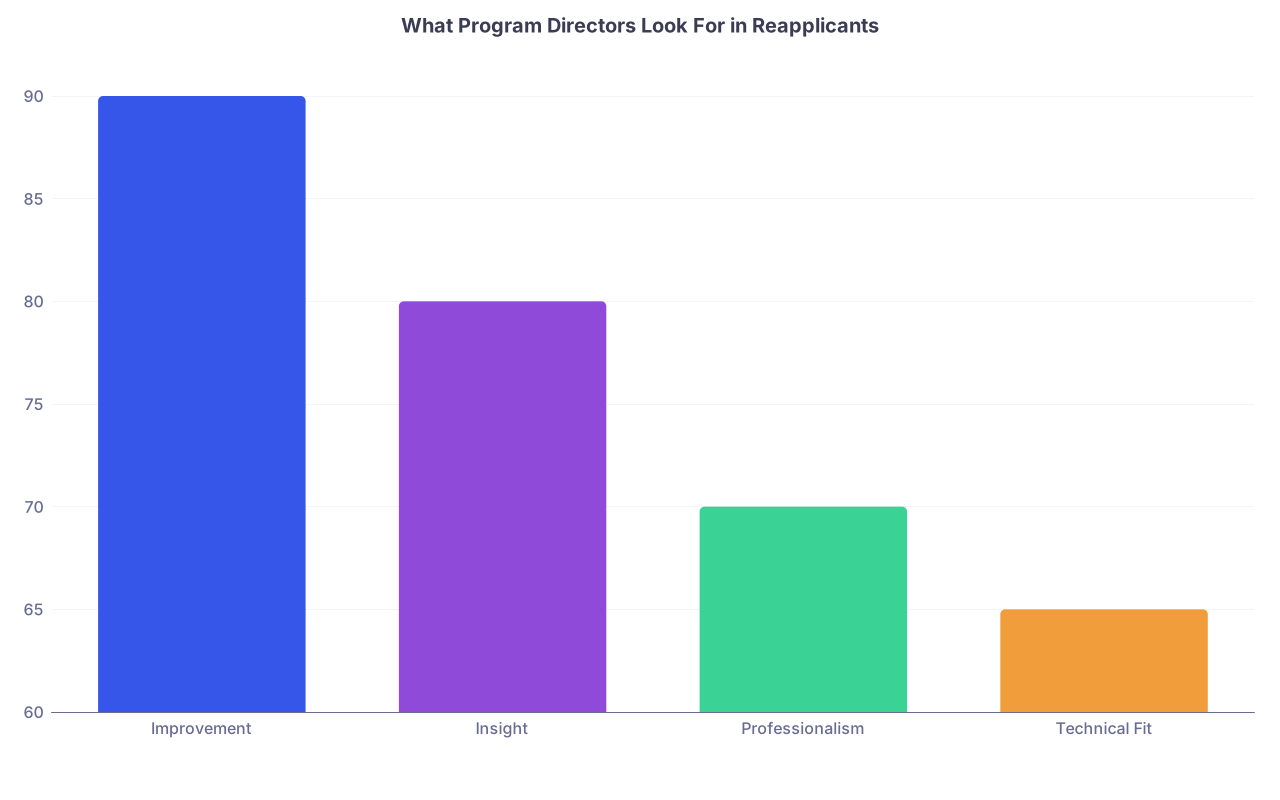
What programs want to see change
At minimum, your statement should clearly show:
- New activities or roles since the last application
- Reassessed or better articulated career goals
- Clear evidence that you understand what held you back
| Category | Value |
|---|---|
| Improvement | 90 |
| Insight | 80 |
| Professionalism | 70 |
| Technical Fit | 65 |
If they don’t see at least two of those, they worry they’re getting the exact same candidate that programs passed over last year.
How to avoid the “unchanged” trap
Do this before you write a single sentence:
- List 3–5 concrete ways you are a stronger applicant now:
- New clinical experience
- Step 3 completed
- New letters from US rotations
- Research accepted/published
- Gap-year job in healthcare
- Then make sure those show up clearly in your:
- Introduction or second paragraph
- Body examples
- Closing paragraph
If someone can’t tell you’re a reapplicant and stronger within 30 seconds of reading, your statement is underperforming.
4. Vague, Generic “Resilience” Without Receipts
Every unmatched reapplicant is “resilient” on paper. That word is basically wallpaper now. Programs barely see it.
The red flag is when your entire response to an unmatched year is:
- “This experience has made me more resilient.”
- “Not matching strengthened my resolve.”
- “This setback taught me perseverance.”
With no specifics.
Why this falls flat
Program directors think:
- “Ok, but what did you do?”
- “How do I know you won’t crumble again the next time something goes wrong?”
Vague “growth” without evidence looks like:
- Coping by word salad
- Zero structural change in how you work or plan
Turn “resilience” into something real
You want concrete behavioral change, not abstract personality traits.
Weak version:
Not matching was devastating, but it made me more determined to become an internist.
Stronger version:
After going unmatched, I met with two program directors and my school’s advising dean to review my application. The feedback was clear: I needed stronger US clinical experience and more impactful letters. Over the past year, I completed two inpatient medicine rotations at academic centers, assumed a senior role on the team as a sub-intern, and obtained new letters that specifically describe my clinical reasoning and reliability on call.
That’s resilience, professionally. Not just emotionally.
Don’t make the mistake of assuming “I stayed in the game” is enough. Show how you stayed and upgraded.
5. Over-Explaining and Over-Apologizing for the Unmatched Year
You can go too far the other way.
Some reapplicants turn their personal statement into a 1,200-word autopsy of the failed match cycle. That’s a red flag too.
Signs you’re overdoing it
You’re in trouble if:
- The first half of your statement is all about not matching
- You’re recounting every detail: which specialties, how many programs, number of interviews
- You spend more words explaining than demonstrating who you are as a clinician
Remember: your personal statement is not your SOAP note for the Match. It’s not a formal appeal.
Programs want:
- Brief context
- Clear evidence of growth
- Then back to: why this specialty, why you’ll be a good resident, what you bring to the table now
How to balance acknowledgment vs obsession
Aim for this rough proportion:
| Content Area | Approximate Share |
|---|---|
| Why this specialty / core story | 40–50% |
| Unmatched year & growth | 20–30% |
| Current strengths & readiness | 20–30% |
If 60–70% of your statement is about the failure instead of the physician you’re becoming, you’re anchoring your entire identity to not matching. That is not how you want to present yourself.
Put a cap on it:
- 1–2 sentences: acknowledge the unmatched cycle
- 3–6 sentences: concrete actions, improvements, and what changed
- Then move on.
Don’t let last March be the main character of your statement.
6. Mixed or Confusing Specialty Signals
This one burns reapplicants who changed direction after not matching.
You:
- Applied to Dermatology last year
- Are now applying to Internal Medicine
- And your statement still screams “I wish I were in Derm”
Or:
- You tried for General Surgery
- Now you’re going into Family Medicine
- But you keep emphasizing procedures and acute care drama
Programs absolutely look for alignment:
- Between your current specialty choice
- Your past choices
- And your explanation of the shift
Red flags they notice immediately
- Mentioning the old specialty directly in a nostalgic tone
- Saying you “settled” for the new field
- Over-emphasizing your previous dream specialty and barely selling the current one
- Having a generic statement you clearly plan to send to multiple specialties
I’ve seen statements where someone wrote: “Although my true passion is orthopedic surgery, I am now applying to internal medicine…” That’s auto-reject territory.
How to handle an honest specialty change
You can be candid, but strategic.
Do:
- Acknowledge the change briefly
- Emphasize what you discovered that fits better with the new specialty
- Show that this isn’t a desperate last-minute pivot
For example:
My first application cycle was to General Surgery, guided by my enjoyment of the OR. During my subsequent year as a hospitalist extender, I realized that what I valued most was following patients over time, managing complex medical problems, and coordinating care across settings. That experience clarified that Internal Medicine is a better fit for my strengths and long-term goals.
That’s reasonable. That shows growth in self-understanding.
Don’t say:
- “I decided to apply to [new specialty] because it is more competitive for me.”
- “Given my scores and experiences, I realized [new specialty] was more realistic.”
Even if that’s partly true, don’t put it in writing.
7. Tone Problems: Desperate, Defensive, or Salesy
Your content may be fine technically, but the tone throws programs off. Tone issues are subtle but deadly.
Three common tone red flags in reapplicant statements
Desperation
- Over-pleading: “I am begging for a chance…”
- Over-selling commitment: “I will be the hardest working resident you have ever seen…”
- Excessive gratitude language: “I would be eternally grateful for any consideration…”
Defensiveness
- “Despite my scores, I believe I deserve an opportunity…”
- “Although my application may not appear competitive at first glance…”
- Repeated justifications for every weakness
Aggressive sales
- “Any program would be lucky to have me.”
- Laundry lists of adjectives instead of proof: “I am incredibly hardworking, motivated, dedicated, and passionate…”
Program directors are looking for:
- Calm
- Professional
- Self-aware
- Grounded
Not panicked. Not combative.
Calibrating your tone
Think of the statement as talking to a future colleague you respect, not begging a judge.
Better style:
- “I welcome constructive feedback and have actively sought it since my first application cycle.”
- “I understand that my path has not been straightforward, but it has made me more deliberate and prepared for the demands of residency.”
You are not on trial. You’re presenting your current readiness, with brief context. Let your facts do the heavy lifting.
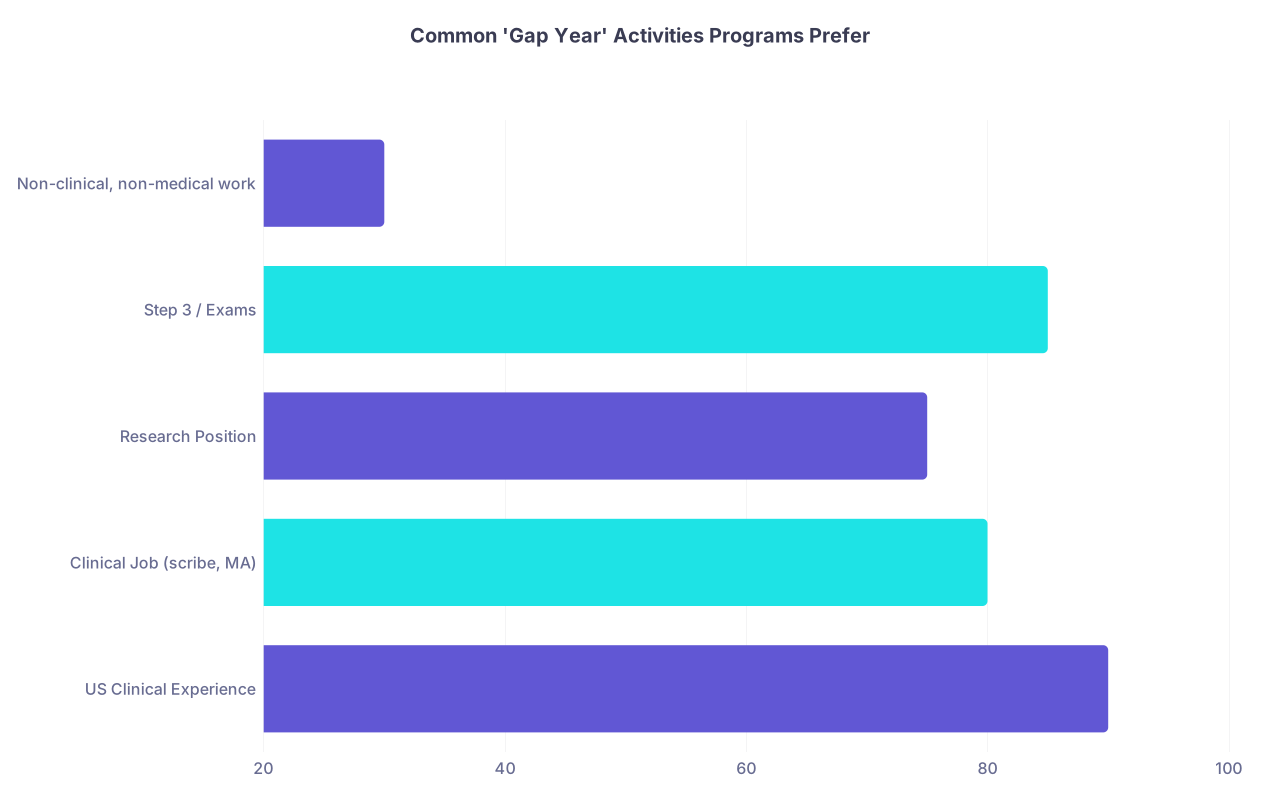
8. Ignoring the Gap: No Concrete Use of the “Off” Year
A blank or weak “unmatched year” is a blazing red flag.
If your ERAS shows:
- Graduation two years ago
- Minimal documented activity since
- And your statement says nothing useful about that time
Programs start talking about:
- Skill decay
- Motivation concerns
- Visa or licensing issues
- Reliability
What’s not enough
- “I took time to reflect and spend time with family.”
- “I used the year to study and prepare to reapply.”
- “I worked on personal growth and resilience.”
That might be emotionally true. It’s professionally insufficient.
| Category | Value |
|---|---|
| US Clinical Experience | 90 |
| Clinical Job (scribe, MA) | 80 |
| Research Position | 75 |
| Step 3 / Exams | 85 |
| Non-clinical, non-medical work | 30 |
Programs are pragmatic. They want to know:
- Did you stay clinically engaged?
- Did you demonstrate that you can function in a work environment?
- Did you address your known weaknesses?
How to write about your unmatched year the right way
Even if you didn’t land a formal research or clinical job, you can still frame things more strongly if you actually did structured work.
Better examples:
- “I worked as a clinical research coordinator in an internal medicine department, enrolling and following patients in a heart failure trial. This kept me in a clinical environment, strengthened my documentation skills, and led to one abstract presentation.”
- “I completed 3 months of observerships at community hospitals, focusing on inpatient medicine, and met weekly with a mentor to review my patient notes and clinical reasoning.”
- “I used this year to prepare for and successfully pass Step 3, while also volunteering at a free clinic where I assisted with triage and patient education.”
Don’t write like you drifted. Show structure, responsibility, and a clear plan.
FAQ (Exactly 4 Questions)
1. Do I have to explicitly say I went unmatched in my personal statement?
You don’t need to use the word “unmatched,” but you do need to clearly address that there was a previous application cycle and what changed. Something like “After my first application cycle was unsuccessful, I…” is enough. Silence is interpreted as avoidance, not professionalism.
2. How honest should I be about why I didn’t match?
Be honest but selective. Do not dump every insecurity or complaint into your statement. Focus on factors that (a) are plausible and (b) you’ve clearly addressed: limited USCE, late exam scores, weak letters, overly competitive specialty. Then show what you concretely did about those. Skip anything that sounds like blaming or speculation.
3. Can I reuse parts of my old personal statement?
You can reuse isolated elements—like a strong clinical anecdote or a well-written description of why you love the specialty—but only if you significantly revise the context and add new growth. If more than ~30–40% of your statement is basically last year’s version with cosmetic edits, you’re sending the wrong message: no real change.
4. What’s one thing I should fix first as a reapplicant working on my statement?
Start with the unmatched year. Write 6–8 sentences that:
- Acknowledge the prior unsuccessful cycle
- State 2–3 specific weaknesses you identified
- Describe 2–4 concrete things you did to improve
Once that block is clear, build the rest of the statement around who you are now, not who you were two cycles ago.
Open your last personal statement draft right now. Highlight every sentence that could have been written before you went unmatched. If that’s more than half the document, stop editing commas and start rewriting your story from where you actually are today.