
The residency match is not merciful. Program directors remember your file. And many of them do not forgive the same reapplicant mistakes—ever.
You are not “starting fresh” when you reapply after going unmatched. You are under a microscope. The benefit of the doubt is gone. PDs are asking a quiet but brutal question: “Why didn’t anyone want this person last year—and what has actually changed?”
If your answer is weak, vague, or cosmetic, you are done.
Let me walk you through the errors that get reapplicants quietly red-flagged, filtered, or laughed about in PD meetings. You can avoid almost all of them—if you stop pretending this is just “one more cycle” and treat it like a reputational rehab project.
1. Pretending Nothing Happened: The “Copy–Paste” Application
This is the cardinal sin. The one PDs talk about openly.
You went unmatched. Then you reapply with:
- The same personal statement
- The same experiences, with no updates
- The same letters, same wording, same everything
PDs see that and think: “No insight. No growth. No ownership. Pass.”
Why this enrages PDs
They assume three things about you if your file looks recycled:
- You did not meaningfully self-reflect.
- You may be difficult to teach or coach.
- You are trying to “brute force” the process instead of addressing real weaknesses.
They are not going to fix you. They are going to pick the applicant who already did the work.
How to avoid this
You need clear, visible change:
Rewrite your personal statement from scratch.
Not “light edits.” New structure, new emphasis, new narrative showing:- What you learned from not matching
- What you did about it
- How that makes you a safer, more serious candidate now
Update your CV with tangible action.
If your “post-match” year reads like a gap year of vague “clinical exposure” and “self-study,” it looks like you hid. You need:- Concrete roles (research assistant, prelim year, clinical fellow, scribe, hospitalist extender, etc.)
- Dates, responsibilities, measurable outcomes
Do not reuse letters blindly.
Recycling old LORs without at least one new letter that reflects your current performance screams stagnation.
If your reapplication looks 80–90% identical to last year’s, PDs will assume your outcomes will be identical too. They are rarely wrong.
2. Not Owning the No-Match: The Silence or Spin Strategy
Another unforgivable error: acting like the unmatched year did not exist.
I have seen personal statements that read like:
- “I am applying to internal medicine because of long-standing interests…”
with zero mention that the applicant went fully unmatched last year.
PDs check NRMP/ERAS history. They know.
The two toxic approaches
Total silence.
No reference to prior application, no explanation, just pretending it did not happen.Manipulative spin.
“I chose to take a year off to pursue research”
when everyone in the room knows you scrambled into nothing.
Both are red flags. PDs do not forgive dishonesty or denial. They do respect accurate, brief ownership.
How to handle it correctly
You do not need a sob story. You need a clear, adult explanation:
- Acknowledge the reality in 1–3 sentences:
- “I applied to the 2024 Match in internal medicine and did not match.”
- Provide a grounded reason, not an excuse:
- “My application was limited by late exam completion and fewer home-rotation based letters.”
- Show corrective action:
- “Since then, I have completed [X], improved [Y], and sought structured feedback from [Z].”
Keep it tight. Honest. Specific. If PDs feel you are hiding or spinning, they will assume the worst about everything else.
3. Ignoring Your Actual Weaknesses (And Fixating on the Wrong Ones)
The unmatched reapplicant who “worked on the wrong thing” is depressingly common.
Typical pattern:
- Step scores: borderline or low for chosen specialty
- No strong home-institution LORs
- Mediocre clinical comments
- Weak interview skills
Then what do they do for a year?
They publish a couple of case reports in a random journal and think they “fixed” their application.
The mistake
You fix the part of your application that feels easiest or most available, not the part that actually cost you interviews or ranks.
Program directors never forgive this kind of misalignment. They read your file and think: “They still do not understand why they failed last year.”
How to correctly identify your real problems
You are not allowed to self-diagnose in a vacuum. That is how you get burned twice.
You need:
- Hard feedback from:
- Your dean’s office
- A trusted attending in your target specialty
- If possible, a PD or APD who will be blunt
- Data from last year:
- How many programs did you apply to?
- How many interviews?
- Any post-interview feedback (even informal)?
- Were you filtered for Step 1/2 cutoffs?
You want to know which bucket you were in:
| Primary Issue | What PDs Expect to See Fixed Next Cycle |
|---|---|
| Weak scores | Step 2 CK improvement, strong clinical evals |
| Weak clinical evals | Fresh rotations with standout comments |
| Poor interviewing | Documented coaching, clear behavioral change |
| Overly competitive specialty choice | Realistic specialty shift or solid backup plan |
| Poor geographic strategy | Broader, targeted list with clear ties |
Once you know the correct problem, sharpen your year around that. If PDs see targeted, rational correction, they are far more willing to give you another look.
4. Applying to the Same Unrealistic Specialty in the Same Unrealistic Way
This one gets eye rolls in PD meetings.
Example:
- Applicant with Step 2 CK 220, no neurology or psychiatry backup, applies only to 80 dermatology programs. Goes unmatched.
- Next year: same person, same story, applies to 90 dermatology programs. Adds two research abstracts.
PDs think: “This is magical thinking. Pass.”
When reapplying to the same specialty is a mistake
Reapplying to the exact same competitive specialty is usually unforgivable if:
- Your board scores are well below the median for that specialty
- You do not have a strong institution or heavy connections
- Your clinical performance is average
- You made no radical change (e.g., 2–3 years of high-impact research at a major center with a champion PI)
I have seen people spend three years chasing a dream specialty while their application currency decays. By the time they switch to a more realistic field, PDs wonder why someone “sat out” so long.
Smarter alternatives
Shift specialties strategically.
For example:- From ortho → prelim surgery or categorical IM
- From radiology → IM, neurology, or transitional with clear plan
Use the SOAP and prelim spots wisely.
A prelim year with strong performance can be application rehab—if your evals are glowing and your behavior is flawless.Align your story with your pivot.
Do not pretend you always wanted the new specialty if you scrubbed your ERAS history. PDs prefer:- “I originally applied to X, but through my work in Y this past year, I developed a clear, lasting commitment to Y because…”
Stubbornly reapplying to a stretch specialty with essentially the same profile is not “persistence.” It reads as misjudgment. PDs are wary of misjudgment.
5. Questionable Professional Conduct in the Gap Year
Nothing kills a reapplication faster than a reputation problem. And yes, PDs talk.
Common unforced errors I have personally seen:
- Chronic lateness or no-shows in a research or clinical role
- Passive-aggressive behavior when feedback is given
- Complaining about your previous school, PD, or the match itself
- Social media posts mocking the match, patients, or programs
- Burning bridges with a PI or attending who is fielding reference checks
You cannot afford any of that as an unmatched reapplicant. Your margin for behavioral error is essentially zero.
What PDs will not forgive here
A bad back-channel report.
Many PDs will quietly text someone who knows you: “You worked with this person last year. How are they?” A single “Honestly, they were difficult” can tank you.Evidence that you blame everyone but yourself.
If you talk about “the corrupt match,” “biased PDs,” or how “IMGs never get a fair shot” in a bitter, unreflective way, it spreads.Unprofessional gap-year stories.
For example: the research position you “left early” after conflicts. PDs can sometimes see that in timing gaps and vague descriptions, and they will probe.
If you went unmatched, your gap year is essentially a long audition. Treat it that way.
6. Applying Sloppily—Again
Stunning how many reapplicants repeat technical and strategic mistakes:
- Submitting ERAS late again
- Applying to far too few programs again
- Ignoring community programs or less competitive regions again
- Generic personal statements that do not reference the specific specialty
- Wrong program names in letters or essays (“I am excited to train at [different program]”)
PDs may forgive a first-cycle miscalculation. They are much harsher when they see the same applicant bungle the logistics twice.
Minimum non-negotiables as a reapplicant
Early submission.
Do not be the applicant whose letters or CK score arrive weeks after programs start reviewing.A realistic program list.
That means:- Broad geographic spread
- Enough community and mid-tier programs
- Documented ties where you can (family, prior rotations, prior work)
No recycled generic fluff.
If your statement could be sent to 150 programs unchanged, it is weak. You do not need 150 unique statements, but you should have:- 1–2 core versions tailored to specific program types (academic vs community, region, or particular focus)
If PDs see sloppiness in your application construction, they assume sloppiness in your clinical work. Reapplicants cannot survive that assumption.
7. Being Vague or Defensive in Interviews the Second Time Around
If you get interviews as a reapplicant, you have cleared the first major barrier. Do not sabotage it at the table.
Common disasters PDs remember:
- Minimizing the no-match (“It was mostly bad luck”) with no self-analysis
- Over-disclosing and spiraling emotionally in the interview
- Blaming prior mentors, school, or “the system”
- Giving rehearsed, plastic answers to “What has changed since last year?”
How to talk about your unmatched year in interviews
You need a tight, matter-of-fact 60–90 second answer that:
- Briefly states what happened
- Identifies 1–2 concrete weaknesses from last cycle
- Shows what you did to correct them
- Ends with what you bring now that you could not before
Something like:
“I applied to internal medicine last year and did not match. In reviewing my application with my dean and a faculty mentor, two things stood out: my Step 2 score was just at the cutoff for many programs, and my clinical letters did not distinguish me.
Over the past year, I completed a sub-internship at [Hospital] and a year as a clinical research fellow in [department], where I received detailed feedback and focused on reliability, documentation, and communication. My recent evaluations reflect that growth. I also strengthened my foundation with additional board-style study and teaching, which improved my clinical reasoning.
I am a more mature, teachable, and consistent team member now than I was a year ago, and I am ready to contribute from day one.”
No drama. No self-pity. No spin.
PDs will not forgive defensiveness or blame in a reapplicant. They will strongly consider someone who clearly learned and improved.
8. Letting the Year Drift: The “Invisible” Gap Year
One of the quietest but deadliest mistakes: doing something, but nothing that really counts.
Typical “invisible” gap year:
- A few sporadic observerships
- Occasional volunteering
- Unstructured self-study
- Maybe one poster in a minor conference
On paper, it looks like 12 months of fog.
What PDs want to see instead
They want:
- Clear role, setting, and duration
- Evidence of showing up consistently
- Someone credible willing to say: “Yes, this person worked here and did well.”
Strong gap-year choices:
- Clinical research fellow with full-time responsibilities
- Scribe/hospitalist extender with direct attending contact
- Prelim or transitional year with clean evals
- Structured teaching or tutoring with supervisor oversight
Your test: if a PD looks at your last 12 months and cannot easily answer “What did you actually do?”, your gap year is a liability.
9. Ignoring the Clock: Extending Too Long Before Reapplying
There is another trap: waiting too long.
If you sit out of clinical medicine for multiple years without:
- Active patient contact
- Ongoing clinical responsibilities
- Recent US clinical experience (USCE), if you are IMG
PDs start asking:
- “Can they still function on the wards?”
- “Why have they been out so long?”
- “Is there some issue we don’t know about?”
A 1-year gap with strong activity is explainable. Two years is harder. Three or more becomes an uphill battle, especially in core specialties.
You must balance:
- Taking enough time to materially improve your application
- Not disappearing from real clinical work for so long that you feel “rusty” or risky to programs
Visual: Where Reapplicants Actually Improve (And Where They Do Not)
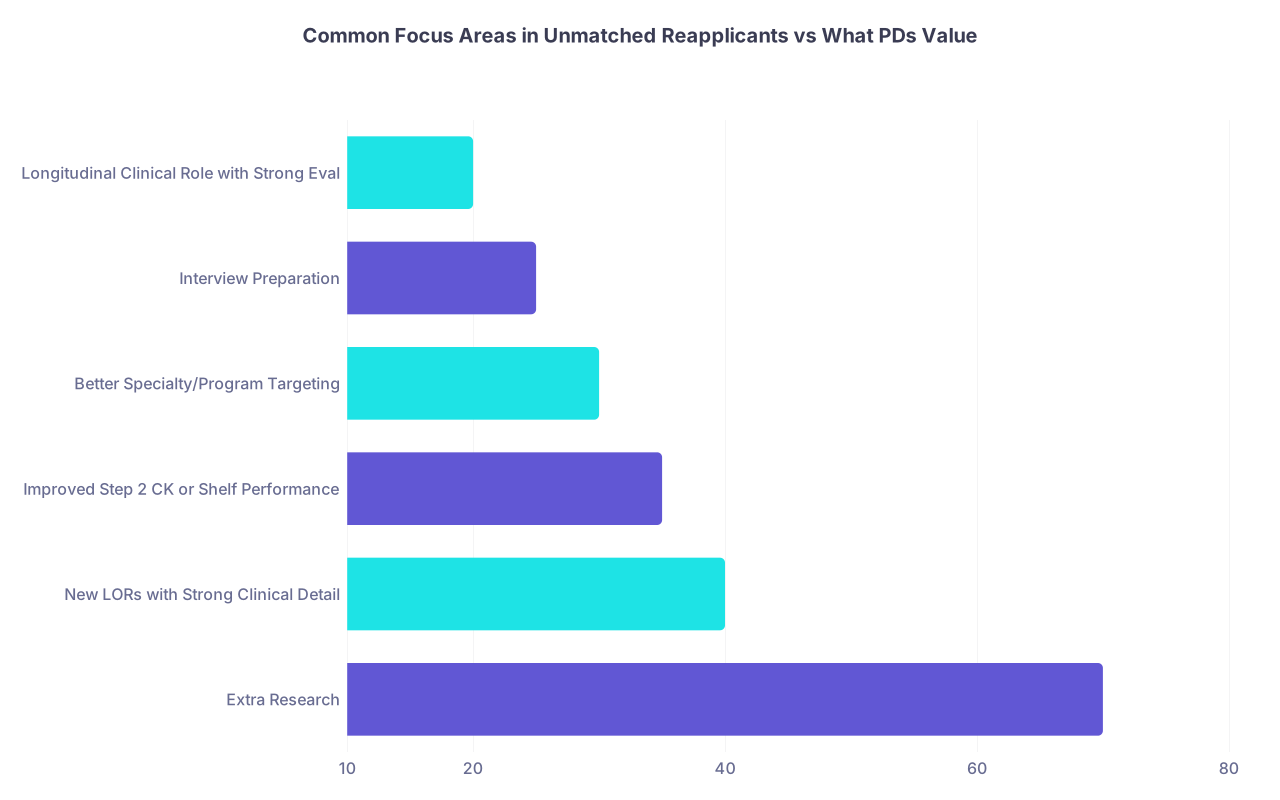
| Category | Value |
|---|---|
| Extra Research | 70 |
| New LORs with Strong Clinical Detail | 40 |
| Improved Step 2 CK or Shelf Performance | 35 |
| Better Specialty/Program Targeting | 30 |
| Interview Preparation | 25 |
| Longitudinal Clinical Role with Strong Eval | 20 |
The problem: most unmatched applicants over-invest in more low-impact research and under-invest in the things PDs actually care about—clinical performance, judgment, realism, and behavior.
10. Burning Bridges With Your Home Institution (Then Needing Them)
Last one, but it is big.
Some unmatched applicants:
- Lash out at their school
- Blame advisors or deans for not “pushing harder”
- Ignore messages, blow off follow-up, or go radio silent in shame
Then a year later, they need:
- An updated MSPE addendum
- A new dean’s letter
- Someone to advocate for them with a skeptical PD
And everyone remembers how they behaved when they were hurt.
You do not have to love your institution. But as an unmatched reapplicant, you cannot afford to lose that infrastructure.
Keep a working relationship. Respond to emails. Be civil. Use them as a resource to fix your trajectory, not as a punching bag.
Process Snapshot: A Safer Reapplication Workflow
To make this concrete, here is what a sane reapplication process might look like:
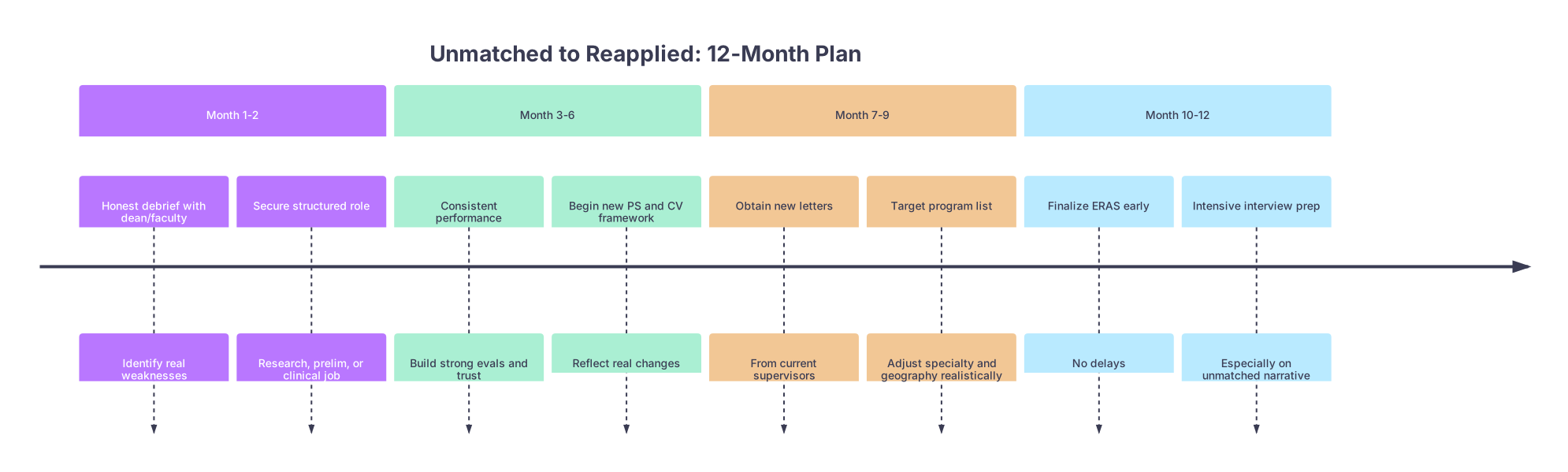
| Period | Event |
|---|---|
| title Unmatched to Reapplied | 12-Month Plan |
| Month 1-2 - Honest debrief with dean/faculty | Identify real weaknesses |
| Month 1-2 - Secure structured role | Research, prelim, or clinical job |
| Month 3-6 - Consistent performance | Build strong evals and trust |
| Month 3-6 - Begin new PS and CV framework | Reflect real changes |
| Month 7-9 - Obtain new letters | From current supervisors |
| Month 7-9 - Target program list | Adjust specialty and geography realistically |
| Month 10-12 - Finalize ERAS early | No delays |
| Month 10-12 - Intensive interview prep | Especially on unmatched narrative |
If your last cycle looked nothing like this, do not repeat it.
FAQ (Exactly 3 Questions)
1. Do I have to explicitly say “I did not match” in my personal statement or can I just let programs infer it?
Yes, you need to explicitly acknowledge it somewhere in your application materials—usually in your personal statement or in an additional ERAS note if appropriate. Programs already know your match history from ERAS/NRMP; avoiding the topic looks evasive. Keep it short and professional: name it, explain in one or two lines what likely contributed, then focus the rest on what you did to fix those issues and how you are a stronger candidate now.
2. Is it ever smart to reapply to the exact same competitive specialty after going unmatched?
It can be, but only in narrow circumstances. If your prior application was undermined by fixable logistics—late scores, very few programs applied to, no US letters—and you have since corrected those and added strong, specialty-relevant experience under respected mentors, reapplying once more may be reasonable. If your scores, evals, and underlying competitiveness are fundamentally mismatched with that specialty’s norms, then reapplying without a major structural change (multi-year high-level research with strong inside advocacy, for example) is usually a serious mistake.
3. What is the fastest way to lose a PD’s trust as a reapplicant?
Three things: minimizing your role in going unmatched, blaming others (school, PDs, “the system”), or being vague about what you actually did in your gap year. PDs are looking for judgment and maturity. If you cannot clearly explain what went wrong, what you learned, and how your behavior and performance changed, they assume you have not improved. And they will not risk ranking you when there are first-time applicants with cleaner trajectories.
Key takeaways:
- Reapplying after no match is not a “redo.” It is an audit of whether you learned, changed, and took responsibility.
- PDs rarely forgive recycled applications, denial about the no-match, or unaddressed weaknesses.
- Your gap year must be visible, structured, and honestly presented—or it becomes one more reason to pass on you.