
What’s the one tweet, story, or DM you could post in the next 24 hours that quietly kills your chances at a successful SOAP, reapplication, or future match?
You’re closer to that mistake than you think.
You’re exhausted, humiliated, angry, maybe a little numb. You open your phone because that’s what everyone does when they’re hurting. And that’s where people torch their futures—on Instagram stories, in private group chats that aren’t really private, on “anonymous” forums that PDs and residents read for fun.
Let me be direct: programs absolutely look at your online footprint. Residents report things. Screenshots travel. PDs talk. I’ve watched an otherwise salvageable application become radioactively toxic because of one night of “venting” online.
You don’t need more motivation. You need guardrails. Here are the five social media mistakes that burn bridges after you don’t match—and how to not be the cautionary tale everyone else whispers about.
1. Public Venting About Programs, The Match, Or Your School
This is the big one. The career suicide note written in 280 characters.
The temptation is obvious: you’re angry, blindsided, and scrolling past everyone’s “I matched!!!” posts. You want to say something. To someone. Anywhere.
So people post things like:
- “Can’t believe how rigged this process is. Some of the dumbest people in my class matched at [specialty] lol.”
- “Huge red flag: [Program Name] ghosted applicants and clearly violated NRMP rules.”
- “Our dean’s office totally screwed us this year. No advocacy, no transparency, nothing.”
I’ve seen versions of all three. From people who later wanted letters, advocacy, or a SOAP spot. They didn’t get them.
Here’s the mistake: assuming your audience is just your classmates and friends. It’s not. It’s:
- Residents from programs that may SOAP you in
- Alumni who might have vouched for you
- Faculty who sit on CCCs and rank committees
- Future PDs who can google your name in 10 seconds

The worst flavor of this mistake is naming programs or people. Even “subtle” posts like “Certain NYC programs really showed their true colors” can be traced back with minimal effort if you applied to a limited region.
Do not do this:
- Subtweeting programs
- Calling out perceived NRMP violations publicly
- Blaming your school, advisors, or classmates by name or obvious implication
Do this instead:
- If you need to vent, use offline spaces: a trusted friend, a therapist, a private (truly private) conversation
- If something genuinely unethical happened, talk to your dean or the NRMP official channels, not Twitter
- On public platforms, stay silent or keep it neutral: “Didn’t get the news I hoped for today. Taking time to regroup and plan next steps.”
The moment you accuse, blast, or mock publicly, you’re telling future colleagues: “When things go badly, I’ll put you on blast too.” No one wants that on their team.
2. “Private” Stories and Group Chats That Aren’t Actually Private
The second most common disaster: false privacy.
People think:
- “Close Friends” Instagram stories are safe.
- Group chats with “just my classmates” are safe.
- Slack/Discord “anonymous” channels are safe.
- Private Facebook groups for unmatched applicants are safe.
They’re not. I’ve seen screenshots from all of them forwarded to residents, faculty, and PDs. Sometimes maliciously. Sometimes just “Look what so‑and‑so posted” curiosity that spirals.

Big mistake: assuming “I trust these people” equals “this cannot leak.”
People leak out of:
- Spite (“They always thought they were better than us.”)
- Guilt (“I feel uncomfortable that they’re trashing Dr. X.”)
- Fear (“If this blows up later, I want it known I wasn’t part of it.”)
- Carelessness (screenshot sent “just to one other person,” who sends it to someone else)
Typical self-sabotaging content I’ve seen in “private” spaces:
- “Honestly, [Program] was a dumpster fire anyway. Their residents seemed miserable.”
- “Our PD is such a narcissist, I’m glad I won’t be stuck there.”
- “If [Classmate Name] can match, this whole system is a joke.”
Later, that same person tries to SOAP into that “dumpster fire” program. Or asks that “narcissist” PD for a letter. Or needs their school to go to bat for them. Good luck.
Your rule: if you’d be horrified to see it screen-shotted and emailed to your dean or a PD, it doesn’t go into any electronic format. Not DMs, not group chats, not “anonymous” platforms.
If you absolutely have to type it, write it in a note, show it to a friend in person, and delete it. Old-school. Analog.
3. Posting Desperate Or Chaotic “Hire Me” Content During SOAP
The unmatched version of a drunk text: chaotic “PLEASE HELP ME FIND A SPOT” posts all over your social media.
I’ve seen students blasting:
- “Unmatched US-IMG seeking ANY IM or FM SOAP spot. 250+ Step 1, strong LORs, ready to work anywhere. Please RT.”
- “If anyone knows any PDs with open spots PLEASE tag them, I’ll DM you my CV.”
- Daily story updates: “Still no SOAP offers. Anxiety through the roof. Considering giving up.”
I get the desperation. SOAP is brutal. But here’s why this is a mistake.
First, it screams panic and poor boundaries. Programs want residents who can manage stress, not melt down publicly in real time.
Second, it puts PDs and faculty in a terrible ethical and professional position. They cannot publicly “poach” you or advertise SOAP spots on Twitter the way you’re hoping.
Third, it can conflict with or undermine whatever your school is doing behind the scenes for you. I’ve watched deans work their contacts only to have a PD email back, “We just saw their public posts—seems like they’re not coping well. We’re going to pass.”
If you want to use the internet productively during SOAP:
- Quietly DM a very small number of trusted people (mentors, alumni you already know, faculty who told you to keep them updated).
- Ask your school who is advocating for you and where. Do not go around them publicly.
- If you must post anything, keep it vague and non-desperate: “Working with my school to explore options. Grateful for mentors who’ve reached out.”
Here’s what you do not post:
- Your Step scores
- Your entire CV begging for “any spot anywhere”
- Daily emotional status updates during SOAP
Your mental health absolutely matters. But process that with people, not a public feed that programs can scroll.
4. Oversharing Your Case Online: Scores, Blame, And Drama
After the initial hit wears off, many people slide into “storytelling mode.” They want to explain. Justify. Control the narrative.
So they write:
Long Reddit posts:
“US-IMG, 245/252, 6 pubs, strong LORs, AOA-equivalent. Applied 120 IM programs, 10 interviews. No red flags I can think of. Deans useless. Why didn’t I match?”
Twitter threads:
“I did EVERYTHING right and still didn’t match. I know others with lower scores who did. The system is broken. Let me tell you how.”
Instagram captions:
“I guess getting COVID during Step 2, losing a parent, and dealing with a toxic advisor wasn’t enough to ‘impress’ programs this year…”
Here’s why this is dangerous.
One, you’re locking your story in public before you’ve actually gotten full feedback. Sometimes there are real issues you don’t know about—questionable LOR, unprofessional eval comments, interview feedback you haven’t heard yet. Your public story might clash badly with what PDs are seeing privately.
Two, you’re teaching future PDs exactly how you handle adversity: by externalizing blame and broadcasting details. Medicine is already full of gossip and half-truths. You don’t want to feed that.
Three, your details are usually identifying. Step scores, school type, number of interviews, regions applied—PDs can absolutely triangulate who you are. Especially in smaller specialties.
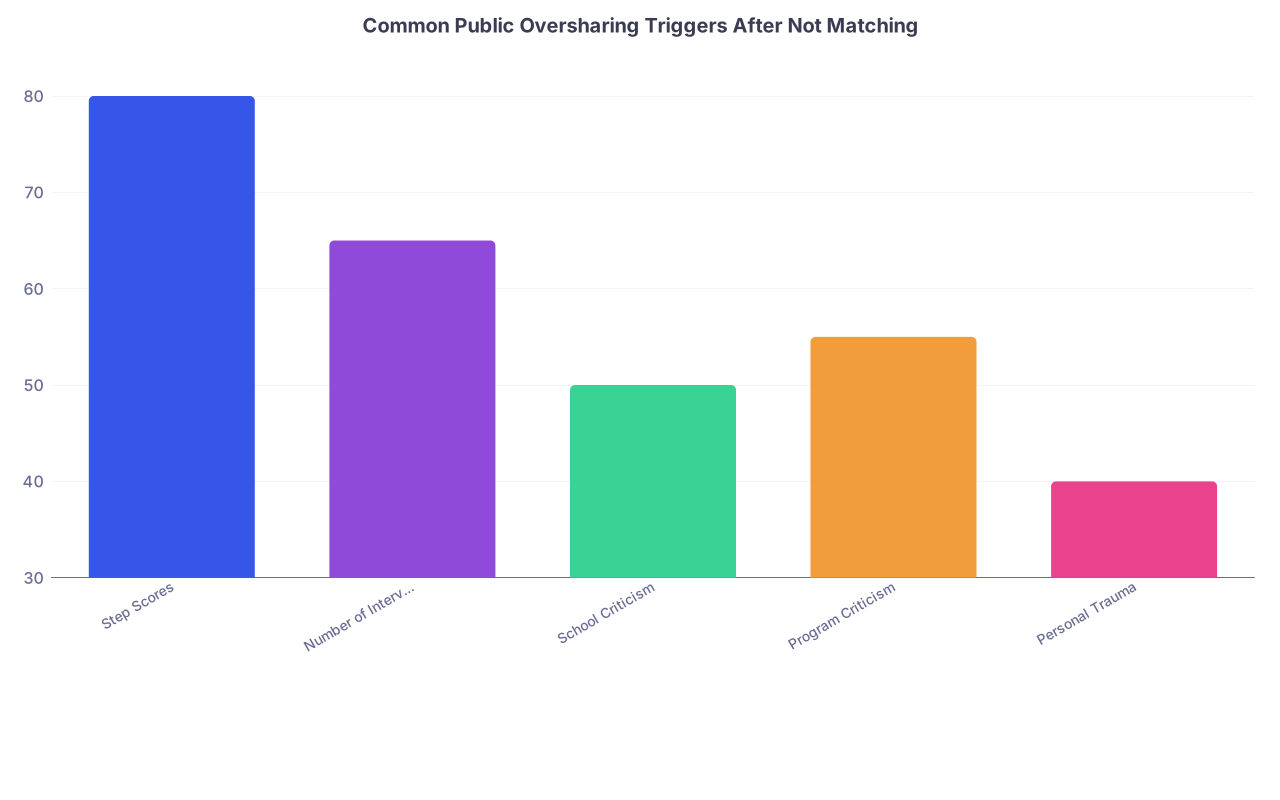
| Category | Value |
|---|---|
| Step Scores | 80 |
| Number of Interviews | 65 |
| School Criticism | 50 |
| Program Criticism | 55 |
| Personal Trauma | 40 |
There’s also a subtler issue: the martyr narrative. “I did nothing wrong; the system failed me.” Sometimes that’s partly true; there are inequities. But framing yourself publicly as a victim of a rigged game doesn’t make programs eager to stick their necks out for you.
Better approach:
- Write everything you want to say in a private document. All the anger, the details, the “I can’t believe this happened” stuff. Get it out.
- Share that with exactly two types of people: a mentor you trust and a therapist. Not the internet.
If you ever do share your story publicly (months later, when the dust has settled), you want it to sound like this:
- Honest, but not petty
- Self-reflective, not self-exonerating
- Focused on what you learned and changed, not just what you suffered
But not in SOAP week. Not in the first month. Not while people are still making decisions about your future.
5. Going Silent Or Deleting Everything Overnight
Everyone talks about the mistake of posting too much. Almost no one warns you about the opposite problem: the panic purge.
Someone doesn’t match. Within 24 hours:
- They delete Twitter, Instagram, and LinkedIn.
- Or they set everything to private and scrub their bio.
- Or they remove “Future [Specialty]” and leave… nothing.
Here’s how this backfires.
Programs do basic due diligence: a quick Google, a glance at LinkedIn. If yesterday you had a professional online presence and today you’re a digital ghost, it raises questions:
- “Did something happen we don’t know about?”
- “Are they hiding unprofessional content?”
- “Why the abrupt wipe right when the match results came out?”
Silence can read as instability just as much as oversharing can. Not always, but enough that you shouldn’t ignore it.
The better move isn’t “nuke everything.” It’s “stabilize and soften.”
You want your online presence during this period to look:
- Calm
- Minimal
- Consistent with someone regrouping and planning
Not like someone wiping fingerprints off a crime scene.
Here’s a simple strategy that doesn’t spook anyone:
- Immediately stop posting reactive content. No subtweets, no vague sadness quotes, no “everything is broken” posts.
- Audit your accounts. Un-tag yourself from questionable photos. Archive anything ranty from the past.
- Adjust bios, don’t erase identity.
Instead of “MS4 matching into dermatology 2024,” change it to “Fourth-year medical student interested in dermatology & internal medicine.” That’s honest and flexible. - Leave a neutral, professional footprint. LinkedIn updated. Maybe a pinned tweet or post like: “Passionate about [field], currently exploring opportunities and continuing to grow as a future physician.”
| Scenario | Panic Response | Professional Response |
|---|---|---|
| Bio after not matching | Delete everything | Update to broader interests |
| Old posts | Leave rants up | Archive anything emotional |
| Online presence | Vanish from all platforms | Maintain low-key, stable profiles |
| Sharing updates | Daily emotional posts | Occasional neutral status if needed |
You don’t need to be beautifully branded. You just need to not look like you lost control of the wheel.
One More Quiet Landmine: Liking, Commenting, And Subtweeting
There’s another category of mistakes that people underestimate: the “small” actions.
Liking a friend’s rage-post about a specific program.
Commenting “THIS!!!” under someone’s “NRMP is corrupt” rant.
Replying “lol same” when a classmate trashes your own school.
Residents and PDs see this too. People send these around. “Did you see who liked this?” is a very common sentence in group texts among residents.
Your ‘likes’ are endorsements, whether you meant them that way or not.
Set a rule for yourself: during SOAP and the next 2–3 months, you’re on social media read-only mode. No likes. No comments. No replies on public threads. You can’t misstep if you don’t step at all.
If someone tags you in drama, ignore it. If they DM you gossip, keep it off the main feed. Protect your future more than you protect the momentary satisfaction of joining the pile-on.
How Programs Actually Think About Your Online Behavior
You’re not being paranoid. People in power really do look.
They often aren’t “digging up dirt.” They’re just:
- Googling your name out of curiosity
- Seeing your public Twitter because you follow other med accounts
- Being sent screenshots from concerned (or petty) residents
What worries them isn’t that you’re human, or sad, or disappointed. What worries them is:
- Patterns of poor judgment under stress
- Public conflict with colleagues, schools, or systems
- Confidential information casually shared
- Signs you may be difficult to remediate or coach
They’re picturing you at 2 a.m. in the ICU when something goes wrong. Will you process it, learn, and debrief—or live-tweet it?
Your social media after not matching is an unintentional audition. The question they’re answering is: “Do I want to be on the other end of this person’s public frustration someday?”
You want the answer to be yes. Or at least, “I’m not worried about it.”
What To Do Today
You don’t need a five-page strategy. You need one decisive move.
Today, right now:
Open your most-used social media app, scroll through your last 30 days of posts, and ask one question on each:
“If a PD read this tomorrow, would I feel even slightly nervous?”
If the answer is yes, archive or delete it.
Then do something even more important: decide that for the next 4–6 weeks, you’re going to treat your social media like a locked glass case. You can look through it. But you do not break the glass unless you absolutely have to.
Your career isn’t over because you didn’t match. But you can absolutely make that outcome permanent if you let one bad day write your online legacy. Don’t hand the match a reason to say no twice.