
It’s Monday of Match Week. 11:58 a.m. Eastern. You’re staring at your NRMP page, palms sweating. The clock flips to noon. The screen refreshes.
You did not match.
Your group chat explodes. Your dean’s office is “here to support you.” ERAS is suddenly open for SOAP. You’re uploading, clicking, sending, panicking. On the other side of this chaos, inside a small conference room you’ll never see, a group of tired faculty and residents is about to rank you… in about as much time as it takes to eat a sandwich.
Let me walk you into that room.
Because what happens in that 30–60 minutes is not what your school tells you. It’s not a careful holistic evaluation of your soul. It’s triage. It’s pattern recognition. It’s shortcuts, politics, and “good enough, let’s move on.”
You need to understand that world if you’re going through SOAP, or want to be ready in case you ever do.
What That Room Actually Looks Like
Most programs do not have some massive, well-oiled SOAP infrastructure. They’re improvising.
Picture this: a cramped conference room, or sometimes the resident workroom hijacked for “SOAP command center.” On the table:
- A printed list of unfilled positions and their quotas
- A shared spreadsheet with all SOAP applicants pulled from ERAS
- Coffee, half-eaten muffins, maybe cold pizza from last night’s call
- One overworked coordinator who is the only reason this will function at all
Who’s there?
Usually:
- Program Director (PD) – ultimate decision authority
- Associate/Assistant PD or a key faculty member
- Chief resident and/or a senior resident
- Program coordinator running the tech and logistics
Often one of the attendings is also on clinical service, half-dictating notes while glancing at the spreadsheet. People are multitasking. This is not some serene admissions retreat.
They have:
- 45–90 minutes before they have to submit something sensible to be ready for offers
- 60–200+ SOAP applications dumped on them in a short window
- Maybe a few pre-flagged “we’d love to get someone like this if they SOAP” notes from previous interview season
Time per applicant? If they’re lucky, 1–2 minutes. Usually less. I’ve been in rooms where we cleared 80 applicants in under 40 minutes. That’s 30 seconds each, and that includes arguing.
This is what you’re competing in.
The First Brutal Pass: Who Gets Looked At, Who Gets Cut
The PD doesn’t start by “holistically reviewing every candidate.” They start by carving the pile down to something readable.
Here’s how the first 5–10 minutes go in a lot of places:
- Coordinator sorts the spreadsheet by some hard filter the PD likes.
- PD says something like: “Okay, let’s kill anything that’s clearly not workable.”
- They run through the columns: school, graduation year, attempts, visa, major red flags.
A very common quick-kill logic set looks like this:
- Too old a grad year – “Anyone before 2021, skip.”
- Multiple Step fails – “Two or more fails? Out unless they’re otherwise incredible.”
- No Step 2 CK when Step 1 is pass/fail or weak – “I’m not gambling in SOAP.”
- Massive professionalism issue in MSPE – “Don’t have time to investigate.”
- Visa they can’t sponsor – “We can’t process a new H-1B in time; skip.”
You might think this is unfair. They think it’s survival. In SOAP they don’t have time to lovingly dissect your story.
The ugly part: they often make these cuts before anyone has read your personal statement or letters. They’re killing based on:
- School name and type (US MD vs DO vs IMG)
- Year of graduation
- Step scores / attempts
- Checkboxes in ERAS (visa, prior training, etc.)
- Maybe a quick glance at MSPE summary line
If you’re in a risky category, you only survive this initial cull if something about you is strikingly attractive in the spreadsheet view. And yes, that can be as simple as: “Oh, he’s from our med school,” or “She rotated here.”
The Quiet Hierarchy: How They Actually Prioritize Categories
No one will say this officially, but I’ll say what I’ve heard PDs say out loud when the door is closed.
There is a default priority ladder in many programs. It varies by specialty and region, but a lot of them roughly think like this:
| Rank | Candidate Type |
|---|---|
| 1 | Home med school students |
| 2 | Students who rotated there |
| 3 | US MD seniors |
| 4 | US DO seniors |
| 5 | Recent US grads (MD/DO) |
| 6 | IMGs with US experience |
There are exceptions. Some community IM programs love IMGs and are explicit about it. Some academic places are genuinely DO-friendly and treat them like MDs. But the ladder exists more often than people admit.
The fastest way the PD shrinks the field is by grouping:
“Let’s first pull anyone who rotated here or is from our school.”
That group immediately gets bumped to the top tier. Often they’ll rank those people first before even looking deeply at everyone else. It’s not always fair, but from their point of view:
- They know your clinical performance
- They’ve heard faculty talk about you
- They understand your school’s grading and culture
- They think they know what they’re buying
If you’re not in that inner circle, your job is to not get tossed out while they prioritize those groups.
The Real Scoring System They Use When Time is Short
Very few programs build a formal SOAP-specific scoring rubric. They repurpose their regular recruitment logic and simplify it.
In practice, this “scoring” often reduces to a quick mental tally across 5 domains, each taking about 5–15 seconds:
Are you in our preferred category box?
Home student / rotator > US MD > US DO > others. If yes, you’re already in a higher lane.Are your exams acceptable enough for SOAP?
Not stellar. Not ideal. Just “can I live with this without feeling like I’m lighting the program on fire.”Can you function clinically on day 1?
They look for evidence of that in your MSPE and clerkship grades, not in your prose.Any major headache I’d be inheriting?
Red flag professionalism comments, repeated test failures, a disastrous letter.Does your story make any sense for us?
Not “perfect narrative.” Just: do you look like someone who wants this specialty and won’t bail?
A lot of PDs literally talk in shorthand like this:
- “She’s fine.” → probably going on the list
- “I don’t love him.” → might go lower, or off, depending how many slots
- “No way.” → cut immediately
There’s no 100-point rubric. It’s mostly pattern recognition built over years of seeing which residents sink them and which residents save their service at 2 a.m.
What Actually Gets Read (And What No One Has Time For)
Let me be blunt. In SOAP, your personal statement is rarely the star.
The review pattern for each candidate, when they actually click in, usually looks like this:
- Quick glance at demographics and school.
- Scan Step scores/attempts, CK especially.
- Jump to MSPE, scroll to summary and any concerns.
- Skim the first letter (usually the departmental or chair letter).
- Maybe glance at experiences to see: “Real clinical? Any US experience if IMG?”
Personal statement? Often opened and scrolled for 5–10 seconds max. They’re hunting for:
- “Is this actually the right specialty?”
- “Is there some catastrophe or bizarre statement?”
- “Is this clearly generic, or is it weirdly off?”
No one is admiring your literary voice during SOAP.
Where they do slow down is:
- MSPE narrative comments
- Any “adverse” or “concerning” headings
- The first decisive letter from a known or credible writer
If your MSPE has phrases like:
- “Professionalism concern”
- “Required remediation”
- “Difficulty with reliability”
That will be discussed in the room. But sometimes only for 20 seconds and with very harsh rounding off: “We don’t have time to unpack this. Pass.”
On the flip side, MSPE comments like:
- “Top 10% of the class on medicine”
- “Outstanding team member”
- “Would be an asset to any residency program”
Those lines get quoted out loud. And they move you up the internal ladder fast.
How The 30-Minute Ranking Sprint Actually Happens
Let me walk you through a very real sequence I’ve watched.
10 minutes: Pre-triage.
Coordinator has the list of candidates who applied. PD gives a few quick filters:- “Only show 2021 or later grads.”
- “Sort by: home students first, then anyone who rotated here.”
- “Flag anyone with a Step 2 below 210 (or whatever line they’ve chosen).”
10–20 minutes: Priority group.
They start with:- Home school students
- Students who did an away there
- Candidates they previously interviewed but didn’t rank high enough in main Match
Those people often get a real review and sometimes an impromptu Zoom or phone call if there’s time. These are the ones who can jump straight to the top of the SOAP list.
10–30 minutes: Bulk sort of the rest.
They fly through the other candidates in waves:- US MD recent grads
- US DO recent grads
- Others
For each, it’s:
- Any immediate dealbreaker?
- If not, are they “good enough”?
- If yes, where do they slot relative to the last person you put on the list?
You end up with a rank order that’s more like buckets than a precise 1, 2, 3:
- Tier 1: “We’d be happy to have them.”
- Tier 2: “We’d be okay with them.”
- Tier 3: “If we’re desperate.”
The coordinator then forces that into NRMP order. They often don’t differentiate that carefully within each tier. If you’re in their top tier of SOAP candidates, you’re in good shape, even if you’re #3 vs #5.
The SOAP Offer Dance: Why Being #2 or #3 Still Matters
Here’s what you may not realize: they’re not just building a list once. They’re building a list they know will shift as offers get accepted or rejected in rapid cycles.
The internal conversation around ranking sounds like this:
“We have 3 positions. Let’s put these 5 people at the top. If #1–3 all go somewhere else, we still want #4 and #5.”
They fully expect:
- Their top choice might get multiple offers and go elsewhere
- Higher-tier programs may “steal” their #1 or #2
- They’ll get another bite at the apple on the next SOAP round
This is why being in that Tier 1 cluster is more important than the exact numeric spot. Programs vary, but a rough psychological pattern is:
- Top ~5–10 for a 3–4 spot program = realistic chance
- Middle = possible if chaos happens
- Bottom of the list = basically “we did this for formality or to satisfy someone”
They also have their own fears:
- Looking bad to their GME office if they don’t fill
- Looking bad to residents if they take someone who clearly can’t handle the work
- Getting stuck with disciplinary nightmares they had soft warnings about
So in that 30-minute rank sprint, they’re constantly negotiating between desperation (“we must fill”) and self-preservation (“I’m not dying on this hill with a disaster intern”).
Where Candidates Actually Win or Lose in SOAP
You don’t win SOAP with poetry. You win it by being easy to understand and easy to trust in 30 seconds.
Here’s what PDs remember and respond to when the clock is ticking and they have your file open:
Clear alignment with the specialty.
You didn’t flip from neurosurgery to FM overnight with zero evidence of interest. You have:- Relevant electives
- A coherent explanation in your MSPE and PS
- At least one strong letter from that specialty
Evidence you can do the job on day 1.
Comments like:- “Functioned at the level of an intern on medicine.”
- “Managed high patient volume efficiently.”
Matter more than your “passion.”
No surprise grenades.
Their nightmare is discovering in September that you:- Can’t pass Step 3
- Constantly miss deadlines
- Explode at nurses or vanish from service
Any hint of this gets magnified in SOAP because there’s no time to investigate nuance.
Simplicity.
SOAP is not the time where the complex, messy, misunderstood candidate shines. It rewards people whose story can be summarized in one clean sentence:“US MD, 2024 grad, passed all Steps, strong medicine rotations, wants IM, good comments, no drama.”
They’re more likely to take that person over someone who might actually be deeper, more interesting, but whose file reads like: “Amazing turnaround after years of struggle, complicated narrative, required remediation twice…”
The Backchannel Stuff No One Admits Publicly
The official story is that everyone is treated equitably. Behind closed doors, you’ll hear things like:
- “Do we know anyone at this student’s school? Can we text them?”
- “Hey, didn’t Dr. S work with this student on their away? Call her.”
- “This guy’s dean emailed me last month saying he might SOAP, said he’s solid.”
Those side channels matter in SOAP more because time is short. A 30-second reassuring text from someone they trust can bump you from “maybe later” to “put them in the top tier.”
I’ve seen PDs literally pull up their phone and group-text: “Anyone know this student?” while the committee waits. A chief or faculty replies: “Yep, great on our service” and the PD says, “Alright, move her up.”
If your dean’s office, mentors, or previous attendings are not actively vouching for you during SOAP, you’re missing an invisible advantage that other students have.
And then there’s politics:
- Some PDs feel pressure from their chair to “take care of our own” (home students).
- Some need to maintain a balance of DO/MD/IMG for optics.
- Some are wary of taking someone their residents don’t want, because it damages morale.
If a chief says, “We cannot work another year with someone who’s unreliable,” the PD hears that. So when your MSPE says “occasionally late, needed reminders,” the residents may lean away hard.
What This Means For You If You Might SOAP
You’re not going to fix your whole application in Match Week. But you can control how readable and trustworthy you look in those 30-second scans.
Think like a PD locked in that room.
- Can they tell, at a glance, what specialty you want and why you’re not just panicking into it?
- Is your MSPE and letter set free of unexplained landmines? Or at least contextualized?
- Does someone out there know you might SOAP and is ready to vouch for you if called or emailed?
- If your file were opened in a room of tired people in a bad mood, would they say “fine, good” or “ugh, risky”?
If the answer to those is mostly “no” right now, you don’t fix that by wordsmithing a new paragraph. You fix it by making sure your clinical performance, your relationships with faculty, and your testing timeline don’t set you up to be one of the easy cuts.
And if you’re already in SOAP, right now? Then your play is:
- Make your intent and story coherent in your documents for this specialty.
- Get the right people aware you’re in SOAP and willing to answer a call or send a note.
- Stop sending applications shotgun-blast style to specialties with no evidence you’ve ever cared about them. That confuses PDs and screams desperation.
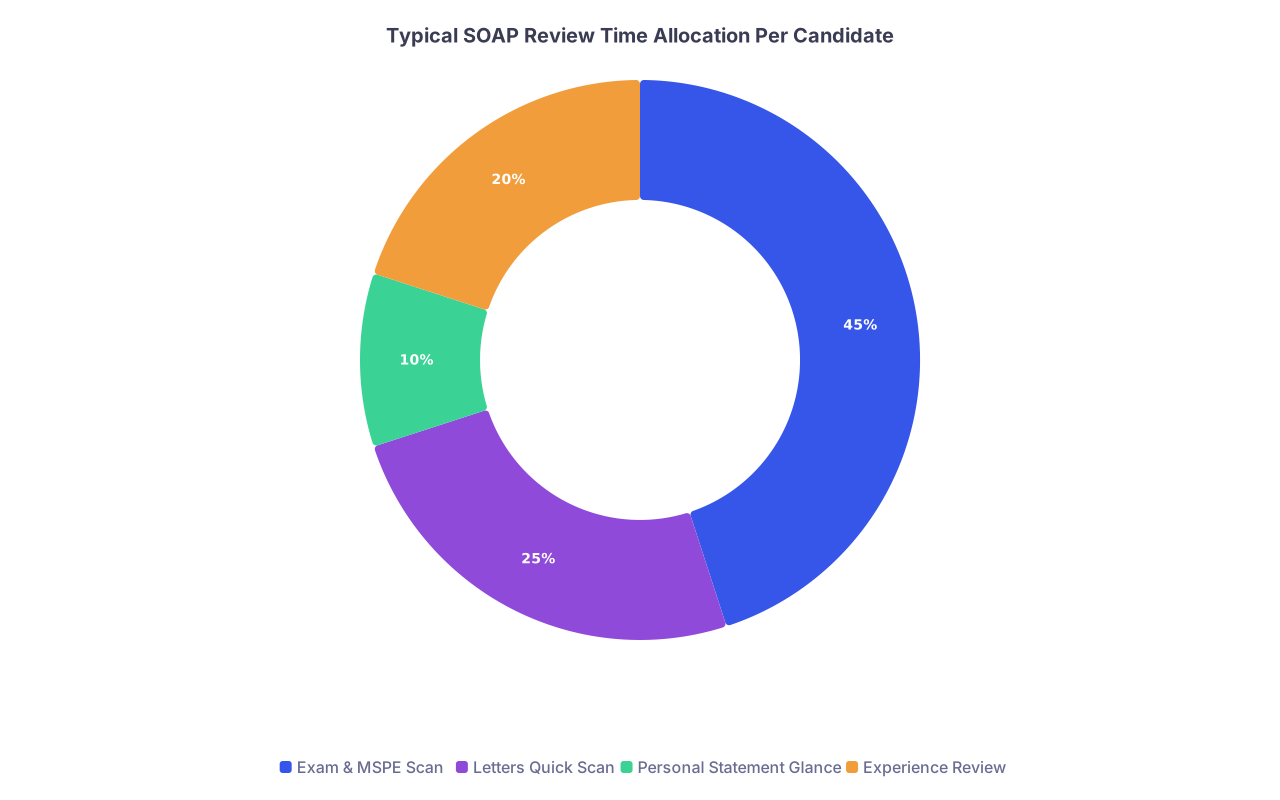
| Category | Value |
|---|---|
| Exam & MSPE Scan | 45 |
| Letters Quick Scan | 25 |
| Personal Statement Glance | 10 |
| Experience Review | 20 |

| Step | Description |
|---|---|
| Step 1 | Receive SOAP Applicants |
| Step 2 | Apply Hard Filters |
| Step 3 | Priority Review |
| Step 4 | Brief Screen |
| Step 5 | Place in Top/Mid Tier |
| Step 6 | Remove or Low Rank |
| Step 7 | Finalize Rank List |
| Step 8 | Preferred Category? |
| Step 9 | No Red Flags? |