
The second your name hits the SOAP list, you are not a mystery. You’re a problem to be solved in 96 hours.
Let me tell you what really happens on the other side of that screen when you enter the SOAP.
Program directors are not sitting there thinking, “What a tragic victim of the system.” They’re thinking three things, in order:
- Why did this person not match?
- Are they going to be trouble?
- Can they help my service tomorrow?
Everything else—your “passion,” your personal statement, the beautifully formatted CV—is background noise during SOAP week. The priorities shift. The rules change. And if you do not understand how PDs actually think in that window, you will get steamrolled.
What Happens in the First Hour After the SOAP List Drops
Here’s what you do not see: the group text threads and the panicked office huddles.
The morning the SOAP list drops, most programs already have a rough idea of what they might need. They know who did not match into their specialty. They know which prelim spots are likely to go unfilled. They’ve been watching the numbers all season.
Then NRMP drops the bomb: the list of unmatched applicants and unfilled programs.
On the program side, the first 30–60 minutes look like this:
- Coordinator prints or opens the SOAP applicant list.
- PD + APDs + maybe chief residents jump into a quick war-room style meeting.
- They pull up filters: US MD vs DO vs IMG, Step scores, attempts, citizenship, graduation year.
- They generate a “call list” and a “maybe list.”
You are not a person yet. You’re a row in a spreadsheet.
| Filter Type | Common Cutoffs/Preferences |
|---|---|
| Graduation Year | Within last 1–2 years preferred |
| Exams | No failures, or max 1 fail |
| Visa Status | US citizen/green card simplest |
| School Type | US MD > DO > IMG in many programs |
| Prior Training | Limited gaps, no incomplete residencies |
No one is reading your personal statement first. No one is admiring your leadership experience. They are scanning for red flags and dealbreakers. Fast.
If you’re wondering whether programs “reconsider” their standards for SOAP—yes and no. They’ll widen their net. But they do not throw their filters out the window. A place that screens out anyone with multiple exam failures during ERAS is not suddenly going to embrace them in SOAP unless they’re absolutely desperate.
The First Question: “Why Didn’t This Person Match?”
Every PD I know starts at the same mental place: What went wrong?
You have to understand something ugly here. In SOAP, programs assume the default explanation is not “the system failed a great applicant.” They assume there’s a reason. And they start hunting for it.
Here are the buckets they quietly sort you into:
System failure / overreach / bad strategy
- Strong metrics, decent application, but applied too narrowly.
- High-achieving candidate who shot only for ultra-competitive specialties or only at big-name programs.
- Red flag: Applied to 25 derm programs and nothing else. Now in SOAP for prelim medicine.
Marginal but workable
- OK scores, average evaluations, maybe weaker letters.
- Some minor “eh” items: one LOA explained, a shelf failure remediated.
- Feels like someone who should have matched somewhere, just not top-tier.
Red-flagged / landmine
- Exam failures, professionalism issues, gaps with poor explanations, prior dismissed residency.
- PDs will often say it plainly in the room: “Why didn’t anyone pick this person up?”
- Sometimes the answer is visible (Step 1=3 attempts). Sometimes it’s invisible but suspected.
When they look at your file in SOAP, they’re not asking, “Is this a good human being?” They’re asking, “Can I explain to my chair and GME committee why I brought this person in?”
If your file doesn’t make sense on first pass, many programs will simply move on. SOAP moves too fast to do deep rehabilitative reads of applications.
How Program Directors Actually Triage SOAP Applicants
Let me walk you through how the mental algorithm really plays out in those rooms.
First, they sort by things they absolutely care about for their setting:
Can we actually hire this person?
Visa issues, prior training history, licensing eligibility. If the hospital can’t credential you, you’re dead on arrival.Will they survive our workload?
A busy county IM program will favor someone who’s already shown they can hang clinically. A malignant surgery program wants stamina and zero drama.Will GME approve them?
PDs know their GME office. Some GME offices hate multiple exam failures. Some are paranoid about prior dismissed residents. PDs self-censor before they even send your name up.
Then comes the more subtle stuff.
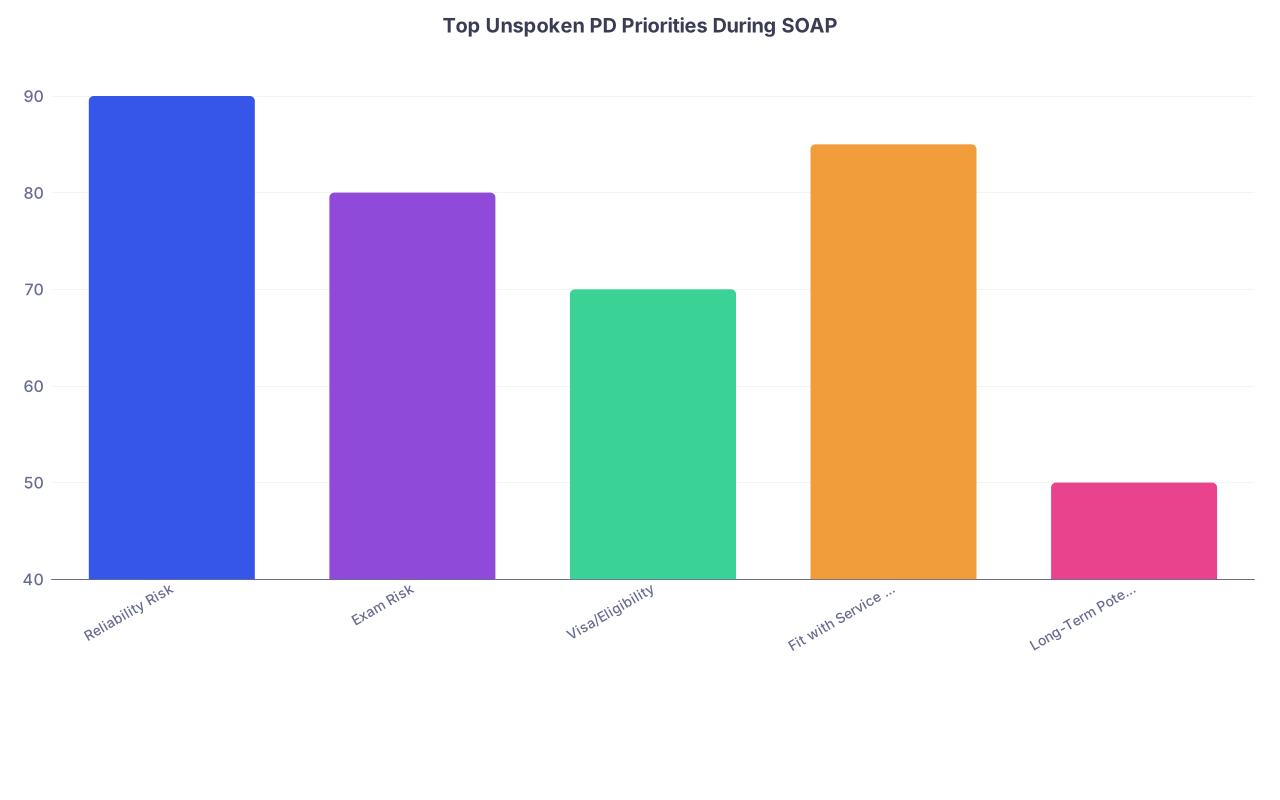
| Category | Value |
|---|---|
| Reliability Risk | 90 |
| Exam Risk | 80 |
| Visa/Eligibility | 70 |
| Fit with Service Needs | 85 |
| Long-Term Potential | 50 |
Your “passion for primary care”? That’s maybe 10 on that scale during SOAP.
What PDs really think as they click through your file:
- “Are you going to show up? On time? Every day? Without chaos?”
- “Are you going to pass Step 3 / boards?”
- “Are you going to get me called into a disciplinary or patient safety meeting?”
- “Are you going to cover my night float or are the chiefs going to be forced to patch holes?”
The brutal truth: in SOAP, many PDs are staffing more than they are “training.” They’re plugging service holes. And they’re judged—internally—on whether the interns they pick are solid, functional, low-headache.
What They Really Think About Unmatched Applicants by Category
You want the truth? Here’s how the conversations actually go behind closed doors. I’ve heard these exact lines.
1. The out-of-match competitive specialty applicant
Example: You applied to ortho, ENT, derm, plastic, neurosurg. Did not match. Now you’re in SOAP looking at prelim surgery, prelim medicine, TY.
What PDs think:
- “Okay, they’re probably smart. Or at least numerically strong.”
- “If they wanted derm/ortho and we’re an IM program, are they going to bail after a year?”
- “Is this a flight risk? Do I want to invest time teaching them if they’ll just jump ship?”
Some places will LOVE you as a prelim. You’re a workhorse they expect to leave. That’s fine. Others, especially categorical-heavy programs, get wary. They want people who intend to stay.
The ones who win in this group during SOAP are very clear, very fast about what they’re doing now:
“I went all-in on ortho, it didn’t work. I’ve reassessed. I am now committed to Internal Medicine as my long-term path, here’s why, and here’s what I’ve already changed about my plan.”
If you sound like “I’m just trying not to be unemployed,” PDs feel that. And they move on.
2. The borderline-but-decent applicant who overreached
This is the silent majority.
These are the people with mid-range scores, okay letters, not much to make them pop—but nothing truly toxic either. They aimed too high. They had no real safety net list.
Program directors actually like this group the most during SOAP. They think:
- “This person could’ve matched at a mid-tier or community program if they’d applied broadly.”
- “We’re essentially their safety net. They’re probably fine.”
These are the applicants who, from the PD perspective, “should have matched somewhere.” You’re their easiest “yes” in SOAP, especially if you’ve got:
- No exam failures.
- No big professionalism issues.
- No suspicious gaps you can’t explain.
You win here by being normal, dependable, and prepared when they call. Not brilliant. Not charismatic. Just organized, clear, and not chaotic.
3. The applicant with exam failures or academic trouble
Here’s where the tone in the room shifts.
I’ve watched PDs pull up an application, see “Step 1: Fail, Pass,” and immediately say:
“Okay, what happened?”
Sometimes they dig. Sometimes they don’t. It depends how desperate they are and how much time they have.
What they really care about:
Pattern vs single event.
One fail, then solid scores? Maybe. Multiple fails or multiple shelf repeats? Big problem.Trajectory.
Step 1 fail, Step 2 246? That’s a story: “turned it around, matured, new strategy.”
Step 1 pass, Step 2 206? That’s a different story: “declining, might not pass boards.”Story coherence.
If your application hints at health, family crisis, mental health—PDs are not blind. Some are sympathetic. But they’re also thinking: “Is this going to happen again during intern year when they’re on nights?”
Most PDs don’t want to be the one who took a chance that imploded. In SOAP, they don’t get days to call your dean, talk to mentors, unspool the nuance. They see the fail. They see the low score. Time is ticking. And they say, “Let’s move to someone cleaner.”
You can still match from here. But understand you are pushing uphill.
4. The prior-residency or dismissed-resident applicant
This is the nuclear red flag bucket.
If you started a residency and left, or were non-renewed, this is how it lands:
- “Why did their prior PD not keep them?”
- “What risk am I taking that I’m not seeing on paper?”
- “What drama am I inheriting?”
If you’re in this group and you SOAP, you absolutely must have:
- A coherent, calm, non-defensive explanation.
- Evidence that you’ve functioned since: research, work, new letters from people who supervised you.
- A dean or prior PD who isn’t torching you when called informally.
Yes, programs talk. PDs email each other. If you think your prior PD won’t be asked about you, you’re living in fantasy.
What PDs Think of SOAP vs the Main Match
You might imagine SOAP as “the leftover round” or “the charity round.” PDs don’t see it that way. They see it as a compressed, high-risk, high-noise selection process where their ability to screen wisely, fast gets tested.
Let me be blunt:
- Many PDs hate SOAP. It’s chaos, it’s rushed, it’s politically loaded.
- They’re terrified of making a decision in 12 minutes that they’re stuck with for 3 years.
- They know GME is watching them more closely during SOAP selections.
So where a PD might stretch on a main-match rank list for someone they “have a good feeling about,” they often become more conservative in SOAP. They can’t meet you in person as thoroughly. They don’t have months of deliberation. It’s rapid triage.
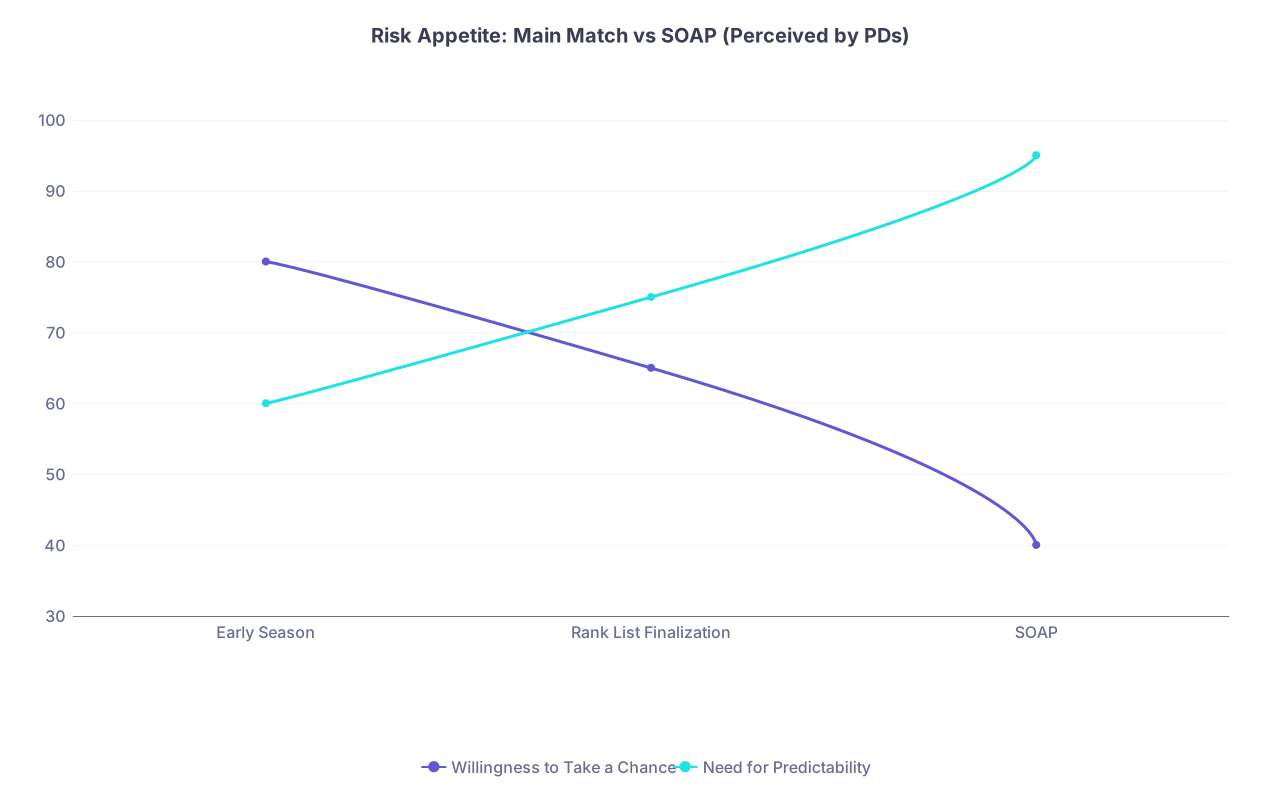
| Category | Willingness to Take a Chance | Need for Predictability |
|---|---|---|
| Early Season | 80 | 60 |
| Rank List Finalization | 65 | 75 |
| SOAP | 40 | 95 |
SOAP, from their side, is mainly about two words: damage control.
- Did they unexpectedly go unfilled and now need to justify it to the department?
- Did they misjudge the market and now have to fill with candidates they didn’t initially target?
- Are they trying to avoid being on that public “unfilled again” list next year?
That shapes how they see you. You’re not just an applicant; you’re tied to their embarrassment level with the chair.
How They Judge You in a 10–15 Minute SOAP Call
You get the email or call. The PD or APD wants to “chat briefly.” You think it’s an interview. It is, but not in the polished, full-day sense you prepared for.
Here’s what’s really happening in their head during that short call:
- “Does this person sound stable?”
- “Can they speak clearly about what happened without crumbling?”
- “Do they blame everyone else for their situation?”
- “Do I sense desperation or grounded realism?”
They’re not trying to grill you clinically. They don’t care about the Krebs cycle on SOAP Wednesday. They’re sanity-checking:
- Basic professionalism in your tone.
- Insight into your application failure.
- Reasonable, believable plan forward.
If you sound scattered, bitter, or like a victim of a grand conspiracy, they move you into the mental “no” pile, even if they stay polite.
The applicants who do well on these calls:
- Speak in short, direct sentences.
- Own their part in not matching without self-flagellation.
- Have a very clear line: “Here’s what I’ve learned, here’s what I’m doing differently now.”
- Show they’ve actually read the program and have some specific reason they might fit.
No long speeches. No stories that sound like depositions. Answer, own, pivot to future.
How Much They Care About Your Specialty Choice in SOAP
Here’s a dirty little secret: some PDs absolutely do not believe your last-minute “lifelong passion” story.
If you went all-in on something else and now you’re in their SOAP pool, they automatically assume one of three things:
- You’re using them as a backup to avoid being unmatched.
- You’re open to their specialty but came to it late.
- You’re genuinely okay pivoting and might commit long-term.
They’d like you to be #3. They suspect you’re often #1. They’ll settle for a believable #2 if they have to.
A medicine PD seeing a SOAP application from a failed neurosurg candidate is thinking:
- “Is this going to be an intern who’s mentally checking out after PGY-1?”
- “Or someone who realizes neurosurg was wrong and actually wants to be here?”
If they’re filling prelim spots only, they may not care as much. For categorical? They care a lot.
Your job is to make your pivot sound:
- Thoughtful, not purely reactive.
- Anchored in experiences: “During third-year, what stuck with me in IM was…”
- Sustainable: “If neurosurgery disappeared from the earth tomorrow, I’d still be happy as an internist.”
If your story is, “I just really want to help people and this is a great program,” you sound like everyone else who’s improvising.
What Programs Really Think If You Don’t SOAP Successfully
Here’s something people rarely say out loud: not everyone should force a SOAP placement at all costs.
From the PD chair, a few conclusions pop into their heads when they see someone go through SOAP and still not secure a spot:
- “Either their application has serious issues, or they handled this process poorly.”
- “Next year, if they reapply, I need to understand what they did with that gap year.”
They’re not automatically writing you off. But their bar for you next cycle goes up. They expect visible evidence that you:
- Worked clinically in some capacity (scribe, research assistant with patient contact, etc.).
- Addressed exam issues if those were the problem.
- Have fresh, strong letters from this interim year.
If you take a year and do nothing except rewrite your personal statement and mope, PDs see that as confirmation that you struggle to function when life goes sideways.
The Programs Themselves: “Why Are They in SOAP?”
You’re worried about being in SOAP. PDs are also hyper-aware when their program lands in SOAP.
Here’s what they’re thinking:
- “What does it say about us that we didn’t fill?”
- “Are we perceived as malignant? Too heavy on service? Too weak in fellowship match?”
- “Did we misjudge our competitiveness this year?”
Some PDs in SOAP are humble and realistic. They know they’re a safety-net or workhorse program. They lean into it and look for gritty, resilient candidates.
Others are in denial. They still think of themselves as mid-tier competitive and treat SOAP like they can cherry-pick the absolute best unmatched candidates. These are the places that will reject you in SOAP and then go partially unfilled anyway.
You’re not crazy if you feel like some SOAP programs are unreasonably picky. They are. Because they’re trying to protect their ego and brand.
How To Behave So You Look Like the Candidate They Want
From all the PD conversations I’ve sat through, the applicant who does best in SOAP has a very specific vibe:
- Grounded.
- Brief.
- Honest without oversharing.
- Forward-looking.
Program directors, even the grumpy ones, are still human. Many actually feel bad for you. But pity does not override fear of a bad hire.
They think:
“I’ve got 15 minutes with this person. Do I walk away thinking, ‘I can trust them on night float with a pager?’”
If the answer is yes, you’re in the game.

| Step | Description |
|---|---|
| Step 1 | See SOAP Applicant List |
| Step 2 | Reject Without Contact |
| Step 3 | Brief File Review |
| Step 4 | Short Phone/Video Call |
| Step 5 | Rank for SOAP Offer |
| Step 6 | Meets Basic Filters? |
| Step 7 | Red Flags Manageable? |
| Step 8 | Seem Stable/Reliable? |

Quick Reality Check: What PDs Actually Respect in SOAP
One last piece of truth: PDs do respect certain things about unmatched applicants who handle SOAP well.
They notice when:
- You own your situation without excuses.
- You do not trash your prior specialty or mentors.
- You are responsive, answer emails quickly, and submit documents immediately.
- You’re composed even when it’s obvious you’re under massive stress.
They’re not expecting a TED Talk. They’re expecting someone who, despite having their gut punched on Monday, still shows up professional on Wednesday.
If they see that, some of them will fight for you in their rank meeting. They’ll say:
“Look, they didn’t match. They know it. But they’re solid, they’ve grown, and we can work with this.”
And that’s all you need.

FAQ (Exactly 3 Questions)
1. Do program directors actually hold SOAP against you long-term?
If you match in SOAP and then show up, work hard, pass your exams, and don’t create drama—most PDs stop caring how you got there by about November of intern year. They may remember you as “one of our SOAP matches,” but the emotional weight disappears fast if you perform. What does stick long-term is not SOAP itself, but any pattern that continues: poor test-taking, professionalism problems, unreliability. SOAP is just the first data point; you control the rest.
2. Should I be completely honest about why I didn’t match?
Honest, yes. Unfiltered, no. PDs want a concise, coherent explanation, not a 20-minute saga. If you overreached, say so. If you had a health or family crisis that impacted your performance, you can mention it briefly with emphasis on what’s changed and how you’re stable now. Do not blame programs, “the system,” your school, or your letters. The moment you sound like you externalize all responsibility, PDs mentally flag you as future-problem material.
3. Is it better to SOAP into a prelim year or go unmatched and reapply?
From the PD side, a successful prelim year with strong evaluations, no drama, and maybe a Step 3 pass can rehabilitate a marginal application far more than another application cycle with nothing new. But a bad prelim year can bury you. If the only SOAP options are in programs where you’re likely to drown or be unsupported, a strategic gap year with real work, stronger letters, and exam improvement can make more sense. PDs don’t all agree—but they all look for one thing next cycle: did you make good use of whatever happened after you didn’t match. That’s what they judge.
Key takeaways:
Program directors in SOAP are thinking about risk, reliability, and service coverage—not your childhood dream story. They’re triaging your file at high speed, searching for a clean, defensible explanation for why you’re unmatched and whether you’re safe to hire. If you can own your situation, present as stable and forward-looking, and give them confidence you’ll show up and pass your boards, you become exactly what they’re praying for in that chaotic week: a solid bet under pressure.