Last March, a US grad sat in an empty call room staring at a “We’re sorry” email from his top program. Then the next one. Then the next. By noon, it was clear: no match, no scramble miracle, nothing. That afternoon his phone started buzzing—not with interviews, but with advice. Faculty telling him to “just do research,” classmates suggesting an MPH, family asking if he could “just work as a doctor somewhere else.”
Let me tell you what really happens on the other side of that gap year when program directors look at your application again. The “do anything clinical” advice you’re getting? Half of it is useless. And some options that sound impressive on paper are poison to a PD’s eyes.
You want to know what PDs actually prefer after a no match. Not what gets said in public webinars. What gets said in the ranking room when your file comes up and somebody asks, “So what did they do last year?”
You’re going to get that here.
The Unspoken Hierarchy of Gap-Year Activities
Every PD has their own quirks, but there’s a pattern. Whether you’re going for IM, FM, psych, gen surg, EM, OB, peds—most of us subconsciously rank gap-year activities into tiers.
We don’t say this out loud at information sessions, but in the conference room, it sounds more like:
“Okay, they didn’t match last year. What did they do—real clinical work, or did they disappear into a degree?”
Here’s the rough, behind-closed-doors hierarchy I’ve heard again and again. This is not theoretical; this is what folks actually say at 6:30 a.m. applicant review meetings.
| Activity Type | Typical PD Reaction |
|---|---|
| Full-time U.S. clinical (non-resident) | Strongly positive |
| Structured prelim/transition program | Strongly positive |
| U.S.-based clinical research (hands-on) | Positive to very positive |
| Home institution research fellowship | Positive |
| MPH/MPH-style degrees (1 year) | Neutral to mildly positive |
| Non-clinical research / bench work | Neutral |
| Pure tutoring, scribing, non-med jobs | Neutral to negative |
| Unstructured “studying, helping family” | Negative |
You’ll notice something: anything that screams “I stayed as close as possible to real patient care and physicians” rises to the top. Anything that looks like you drifted away from clinical medicine drops quickly.
Now let’s go through the main categories, because the nuances matter.
#1: The Gold Standard – Real, Ongoing U.S. Clinical Involvement
If you want to know what PDs secretly love to see after a no match, it’s this: you found a way to be reliably embedded in a clinical environment, in the U.S., with clear responsibility and continuity.
Not token shadowing. Not a two-week observership. I mean you show up daily, your badge actually works, nurses know your name.
Typical forms:
- Clinical research coordinator in a busy academic department
- Full-time sub-intern/clinical fellow–style position (often at IMGs-heavy sites)
- Non-ACGME “clinical fellow” roles where you see patients under supervision
- Hospitalist extender / APP-extender type positions (in some systems they’ll use MDs who aren’t residents yet)
Here’s how the conversation actually goes when we see this:
“They didn’t match last year, but look—they’ve been a clinical research coordinator on the cardiology service. Full-time. LOR from the section chief. They’ve been writing notes, helping in clinic, seeing patients. Okay, they stayed in the game.”
PDs like this because:
- It proves you still want to practice medicine
- It shows reliability: you got hired, you showed up, you functioned in a team
- It gives access to strong, current U.S. letters of recommendation
- It tells us your clinical skills haven’t rusted out
The best setups:
- You’re embedded in the specialty you’re applying to (IM job for IM apps, psych job for psych, etc.)
- You get your name on a couple of posters/abstracts as a side effect of the work
- You have measurable outcomes: patient volumes, projects finished, responsibilities clearly described
Red flags inside this category:
- Titles that sound clinical but are actually glorified data entry with zero physician interaction
- “Volunteer” roles that are a few hours per week – we can tell you’re padding
- No letter from anyone supervising you clinically – that tells us you weren’t impressive or weren’t really there
If you can swing real U.S. clinical involvement for a year, this is overwhelmingly the preferred path in PD eyes.
#2: Prelims, Transitional Spots, and “Second Chances” in Training
If you’re in a field where prelim or transitional spots exist, this is the other thing PDs quietly favor. It’s messy, and not everyone can do it, but from a PD standpoint, this is almost as good as gold.
Example: You didn’t match categorical IM, you grabbed a prelim IM or transitional year, then you’re reapplying to IM or another specialty.
In a ranking meeting, your file triggers comments like:
“They’ve already completed a year of ACGME training, no red flags, solid evals. Plug-and-play. We know exactly what we’re getting.”
Why PDs like this:
- Your competence has been documented in a U.S. residency environment
- You’ve worked in the EMR, with real workload, night float, admissions, etc.
- Another PD already took the initial risk—and vouched for you in their letter
But here’s the hidden part students don’t get told:
We scrutinize the narrative behind why you’re switching or reapplying.
If you did a prelim year aiming for derm but now you’re applying to IM, we ask:
“Did they finally get realistic?”
If you did a prelim surgery year and now apply to anesthesia, we ask:
“Are they running away from the hours or did they genuinely find the right fit?”
The strength of your current PD’s letter is pivotal. A weak, generic PD letter after a prelim year can kill you faster than doing research instead.
Things that help:
- Explicit statements like: “We would have gladly taken this resident into our categorical program if we had the slot.”
- Clear performance data: “Ranked in the top third of our interns in medical knowledge and professionalism.”
- Evidence you weren’t a problem: no professionalism flags, no probation, no remediations
If you have the option between a decent prelim year and a vague research/MPH option, most PDs will take the former every time—unless your specialty is heavily academic and research-driven (e.g., academic neurology, heme/onc down the line).
#3: The “Workhorse” Option – Real Clinical Research With Patient Contact
Let me be blunt: “research” is one of the most abused words in post–no match years.
PDs do not care that you ran Western blots in a basement for a year if you’re applying IM or FM. That doesn’t convince anyone you’ll be a safe intern.
But clinical research in a subspecialty clinic? Different story.
What we like:
- You’re rooming patients, collecting histories, helping with consent
- You’re writing drafts for case reports and retrospective studies
- You’re at conferences presenting posters, ideally in the field you’re applying to
- You’re in clinic days every week, not just in an office clicking REDCap checkboxes
Programs at big academic centers love hiring gap-year grads into these roles because you’re overqualified, motivated, and familiar with medicine.
Here’s the line a PD might say reviewing your file:
“Alright, they didn’t match, but they spent the year as a clinical research fellow in our GI clinic. Daily patient exposure, three abstracts at DDW, strong letter from the PI. That’s a productive year.”
What kills this category:
- No tangible output. “I assisted with a variety of projects” and not one poster, not one abstract, not one in-submission paper? That says you were wallpaper.
- You never stepped into clinic. Everything you describe is data cleaning and chart review at home in sweatpants.
- No timeline clarity. If it sounds like you did three months of half-time research and then drifted, we notice.
Done right, this is one of the top 2–3 most valued gap-year paths in the eyes of many PDs.
#4: Degrees – MPH, MS, MBA, and the Quiet PD Skepticism
Here’s the uncomfortable truth no one tells you on the MPH program’s marketing page.
Most PDs are mildly skeptical when they see a one-year degree after a no match. It’s not an automatic negative, but it triggers a mental question:
“Were they hiding in school because they didn’t know what else to do?”
Now, is there a way to do a degree that helps you? Yes. But you have to understand how it’s interpreted.
MPH example: You did not match IM, now doing a one-year MPH in epidemiology.
Positive reactions happen when:
- Your MPH has a strong, completed capstone or thesis clearly tied to your specialty (e.g., diabetes outcomes in underserved populations for IM/FM; trauma systems for EM; maternal health for OB)
- You used the MPH to secure serious letters from recognizable faculty
- You stayed clinically engaged while studying—free clinics, hospital volunteer roles with direct patient contact, per diem clinical jobs allowed under your visa/circumstances
Negative reactions occur when:
- Your MPH is obviously a placeholder, no clear focus, generic global health buzzwords
- You’ve done zero clinical anything during the year
- You now look like you’re drifting away from clinical medicine into policy, advocacy, “leadership,” with no clear story of why you still want frontline residency
What PDs say when it looks off:
“They missed once, then disappeared into an MPH, no recent clinical contact, and now want to jump straight back in? I don’t know…”
MBA or other non-med master’s usually land even worse unless you can convincingly tie them to a long-term, clinically anchored career path.
So: a degree isn’t fatal. It’s just not the “saving grace” students imagine. On average, a full-time, hands-on clinical role beats a degree year for most core specialties.
#5: The “Looks Bad Unless Explained” Bucket
Here’s where PDs really start to raise eyebrows.
These are the things that don’t automatically destroy your chances, but absolutely need to be reframed with a precise explanation in your personal statement and interviews.
Examples:
- Working as a scribe for a year
- Full-time tutoring or test prep
- Non-medical jobs: tech startup, finance, family business
- “Family responsibilities” with no further context
- Studying for Step 2/3 for an entire year
What we actually think when we see just “scribe” or “tutor” for a no-match year:
“You couldn’t find anything more substantive or closer to being a physician?”
Now, if you were a scribe in the ED, saw high volumes, and used it to get strong letters from EM faculty, that’s salvageable. The problem is most people don’t frame it that way—they just list “scribe” and move on.
The worst is the “I studied for Step” year. Unless your score jumped dramatically and you can show you were course-correcting a previous weak area, this reads like:
“I wasted a year spinning my wheels and avoiding real responsibility.”
If this is your situation, you need to:
- Be brutally specific about what changed—new score, improved test-taking, remediation, study strategies
- Add any side clinical or volunteer work you did concurrently, even if part-time
- Have a mentor-backed narrative: faculty letter that explicitly says you used the year maturely
The bar is simple: if you weren’t doing something that would make you a better intern, we’re suspicious.
What PDs Are Silently Scanning For in Your Gap Year
When your application hits the table the second time, three quiet questions run through people’s heads:
Did this person stay clinically warm?
Did they keep their hands in real medicine, seeing real patients, under supervision by physicians who can now vouch for them?Can I explain their story to my colleagues in one confident sentence?
“They didn’t match, spent a year as an IM research fellow on our wards, crushed it, and now they’re back.” That’s easy to defend. “They did…an MPH and some tutoring” is not.Is their trajectory clearly upward?
New scores better than old scores. New LORs stronger than old LORs. Concrete productivity. Growth. Not just time passing.
The content of the gap year matters less than how convincingly it shows those three things.
How This Plays Differently by Specialty
Let’s not pretend all specialties weigh this the same.
Internal Medicine / Family Med / Psych / Peds: Strong preference for anything that screams clinical continuity. Clinical research coordinator or prelim year are ideal. MPH can help if tied to primary care, community health, or psych outcomes, but not as strongly as clinical work.
Surgery / OB-GYN: PDs heavily favor prelim or other true clinical roles. Surgical clinical research is acceptable if you’re in the OR, attending M&M, and clearly embedded in the service. Pure bench work is often a weak signal.
EM: ED scribes are common, but not as meaningful after a no match. A formal EM research fellowship with clinical shifts or simulation involvement is preferred. Extra degrees are usually seen as fluff unless strongly tied to EM systems/administration.
Radiology / Pathology: Research and advanced imaging/path fellow-style positions can be genuinely valuable. These fields care more about intellectual engagement and technical skills, so certain nontraditional years can play better here than in pure clinical specialties.
You need to match your gap year to your field’s culture, not some generic template.
A Brutal But Useful Rule of Thumb
When you’re choosing among options, ask yourself this exact question:
“If my future PD described my last year in one blunt sentence to the selection committee, would it sound strong or weak?”
Strong sentences:
- “They didn’t match last year, spent the year as a full-time clinical research fellow in our cardiology clinic, published two abstracts, and we’d gladly have them as an intern.”
- “They completed a prelim medicine year, had excellent evaluations, and would have been taken categorical if we had space.”
Weak sentences:
- “They did an MPH and some tutoring.”
- “They were studying for their boards and working as a scribe.”
- “They helped with some research projects but didn’t really have any concrete outputs.”
Design your year so that one sentence sells you.
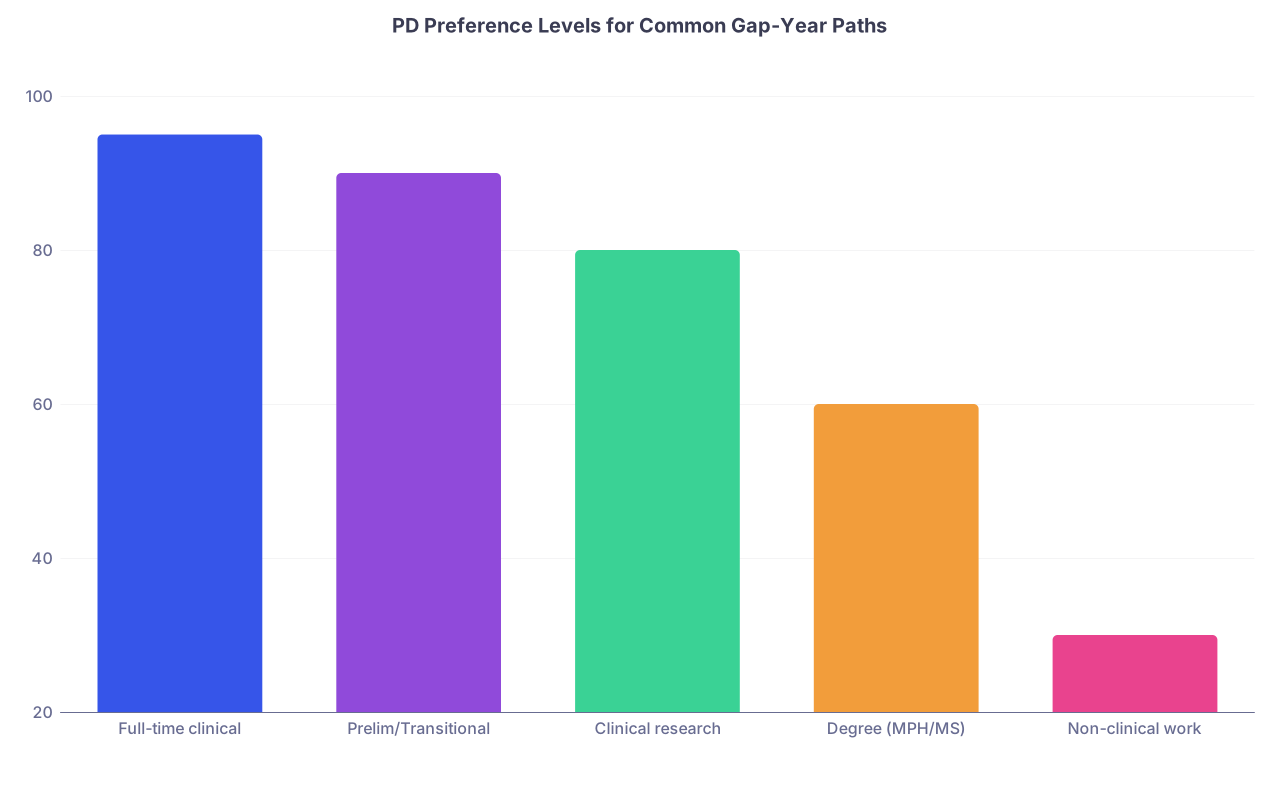
| Category | Value |
|---|---|
| Full-time clinical | 95 |
| Prelim/Transitional | 90 |
| Clinical research | 80 |
| Degree (MPH/MS) | 60 |
| Non-clinical work | 30 |
How to Talk About a “Less-Than-Ideal” Gap Year
Sometimes the reality is ugly. Visa issues. Family illness. Financial constraints. A toxic advisor who promised you the moon and delivered Excel sheets.
You cannot rewrite history, but you can rewrite the frame.
Three moves that help:
Own it clearly, without self-pity.
“I initially accepted a research role that turned out to be largely non-clinical and not aligned with my goals. Midway through the year I corrected course by adding weekly clinical volunteering and seeking out direct patient exposure.”Highlight what you learned about yourself and your work habits.
Not in a generic “I grew a lot” way. Be specific: time management, clinical judgment, new skills, improved study approach.Point to concrete improvement.
New Step score, first-author paper, new letters, leadership role, more mature specialty choice.
We have more tolerance for imperfect trajectories than you think. What we do not have patience for is people who seemed to drift for 12 months and learned nothing from it.

| Step | Description |
|---|---|
| Step 1 | No Match |
| Step 2 | Full-time Clinical or Clinical Research |
| Step 3 | Take Prelim/Transitional Year |
| Step 4 | Targeted MPH/MS + Clinical Involvement |
| Step 5 | Work + Part-time Clinical/Research |
| Step 6 | Strong Letters & Output |
| Step 7 | Reapply With Clear Narrative |
| Step 8 | US Clinical Role Available? |
| Step 9 | Prelim/Transitional Spot Possible? |
| Step 10 | Degree Truly Strategic? |
FAQs: What PDs Really Think About Your Gap Year
1. If I can’t get a paid clinical or research job, is volunteering enough?
Volunteering is better than nothing, but only if it’s real, ongoing, and clinical. Four hours a week of occasional clinic volunteering is weak. Twenty hours a week in a busy clinic, working closely with attendings who can write detailed letters—that’s much better. If you cannot get paid roles, make your volunteer role mimic a job in structure and responsibility.
2. Is doing a second degree (MPH, MS) after a no match ever clearly preferred?
Only in narrow situations. If you’re aiming at a field that values population health or research and your prior weakness was research experience, a tightly focused MPH/MS with strong output and clinical side involvement can help. But if you’re choosing between an MPH with light clinical exposure and a true full-time clinical or clinical research role, most PDs prefer the latter.
3. Does a gap year after no match permanently label me as “damaged goods”?
No. I’ve seen plenty of unmatched grads become stellar residents and fellows. The gap year becomes a problem only if your record shows stagnation or avoidance. If your year is clearly productive, clinically relevant, and shows upward momentum, many PDs treat it as a maturity year, not a scarlet letter.
4. How important is it that my gap-year work matches the specialty I’m reapplying to?
Helpful, but not absolute. Specialty-aligned roles are ideal—IM-related work for IM, psych exposure for psych, etc. But a strong, well-supervised clinical role in any field is still better than a non-clinical or vague academic year. Just be ready to connect the dots: what you did, what you learned, and why it prepares you specifically for this specialty.
5. What’s the single biggest mistake applicants make in choosing a gap-year activity after no match?
They pick something that sounds prestigious rather than something that proves they can function as a doctor. A shiny-sounding master’s, a “research” job with no patient contact, or a vague “personal time” year are all common traps. PDs overwhelmingly prefer one thing: you stayed in the clinical arena, got trusted with real responsibility, and have current physicians willing to go on record saying, “This person will be a good resident.”
If you remember nothing else, remember this: PDs are not judging how “interesting” your gap year sounds. They’re judging how confidently they can say, “I trust this person to be my intern in July.” Choose the year that makes that sentence easy for them.