
The way program directors evaluate reapplicants after an unmatched year is harsher, more suspicious, and more mechanical than anyone tells you publicly. You are no longer “just another applicant.” You are a risk calculation.
Let me tell you how they actually look at you, behind closed doors, when no one’s sugarcoating it for social media.
The Unspoken First Question: “Why Didn’t They Match?”
No PD starts with “let’s see how they’ve grown.” They start with: “Why did this person fail to clear the bar the first time?” That’s the lens everything else goes through.
Every reapplicant gets mentally sorted into one of four buckets within the first 60–90 seconds of review:
| Bucket | PD's Gut Label | Baseline Openness |
|---|---|---|
| 1 | Statistical near-miss | High |
| 2 | Strategy/fit failure | Moderate |
| 3 | Performance/behavior concern | Low |
| 4 | Red-flag toxicity | Essentially none |
Bucket 1: Statistical Near-Miss
These are the “we could’ve taken them the first time” candidates. People who applied very competitively, maybe in a hyper-competitive specialty, and just got squeezed by numbers.
Think: 235+ on Step 2 in IM, solid clinical grades, a couple of interviews last year, maybe overreached on program choices. PDs actually like these reapplicants if they’ve spent the off-cycle year doing something aligned with the specialty. They feel “safe.” Seen this dozens of times.
But you only land in this bucket if your numbers, letters, and narrative already looked clean the first time. If you were bottom-quartile on metrics? You’re not “near-miss.” You’re noise.
Bucket 2: Strategy/Fit Failure
These are the “OK on paper but played the game badly” folks. Maybe:
- Applied to 30 competitive programs instead of 120
- Ignored community or mid-tier programs
- Aimed at a region that didn’t aim back
- Had mismatched personal statement / letters (e.g., “I love academic medicine” then applied to almost exclusively community programs)
PDs here ask: did you fix the process or are you just rerunning the same failed experiment?
If your reapplication shows a smarter list, better alignment, and a believable plan (prelim year, solid research, meaningful clinical work), you can climb out of this bucket. If not, you’re just “persistent, not insightful.” That is not a compliment.
Bucket 3: Performance or Work Ethic Doubts
This one hurts. These are applicants where the file quietly whispered: “They might be a problem to supervise.”
Common reasons:
- Mediocre or concerning MS3/MS4 evaluations (“needs frequent redirection,” “struggled with time management”)
- A letter that was technically supportive but lukewarm between the lines
- Inconsistent Step performance suggesting discipline or test-taking problems
- A CV full of fluff with little substantive follow-through
PDs remember these. They’re brought up on Zoom calls: “We saw them last year – weren’t there concerns about their performance?” And here’s the ugly part: very few programs will give a second chance to someone they already coded as “possible headache,” unless they have clear, hard evidence of turnaround.
Bucket 4: Red-Flag or Toxic
You almost never hear this category discussed plainly.
This is where applicants land when there’s:
- A professionalism incident
- A documented complaint
- Unexplained leaves or extended timelines
- A dean’s letter with “concerns” in the subtext (yes, PDs are trained to read these like intelligence reports)
Reapplicants in this category will occasionally get interviewed — usually at places that didn’t see the original red flag in detail the first time. But once the deeper story emerges through phone calls and backchannel conversations? Doors close.
If you’re in this bucket, your strategy can’t be “reapply with a better personal statement.” You need structural damage control, remediation, and very high-quality new advocates. Otherwise you’re just re-sending the same warning label.
The Timeline Trick: PDs Compare Your Two ERAS Files Side by Side
Let me tell you one of the things applicants don’t realize: PDs, APDs, and coordinators literally open your old application and new application together. Some have the coordinator print both and highlight differences. They scan for coherence.
The questions they silently ask:
- Did this person get honest feedback, or are they in denial?
- Does their new year make sense with the failure to match?
- Are they spinning, or are they owning?
The biggest silent killer? Timeline chaos.
, Nothing Substantial](https://cdn.residencyadvisor.com/images/articles_svg/chart-common-reapplicant-year-activities-1043.svg "Common Reapplicant Year Activities")
| Category | Value |
|---|---|
| Research | 45 |
| Prelim Year | 25 |
| Non-clinical Work | 15 |
| [Observerships](https://residencyadvisor.com/resources/match-alternatives/the-gap-year-trap-activities-that-actually-hurt-unmatched-applicants) | 10 |
| Nothing Substantial | 5 |
The PD will literally walk through your year like this:
“OK, they didn’t match March 2025. From April to July, what happened? By August, did they have some structured plan? Research position? Prelim spot? Or does this look like drift and then last-minute scrambling?”
Gaps without an explicit, believable explanation are deadly for reapplicants. A two-month gap becomes, in their heads, six months of flailing. You’d be shocked how much projection happens in those meetings.
If your year looks like: “Uber driver / ‘independent study’ / shadowed occasionally,” and that’s it? You’ll be politely filtered out at many programs. Not because they hate you. Because they have 500 applicants who did not disappear from structured medicine for a year.
The Five-Second Filters: Scores, Attempts, and Specialty Choice
PDs are not combing your file line by line looking for reasons to rescue you. They’re scanning for reasons to discard you quickly — especially as a reapplicant.
There are three brutal first-pass screens for reapplicants.
1. Exam History Becomes a Bigger Deal
If there’s one thing that becomes more important as a reapplicant, it’s your exam pattern.
- Step 1: Pass/fail now, but multiple attempts still raise eyebrows
- Step 2 CK: Your primary quantitative anchor
- Any repeat attempts: magnified as risk signals
Programs think in probabilities. A reapplicant with a Step 2 failure or borderline score is not just “someone with a 219.” They’re “someone who already applied once, didn’t match, and has a borderline metric that might reflect performance under pressure.”
You know what every PD is thinking? “If they struggled here, what happens on in-training exams and boards?”
A strong Step 2 CK, especially if you only took it once and did well, can partially reset the narrative. A late improvement (e.g., strong in-training exam during a prelim year) can help. But no one pretends your test history doesn’t matter. They just don’t say it out loud anymore.
2. Specialty Choice: Stubborn vs Strategic
Here’s a harsh truth: if you reapply to the exact same hyper-competitive specialty with the same or slightly tweaked credentials, many PDs silently code you as unrealistic.
Reapplying to dermatology, plastics, ortho, ENT, with essentially the same academic profile and no transformational year? That reads as denial. Or entitlement. Neither sells.
Reapplying to IM, peds, FM, psych, EM, gen surg with a stronger, aligned year? That reads as persistence.
This is how PDs think — they won’t say it explicitly, but I’ve heard the conversations:
- “They didn’t match into ENT last year; now they’re applying categorical surgery with a solid surgery prelim year and good letters. OK, they ‘get it’ now.”
- Versus: “They’re applying ENT again with a few extra case reports and the same letters? Pass.”
3. Number of Attempts and Years Out
The further you drift from graduation, the colder the room gets when your name comes up.
One unmatched year? People are open. Two? They start talking about skill decay, clinical rust, “why has no one picked them up yet?” After three? You’re practically in a different category — some programs have quiet internal rules about “no more than X years from graduation” except for very special cases.
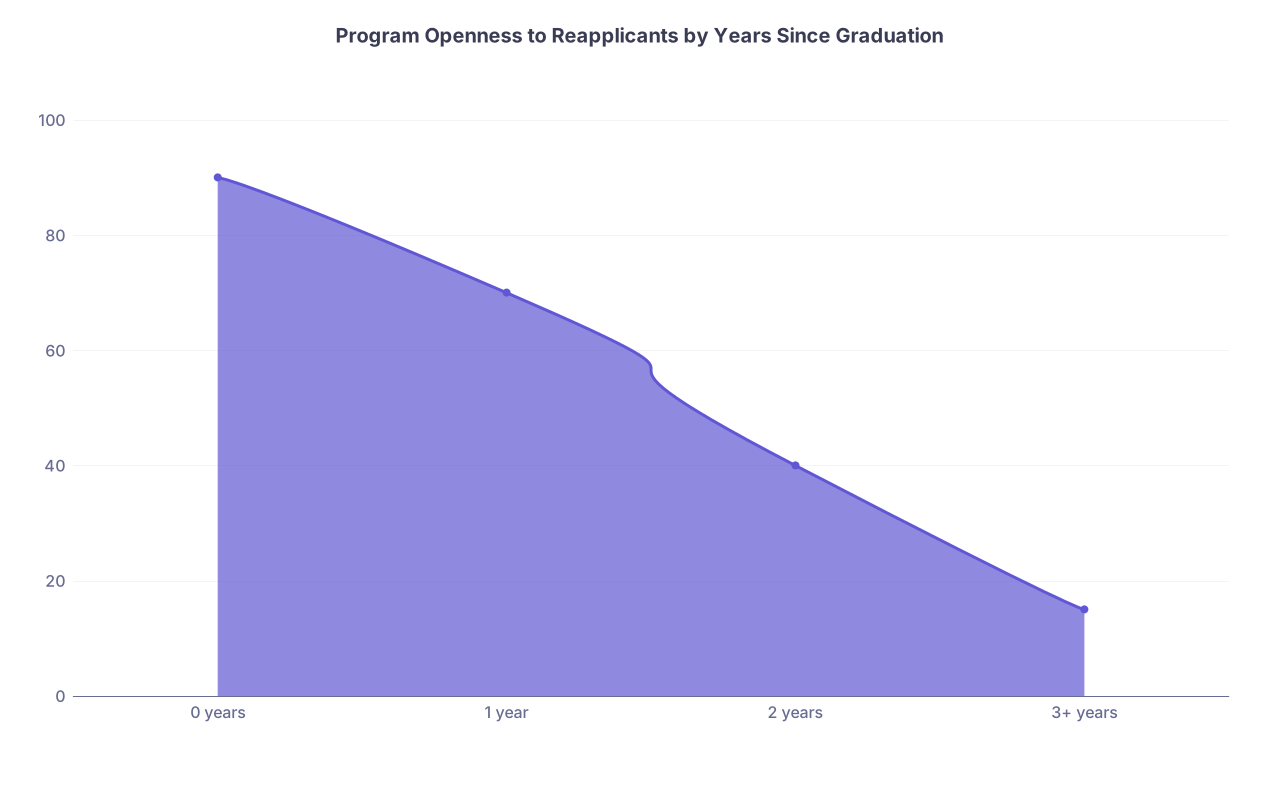
| Category | Value |
|---|---|
| 0 years | 90 |
| 1 year | 70 |
| 2 years | 40 |
| 3+ years | 15 |
No one publishes those curves, but they exist in PDs’ heads. That line above is closer to reality than most deans will admit.
What PDs Actually Want to See in Your “Unmatched Year”
Let’s strip away the inspirational fluff. PDs are looking for three concrete things in your reapplication year: proximity to real clinical work, evidence of coachability, and clear alignment with your chosen specialty.
1. Proximity to Real Medicine
You want to know the ranking of activities in most PDs’ minds? Roughly this:
- A strong, busy prelim year (medicine, surgery, transitional) with good evaluations and fresh letters
- A well-supervised clinical research year embedded in a department with patient contact, conferences, and faculty seeing you consistently
- A structured non-ACGME clinical role (hospitalist scribe with heavy involvement, clinical assistant in a meaningful way)
- Pure bench research with zero patient contact (neutral to mildly positive, depending on specialty)
- Observerships that are basically passive and short
- “Self-study,” “independent reading,” and vague “personal projects”
If you’re unmatched and you spend your year away from structured medicine, PDs immediately worry: “Are they staying sharp? Do they still know how to function in a clinical environment?”
They’re not expecting miracles. They just need evidence you haven’t disconnected from the world you’re trying to re-enter.
2. Evidence of Coachability and Insight
Here’s a line I’ve heard in closed PD meetings more than once:
“I can work with low scores. I can’t work with zero insight.”
You’re being evaluated as either:
- Someone who got knocked down, figured out why, sought feedback, and made targeted changes
- Or someone who’s just mad at the system and reapplying on autopilot
Coachability shows up in very specific places:
- How you explain your unmatched year in your personal statement and interviews
- How your new letter writers describe your response to feedback
- How your activities show intentional repair, not just activity for its own sake
The worst look? Blaming. “I didn’t match because COVID, or Step 1 pass/fail, or the SOAP was unfair, or my school didn’t support me.” All of that may be true. PDs don’t care. They’re thinking: what did you do about it?
3. Alignment with the Specialty You’re Now Pursuing
If you’re reapplying to the same specialty, PDs expect a year saturated with that field. Not tangentially related. Directly aligned.
If you’re switching — say from anesthesia to IM — they expect to see a narrative arc:
- Clear clinical or personal reasons for the switch
- Meaningful experiences in the new field (research, observerships, prelim year exposure, etc.)
- Letters from people in that field explicitly saying: “They belong here.”
What they hate is a scattered pattern: last year derm, this year EM/FM/psych combo, with no coherent story. That reads as desperation. You’ll be surprised how quickly that gets discussed in committee: “They’re applying to five different things — how serious can they be about us?”
What Your File Looks Like in a PD Meeting
Let me walk you into the room.
Imagine a mid-tier IM program. They’re reviewing reapplicants in November. Your name comes up on a shared screen. The coordinator has flagged: “Reapplicant – Unmatched 2025, did research year.”
Here’s roughly how it goes:
- APD skims your scores and graduation year out loud. Quick gut check: in range or not?
- Someone glances at the summary of your prior Match: how many programs you applied to, whether you SOAP’d into anything, if there was a prior prelim.
- They look at the new year’s activities in a block: one line, two lines, that’s it. They’re not reading all your bullet points.
- Then one person — sometimes two — reads snips of letters. Not whole letters. The highlighted phrases.
You get maybe 3–5 minutes of real attention max, unless someone in the room knows you or your new letter writer calls personally to advocate for you.

| Step | Description |
|---|---|
| Step 1 | See Reapplicant Flag |
| Step 2 | Check Step 2 and Attempts |
| Step 3 | Screen Out |
| Step 4 | Review Unmatched Year Activity |
| Step 5 | Scan New Letters |
| Step 6 | Offer Interview |
| Step 7 | Scores Acceptable? |
| Step 8 | Risk vs Reward? |
That’s what you’re up against. Not a careful literary analysis. A 3–5 minute risk assessment.
Which means your file has to scream a very simple message quickly: “I learned from last year, stayed clinical, and people who know me now trust me with a residency spot.”
Anything more nuanced than that gets lost.
The Interview: How PDs Probe Reapplicants Differently
If you make it to the interview stage as a reapplicant, you’re already in a better position than you think. It means someone on the inside decided you were worth the risk.
But your interview is not the same as a first-time applicant’s. They’re asking themselves three extra questions about you, even if they never phrase them this way:
- Are they going to bring unmatched-year baggage into our program?
- Are they going to crumble if things get hard again?
- Are they going to be bitter or entitled?
You’ll see this in the way they ask very targeted questions:
- “Walk me through what you did after the last Match.”
- “What do you think went wrong the first time?”
- “What’s different about your application this cycle?”
- “If you were unsuccessful again, what would you do?”
They’re not asking to torture you. They want to know whether your story is coherent, grounded, and emotionally intact.
The strongest reapplicants do three things in that conversation:
- Own the failure clearly without self-flagellation
- Name specific changes they made — not generic “I worked hard” nonsense
- Tie it back to being a better resident, not just a better applicant
Example of how that sounds when it lands well:
“Last cycle I underestimated how important program fit and breadth of applications were. I applied narrowly, and I didn’t seek frank feedback until after I went unmatched. This year I had a structured research position in your field with consistent patient contact, I got honest input from three faculty on my weaknesses, and I worked on X and Y specifically. I’m coming in with a much clearer picture of what residency actually demands and where I fit in that.”
That reads as coachable, reflective, and adult.
What bombs? Anything that sounds like: “I don’t really know why I didn’t match” or “I think it was just bad luck.” PDs do not believe “pure bad luck” explains a full unmatched year in most fields. They think you either didn’t apply smartly, didn’t perform well in interviews/SOAP, or there was something off in your file.
They may be wrong. But that’s how they think.
How Different Programs Secretly Vary in Tolerance for Reapplicants
There’s a pattern no one spells out for you, but I’ll say it plainly:
- Highly academic, big-name programs: Much more likely to favor first-time, clean-sheet applicants unless your reapplicant profile is stellar and supported by one of “their own” faculty. They don’t need to take risks.
- Solid mid-tier university and strong community programs: Often the most rational and fair with reapplicants. They look carefully at the story and what you did with your year.
- Chronic-underfilled or new programs: Sometimes very open to reapplicants, but can be opportunistic. They’ll take a chance if they need bodies, but they will also be wary if the file screams chronic issues.
The quiet rule-of-thumb: the higher the program’s applicant volume and reputation, the lower their tolerance for ambiguity in a reapplicant’s story.

So when you make your new list, you need to be brutally honest with yourself. If you were not in the top 20–25% of applicants even in your original cycle, planning a reapplication strategy that depends on top 10 programs “finally seeing your potential” is fantasy.
You tailor where you’re competitive now, not where you wish you were last year.
Red Flags You Don’t Realize You’re Sending
There are subtle cues reapplicants send constantly that scream trouble to PDs. Let me name a few that keep coming up in those back-room conversations:
- Bitterness leaks: Offhand comments in interviews about how your school “didn’t help you” or “the Match is broken.” PDs hear that as: “This person will blame us when things go sideways.”
- Overcompensation: Suddenly “hyper-passionate” about a new specialty with almost no track record in it before the unmatched year. If you were all-in on ortho and now you’re “lifelong dedicated to psych” with no coherent connecting thread, people don’t buy it.
- Story drift: Telling slightly different explanations to different interviewers in the same program. They compare notes. They notice.
- Defensive posture: You answer every question about last year as if you’re on trial. PDs are gauging how you respond to stress — and they know residency will hit you harder than this conversation.
If you recognize yourself in any of those, fix it now. Not with better lines. With better insight.
What Actually Moves the Needle for a Reapplicant
Let me be blunt. PDs are pragmatic. Here’s what really changes your odds the second time:
- A prelim year or other structured clinical role with excellent evaluations and a killer new letter saying, “I would absolutely take this person as a categorical if we had space.”
- A trusted advocate (faculty who is known and respected in the specialty) emailing or calling PDs specifically on your behalf. These quiet calls move mountains.
- A clean, coherent year that shows stability: same institution, consistent responsibilities, clear progression, not scattered one-month observerships everywhere.
- A specialty-appropriate research/clinical focus that makes sense with where you’re applying now.
- A mature, non-defensive narrative about your unmatched year that makes PDs think, “They took a hit, learned, and came out stronger.”
What doesn’t move the needle much on its own?
- Random extra publications with no meaningful clinical involvement
- Over-designed personal statements full of drama and metaphors
- Vague “volunteering” without depth or continuity
- Last-minute LORs from people who barely know you from a two-week observership
You’re not trying to prove you’re perfect. You’re trying to prove you’re safe, stable, and growing. That’s a different target.
The Quiet Reality: You’re Being Judged on How You Handled Losing
Here’s the part most people won’t say to your face.
For PDs, your unmatched year has become your first big professionalism stress test. They’re less interested in the fact that you fell short, and much more interested in how you behaved when that happened.
Did you disappear? Complain? Drift? Or did you:
- Seek out uncomfortable, honest feedback
- Show up to something every day and do it well
- Let other people see you work, long enough to vouch for you
- Rebuild your application with intention, not panic
Years from now, you really will forget the raw sting of not seeing your name on a Match email. What won’t fade as easily is the person you became in the twelve months after that.
Because whether you match as a reapplicant or have to pivot to a different path, the rest of your career will be full of versions of this same test. PDs know that. They’re not just hiring someone to fill a call schedule. They’re choosing who they want next to them when things go wrong.
If you use your unmatched year to prove that version of yourself exists — steady, coachable, honest — more doors will stay open than you think. And if a door closes after that, you’ll at least know it closed on the truth, not the version of you who pretended nothing needed to change.