
The brutal truth is this: post-Match “rescues” are not fair, not transparent, and not primarily about merit. They’re about relationships, timing, and whether someone with power is willing to put their name on you.
I’ve watched these decisions happen in real time—behind closed doors, in half-whispered hallway conversations, and in frantic text threads on Match Week. You see the public façade: SOAP instructions, NRMP rules, “holistic review.” What you do not see is the informal marketplace of favors, loyalties, and quiet advocacy that determines who lands a last‑minute spot and who gets left hanging.
Let me walk you through how it actually works.
What “Rescue” Really Means (And What It Doesn’t)
First, get clear on definitions. “Rescue” in faculty language is not the same as “just applying through SOAP.”
When attendings or program directors talk about “rescuing” someone, they mean:
- Using personal or institutional influence to secure you a position that you probably would not get on your own
- Often bypassing or pre‑shaping the normal applicant pile
- Sometimes even creating a position or diverting one
It can look like:
- A PD calling a friend at a different program: “I’ve got a strong kid who slipped through. Do you have anything?”
- A department chair reallocating a preliminary surgery spot to internal medicine to pick up a specific student
- A home program pulling a late, unadvertised open position and plugging in “their” unmatched student
What it is not:
- Random kindness from strangers
- A process you can sign up for
- Guaranteed for “good” students or “deserving” applicants
You are not in a fair lottery. You are in a hidden economy of who owes whom, who likes whom, and who is willing to take a perceived risk.
The First 48 Hours: How The Phone Calls Actually Happen
You want to know what happens the moment unmatched lists go out? Let me show you.
The Scene on Monday Morning
Programs get their match lists. They see who they got, who they missed, where they underfilled. At the same time, your medical school gets the list of who didn’t match.
Within hours, at many med schools, there’s a closed-door faculty meeting:
- Dean of students or student affairs
- A few key clerkship directors
- Department chairs or vice-chairs of core specialties
- Sometimes the PDs of the big home programs
They essentially create three internal piles of unmatched students (they won’t say it this bluntly out loud, but this is how they think):
- We must save this person if at all possible
- We’ll help them SOAP, but we’re not burning capital
- They’re on their own beyond basic support
The “rescue” conversations focus almost entirely on pile #1.
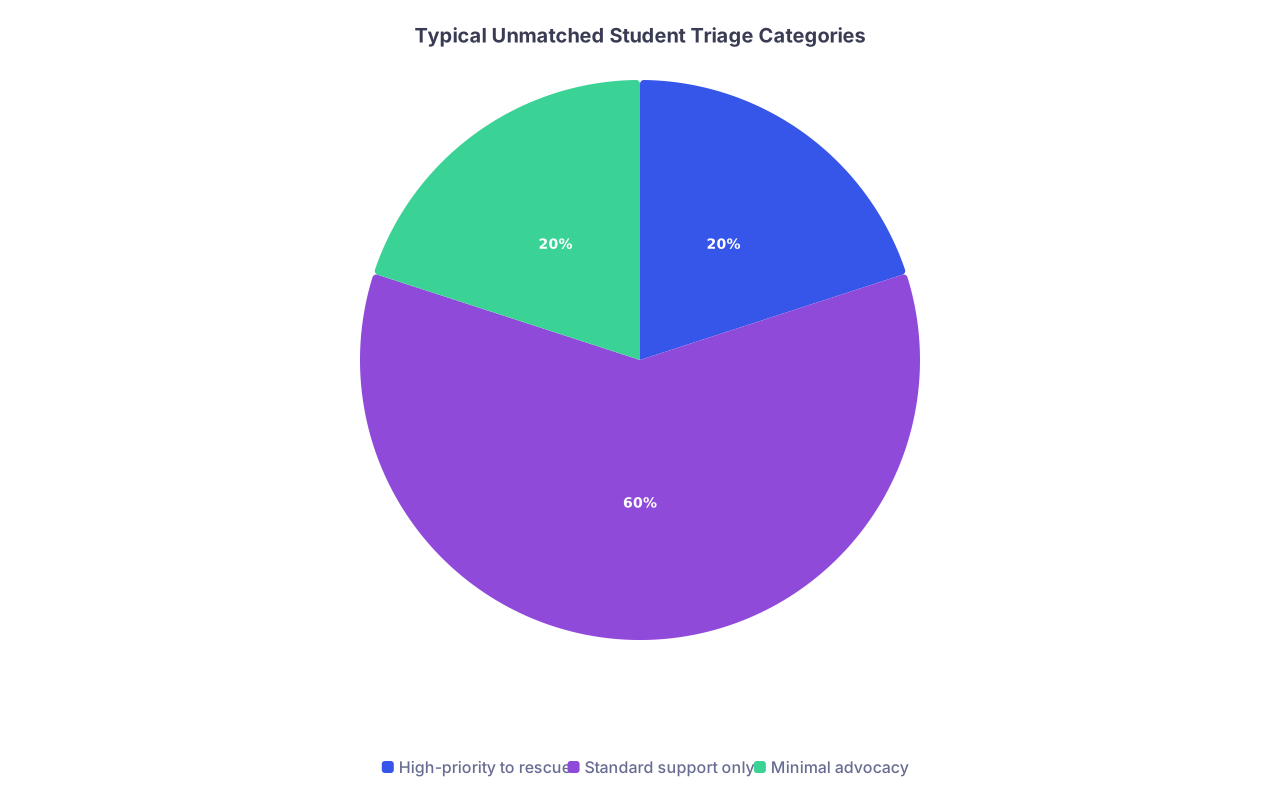
| Category | Value |
|---|---|
| High-priority to rescue | 20 |
| Standard support only | 60 |
| Minimal advocacy | 20 |
How Names Get Into the “Rescue” Pile
Here’s what actually puts you in that top internal pile. Not what students think matters. What faculty actually talk about.
They ask three questions:
Who do we know well enough to vouch for?
Your clerkship director saying, “I’d take this person as a resident tomorrow.” carries immense weight. Generic “hard worker” comments do not.Who will not embarrass us if we push for them?
Translation: solid professionalism, no big attitude problems, no whisper network issues.Who is realistic to place?
They look at specialty, Step performance, geographic flexibility, citizenship status, family constraints. They’re not going to spend all day calling neurosurgery programs for a borderline applicant; they’ll focus on realistic salvage.
And then the real game starts: call lists.
Chairs and PDs start calling their personal contacts. The language is very specific:
- “I’ve got someone who fell through the cracks. Would you look at them?”
- “If you’re SOAPing, can you flag this name?”
- “If a prelim or categorical spot opens late, can I send you a file?”
If your name is being said in those conversations, you are being “rescued.” If not, you’re in the general pool like everyone else.
The Criteria They Actually Use (Not the Ones on the Website)
Publicly, programs talk about holistic review, commitment to the specialty, diversity, and all the usual brochure language. Behind closed doors, when they’re deciding whom to rescue, the criteria shift.
Here’s what actually gets weighed.
1. How Much Risk You Represent
Rescue is a form of risk-taking. Nobody wants to spend their political capital on a grenade.
They look hard at:
- Professionalism flags: late notes, poor evaluations, “difficult to work with,” rumors of drama. I’ve seen one “unreliable, frequently late” comment kill any advocacy.
- Serious academic struggles: repeated Step failures, course repeats, chronic remediation. One stumble is survivable; a pattern is deadly.
- Unexplained specialty whiplash: Orthopedics → now wants Family Medicine → but actually “open to anything.” This screams desperation, not commitment.
When a faculty member says, “I’ll call for this person,” they’re really saying, “I’m willing to attach my reputation to this person.” That’s the currency.
2. How Easy You Are to Sell
Yes, they will use that word. “Sellable.”
A “sellable” unmatched applicant might look like:
- Strong clinical comments across the board
- Good Step 2 score even if Step 1 was marginal
- Consistently described as pleasant, coachable, and reliable
- Has at least some connection or plausible story for the specialty you’re pivoting into
You do not need to be a superstar. But you need a clean narrative: “Strong student, applied too high/too narrow, got squeezed.”
What they hate? Someone they have to explain or apologize for.
“I know the Step is low, but…”
“There was this professionalism issue, but…”
“They were kind of unfocused until late, but…”
Those “buts” quietly destroy rescue momentum.
3. Political and Institutional Factors
This part students almost never see, but it’s real:
- Home program priorities: If your med school is trying to show its graduates match well into a certain specialty, or maintain a relationship with a particular hospital system, some students get prioritized to support that pattern.
- Faculty loyalty: A beloved clerkship director has more pull than a marginally engaged one. If that person cares about you, doors open.
- Distribution optics: Schools do keep informal track of “How many of our graduates went unmatched?” A student who’s closer to matching with a little push is more likely to get that push, because rescuing them improves the statistics.
This is why two students with similar stats can have wildly different experiences after not matching. It’s not fair. It’s reality.
The Shadow Market: Quiet Calls Between Programs
Students think SOAP is the whole story. It’s not. There’s a parallel channel: quiet contact between program leaders.
What Those Conversations Look Like
Some examples I’ve personally heard, or close versions of them:
“Hey, we’ve got an unmatched FM applicant who did a sub-I with us, rock solid, just over-applied to competitive cities. You got any prelim medicine spots?”
“I’ve got a kid who’s dead-set on IM but sunk by their Step 1. Would you take a serious look if they SOAP into your prelim?”
“We had a surgery applicant we love who didn’t match. If you see their name in SOAP for prelim surgery, that’s a safe bet.”
Sometimes, the rescue is more direct: “We just had someone sign a late fellowship, opening a PGY-2 next year. Would your student be interested if we reclassify the position?”
You never see these emails. You never hear these calls. But they shape outcomes.
The Informal “Do-Not-Rescue” List
The harsher side: there are names that come up with a quiet, “I’d be careful with this one.”
Common triggers:
- Known professionalism or behavioral issues
- Dishonesty in the application or about leaving a program
- Toxic attitude, disrespect to staff, residents complaining
That’s it. You’re done. No one will say that to your face. But the faculty decision is: basic SOAP help only, no extra calls.
Where You Stand: The Silent Ranking Inside Your Own School
You are being ranked informally long before Match Day. Faculty will never put it this plainly to students, but I’ve seen the spreadsheets.
| Internal Tier | Typical Description | Likely Faculty Effort |
|---|---|---|
| Tier 1 | Strong, well-known, unlucky | Active calls & targeted placement |
| Tier 2 | Solid but not distinctive | Standard SOAP guidance only |
| Tier 3 | Significant concerns | Compliance-level support |
Tier 1: “We Need to Get Them Somewhere”
Common pattern:
- Known personally by at least one influential faculty member
- Seen as safe, hard‑working, no drama
- Maybe overreached on specialty or geography
- Viewed as someone who “deserves” a spot
For these people, I’ve seen:
- Chairs calling 5–10 colleagues at other institutions
- PDs emailing personal letters of support directly to other PDs
- “If any spot opens, we’d like to place X there”
Sometimes a position gets reshaped or created for them: turning a research year into a funded “gap” with the intention of sliding into a residency spot a year later.
Tier 2: “We’ll Help You SOAP”
This is most unmatched students:
- They get individual counseling
- They get a faculty advisor to help plan SOAP strategies
- But no one is burning high‑value favors for them unless something changes
This group lives or dies on their own application and interview performance during SOAP.
Tier 3: “We’re Minimizing Damage”
These are the quiet tragedies:
- Multiple professionalism issues
- Repeated exam failures or serious remediation
- Bad reputation among residents or staff
For them, the focus becomes risk management: making sure letters are honest, not over-promising to other programs, and encouraging realistic alternatives.
How To Make Yourself Rescue-Worthy Before Match Day
You’re probably wondering: “How do I get into Tier 1 if I haven’t matched yet?”
You do not build rescue capital after you go unmatched. You build it 6–18 months before, often without realizing that’s what you’re doing.
1. Become Someone Real Faculty Actually Know
If the only thing faculty know about you is your name on a roster and a few generic evals, no one is putting their neck out.
You want 1–3 people who could say, convincingly:
“I’ve worked closely with them on wards/scholarly project/clinic. I trust them.”
That means:
- Staying late sometimes and saying, “Anything else I can help with?”
- Following up with an attending who liked you: “Could I work with you on a project?”
- Being the student residents mention positively: “They were great—send us more like that.”
Those stories are what faculty remember when your name shows up on the unmatched list.
2. Avoid Becoming a Whisper Risk
You don’t need to be perfect. You do need to not be a problem.
What kills quiet advocacy fastest:
- Complaining about hours or work in front of staff
- Eye-rolling, visible annoyance, passive-aggressive behavior
- Angry emails when you don’t get what you want (away rotation, letter, honor)
- Poor communication when you’re struggling—vanishing instead of asking for help
When faculty sit down to decide who to fight for, nobody wants to take on a reputational liability. I’ve watched outstanding test‑takers get effectively blacklisted from rescue because nurses or residents described them as rude or dismissive.
3. Be Strategic, Not Delusional, About Specialty
Rescue is easier when the narrative is, “Strong candidate who overreached a little.” It’s almost impossible when the narrative is, “They refuse to recalibrate.”
If you’re in a hyper‑competitive specialty with borderline stats, and you ignore multiple pieces of advice to apply more broadly, faculty are less sympathetic when you go unmatched. They may still help. But they’re not going to war for you.
I’ve heard this exact phrase multiple times:
“We told them. We warned them. They chose this.”
Those students slide from Tier 1 potential to Tier 2 or 3.
If You’ve Already Gone Unmatched: What You Can Still Influence
Let’s say the damage is done. You didn’t match. Where’s your leverage now?
Look Around: Who Is Actually In Your Corner?
Not who’s “nice” to you. Who is actually doing something?
Signs someone might quietly advocate:
- They explicitly ask for your updated CV and personal statement
- They request permission to reach out to contacts on your behalf
- They talk about specific programs by name: “I’ll call X, Y, and Z”
Faculty who like you but are not going to act will default to generic sympathy and advice: “You’ll be okay, lots of people SOAP successfully, keep your spirits up.” That’s not rescue behavior.
Your move: Identify the 1–2 people most likely to be influential and candidly say:
“If there’s any program you think I’d be a good fit for, I’d be incredibly grateful if you were willing to vouch for me.”
Then shut up and see what they offer. If they say, “I’m happy to write a strong letter,” that’s baseline. If they say, “Let me reach out to a couple of folks,” now you’re in rescue territory.
Be Extremely Easy To Help
Once someone decides to help you, do not make them work harder than necessary.
- Respond to emails quickly and professionally
- Have all your documents (CV, PS, score report) ready to send instantly
- Be flexible with geography and type of position (prelim, transitional, IM instead of neuro, etc.)
Behind closed doors, faculty absolutely say, “I’m not going to spend all day chasing things for someone who will only consider three cities.”
The Harsh Reality: Some People Will Not Be Rescued
Here’s the part nobody says out loud.
Even in the best-intentioned schools, capacity to rescue is limited. Each chair, PD, and dean has finite favors they can call in. They are not going to spend those on everyone.
If you’re:
- In a very small or new medical school with few alumni and weak institutional networks
- In a visa-required category where options are narrower
- Carrying serious academic or professionalism baggage
…then the rescue machinery may not even spin up for you.
That doesn’t mean your career is over. It means your path is going to be driven by:
- What you do in SOAP on your own merits
- Whether you’re willing to pivot specialties or take a less glamorous path
- How you rebuild your profile over 1–2 years (research, prelim, MPH, etc.)
But understand: in the quiet meetings, some students are explicitly labeled “unlikely to place this cycle; focus on long-term plan.” And once you’re in that box, no one is burning last‑minute favors pulling you out.
How Rescue Differs by Specialty
The specialty you’re in changes the calculus more than you think.
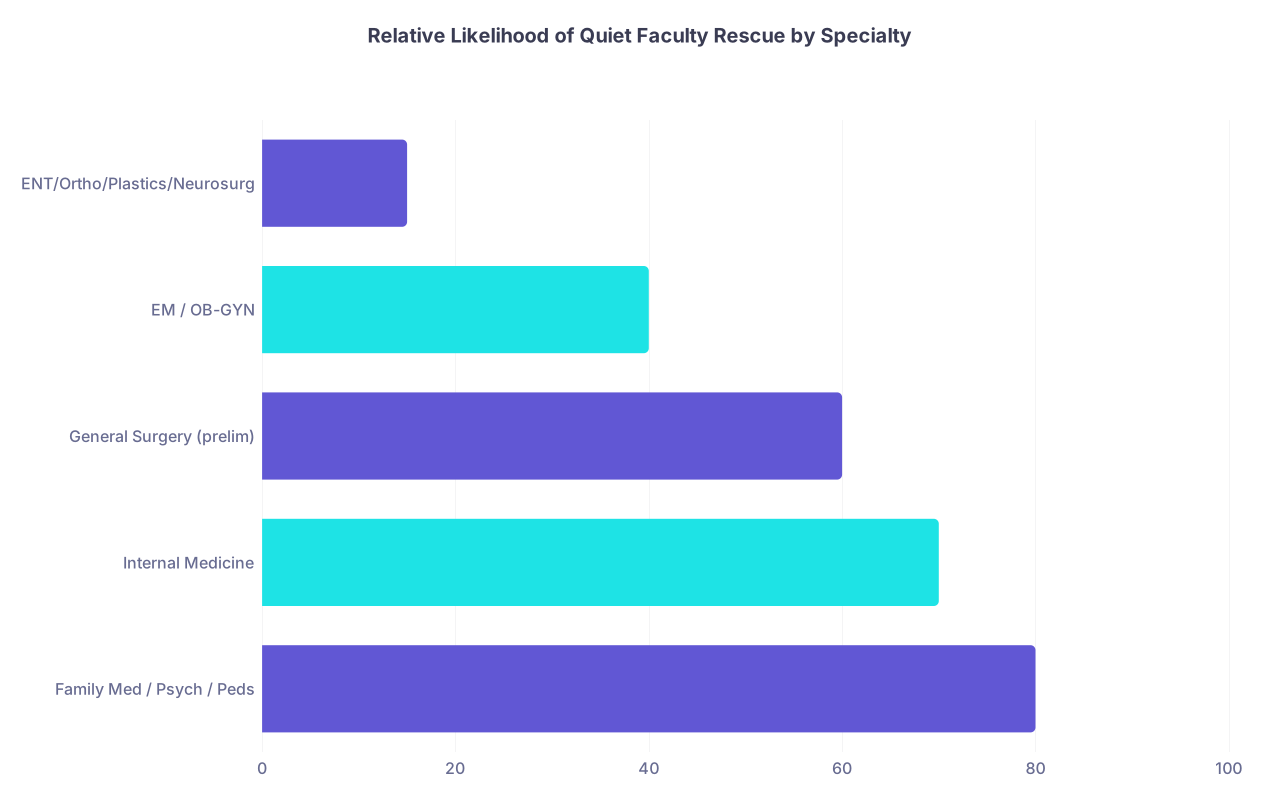
| Category | Value |
|---|---|
| Family Med / Psych / Peds | 80 |
| Internal Medicine | 70 |
| General Surgery (prelim) | 60 |
| EM / OB-GYN | 40 |
| ENT/Ortho/Plastics/Neurosurg | 15 |
Primary Care Heavy Schools
In schools where FM, IM, and Peds dominate, there’s often a semi-formal system: “We take care of our own.” Chairs know each other across state lines. They will swap names, quietly expand class sizes, or shift prelim spots to categorical with the right person.
Competitive Surgical Specialties
Here the rescue is rarer and more brutal.
A strong unmatched ortho applicant might get:
- Pushed into a research fellowship under a big-name surgeon
- Guided towards a prelim surgery spots with an “if you crush it, we’ll talk next year” promise (note: these promises are not always kept)
But many unmatched hyper-competitive applicants get told (again, quietly), “You need to think seriously about switching specialties.”
EM and Transitional Years
Rescues here are often about plugging holes:
- Programs that unexpectedly underfill
- Hospitals scrambling to maintain coverage
If a PD trusts your school and gets a call vouching for you, you might get scooped up quickly. If not, you’re just another name in a very crowded SOAP list.
The Back-Channel Stories Students Never Hear
A few composite scenarios I’ve watched unfold, with details blurred but dynamics unchanged.
Story 1: The Quiet Star Who Overreached
Strong IM-bound student. Step 2 in the 240s. Honors on wards. Loved by residents. Applied mostly to coastal academic IM programs, not enough community programs.
Didn’t match.
Within two hours of the unmatched list, the IM PD at their school had called three PD friends in the region. One had a late-opening categorical spot due to a contract issue. Interview done by Zoom on Tuesday. Verbal offer by Wednesday. SOAP was almost irrelevant.
On paper, it looked like the student “got lucky in SOAP.” Behind the scenes, it was a rescue.
Story 2: The Brilliant But Toxic Applicant
Surgical subspecialty applicant. Step scores through the roof. Researched with a big name. Residents hated working with them. Repeated nurse complaints. A documented unprofessional outburst.
Didn’t match.
There was a 10-second pause when their name came up in the dean’s meeting, then a quiet, “We’ll support their SOAP process.” No one called anyone. The chair who once championed them didn’t say a word.
From the student’s perspective, “My school abandoned me.” From the faculty’s perspective, “We’re not exporting this problem.”
Story 3: The Underrated Late Bloomer
Switched into psychiatry late. Average Step scores, no research. But every psych attending loved them. Residents described them as “the one student I’d trust on day one.”
Didn’t match (applied narrowly, a bit geographically rigid).
Psych chair called three programs where they trained, sent a personal email for each, and mentioned the student on a regional PD call. One program had been debating whether to request another position from the hospital. That nudge pushed them over the line. Position created, student rescued, announced publicly as a “late-opening slot” during SOAP.
The applicant thought it was chance. It was not.
Useful Visual: How the Rescue Path Really Flows

| Step | Description |
|---|---|
| Step 1 | Unmatched List Released |
| Step 2 | School Reviews Unmatched Students |
| Step 3 | Faculty Identify Contacts |
| Step 4 | Standard SOAP Guidance |
| Step 5 | Calls & Emails to Programs |
| Step 6 | Targeted Interview/Spot |
| Step 7 | Tier 1 Rescue-Worthy? |
| Step 8 | Program Interested? |
FAQ (Exactly 4 Questions)
1. Can I directly ask a faculty member or PD to “rescue” me if I don’t match?
You should not use the word “rescue.” But you can explicitly ask for advocacy. Something like: “If you feel you can genuinely support me, I’d be very grateful for any programs you’d be willing to contact on my behalf.” The key is: do they already trust you enough to put their name on the line? If you’ve been distant, unreliable, or transactional all year, asking won’t change much.
2. If my school is small or new, am I basically out of luck for rescue?
You’re not doomed, but the network is thinner. Chairs and PDs at newer schools simply don’t have decades of alumni in leadership positions. That means you lean harder on the few faculty who do have deep networks (often older hires from established institutions) and on building such a clean, easy-to-sell profile that even limited calls carry weight. You also need a more aggressive, realistic SOAP strategy because the informal rescue machinery is weaker.
3. How much do Step failures or low scores kill my rescue chances?
One failure or a low Step 1 with a strong Step 2 is not automatically disqualifying for rescue—if you’re otherwise rock solid and well liked. Multiple failures, or a pattern of barely scraping by, moves you into “significant risk” territory. Faculty then have to ask, “If I push for this person and they struggle, will that damage my credibility?” Many will back off at that point, regardless of how much they like you personally.
4. If I didn’t match and clearly got no rescue, how should I approach my school now?
You approach calmly, strategically, and without accusation. Ask for a frank debrief: “Where did my application fall short, and what would make me someone you’d feel comfortable strongly advocating for next time?” Then listen without defensiveness. You’re trying to learn whether your barrier is fixable (test scores, experience, specialty choice) or structural (reputation, professionalism). Only then can you decide whether to reapply, pivot specialties, or reroute your career entirely.
Key takeaways: faculty rescues after an unmatched result are real, but they’re reserved for students with prior relationship capital and low perceived risk; the real decisions are made in quiet internal triage meetings and private phone calls, not in SOAP portals; and if you want any chance of being rescued, you build that possibility long before Match Week by being the kind of person someone in power is willing to bet their reputation on.