Most attendings will lie to your face about switching specialties after the Match.
Not because they’re evil. Because there are politics, funding, and their own reputation tied up in whether you stay or go. What they say “on the record” at noon conference is not what they say about you in the chiefs’ room or the GME office.
I’m going to walk you through what actually happens when a resident starts thinking about jumping ship. The conversations in program director offices, the group texts between chiefs, and the back-channel emails between PDs at different institutions.
If you’re even half-seriously considering a specialty switch, you need to understand the terrain you’re walking into.
The Real Hierarchy of “Switch-Friendly” vs “You’re Stuck Here”
Some specialties quietly build their pipelines on “converts.” Others resent every resident who leaves.
Here’s the unspoken ranking most attendings use when they hear you want to switch:
- From surgical field → cognitive field (IM, psych, FM, path): quietly common, often supported if you’re not a disaster.
- From primary care → more competitive specialty (derm, rad onc, plastics): usually seen as fantasy unless you bring something massive (scores, research, connections).
- From one high-intensity field → another (surgery → EM, OB → anesthesia, IM → neuro): possible but politically messy.
- From anything → derm, plastics, ENT, ortho, ophtho post-Match: extremely rare unless you basically re-enter the Match with a nuclear CV and inside help.
And here’s the part no one says out loud: many PDs see your switch as either a system failure, a personal betrayal, or a budget problem. Sometimes all three.
So the advice you get will reflect how they personally categorize your situation:
“Misfit we should help” vs “Problem we should contain” vs “Asset we shouldn’t lose.”
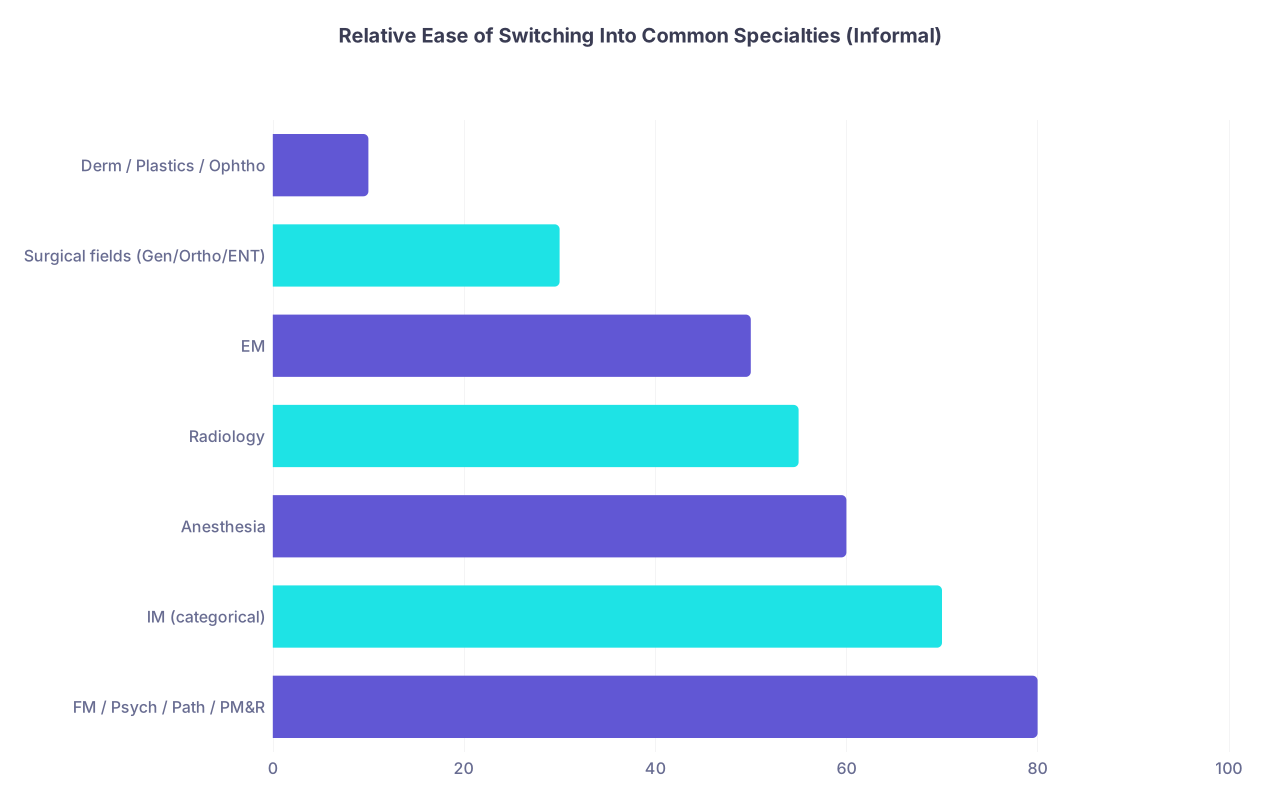
| Category | Value |
|---|---|
| FM / Psych / Path / PM&R | 80 |
| IM (categorical) | 70 |
| Anesthesia | 60 |
| Radiology | 55 |
| EM | 50 |
| Surgical fields (Gen/Ortho/ENT) | 30 |
| Derm / Plastics / Ophtho | 10 |
Those numbers aren’t official. They reflect what I’ve actually seen in chairs’ meetings and hallway conversations at mid-tier academic programs.
What Attendings Really Think When You Say “I Want to Switch”
Here’s the part you never hear: attendings are categorizing you in their head within 60 seconds of you bringing this up.
There are three archetypes we talk about privately.
1. The Burned-Out but Salvatable Resident
Classic example: PGY-1 in general surgery who’s consistently overwhelmed, hates the culture, but is clearly smart, decent with patients, and not dangerous.
Behind closed doors, your attendings say things like:
- “They’re not a surgeon. But they’d be a great internist or hospitalist.”
- “We should help them land somewhere else before they crash and burn.”
These are the residents where attendings do pick up the phone. They call the IM PD, psych PD, maybe anesthesia. They vouch. They say, “Look, they’re a solid human, just wrong fit for this specialty.”
If this is you, and your performance is average or above and you haven’t poisoned relationships, your chances of a successful switch are actually decent—if you move early enough and don’t make it a drama show.
2. The Resident Running From Accountability
These are the ones where the off-record commentary turns sharp.
Pattern:
- Multiple professionalism complaints
- Consistent lateness, charting issues, or poor follow-through
- Below-average evaluations and poor exam performance
- Now suddenly wants to “switch specialties” because they “realized their passion is actually [insert easier perceived specialty].”
What attendings actually say:
- “They’re trying to reset their reputation.”
- “I’m not passing this problem to someone else.”
- “I’ll confirm dates of training, but I’m not sugarcoating anything.”
If you’re in this category, no one’s going to sabotage you explicitly. But they aren’t going to expend political capital for you either. The “lukewarm, vague” reference is death in a tight GME market.
3. The High-Performer Outgrowing the Match
Rarer, but it happens.
Example: PGY-1 in FM with a 260+ Step 2, strong research, realizes they want rad onc or radiology and genuinely have the horsepower and academic profile.
What attendings say:
- “We’re going to lose them regardless; better help them land well.”
- “They’re overqualified for what we do here.”
- “If we help them, it reflects well on us when they succeed.”
These are the residents who can realistically re-apply to a more competitive field after a prelim year or even a partial categorical year—if they’re willing to basically start over and build a new application.
The Truth About Timing: When You Speak Up vs When You’re Screwed
There is a brutal, unwritten timeline here that matters far more than people admit.
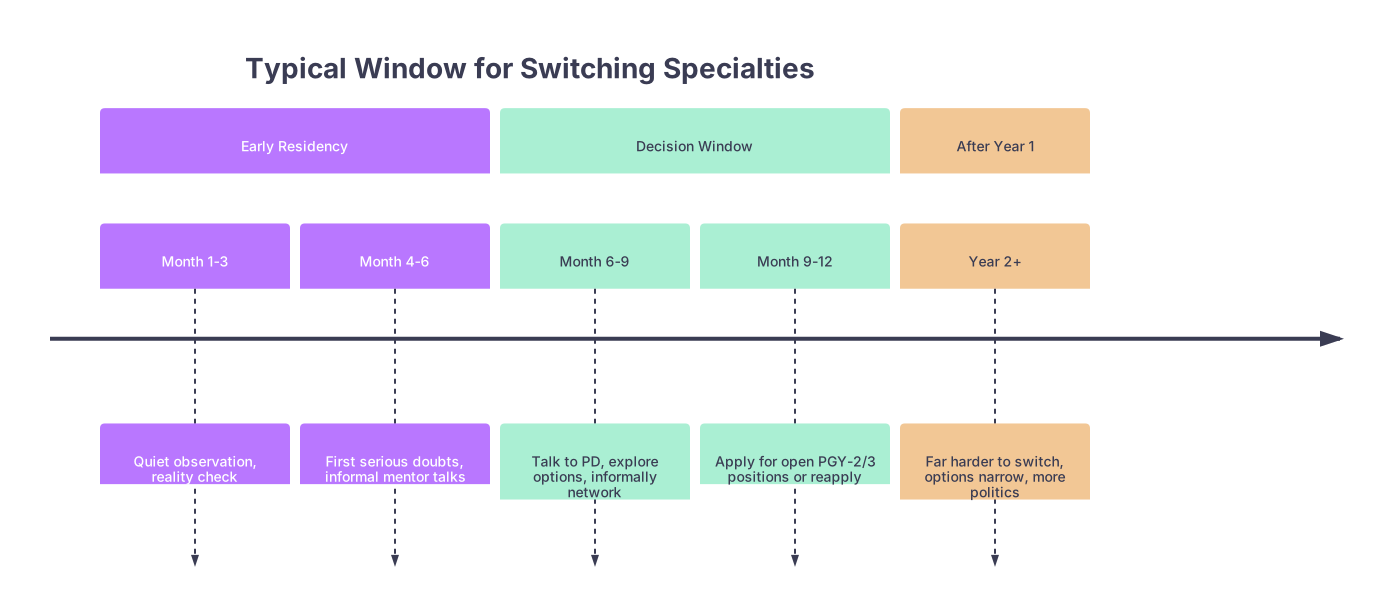
| Period | Event |
|---|---|
| Early Residency - Month 1-3 | Quiet observation, reality check |
| Early Residency - Month 4-6 | First serious doubts, informal mentor talks |
| Decision Window - Month 6-9 | Talk to PD, explore options, informally network |
| Decision Window - Month 9-12 | Apply for open PGY-2/3 positions or reapply |
| After Year 1 - Year 2+ | Far harder to switch, options narrow, more politics |
Here’s how attendings actually interpret timing:
You say something in the first 2–3 months:
They assume this might be “shock of internship.” People will say: “Let’s revisit at 6 months.” Few serious moves yet, unless it’s an absolute disaster fit.You say something 4–8 months into PGY-1:
This is the golden window for a switch. There’s still time to quietly explore available PGY-2 spots, both in-house and externally.You say something after end-of-year evaluations or after you renew your contract:
Now you’ve made it their problem. They’ve already budgeted for you. The department is counting on your FTE. The tolerance drops.
Behind the scenes, PDs talk like this:
- “If they’d come to me in December, I could have helped. Now my budget is locked.”
- “I already turned down a transfer because we thought we were full.”
The ugly version: the longer you wait, the more you look flaky rather than misaligned.
The Back-Channel Market of Open Spots (That No One Advertises Well)
Here’s something you’re not told in med school: there’s a shadow market of positions that never hit Residency Explorer or public job boards.
Attending mentors and PDs talk to each other. Constantly. Off the record.
I’ve literally been in a room where a PD said during a GME meeting: “By the way, we might have an open PGY-2 in IM if our current resident leaves; if anyone has someone good, email me directly.”
That never appears on a website. It never becomes a formal posting. It’s filled through a call, a CV, and a quick informal interview.
| Pathway | How It Really Happens |
|---|---|
| Direct PD-to-PD call | Current PD vouches for you to another PD who has (or can create) a slot |
| Internal transfer | You move to another department within the same hospital system |
| Word-of-mouth via faculty | An attending knows another program with a quiet opening |
| Public vacancy listings | SDN / Reddit / institutional vacancy lists (often outdated) |
| Re-entering the Match | Full re-application cycle, essentially starting over |
Most residents only ever see option four and five. The public, slow, painful routes. The good switches often happen via the first three.
This is where your attending mentor’s off-record opinion of you is everything.
If they say:
“I’d stake my name on this resident” — doors open.
If they say:
“They’re… fine? Some concerns about follow-through” — you’re done. PDs hear the subtext immediately.
What Strong Mentors Actually Advise (That You Rarely Hear Out Loud)
Let me spell out the advice experienced, unfiltered attendings quietly give their favorite residents who are thinking about jumping specialties.
1. Do not torch the bridge you’re standing on
Good mentors say something like: “Assume your current PD will be asked directly: ‘Would you take this resident back?’ You want the answer to be yes, even if you have zero intention of staying.”
Why? Because PDs use that question as code for:
- Are they safe?
- Are they reliable?
- Are they a pain in the ass?
If your current PD would not rehire you, that blacklists you at a shocking number of programs.
So:
- You keep showing up early.
- You do your notes.
- You help your co-interns.
- You don’t start saying “Well I’m leaving anyway, so…”
Attending mentors pick up immediately when a resident mentally checks out. And they stop advocating for them.
2. Control the narrative before someone else does
The grown-up script behind closed doors is very different from the sentimental “follow your passion” garbage you get in wellness lectures.
You want your story to sound like:
- “I realized this specialty is not a good fit for my long-term skills and interests. I’m functional here, but I won’t thrive. I want to move towards [new specialty] because [clear, believable reasons].”
You do not want it to sound like:
- “I hate this place, I hate the hours, I hate my co-residents, I thought this would be like Grey’s Anatomy.”
Mentors will tell favored residents: “Never make this about hating your current program, even if that’s true. Make it about fit, strengths, and longevity. PDs trust people who own their decisions without trashing others.”
3. Target realistic landing zones first, then dream a little
Off the record, this is how we actually game it out with residents:
You in gen surg with okay scores, no research, miserable:
Reality: IM, FM, psych, path, PM&R are all reasonable. Anesthesia or EM maybe, if you have someone willing to go to bat for you.You in FM with average scores wanting derm/ENT:
Reality: borderline fantasy unless you’re ready to fully re-apply, do legit research, and accept a real chance of ending up nowhere.
Good mentors will say it bluntly: “Switching is hard enough when you’re moving laterally. Switching up in competitiveness is a gamble. Don’t do it blind.”
How PDs Actually Talk About Residents Who Switch
You need to understand the language PDs use behind closed doors.
Here are some direct phrases I’ve heard in PD meetings, scrubbed of identifiers:
- “They realized early this wasn’t the right lane. Handled it professionally. Happy to support the move.”
- “Honestly, I think this is them trying to escape low evaluations. I wouldn’t recommend them without reservations.”
- “Clinically solid, culturally not a fit here. Might do better in a smaller community program.”
- “If they want to leave, I’m not stopping them, but I’m also not going to advocate hard.”
Every one of those sentences will decide whether your email to another program gets a polite rejection or a serious look.
The thing you never see: when you apply to another program, those PDs don’t just read your ERAS and guess. They email your current PD directly. Often informally: “Anything I should know about this resident?”
If your PD really likes you, they’ll email first: “I have a resident interested in switching into your field. Would you have time for a quick call if I send you their CV?”
That one sentence from your PD is more valuable than any tear-soaked personal statement about lifelong passion.
Internal Transfers vs External Switches: Two Very Different Games
Switching within your institution is a completely different beast than trying to jump to a new hospital.
Here’s the real difference.
Internal Transfers
When you’re trying to move from, say, surgery to IM within the same health system, everything is transparent:
- Everyone knows your reputation already.
- Your evaluations are easily visible.
- PDs talk face-to-face, not just by email.
- GME knows exactly what’s happening financially.
Very common off-record dynamic:
- Surgery PD: “This resident isn’t a surgeon, but they’re not unsafe. If IM has a spot, I’d be okay letting them go.”
- IM PD: “We have a maybe opening for next year. Let me meet them.”
Internal transfers are less about your CV and more about: Are you safe, reliable, and not a drama grenade?
If yes, internal moves are often the cleanest route.
External Switches
External moves are more brittle:
- The new PD doesn’t know you.
- They don’t see the context for your evals.
- They’re risking taking someone trained under a different system and culture.
Mentors often warn residents: “If you can solve this internally, do that first. External switches can work, but they’re slower, riskier, and more dependent on perfect timing.”
And they’re right.
The Psychological Trap: Leaving to “Escape” vs Leaving to “Build”
Behind closed doors, good mentors are watching for one thing: are you moving toward something, or just away from pain?
Residents who just want to escape misery often:
- Idealize the new specialty (“Radiology will be chill and happy, right?”)
- Underestimate the grind of restart (new intern culture, new call, more exams)
- Don’t fix the underlying problems (poor coping, disorganization, conflict patterns)
We’ve all seen the story:
- Miserable in surgery → switches to EM → 6 months later, miserable again.
That’s why the best attendings will push you hard in private: “Tell me what exactly you think will be better in [new specialty]. And what are you going to do differently this time?”
They’re not just poking holes. They’re testing whether you’ve actually thought past the fantasy.
The Quiet Risk No One Mentions: Not Matching Anywhere If You Re-Apply
Plenty of residents toy with the idea of re-entering the Match to pivot into a competitive field.
Here’s what attending mentors say off-record about that:
“If you’re going to blow up a guaranteed training pathway, you need to be damn sure you’re not doing it with a mediocre application and vibes.”
Re-applying is essentially:
- You walking away from a salaried training spot
- To compete again with med students and transitional interns
- With a personal statement that screams: “I changed my mind once, trust me this time.”
We have seen:
- People leave FM to chase derm and end up unmatched.
- Prelim surgery residents refuse categorical offers because they’re “re-applying ortho,” then never match ortho.
Those are brutal situations. And attendings are much more cautious about endorsing that path than they will ever admit in front of a full resident class.
How to Approach an Attending Mentor Without Spooking the Whole Program
Let me give you the off-record script attendings actually respond well to.
You book a one-on-one with someone who:
- Knows you clinically
- Is relatively politically safe (not the gossip queen)
- Has some clout with the PD
You say something like:
“I wanted to get your candid read on something, totally off the record for now. I’m realizing some real misalignment between my strengths and this specialty. I’m committed to doing my job well here. But I’m starting to think seriously about whether I should explore [new specialty]. I want your honest impression of whether you think that’s realistic, and how I’m perceived right now.”
That does three things:
- Signals maturity and self-awareness instead of panic.
- Reassures them you’re not about to catastrophically disengage.
- Invites real, sometimes uncomfortable feedback.
A good mentor will:
- Probe your motives
- Tell you frankly if your target is unrealistic
- Give you a sense of how PD and faculty actually see you
- Start thinking about who they could call if you decide to move
A bad mentor will:
- Hand-wave, tell you “everyone feels like this as an intern,” and brush you off.
You want the first group. Hard stop.

Financial and Contract Realities Attendings Talk About, But You Rarely Hear
Attendings will say behind closed doors: “Look, GME isn’t in the business of charity. There’s funding, visa issues, and service coverage. That’s why switching is hard, even when it’s the right thing.”
What that means for you:
Funding lines are tied to PGY years and specialties.
A PGY-2 slot in IM isn’t just a chair someone can pull up. The money is earmarked and tracked.Some programs can reclassify or reallocate funding.
Others can’t without a bureaucratic nightmare. Your fate partially depends on how flexible your institution’s GME structure is. Residents never see this; attendings do.If you’re on a visa, several PDs will quietly say:
“I would have taken them, but the visa complications made it too hard.”
None of this is about your worth as a physician. It’s raw logistics. But it hits you just the same.
The Off-Record Bottom Line
Here’s what attending mentors really say when the door is closed and the recording isn’t running:
- Switching specialties after the Match is possible. People do it every single year.
- It’s way easier if you’re seen as a fundamentally solid resident who just landed in the wrong ecosystem.
- Your current performance and attitude matter far more than your future dreams.
- Most of the “good” switches happen because a PD or senior faculty picked up the phone for you, not because you filled out some random vacancy form.

FAQs

1. When is the latest I can realistically switch specialties?
Once you’re past PGY-1, your chances drop and the politics explode. PGY-2 switches do happen, often to IM, FM, psych, or path, especially within the same institution. But by mid-PGY-2 and beyond, you’re usually talking either re-applying as a new candidate or accepting that you’ll probably finish your current residency first, then pivot via fellowship (IM → cards/onc, FM → sports, etc.).
2. Should I tell my PD early or wait until I have another offer?
If you have strong attendings who support you and your performance is solid, earlier is better. They can quietly explore openings, especially internal ones. If your relationship with leadership is already strained, you may need to lock in a concrete path (at least serious interest from another PD) before you go fully transparent. But understand: many PDs will find out via back-channel regardless.
3. Does switching specialties permanently hurt my career?
Not if it’s handled well and you land somewhere that fits. Many of the best attendings I know started in the “wrong” field. What hurts you is chaos: burning bridges, disappearing mid-year, or ping-ponging between interests every few months. If your story is: “I realized early, I owned it, I performed well while I was here, and I moved thoughtfully,” most people respect that and then never think about it again.
Two things to remember:
- Your current behavior is your most powerful reference letter. Every day you’re writing it.
- Switching is not just a personal decision; it’s a political maneuver in a system that does not advertise its rules. Learn those rules, then decide.