
Why Some Unmatched Graduates Vanish from Medicine: Avoid These Patterns
What actually happens to the unmatched classmate everyone stops talking about after March? The one who swore they would "reapply for sure," then slowly disappears from every group chat?
Let me be blunt: people do not just “vanish” from medicine by accident. There is a series of patterns—avoidable ones—that quietly push them out. If you are not careful, you will walk the same path.
This is not about blaming you for not matching. The Match is brutal, often unfair, and influenced by things you cannot control. But what happens after you do not match? That part is where I see preventable disasters over and over again.
You are here to avoid becoming another “we lost track of them” story. Good. Let us walk through the patterns that push unmatched graduates out of medicine, and what you must not do.
Pattern #1: Going Dark and Isolating Yourself
The first big mistake usually happens within 48 hours of not matching.
You feel ashamed. Humiliated. Angry. So you do what almost everyone’s first instinct is: disappear.
- Stop answering messages.
- Stop emailing advisors.
- Avoid opening ERAS or NRMP again.
- Ignore the SOAP email because just seeing it hurts.
I have seen this exact sequence lead to people missing deadlines, not reapplying, and then slowly drifting into non-clinical limbo “for a year.” That year often becomes permanent.
Why isolation is so dangerous
You miss time‑sensitive options.
SOAP, prelim spots, last‑minute off‑cycle openings, research positions—these move fast. If you vanish for two weeks, many of these doors close.Shame turns into a story in your head.
“I did not match because I am not good enough” becomes your default narrative. That story gets heavier the longer you keep it private. People quit medicine based on that internal monologue, not on reality.Your network forgets you.
Out of sight, out of mind. Faculty remember the student who keeps showing up, not the one who vanishes after graduation. When a random program director emails, “Know anyone who could fill a spot?” your name is not the one mentioned.You start rewriting your own goals to avoid the pain.
“Maybe I never really wanted clinical work anyway.” Sometimes that is true. Often it is a defense mechanism that turns into a life decision.
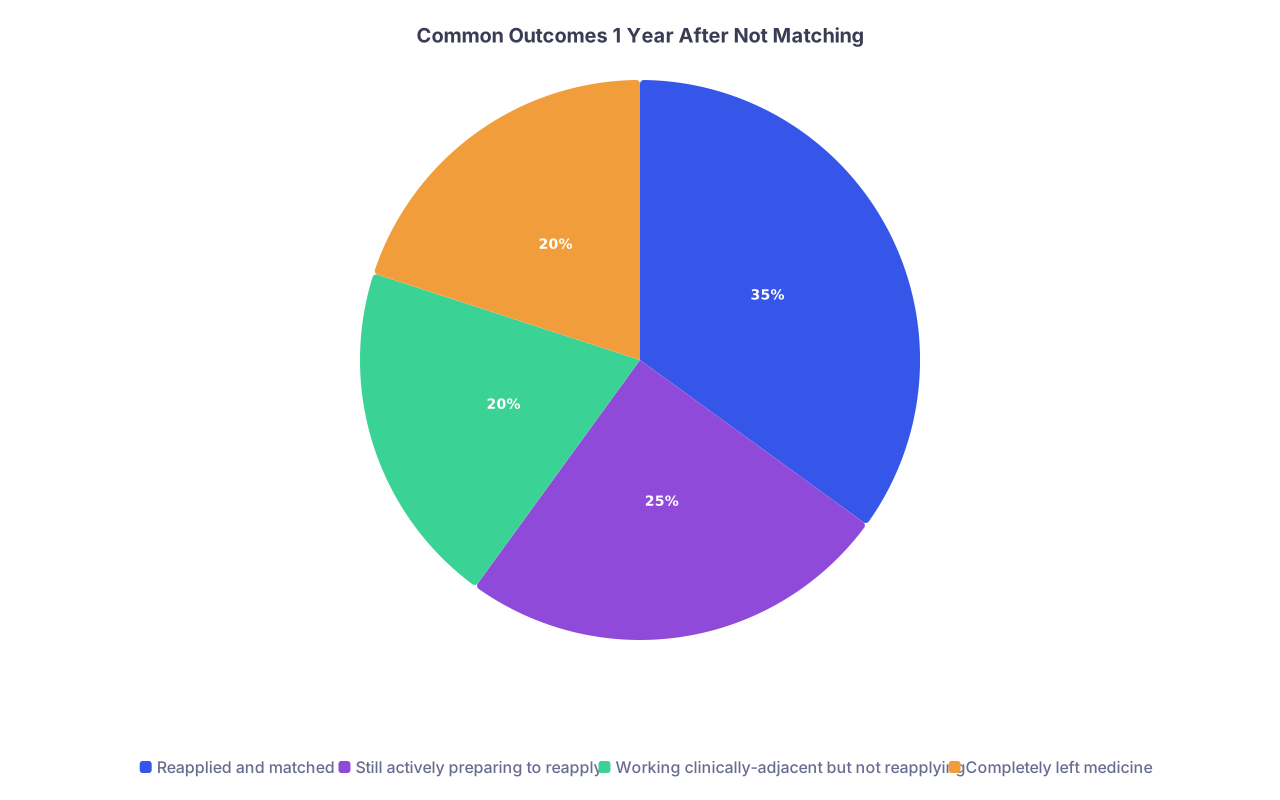
| Category | Value |
|---|---|
| Reapplied and matched | 35 |
| Still actively preparing to reapply | 25 |
| Working clinically-adjacent but not reapplying | 20 |
| Completely left medicine | 20 |
What you should do instead
You do not need to be cheerful. You do need to be reachable.
- Tell 2–3 key people: an academic advisor, a trusted attending, and a peer you respect, “I did not match. I am upset, but I want to stay in medicine. I need help planning next steps.”
- Set a rule: you are allowed to feel awful, but you are not allowed to ignore important emails.
- Schedule at least one formal meeting within 7 days with someone who can help you map out options.
Do not make the mistake of waiting until you “feel better” to engage. Action usually lifts the shame; the shame rarely lifts on its own.
Pattern #2: Treating the Next Year as a Vague “Gap Year”
The unmatched year can be the single most important year of your career. Or the year that quietly ends it.
People who vanish from medicine often describe that year with the same phrase: “I kind of just took a gap year, did some stuff, then… it just got harder to go back.”
Translation: no clear plan, no structure, no accountability.
The common “gap year” traps
I have seen versions of these too many times:
“I worked part‑time as a scribe and did a little bit of research on the side.”
No concrete output. No strong letter. No new skills. Weak story for reapplication.“I studied for Step 3 but never scheduled it.”
Endless ‘studying’ with no test date. Programs see an untested promise, not evidence of improvement.“I helped with a QI project but it never got finished.”
Half‑done projects impress no one and are easy to forget.
Unmatched graduates who drift usually:
- Do not define what “success at the end of this year” actually means.
- Do not lock in commitments with mentors who will expect deliverables.
- Do not track anything in writing—no outcomes, no deadlines, no concrete milestones.
What structured vs unstructured looks like
| Aspect | Structured Reapplicant Year | Drifting 'Gap Year' |
|---|---|---|
| Main role | Formal research/clinical position | Casual work (scribe, tutor, PRN jobs) |
| Clear supervisor | Named faculty mentor with meetings | “Kind of” supervised, no regular check-ins |
| Defined outputs | Manuscript, poster, strong LOR, exam score | Vague experience, maybe a draft |
| Exam progress | Step/COMLEX test date + completed | Studying without a scheduled test |
| Timeline | Written plan with monthly milestones | “I’ll re-evaluate later” |
If your year looks like the right-hand column, you are setting yourself up to disappear.
The fix: treat this as a recovery year, not a vacation
You need:
- A primary identity for the year: researcher, full‑time clinical fellow, dedicated Step taker with structured schedule—something program directors can understand and respect.
- Measurable outputs: exam score improvement, publications, sustained clinical experience, leadership in a meaningful project.
- A written plan: what you will have accomplished by 3 months, 6 months, 9 months.
Do not tell yourself you are “keeping options open” by staying vague. That is how options die.
Pattern #3: Refusing to Adjust Specialty Expectations (Staying Stuck on the Same Plan)
This one is brutal, but necessary: some people vanish from medicine because they tie their entire identity to one specific, competitive specialty—and will not consider anything else.
I have watched this happen with:
- Dermatology
- Plastic surgery
- Orthopedics
- ENT
- Certain elite internal medicine programs
They go through:
- Two failed application cycles to the same ultra‑competitive specialty.
- No meaningful strengthening of their application.
- Increasingly vague plans: “I’ll just get more research and reapply… again.”
At some point, they are no longer competitive for their dream field and they have aged out of realistic options for others. Time in medicine is not infinite. Visa issues, graduation year, outdated clinical experience—all of that starts to work against you.
Data reality: competitiveness is not feelings-based

| Category | Value |
|---|---|
| Community IM/FM/Peds | 20 |
| Mid-tier IM, Psych, Neuro | 40 |
| Surgical prelims, OB/GYN | 70 |
| Derm, Plastics, Ortho, ENT | 90 |
(Values here represent relative competitiveness, not exact percentages. Point is: the gap is enormous.)
Clinging to a hyper‑competitive specialty when your Step scores, class rank, or prior failures are already red flags is not persistence. It is self‑sabotage.
Common red flags that you need a strategy shift
If any of these apply, doubling down on the same specialty without major changes is dangerous:
- Failed to match twice to the same field.
- Step scores significantly below the average for that specialty.
- Weak or generic letters in that specialty.
- You are >3 years out from graduation without a categorical position.
- You are relying on “I just need someone to give me a chance” as your plan.
The people who vanish often say, “I’d rather not be a doctor than give up on [specialty].”
Many of them get their wish. Accidentally.
I am not telling you to abandon your dream lightly. I am telling you not to let one version of that dream erase the entire career you have already fought for.
Smarter pivoting vs sudden surrender
A smart adjustment might be:
- From plastics → general surgery or surgical prelim + structured plan.
- From derm → internal medicine with strong derm research focus, later pursuing fellowship options like rheum, allergy, complex med-derm collaborations.
- From ortho → PM&R with a strong musculoskeletal focus.
You can still work with similar patient populations or procedures in many cases. But you must stop pretending that infinite reapplications to the same impossible target are “dedication.” They are how people disappear.
Pattern #4: Letting Exams and Licensing Linger Unfinished
Another consistent pattern: people who never lock down their exam and licensing status.
They say:
- “I am still working on Step 3.”
- “I plan to retake Step 2 after more studying.”
- “I will schedule COMLEX later once my research slows down.”
Then “later” never comes. Programs see someone who has not closed academic loops. That is a liability.
Why unfinished exams push people out
Program directors think in risk. A candidate with incomplete exams is a candidate who might:
- Fail during residency and jeopardize board pass rates.
- Require remediation time the program does not have.
- Be unable to get a full license on schedule.
So when they see:
- Gaps of years between graduation and exams.
- Multiple failures with no visible improvement.
- Vague explanations about “testing anxiety” and no concrete remediation steps.
They pass. And pass again. And then they stop looking at your application at all.
You need a testing story that shows closure, not limbo
The difference between someone who recovers and someone who vanishes is not a perfect score. It is a clean, credible arc:
- “I failed Step 2 once. I enrolled in a formal course, worked with a tutor weekly, took 6 NBME practice tests, and improved by 20 points on my retake.”
- “My Step 1 was low, but I passed Step 3 on the first attempt while doing full‑time research, with a clear upward trend.”
The mistake is pretending that “I’ll just keep studying on my own and take it when I feel ready” is a plan. That is how 6 months turns into 2 years of nothing.
Set a date. Build a schedule. Get external accountability. Otherwise the exam becomes the excuse that quietly keeps you out of every program.
Pattern #5: Burning Bridges (or Letting Them Wither)
Unmatched graduates rarely vanish alone. They often go missing from other people’s radar first.
I have watched candidates:
- Ignore emails from faculty trying to check in.
- Ghost a PI because the project felt overwhelming.
- Fail to show up consistently for a volunteer clinical role, then stop replying.
Fast way to lose allies. And you desperately need allies.
How burned bridges show up on your application
You do not see it, but behind the scenes:
- A program director emails your school asking, “Would you support this applicant?” and the response is lukewarm.
- A previous mentor is asked informally for feedback and says something vague like, “There were some professionalism concerns.”
- A potential letter writer quietly declines to write for you.
You cannot fix all past missteps, but you can absolutely avoid adding new ones during this vulnerable period.
Minimum professionalism standard if you want to stay in medicine
- Respond to all professional emails within 48 hours, even if it is just: “Thank you, I am processing next steps and will follow up by [date].”
- If you commit to something—clinic, research, call—honor it. Or communicate early if you need to adjust.
- Treat every interaction as if the person might be asked later, “Would you take this person in your program?”
Unmatched status does not give you a pass on professionalism. It raises the bar. People are already nervous. You either ease their concern—or confirm it.
Pattern #6: Financial Freefall and Life Logistics Chaos
Here is the part almost no one talks about openly: some unmatched graduates leave medicine not because of motivation, but because of money and logistics.
You cannot live indefinitely on:
- High‑interest med school loans.
- Zero stable income.
- Family support that is already stretched thin.
I have seen people forced out because they:
- Took on random gig jobs that made it impossible to maintain clinical or research commitments.
- Moved to a city purely for a low‑pay job with no real career upside.
- Avoided budgeting and ended up in deep debt, then felt they had “no right” to spend more time chasing medicine.
Where people go wrong financially
- No written budget.
- No serious attempt to find a position that is both paid and clinically/research relevant.
- Taking on new debts (cars, big moves, lifestyle inflation) in the middle of an already unstable period.
Once financial pressure reaches a certain point, long‑term planning collapses. You go from “How do I match next year?” to “How do I pay rent this month?” That is when many quietly exit medicine and never come back.
Smarter financial moves that keep you in the game
You do not need to be wealthy. You do need to be deliberate.
- Look aggressively for paid roles in academic centers: research coordinator, clinical fellow, post‑doctoral research associate, hospitalist extender, etc.
- Live cheaply. No ego. Roommates, moving back home, smaller cities—these are tools, not failures.
- Talk to a financial counselor about loan forbearance, income‑based repayment, or any programs available to you.
Do not pretend money is irrelevant to your ability to stay in medicine. It absolutely is.
Pattern #7: Letting Time Drag On Without a Clear Narrative
Program directors care a lot about timeline.
When they see:
- Grad year: 2020
- Current application: 2026
- No residency. No clear story.
They assume there is a problem. Fair or not.
The unmatched graduates who vanish tend to accumulate unstructured years like this:
- Year 1: “I was figuring things out.”
- Year 2: “I did some research here and there.”
- Year 3: “I worked outside medicine while deciding.”
By Year 4, they are essentially an outsider to the profession they trained for.
You need a clean story for every year
If you are more than 1–2 years out from graduation, your application should make it brutally clear:
- Where you were.
- What you did.
- What concrete outputs came from it.
- How it made you a stronger candidate now.
If you cannot write 3–4 tight sentences about each year that sound intentional and coherent, you have a problem.

| Step | Description |
|---|---|
| Step 1 | Did Not Match |
| Step 2 | Structured Recovery Year |
| Step 3 | Isolation & Drifting |
| Step 4 | Competitive Reapplication |
| Step 5 | Repeat Failure Risk |
| Step 6 | Financial/Exam/Timeline Problems |
| Step 7 | Leaves Medicine or Stuck Long-term |
| Step 8 | Engage Immediately? |
| Step 9 | Adjust Strategy? |
The people who stay in medicine are not necessarily the luckiest or smartest. They are the ones who refused to let their story become “I just sort of drifted.”
Pattern #8: Letting Identity Collapse Instead of Rebuilding It
Final pattern, and it might be the most subtle.
For many unmatched graduates, medicine was not just a career path. It was their identity. The thing their family bragged about. The story they told themselves for a decade.
When the Match says “No,” some people interpret it as “You are not who you thought you were.”
What happens next?
- Some overcorrect: “I guess I was never meant to be a doctor.”
- Others freeze: they do nothing, because any step feels like admitting they failed.
Over time, the discomfort of staying close to medicine (seeing classmates in residency, hearing about successful matches) becomes so painful that it feels easier to cut ties completely.
So they vanish. Not because they had no options. Because staying engaged hurt too much.
You must separate “not matched” from “not a physician”
You are not your NRMP result. You are not your Step score.
But here is the catch: you have to act like that is true before anyone else can.
The people who stay in medicine after not matching usually:
- Keep showing up to conferences, grand rounds, journal clubs.
- Introduce themselves as “a physician working in research / exam prep / clinical fellowships” rather than “an unmatched grad.”
- Talk about their path as a work in progress, not a post‑mortem.
This is not delusion. It is refusing to let a broken system decide you are done.
What To Do Now: Protect Yourself From Vanishing
You do not need a perfect plan today. You do need to avoid the patterns that quietly erase unmatched graduates from the profession.
If you remember nothing else, keep these in front of you:
Do not disappear.
Stay reachable, stay in contact with mentors, and do not let shame push you into isolation where deadlines and opportunities go to die.Give the next 12–24 months a clear structure and story.
No vague “gap year.” Choose a primary role, pursue measurable outputs, and close your exam/licensing loops.Be flexible on how you practice medicine, not whether you belong in it.
Adjust specialty, strategy, or location if needed—but do not quietly walk away because one path closed.
You have already done the hard part: you made it through medical school. Do not let a combination of drifting, silence, and unexamined pride quietly cancel everything you worked for.