
The way most people use a “research year” is a waste of time and tuition money. Used correctly, that same year can turn a borderline application into one that gets real attention on rank lists.
You are not taking “time off.” You are buying twelve months of opportunity. The question is whether you treat it like a gap year vacation or like a one‑year startup where the product is your future Match.
This is the manual for the second option.
Step 1: Get brutally clear on what your research year must accomplish
A research year is not a generic “good for residency” badge. It has to fix specific weaknesses and amplify specific strengths. Anything else is noise.
Start by defining your problem in one sentence. Something like:
- “I want competitive dermatology but my Step 2 is 236 and I have no pubs.”
- “I failed Step 1, passed on second attempt, and want to match IM at a solid academic program.”
- “I’m an IMG with zero U.S. experience aiming for internal medicine.”
Your research year must then serve 3 concrete goals:
- Repair or reframe red flags
- Low scores, failed attempts, lack of home program, late specialty switch.
- Create undeniable academic output
- Publications, posters, abstracts, letters, presentations.
- Embed you in a network that matters
- Faculty who pick up the phone. Chairs who email PDs. Residents who vouch for you.
If a potential research position does not clearly help you with at least two of those, you pass. Even if the project sounds “cool.”
Quick diagnostic: What do you need most?
Look at your current profile honestly and rank your deficits:
- Objective metrics (Step 2 / COMLEX 2, clerkship grades)
- Specialty‑specific exposure (no rotation, late switch)
- Academic productivity (zero pubs vs. scattered case reports)
- Relationships (no mentors in your desired specialty)
- Geographic ties (you want to match in a region where no one knows you)
That ranking should drive how you select and structure the year.
Step 2: Choose the right kind of research position (not just the first one offered)
The worst mistake I see: students grabbing any research year that appears, then realizing in January it has almost zero impact on their application.
You want leverage. That comes from environment, mentor, and output potential.
A. Assess the environment: where you sit matters
You want to be physically and socially embedded in the department that owns your specialty.
- Aspiring ortho? You sit in the ortho department, not basic science across campus.
- Aspiring cards? You sit on the cardiology service or research office, not generic epidemiology.
Ask directly:
- “Where is this position based—within the clinical department or a separate research center?”
- “How often do research assistants interact with attendings and residents?”
- “Do your research fellows usually rotate clinically with the team?”
Red flags:
- You are essentially a data monkey in a basement with no contact with the department.
- No structured way for you to join clinics, conferences, or rotations.
- Prior students from that position have weak match outcomes or shifted out of your specialty.
B. Evaluate the mentor: name and behavior both matter
You need two things:
- A visible name in the specialty or at least in the region.
- A producer—someone who actually publishes and supports trainees.
How to assess quickly:
Search them on PubMed. Look for:
- Recent activity (last 1–2 years)
- First/last author papers
- Trainees (med students, residents) in authorship positions
Ask current or former students:
- “How often did you meet one‑on‑one?”
- “Did projects actually get published or die in draft hell?”
- “Did they write you a strong letter or make calls for you?”
If you cannot find prior med students or residents who’ve worked with them and matched successfully, you are gambling.
C. Prioritize project types that actually produce on a 12‑month clock
Some project types are terrible for a one‑year timeline. Others are perfect.
| Project Type | Time to Output | Match Utility |
|---|---|---|
| Retrospective chart review | Short–Medium | High |
| Case series / case reports | Short | Medium |
| Systematic review/meta-analysis | Medium–Long | Medium–High |
| Prospective clinical trial | Long | Low (for 1 year) |
| Basic science bench work | Long | Low–Medium |
For a pure match‑boosting year, you bias strongly toward:
- Retrospective studies
- Quality improvement with publishable endpoints
- Case series
- Meta‑analyses with clear timelines and division of labor
You avoid being the junior person on a huge R01‑level trial that will publish in 2028.
Step 3: Build a 12‑month plan that back‑calculates from ERAS deadlines
If you treat the year as “July to June,” you are already doing it wrong. ERAS and interview season cut that year in half.
Think in three phases, anchored to ERAS:
Phase 1: Front‑load (Months 0–3)
Goal: Get on as many fast‑moving, realistic projects as possible.Phase 2: Convert to visible products (Months 3–9)
Goal: Submissions, abstracts, posters, early acceptances.Phase 3: Leverage during application and interviews (Months 9–12)
Goal: Use your work to get letters, calls, and talking points.
A. Draft your personal Gantt chart
Do this on day 1. Not as a fantasy. As a constraint.
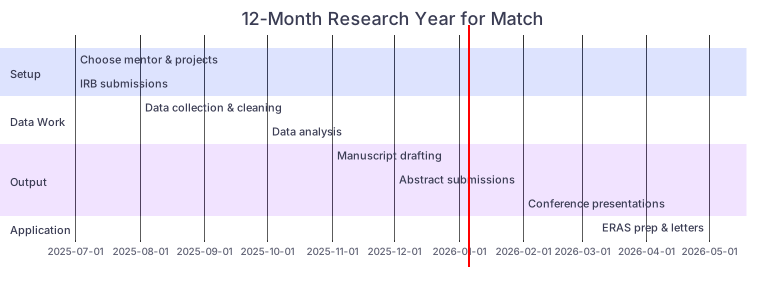
| Task | Details |
|---|---|
| Setup: Choose mentor & projects | a1, 2025-07, 1m |
| Setup: IRB submissions | a2, after a1, 1m |
| Data Work: Data collection & cleaning | b1, 2025-08, 4m |
| Data Work: Data analysis | b2, 2025-10, 2m |
| Output: Manuscript drafting | c1, 2025-11, 3m |
| Output: Abstract submissions | c2, 2025-12, 2m |
| Output: Conference presentations | c3, 2026-02, 4m |
| Application: ERAS prep & letters | d1, 2026-05, 3m |
Adjust dates to your reality, but keep the logic:
- You want at least 1–2 manuscripts submitted before ERAS opens.
- You want abstracts accepted for a regional or national meeting by interview season.
- You want your letters from research mentors drafted by late summer.
B. Weekly structure that prevents the “busy but nothing done” trap
If you just “show up and help,” you will be busy and strangely unproductive. You need protected project time.
A workable weekly template:
- 2 days: Deep work on your primary project (analysis, manuscript writing).
- 1 day: Secondary projects (case reports, reviews; things that finish faster).
- 1 day: Department engagement (grand rounds, journal club, clinic).
- 1 day: Application prep / Step 2 (if still pending) / admin.
The rule: Every week, you move at least two projects forward in a visible way. That may be:
- Finalizing a figure
- Sending a draft section to your mentor
- Submitting an abstract
- Extracting data for a case series
You track this. Yes, like a slightly obsessive person.
Step 4: Design your research portfolio like a diversified investment
You are not doing “one big project.” That is how smart students end up with a single “manuscript in preparation” bullet on ERAS.
You want a portfolio:
- 1–2 medium‑sized, higher‑impact projects where you are 1st or 2nd author.
- 2–4 smaller, fast projects (cases, small series) that actually publish.
- 1 review or meta‑analysis that shows depth in the field.
Think of it as risk management.
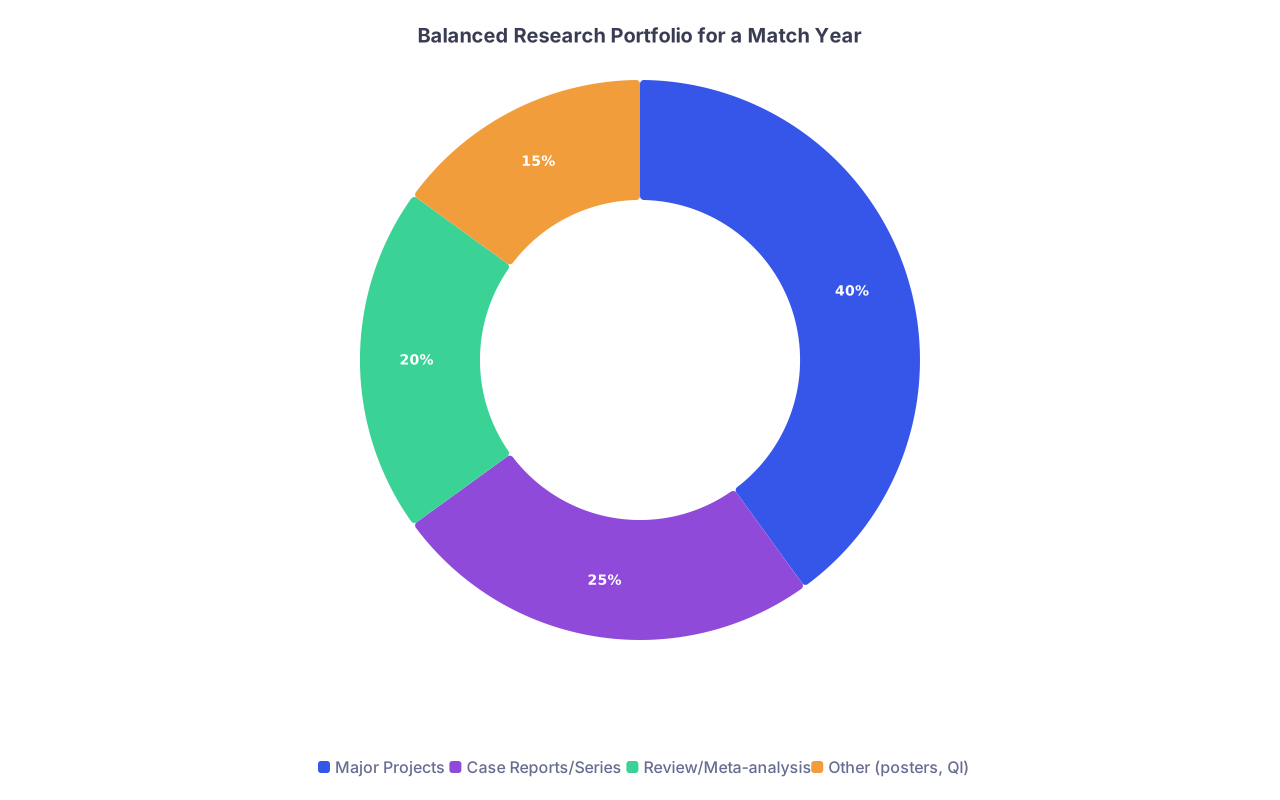
| Category | Value |
|---|---|
| Major Projects | 40 |
| Case Reports/Series | 25 |
| Review/Meta-analysis | 20 |
| Other (posters, QI) | 15 |
A. Get your name near the front
Being 7th author on 3 papers is better than nothing, but it will not rescue a weak application. You want at least one first‑author work if at all possible.
How to negotiate that:
- “Is there a project where I could take the lead on the manuscript if I handle the bulk of the data and drafting?”
- “If I start a new retrospective project under your guidance, would I be first author if I drive it?”
Most attendings will say yes if they believe you are serious and organized.
B. Use case reports and series for quick wins
They are not glamorous. They are also:
- Fast (weeks to a few months).
- Good for teaching you the mechanics of submission and revision.
- Easy ways to show specialty‑specific interest.
Every time you see an odd case, complication, or classic but visually striking presentation, think:
- Does this fill a gap (rare association, novel imaging, unusual complication)?
- Is there an attending interested in writing it up with me?
Set a hard ceiling: do not let case reports consume more than 25–30% of your time. They are side dishes, not the main course.
Step 5: Turn passive presence into active visibility in the department
If your plan is “do good work and hope someone notices,” you will be invisible. You must deliberately become “that student who is always at X and does Y.”
A. Show up where the decision‑makers are
Minimum commitments:
- Grand rounds weekly. Ask 1–2 intelligent questions per month. Not every week.
- Journal club regularly. Volunteer to present at least once.
- Resident didactics when appropriate, especially if they are open to students.
- Clinic or OR with your mentor at least twice monthly if your visa/school rules allow clinical involvement.
You are not just learning. You are becoming familiar: face, name, work ethic.
B. Ask for real responsibility
Most faculty underestimate what a motivated research fellow can do. You need to push the boundary a bit.
Examples:
- “Could I present our preliminary data at the next division meeting?”
- “If I put together a draft protocol for a small QI project, would you review it?”
- “Can I coordinate data collection across the three sites for this project?”
When you step up and then actually deliver, two things happen:
- They trust you with better projects.
- They start thinking of you when they hear about positions or rotations.
Step 6: Engineer letters of recommendation that actually move your application
A generic “worked with us on research and did fine” letter is useless. You want specific, story‑driven letters from people with names that mean something in your specialty or region.
A. Choose your letter writers early
Aim for:
- 1–2 core research mentors within the specialty.
- 1 clinically oriented attending who has seen you interact with patients (if possible).
- 1 department leader (vice chair, program director, division chief) who knows you well enough.
By month 4–5, you should already have these targets in mind.
B. Give them material to write from
Do not just ask, “Can you write me a strong letter?” and hope.
Provide:
- A 1‑page summary of:
- Projects you worked on with them.
- Specific tasks you owned (data, writing, presentations).
- Outcomes (submitted, accepted, presented where).
- A brief note on:
- Your target specialty.
- Programs or regions you care about.
- Any red flags you want reframed (low scores, non‑trad path).
You want them to be able to write things like:
- “She independently designed and executed a multicenter chart review…”
- “He took initiative to lead our journal club and presented complex data clearly…”
Those phrases only appear if you gave them concrete examples.
Step 7: Use the research year to strategically fix red flags
If you are doing a research year, there is usually a story. Low scores. Step failure. Late switch. IMG. That story can either sink you or become the setup for a redemption arc.
A. Low Step / COMLEX scores
You cannot erase numbers. You can overpower them with evidence that you are now a different caliber of trainee.
Focus on:
- High‑quality letters that explicitly comment on your knowledge, reliability, and work ethic.
- Demonstrated mastery: taking the lead on data analysis, presenting at conferences, teaching others.
- If Step 2 or COMLEX 2 is still pending:
- Use the first 3–4 months of your research year with structured dedicated time to crush it.
- Then your narrative becomes: “Yes, Step 1 was weak. Then I refocused and my Step 2 and research year show that pivot.”
B. Failed Step attempt
You do not hide this. You frame it.
In your personal statement and interviews:
- Acknowledge briefly and without excuses.
- Emphasize concrete changes in behavior (study strategies, time management, using faculty feedback).
- Point to your research year as evidence that you can handle complex, long‑term projects and follow through.
Your research mentor’s letter should ideally echo: “This person is nothing like their early exam misstep suggests.”
C. IMG or DO aiming for competitive programs
Research years are oxygen here. But not any research—U.S.‑based, specialty‑specific, name‑recognizable work.
You must:
- Work with at least one attending who is known in the specialty or at least in that geographic region.
- Be present enough that they are comfortable emailing or calling PDs: “You should look at this applicant.”
- Secure at least one U.S. clinical experience or observership attached to that year if possible.
Step 8: Convert research into ERAS entries that scream “fit for this specialty”
A common fail: students list research by raw output, which reads as scattered and unfocused. You want your ERAS to tell a coherent story.
A. Group and name your experiences strategically
In the “Experiences” section, instead of random listings like:
- “Research assistant – Department of Medicine”
- “Research assistant – Quality Improvement”
Use titles that telegraph specialty and responsibility:
- “Research fellow – Cardiovascular Outcomes, Cardiology Division”
- “Clinical research coordinator – Spine Surgery Outcomes”
Bullet points should be:
- Outcome‑driven: “Co‑authored 2 manuscripts (1 submitted, 1 in revision) on X.”
- Responsibility‑specific: “Led data extraction and analysis for Y.”
- Specialty‑linked: “Focused on postoperative complications in total joint arthroplasty.”
B. Present your scholarly output with intent
Do not bury your first‑author paper on page two.
If you have:
- 1–2 first‑author manuscripts
- Several abstracts / posters
- A review
Make that obvious in your ordering and descriptions. Highlight “first author” explicitly. Program directors skim; make the important things skim‑proof.
Step 9: Talk about your research year in interviews like a closer, not a tourist
You will be asked: “Tell me about your research year” or “Why did you take a year off?” Your answer cannot sound like “I was unsure of my path” or “I just wanted to explore.”
You want a clean, three‑part frame:
- Why you did it
- “I knew I wanted to be in academic [specialty], but my application lacked depth in research and strong specialty‑specific mentorship.”
- What you actually did
- Concrete numbers: projects, publications, presentations, responsibility.
- How it changes what kind of resident you will be
- “This year taught me how to manage long‑term projects, work across disciplines, and critically appraise literature, which I bring directly to residency.”
Avoid getting lost in technical details unless they ask. You are not defending a PhD. You are showing judgment, work ethic, and fit.
Step 10: Do not let the year quietly wreck your clinical skills or test performance
Research years have two hidden risks:
- Clinical atrophy (you lose speed and comfort on the wards).
- Academic complacency (you forget how to study for standardized tests).
You address both deliberately.
A. Keep your clinical muscle alive
Options:
- Regularly attend clinic or OR with your mentors.
- Volunteer for student‑run clinics if allowed.
- Do a short sub‑internship or elective halfway through the year if your school permits.
Bare minimum: keep reading clinically relevant material weekly and present at case conferences if offered.
B. Protect Step 2 / COMLEX 2 and shelf‑style thinking
If you still have exams to take:
- Block 8–10 weeks early in the research year with reduced research hours.
- Be honest with your mentor: “I need this window to get a strong score; it will help the department too when I match well.”
- After exams, ramp research back up. Now you have a strong test score plus research.
If all exams are done, still:
- Read journals in your specialty.
- Use your data work to reinforce pathophys and guideline‑based management. Talk about it in that language.
Step 11: Measure your progress like a project manager, not a passenger
If by month 5 you have:
- No abstracts submitted.
- No draft manuscripts started.
- No one in the department who knows you by name.
You are in trouble. The fix is not “work harder.” It is “change the system.”
Have a simple tracking sheet with:
- Each project, your role, mentor, start date.
- Milestones: IRB, data complete, analysis complete, draft, submitted, accepted.
- Target completion dates.
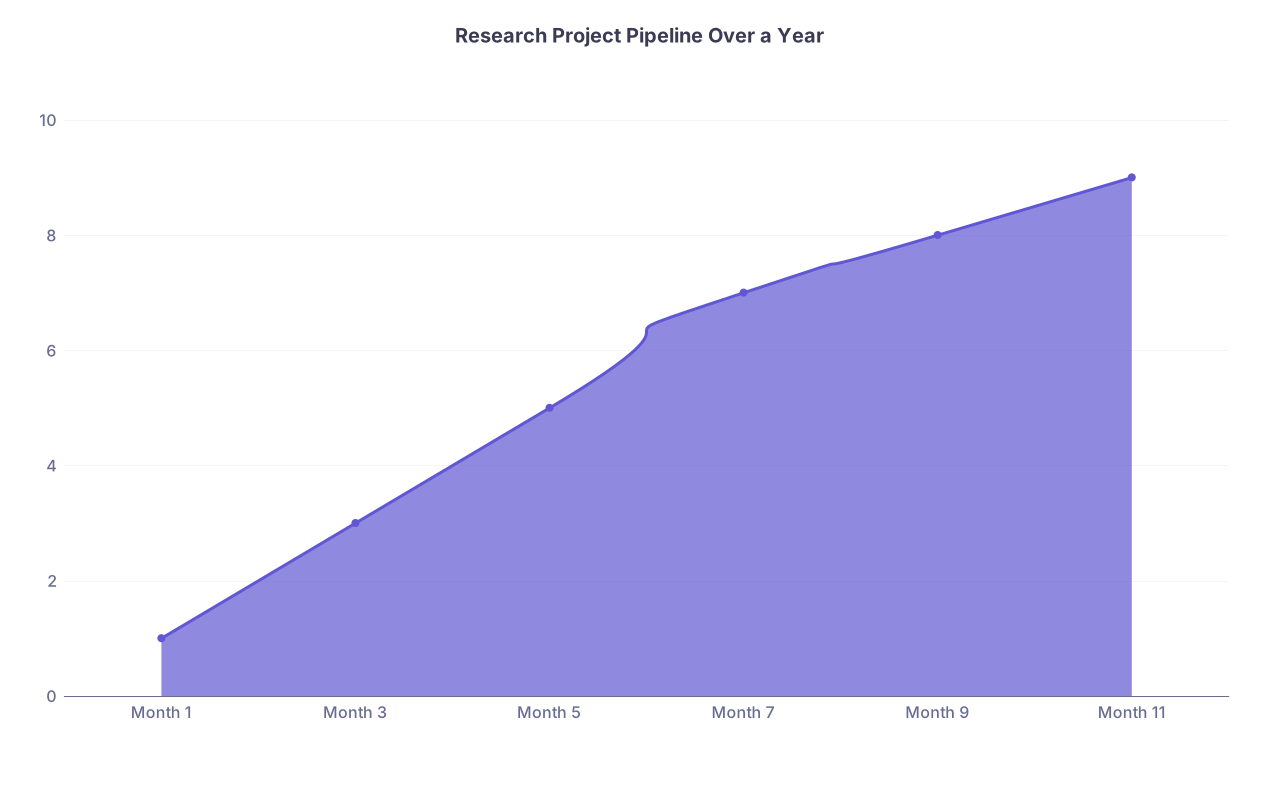
| Category | Value |
|---|---|
| Month 1 | 1 |
| Month 3 | 3 |
| Month 5 | 5 |
| Month 7 | 7 |
| Month 9 | 8 |
| Month 11 | 9 |
If the curve is flat for 2 months:
- Meet with your mentor.
- Ask: “Where can I add value to move something over the finish line?”
- Offer to take over stalled manuscripts or neglected data analysis.
Good mentors will hand you stuck projects. Bad mentors will keep you stuck; then you seriously consider aligning with another faculty member while remaining polite.
Step 12: Align your research year with your long‑term career, not just the Match
Yes, this is about getting you into residency. But a smart research year also sets you up for fellowship and academic credibility.
You can:
- Target projects that line up with likely fellowship interests (heart failure, surgical oncology, epilepsy).
- Build early collaborations with fellows who will become faculty and co‑authors later.
- Learn skills that will keep paying dividends:
- Basic stats in R or SPSS.
- How to respond to reviewer comments.
- How to run REDCap or similar databases.
Your future self as a PGY‑2 or fellow will be very happy you did not spend the year copying data into Excel and nothing else.
If you are starting late or stuck halfway through
Many students realize in January or February: “I have been busy all year and have almost nothing to show.”
Do not panic. You still have moves.
Rapid salvage protocol (Month 6+)
Audit all current projects
- Which are <4 weeks from being submittable if someone just grinds?
-
- “Can I take over finalizing the figures and drafting the results?”
- Offer to be 2nd or 3rd author; you need finished products now more than first‑author status later.
Initiate 1–2 ultra‑fast projects
- Case reports or small series from already seen patients.
- Short retrospective analyses where data are already collected.
Schedule one honest meeting with your main mentor
- Show your target ERAS timeline.
- Ask directly: “What can we get submitted before August, and what do I need to do to make that happen?”
Most faculty respond well to a clear, motivated plan.
Key points to walk away with
- A research year only boosts your Match if you treat it as a focused, time‑limited operation to fix specific weaknesses and create visible, specialty‑aligned output.
- The combination that moves programs is: strong, concrete productivity (especially first/second‑author work), deep engagement with the department, and targeted letters from people whose names carry weight.
- You must manage the year like a project manager—tracking progress, adjusting course early, and using every phase (pre‑ERAS, ERAS, interviews) to convert that work into real application strength, not just a long “research year” line on your CV.