
How to Systematically Deconstruct a Failed Match and Rebuild Stronger
You did not just “get unlucky.” If you failed to match, there are specific, fixable reasons—and you need to treat this like a root-cause analysis, not a tragedy.
I have yet to meet an unmatched applicant who did a cold, systematic postmortem on their cycle without coming away with a clear action plan and a significantly stronger application the next year. The problem is most people either spiral emotionally or rush into random “fixes” (another research year, a prelim spot anywhere, a last-minute SOAP scramble) without understanding what actually went wrong.
Let us not do that.
You are going to:
- Tear your last application cycle apart—piece by piece.
- Identify the actual failure points.
- Choose a realistic, data-driven path forward.
- Execute a concrete 12-month rebuild plan.
This is repairable. But only if you stop guessing.
Step 1: Stabilize and Set Your Time Horizon
Before you analyze anything, you need two decisions:
- Am I willing to reapply?
- If yes, in how many years—this coming cycle or later?
You cannot plan without a time horizon. So:
- If you are emotionally raw this week, fine. Take 72 hours. Sleep, talk to people who actually understand the process (not your random cousin with opinions), and stop doom-scrolling Reddit.
- Then set a decision deadline: “By [date 2–3 weeks from now], I will decide if I am reapplying and for what year.”
You have three basic paths:
| Path | Time to Next Match | Typical Use Case |
|---|---|---|
| Immediate Reapply Next Cycle | 12 months | Solid stats, minor gaps, fixable issues |
| Delay 1–2 Years | 24–36 months | Major red flags, need big improvements |
| Pivot Out of Clinical Path | Indefinite | Multiple failed cycles, no realistic fit |
For now, assume you will reapply at least once. You can always pivot later if the data say so.
Step 2: Build a Brutally Honest Application Autopsy
You cannot fix what you do not accurately see.
You are going to reconstruct your entire cycle in a format you can analyze—not vague impressions, actual data. Set aside one uninterrupted block of 2–3 hours. No phone. No email. Just you and the evidence.
2.1 Collect the raw materials
Gather:
- ERAS application (final submitted version)
- Every personal statement you used
- All MSPE/dean’s letter and transcript
- USMLE/COMLEX score reports (including fails, retakes)
- List of every program you applied to
- Interview invites vs no response vs rejections
- Any written feedback from mentors, PDs, faculty
- Your rank list (if you had one) and interview log
Now you are going to systematize this instead of staring at the pain.
2.2 Create your Match Cycle Summary Sheet
Open a spreadsheet or a document and build a high-level summary:
- Specialty (and if applied to more than one)
- Number of programs applied to per specialty
- Programs by tier (community vs academic vs top tier)
- Number of interviews offered vs accepted vs attended
- SOAP participation and outcomes (if applicable)
- USMLE / COMLEX scores
- Step 1: ___ (Pass/Fail + any failures)
- Step 2 CK: ___
- Step 3 (if taken): ___
- Red flags
- Exam failures
- Course/clerkship failures or repeats
- Gaps in training
- Unprofessionalism issues / leaves of absence
You want something that looks blunt and undeniable.
Step 3: Diagnose Your Failure Domain(s)
Unmatched is a symptom. You need to find the primary failure domains. For most, it is a combination of these:
- Insufficient interview volume
- Weak interview performance
- Unrealistic specialty choice or program list
- Objective metric deficits (scores, grades, fails)
- Weak or generic letters / lack of specialty-specific advocacy
- Poor narrative / PS / ERAS content
- Red flags not addressed or poorly framed
You are going to walk through each domain and place yourself—honestly.
3.1 Interview volume: Did you even get a shot?
Use this rule of thumb for a first-pass assessment:
| Competitiveness Category | Solid Chance to Match | Danger Zone |
|---|---|---|
| Less Competitive (FM, Psych, Peds, IM community) | ≥10–12 interviews | <8 interviews |
| Mid (IM academic, OB/GYN, Anesthesia) | ≥12–15 | <10 |
| Highly Competitive (Derm, Ortho, ENT, Plastics) | ≥15–18+ | <12 |
- If you were below the danger zone: your problem is primarily front-end (application, scores, letters, specialty, program list).
- If you were within or above those numbers and still did not match: your problem is mostly interview performance, rank strategy, or major red flags.
That alone dramatically narrows what you need to fix.
3.2 Specialty choice and program list realism
Ask these three questions:
- How do my scores and academic record compare to the median matched applicant in my chosen specialty?
- Did I apply to enough safety programs (community, less competitive locations)?
- Did my clinical experiences and letters convincingly support that specialty?
Example: You applied to dermatology with Step 2 CK 234, one derm letter, and no derm research. That is not “bad luck”. That is denial.
Find the NRMP Charting Outcomes (or the equivalent updated data) for your specialty. If you are significantly below the median in multiple areas and did not have compensating strengths, you chose an unrealistic target or you needed a much more aggressive backup strategy.
3.3 Objective metrics: scores and failures
Be blunt:
- Any Step/COMLEX failure is a major drag.
- A low Step 2 CK (for many core specialties < 220–225 for IM/FM, < 230–235 for anesthesia/OB, and higher for surgical subs) puts you at a disadvantage unless something else is outstanding.
- Multiple course or clerkship failures are another red flag.
You do not fix these with “a stronger personal statement.” You fix them with:
- Strong late metrics (Step 3, in-training exams)
- A super tight recent clinical performance record
- Heavy advocacy letters from reputable people who explicitly state they would rank you highly
Write down, in one sentence, your score narrative:
- “Step 1 fail, Step 2 226, no Step 3.”
- “Step 1 P, Step 2 252, no failures, strong improvement.”
- “Two shelf failures, remediated; Step 2 232, Step 3 220.”
You need to know exactly what programs are seeing.
Step 4: Forensic Review of Application Content
Now shift from numbers to narrative. Your ERAS and personal statement can quietly kill you even with decent stats.
4.1 Personal statement: Does it actually do anything?
Print your main personal statement. Read it with a pen in hand. Then ask:
- Could this PS belong to any applicant in your specialty?
- Does it contain specific, verifiable details (rotations, patient stories, mentors, projects)?
- Do you clearly state:
- Why this specialty?
- What you bring that is useful to programs?
- What you want in training (in a realistic, grounded way)?
Common failure patterns I see:
- Generic “I have always wanted to help people” fluff.
- Trauma autobiography with no professional integration.
- Over-selling research interest when your track record is thin.
- Ignoring or hiding obvious red flags instead of framing them.
If a faculty member who knows you well would say, “This does not sound like you,” then it failed.
4.2 ERAS experiences: Were they strategic or just a list?
Your experiences section should look like a curated argument for “I would be a strong resident in X specialty,” not a life resume.
Scan your entries:
- Are your 3–5 most meaningful experiences tightly connected to your specialty or to core traits of a good resident (ownership, reliability, teamwork, grit)?
- Do you use vague verbs (“helped with”, “exposed to”) instead of action verbs with outcomes (“designed”, “implemented”, “led”, “completed”)?
- Do you highlight recency? Programs care far more about what you did in the last 2–3 years.
If half your entries read like this: “I shadowed Dr. X and learned the importance of empathy,” you wasted space.
4.3 Letters of recommendation: Who actually went to bat for you?
You probably do not know exactly what they wrote, but you can infer:
- Did the letter writer supervise you directly and recently?
- Do they know your chosen specialty and what programs look for?
- Did any PD or chair explicitly tell you, “I will support your application strongly”?
Weak letters sound “nice” but are noncommittal. Helpful letters carry advocacy.
You need to list:
- Writer name, role, specialty
- How well they know you (1–10)
- Specialty alignment (Y/N)
- Strength (your best guess): weak / neutral / strong / champion
If you do not have at least 2 letters that are both:
- In your target specialty (or directly relevant) and
- From people who actually know your work well
—you were likely at a disadvantage.
Step 5: Interview and Ranking Performance
If you had a normal or high interview count and still did not match, this section is your main rehab project.
5.1 Interview self-audit
Write down every program that interviewed you and rank them in three ways:
- How you felt the interview went: poor / average / strong
- How much genuine specialty/program insight you displayed
- Whether you had a clear, confident answer to:
- “Why this specialty?”
- “Why this program?”
- “Tell me about yourself.”
- “Explain [red flag]?”
If you struggled with:
- Behavioral questions (“Tell me about a time you made a mistake”)
- Gaps/failures explanations
- “Any questions for us?” (and you asked weak or generic ones)
—then your interview skills probably cost you ranks.
5.2 Rank list realism
Another hard question: Did you create a realistic rank list?
Patterns that worry me:
- Ranking only a small subset of “dream” programs high and pushing solid, but less prestigious, programs lower.
- Applying broad but interviewing selectively because some programs felt “beneath you.”
- Under-ranking community programs when your application profile fit them best.
If you ranked fewer than 10–12 programs in many core specialties, you intentionally played a high-risk game.
Step 6: Choose Your Rebuild Strategy (by Profile)
Now that you have a diagnosis, you need a clear strategy. Here are the most common profiles and what actually works.
6.1 Profile A: Under-interviewed, reasonable scores, no major red flags
Typical pattern:
- Step 1 P (or 220–235 old score), Step 2 CK 230–245.
- 1–2 minor academic issues, nothing egregious.
- 0–6 interviews in a moderately competitive specialty.
Likely issues:
- Poor program targeting (too many reaches, not enough safeties).
- Weak specialty identity (few relevant rotations, generic PS).
- Letters not strong or not specialty-specific.
Your fix:
- Rebuild specialty credibility
- Do substantive rotations (observerships, externships, sub-I’s) in that specialty at places that actually take graduates like you.
- Aim for fresh letters from those rotations.
- Fix application content
- Rewrite PS and ERAS to lean heavily into recent, specialty-aligned work.
- Get a specialty mentor or PD to review your materials.
- Retarget your applications
- Heavy emphasis on community and mid-tier academic programs.
- Geographic flexibility: expand to less saturated regions.
- Increase volume intelligently
- Apply to more programs where you are competitive on paper, not just to more prestige names.
6.2 Profile B: Red-flagged (exam failures, multiple attempts, professionalism issues)
Typical pattern:
- Step 1 failure, Step 2 CK barely passing or modest.
- Course or clerkship failures.
- Leaves of absence or professionalism notes in MSPE.
You must accept this: You will not “PR” your way out of this with a pretty essay. You need counterbalancing proof.
Your fix:
- Generate new, clean clinical performance
- Paid clinical work (prelim year, transitional year, or non-categorical spot) done well.
- Or a structured clinical fellowship / supervised role where someone can truthfully write: “In the past year, Dr. X has shown exceptional reliability and has functioned at the level of a PGY-1.”
- Add a strong late metric if possible
- Step 3 with a decent score can help if Step 2 was weak.
- Target less competitive specialties and programs
- You may need to shift from, say, EM to IM/FM or Psych.
- Directly address the red flag
- In your PS and interviews, have a short, accountable, growth-focused explanation framework: “Here is what happened, here is what I changed, here is how it has shown up in my recent performance.”
6.3 Profile C: Competitive specialty, marginal profile, no backup
Typical pattern:
- Applied only to Ortho, Derm, Plastics, ENT, etc.
- Decent but not standout metrics.
- Light research for the specialty, minimal advanced electives, and no credible backup application.
Your fix options (and you must choose):
- Double-down with a structured year
- Dedicated research year with clinical exposure and leadership from recognized faculty in the specialty.
- Goal: stronger CV, strong letters, maybe a publication or two.
- Switch to a more realistic specialty
- IM, FM, Psych, or Anesthesia where your metrics are closer to or above average.
- Get targeted rotations and letters in the new field asap.
- Hybrid approach
- Apply to your dream specialty but with a real parallel application to a backup where you would be content long-term.
What you should not do: Reapply to the same hyper-competitive field with essentially the same profile and no new advocacy.
6.4 Profile D: IMGs and gaps
If you are an IMG or have multi-year gaps, the bar is higher for recency and relevance.
Critical moves:
- Recent, supervised U.S. clinical experience (hands-on if possible, not just shadowing).
- Strong letters from U.S.-based attendings in your specialty.
- Transparent, concise explanation of any long gap.
- Extreme geographic flexibility and broad program list.
Step 7: Build a 12-Month Rebuild Plan
Now turn this into a calendar. Reapplication without a timeline is fantasy.
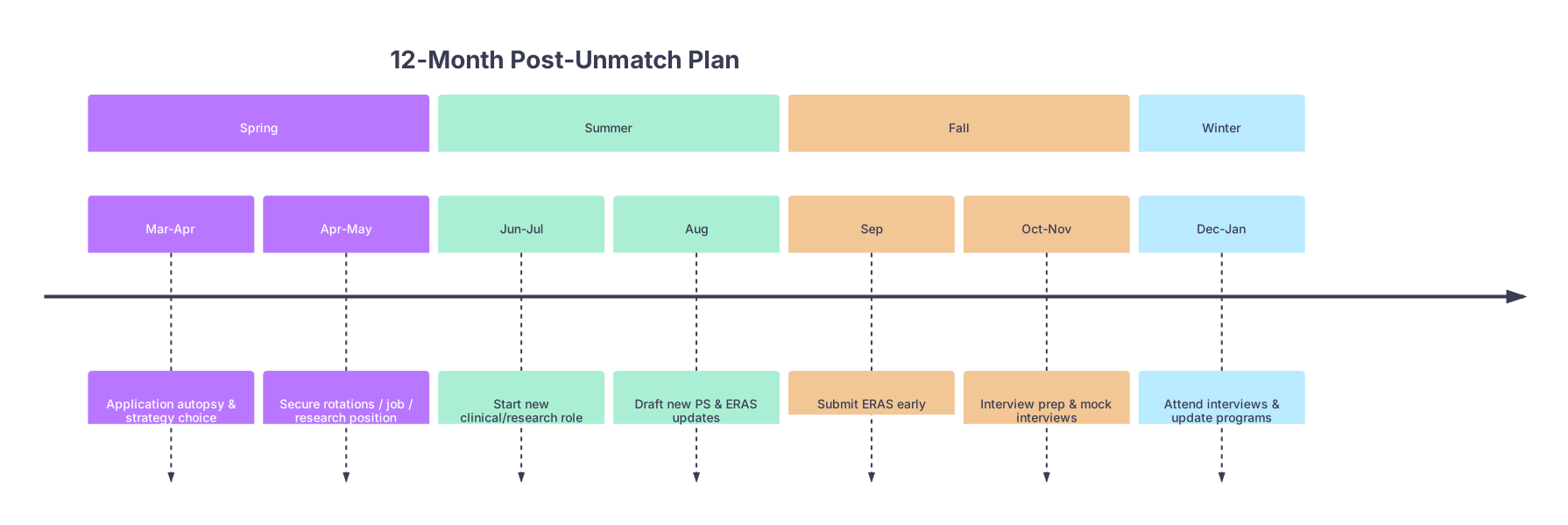
7.1 Map the year backward from next ERAS submission
Assume you are targeting the next cycle. Rough timeline:
| Period | Event |
|---|---|
| Spring - Mar-Apr | Application autopsy & strategy choice |
| Spring - Apr-May | Secure rotations / job / research position |
| Summer - Jun-Jul | Start new clinical/research role |
| Summer - Aug | Draft new PS & ERAS updates |
| Fall - Sep | Submit ERAS early |
| Fall - Oct-Nov | Interview prep & mock interviews |
| Winter - Dec-Jan | Attend interviews & update programs |
Modify months as needed, but keep the structure:
- Quarter 1: Diagnose and commit to a path.
- Quarter 2–3: Execute the main “fix” (clinicals, research, job, Step 3).
- Quarter 4: Application polish and interview preparation.
7.2 Define concrete outputs by quarter
You need visible, documentable improvements.
By end of Q1 (3 months from now):
- Final specialty decision (including backup if needed).
- Confirmed positions:
- Rotation(s) or observerships
- Clinical job (scribe, research coordinator, hospitalist assistant, etc., if meaningful)
- Or research year with named mentor
- Draft framework for new PS and ERAS strategy.
By end of Q2:
- At least one new letter writer committed.
- 2–3 months of strong performance in your new role.
- If aiming for Step 3: exam date scheduled or completed.
By end of Q3:
- Step 3 score in hand (if part of strategy).
- At least two fresh letters uploaded or ready.
- Revised ERAS and PS reviewed by at least one honest mentor and preferably a PD or senior resident in your field.
By ERAS submission:
- Application submitted early in the season (not weeks late).
- Targeted, realistic program list finalized.
Step 8: Fix Your Interview Skills Now, Not “After Invites”
Many unmatched applicants treat interviews like something they will “worry about if I get invites.” That is how you waste your second chance.
You will:
- Write out clear answers to:
- Tell me about yourself.
- Why [specialty]?
- Why [this program / type of program]?
- Tell me about a significant challenge or failure.
- Explain [your specific red flag here].
- Practice with real humans:
- At least 2 mock interviews with:
- One faculty / attending.
- One peer or recent graduate who matched recently.
- Record at least one (audio or video) and critique your:
- Clarity and concision.
- Nonverbal quirks.
- Tendency to over-explain or become defensive.
- At least 2 mock interviews with:
- Build 5–7 strong questions you will ask every program, tailored to:
- Education / curriculum.
- Culture and resident support.
- Graduates’ outcomes.
Your goal: by the time invites hit, you are already in “polish” mode, not “I should probably google interview questions.”
Step 9: Decide on Match Alternatives and Parallel Paths
This article is under “MATCH ALTERNATIVES,” so let us be candid. For some, the smartest move is not just “try again exactly the same way.”
Here are structured alternatives that can actually strengthen you:
9.1 Preliminary or transitional year
Best used when:
- You can secure a prelim in IM, Surgery, or Transitional with a decent learning environment.
- The PD is willing to support your future applications.
Benefits:
- You prove you can function as a resident.
- You get up-to-date clinical letters.
- You get a salary and stay clinically sharp.
Risk: If the program is malignant or not supportive, it can worsen things. Vet this choice carefully.
9.2 Dedicated research year
Best used when:
- You are targeting academic or competitive specialties.
- You have a committed PI or mentor who understands the match and will advocate.
- The position includes some clinical exposure and networking with faculty.
This is not “I am just hanging out doing random case reports.” It should be a structured role with deliverables.
9.3 Non-residency clinical roles
Consider:
- Hospitalist extender, APP scribe for a service, research coordinator with heavy patient contact, etc.
- These can keep you in the system, generate letters, and pay your bills.
Weak alternative:
- Low-responsibility observership with minimal supervision or contact, especially for more than 6–12 months. It can look like floundering if that is all you have.
9.4 Strategic pivot out of clinical medicine
This needs to be on the table, especially after multiple failed cycles with minimal improvement in your profile.
Alternative careers:
- Clinical research management
- Pharma / biotech (medical affairs, safety, trials)
- Health tech, consulting, public health, medical education
This is not failure. It is triage. But you need to decide based on:
- How many realistic cycles you have left (age, visa, finances).
- Your mental health and burnout level.
- Objective data from mentors about your chances with a rebuilt application.
Step 10: Get Real Feedback From People Who Actually Know
The last piece: you need outside eyes.
You are too close to your own story. I have seen people insist “I have no red flags” with two Step failures and a professionalism note in their MSPE.
You need:
- At least one program director or APD in your target specialty to review:
- Your scores and academic record.
- Your CV.
- Your new plan (rotations, letters, timing).
- At least one brutally honest mentor who will tell you:
- If your specialty choice makes sense.
- If your narrative matches your track record.
Approach them with:
- Your one-page Match Cycle Summary.
- Your honest assessment of what went wrong.
- A draft of your proposed plan for the next 12–18 months.
Ask specifically:
“Based on my profile and this plan, do you believe I have a realistic chance to match in [specialty] if I execute this? If not, what would you recommend instead?”
If three knowledgeable people say some version of “You are fighting uphill; I would strongly consider switching specialties or paths,” take that seriously.
Your Next 24 Hours: One Concrete Move
Do not just “think about this.” You need to take a visible, external action.
Within the next 24 hours:
- Open a blank document titled: “[Your Name] – Match Autopsy and Rebuild Plan.”
- Fill in:
- Scores and academic issues.
- Number of applications and interviews.
- Red flags.
- Your best guess at your top two failure domains (e.g., “Under-interviewed due to poor targeting and weak specialty brand”).
- Email one faculty member or mentor you respect with that document attached and ask:
“Could we schedule 30 minutes in the next 1–2 weeks to review this and discuss a realistic plan for next cycle?”
That single step shifts you from “unmatched” to “in the middle of a structured rebuild.”
Open the document. Start writing your autopsy now.