
The biggest lie you are told after going unmatched is that your career is over. It is not. But your margin for error just got very small.
If you use a prelim or transitional year (TY) passively, it will swallow you. You will work hard, get tired, and end up applying again with essentially the same profile and the same result. I have watched that play out more times than I care to count.
If you use it tactically, you can convert that year into a categorical spot. I have watched that too. Different outcome. Different mindset. Different daily behavior.
This guide is about the second path.
1. Understand Exactly What Prelim and TY Years Can (and Cannot) Do
First, get the landscape straight. If you misunderstand what these positions are, you will make sloppy choices and waste time.
What is a Prelim Year?
Preliminary (prelim) years are 1-year internships, usually in:
- Internal Medicine (IM)
- General Surgery
- Occasionally other fields (e.g., transitional slots labeled “prelim medicine”)
They can be:
- Designated prelim – tied to an advanced position (for example, you matched into Radiology starting PGY-2, and this PGY-1 is part of that contract).
- Non-designated prelim – stand-alone 1-year position with no guaranteed PGY-2.
If you went unmatched in your target specialty (e.g., IM, Surgery, Anesthesia, EM), the spot you care about is non-designated prelim. That is your potential bridge year.
What is a Transitional (TY) Year?
A TY year is like a more flexible prelim. Usually:
- ~4–6 months of internal medicine
- A mix of electives (outpatient, subspecialties, sometimes procedural)
- Often less malignant call schedules than surgery prelim, sometimes comparable to cush IM prelims
TY years are common for:
- Advanced specialties (Radiology, Derm, Ophtho, Rad Onc, Anesthesia)
- People who want a broad intern year
From an unmatched perspective, TY = “flexible intern year + networking + time to rebuild application.”
What These Years CAN Do For You
If handled correctly, a prelim or TY year can:
Prove you can function as a resident in the U.S. system
Particularly critical if:- You are an IMG
- You had academic issues
- You had a leave of absence, remediation, or a red-flag narrative
Generate powerful new letters
From PDs and core faculty who have watched you manage real patients at 2 a.m.Give you internal access to PGY-2 categorical spots
Off-cycle vacancies, expansion positions, “funded but unfilled” slots.Let you repair your story
You can go from “unmatched applicant with concerns” to “outstanding intern who is already doing the job.”
What These Years CANNOT Do
They will not fix:
- Catastrophic professionalism issues that continue (chronic lateness, anger problems, dishonesty)
- A complete lack of specialty focus or vision
- A USMLE/COMLEX record that is unchanged and obviously inadequate for your target specialty, if you refuse to adapt your goals
They also will not automatically:
- Convert into a categorical spot
- Guarantee internal promotion
- Overcome zero effort on your part during the year
You are not “owed” anything because you took a prelim or TY. That entitlement mindset kills a lot of chances.
2. Choosing Between Prelim and TY: A Tactical Decision
If you are unmatched and staring at SOAP / post-Match options, you have to choose carefully. This is not about what sounds less painful. It is about what gives you the best path to a categorical PGY-2.
Core Question: What Is Your Realistic Target Specialty Now?
Be honest. Not aspirational. Realistic.
- If your Step/COMLEX scores and profile are not competitive for Derm, but you are strong for IM → stop pretending. Target IM.
- If you wanted Ortho but barely scraped through exams and have limited ortho research → consider Gen Surg, IM, or FM as primary targets with future subspecialty options.
Your choice of prelim/TY should match the specialty you now plan to pursue.
| Target Specialty | Best Bridge Year Type | Second-Best Option |
|---|---|---|
| Internal Med | Prelim IM | TY with heavy IM |
| General Surgery | Prelim Surgery | Prelim IM (rare cases) |
| Anesthesia | TY or Prelim IM | Prelim Surgery (if strong surg interest) |
| Radiology | TY | Prelim IM |
| EM | Prelim IM | TY |
When to Prefer a Prelim IM
Pick a prelim internal medicine year if:
- You are aiming for IM, EM, Neuro, Anesthesia, or sometimes Radiology.
- You want maximum “this person can run an inpatient list” credibility.
- You want direct internal access to IM PGY-2s if they open.
Upside:
- Solid inpatient exposure, many PDs respect IM prelim training.
- Strong platform for letters.
Downside:
- Can be brutal depending on program.
- Less elective flexibility than a TY.
When to Prefer a Prelim Surgery
Pick a surgery prelim if:
- You still realistically want a categorical general surgery spot.
- Your scores and background are at least in the ballpark (even if initially unsuccessful).
- You are prepared for extremely hard work and sometimes harsh culture.
Upside:
- Direct lane into categorical gen surg if a spot opens or they expand.
- If you excel, PDs absolutely notice; many surgery PDs will “upgrade” successful prelims.
Downside:
- Some programs treat prelims as disposable labor.
- If you do not stand out, you can get lost in the machine.
- Harder to pivot to non-surgical specialties without careful planning.
When a TY Year Makes the Most Sense
Choose a TY year if:
- You are targeting Radiology, Derm, Ophtho, Rad Onc, or Anesthesia and want breadth.
- You had significant burnout or mental health strain and need a more balanced year while still moving forward.
- You want more elective time to do research / specialty exposure during the year.
Upside:
- Better schedule in many TY programs compared to heavy IM/surg prelims.
- Flexible structure to build research, niche interest, or outpatient experience.
Downside:
- Some PDs see TY as “lighter” than prelim IM or surg (varies by program).
- Less inpatient grind can reduce your “this person can manage acute floor chaos” narrative.
3. Before You Start: Set a Concrete Tactical Plan
Going into a prelim/TY year without a plan is like starting a code without assigning roles. Chaos and wasted time.
Your 4 Core Goals for the Year
Your prelim or TY year must achieve these:
- Crush clinical performance
You must be in the top tier of interns by the end of the first 3–4 months. - Generate at least 2–3 high-impact letters
PD + at least one core faculty in your target field. - Position yourself for internal opportunities
Make sure the department actually sees you as promotable. - Upgrade your application story
A very clear, compelling narrative about resilience, growth, and concrete achievement.
Set Measurable Targets
Write it down somewhere you see weekly. For example:
- “By end of month 3: PD knows my name, at least 3 attendings in my target specialty have worked with me directly, no professionalism flags, no missed notes, zero serious complaints.”
- “By end of month 6: I have 2 letter writers committed, 1 research or QI project ongoing, and clear understanding of internal PGY-2 spot prospects.”
You are not a passenger. You are running a project: “Turn intern year into categorical spot.”
4. How to Perform in a Prelim or TY Year to Maximize Conversion
Here is where people either win or disappear.
Clinical Performance: Be the Intern PDs Fight to Keep
Do these consistently:
Reliability first
- Show up early. Not just on-time.
- Notes done when they are supposed to be done.
- Follow-up tasks actually followed up. No dropped balls.
Be low-drama, high-output
I have seen interns with average knowledge get promoted because they were steady, kind, and dependable, while smarter but volatile interns got quietly sidelined.Ask for feedback early and specifically
Not “how am I doing?” but:- “Is there one thing I can do this week to make your life easier as my senior?”
- “Am I missing anything in my assessment and plan format that you want to see?”
Master the fundamentals
- Clear, concise notes
- Organized presentations
- Knowing your patients cold
- Anticipating next steps (labs, imaging, consults)
Do unglamorous tasks without complaining
Paging consults, calling families, chasing down outside records. People notice the attitude.
5. Strategic Relationships: PDs, Faculty, and Allies
You are not just working. You are auditioning.
Early PD Contact (Month 1–2)
Within the first 4–6 weeks:
- Schedule a brief meeting with your PD or APD.
- Script it roughly like this:
“I am very grateful to be here. I went unmatched in [specialty/program type] last cycle and I am determined to earn a categorical spot in [X] if the opportunity arises, here or elsewhere. I wanted you to know I am fully committed to giving everything to this program this year. I would appreciate any feedback as we go about how I can be the kind of trainee you would confidently recommend for a categorical PGY-2.”
Why this works:
- You show humility and intent.
- You avoid sounding entitled.
- You encourage them to watch you more closely, which is exactly what you want.
Choose 2–3 Faculty to Impress Deliberately
Look for:
- People with influence in your target specialty (program leadership, clerkship directors, respected attendings).
- People who are known to be fair and invested in teaching.
Then:
- Volunteer for cases, clinics, or projects with them.
- Ask, near the end of a rotation:
“If I keep working at this level or better, would you feel comfortable writing a strong letter for me this fall?”
Do not ask for letters blindly. Confirm they will be strong.
Build Peer and Senior Resident Allies
Why this matters:
- PDs ask chiefs and seniors, “Who are your best interns?”
- If your peers find you supportive and competent, they will say so. If you are toxic, that message travels faster.
Concrete behaviors:
- Offer to help on bad days (“I finished my notes, want me to place those orders for you?”).
- Do not gossip about co-residents or attendings. Ever.
- When you make a mistake, own it and fix it. No excuses.
6. Using the Year to Improve Your Application: Step by Step
You are running two parallel tracks:
- Succeeding as an intern
- Rebuilding your application
Step 1: Dissect Why You Went Unmatched
Do this brutally honestly. Categories:
- Scores: Below the typical range for your specialty? Any fails?
- Letters: Weak, generic, or from non-influential people?
- Clinical performance: Bad evals, professionalism concerns, failed rotations?
- Specialty alignment: Minimal research / exposure in the chosen field?
- Application strategy: Too few programs, poor personal statement, late application?
Once you have the list, connect each problem to a specific fix during this year.
Step 2: Fix Scores Where Possible
- If you failed Step/COMLEX: You must have passed and, ideally, shown improvement. If there is a retake left and PDs suggest it might matter, schedule it strategically during lighter months.
- If scores are low but not failing: You cannot change them, but you can create a strong “overcame low scores through performance” narrative by excelling in a rigorous program.
Step 3: Build Real, Visible Output
Pick 1–2 realistic projects during the year:
- A QI project on something you see daily: discharge delays, readmission patterns, handoff problems.
- A short retrospective study with a faculty mentor (start with something that is IRB-light or already being done).
- A case report or case series tied directly to your specialty interest.
Time is limited. Do not over-commit. One completed, presented project beats five “in progress” lines that never materialize.
7. Hunting for Categorical Spots: Internal and External
You are not waiting passively for the Match fairy. You are looking for PGY-2 seats like a hawk.
Internal Opportunities
There are three main pathways:
Planned expansion
Some programs add positions. PD sometimes signals this early: “We may be adding two PGY-2 spots next year.”Unexpected vacancies
Residents leave for:- Fellowship early
- Family reasons
- Performance issues
- Visa or health problems
Prelim-to-categorical conversion culture
Some services regularly promote their strongest prelims.
How to position yourself:
- Ask PD/APD mid-year:
“If any PGY-2 categorical spots open for next year, I would be extremely interested. What would I need to demonstrate to be seriously considered?” - Continue to earn relentlessly. Do not let up after that conversation.
If nothing is available internally:
You still leave with strong letters, documented performance, and a better story. That matters in the broader market.
External PGY-2 Spot Search
Two main channels:
Formal Match (categorical or advanced PGY-2)
- Apply broadly through ERAS again, but now with:
- New letters
- Updated CV with intern performance
- Strong PD letter
- Apply broadly through ERAS again, but now with:
Off-cycle PGY-2 openings
- These appear on:
- Program websites
- Specialty society job boards
- The APDS listserv for surgery, or similar lists in other fields
- You email directly:
- Updated CV
- Personal statement specifically addressing why PGY-2 at their program
- PD letter or at least PD contact info
- These appear on:
You must be organized here. Maintain a simple spreadsheet:
- Program
- Contacted (date)
- Response
- What they requested
- Follow-up date
You are essentially in a quiet, rolling application cycle while working full-time.
8. Timeline: What To Do, Month By Month
Here is a rough structure. Adjust for your own program’s schedule.
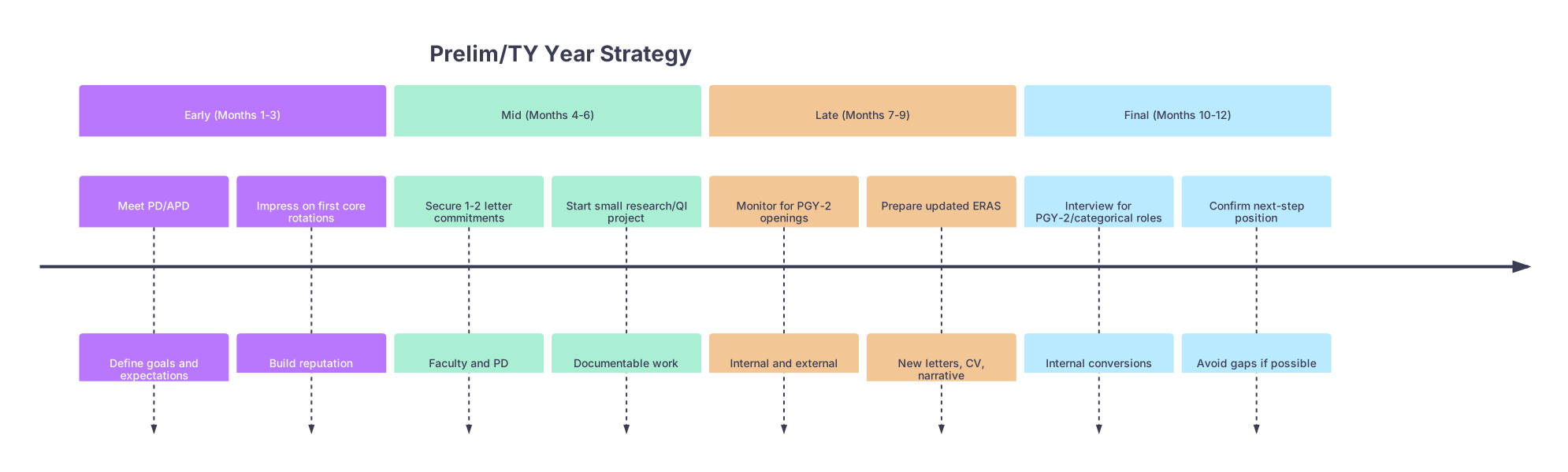
| Period | Event |
|---|---|
| Early (Months 1-3) - Meet PD/APD | Define goals and expectations |
| Early (Months 1-3) - Impress on first core rotations | Build reputation |
| Mid (Months 4-6) - Secure 1-2 letter commitments | Faculty and PD |
| Mid (Months 4-6) - Start small research/QI project | Documentable work |
| Late (Months 7-9) - Monitor for PGY-2 openings | Internal and external |
| Late (Months 7-9) - Prepare updated ERAS | New letters, CV, narrative |
| Final (Months 10-12) - Interview for PGY-2/categorical roles | Internal conversions |
| Final (Months 10-12) - Confirm next-step position | Avoid gaps if possible |
Use this as your checklist. If you reach month 6 with zero letters, no project, and PD does not know you, you are behind. Not doomed, but behind. You must accelerate aggressively.
9. Common Mistakes That Derail Prelim and TY Years
I have seen these sink good people:
Treating the year as a holding pattern
“I will just work hard, someone will notice.” They will not. You must push the process.Chasing too much research at the expense of clinical performance
PDs will not rescue someone with shaky clinical work because they published a poster. Clinical comes first.Being openly bitter about going unmatched
You are allowed to feel it. Just not leak it all over the workplace. It makes seniors and attendings hesitant to endorse you.Not adjusting specialty goals when clearly unrealistic
If three PDs tell you that your profile will not clear the bar for your dream specialty, pivot. Salvage the career. You can still have a meaningful, excellent trajectory in a different field.Blowing professionalism
Late notes, no-shows, attitude issues. A single major professionalism event can permanently kill internal promotion chances.
10. Sample Weekly Operating Protocol
To keep this from staying theoretical, here is a simple weekly rhythm that works.
Every Week
- Identify one attending or senior to actively impress (present especially crisply, ask for feedback).
- Do one extra thing:
- Call an extra family, follow up a lab you “could have left to day team,” close a loop.
- Spend 30–60 minutes on your project (QI, research, or scholarship).
Every Month
- Review your tactical plan:
- Did I move closer to 2–3 strong letters?
- Does PD know my name and view me positively?
- Am I tracking potential internal PGY-2 opportunities?
- Adjust if you are off pace.
At 3, 6, and 9 Months
- Brief check-in with PD or APD:
- “I want to confirm that I am on track for a strong letter and that I am meeting expectations as an intern. Is there any concern you have not told me that I need to address now?”
This prevents silent, festering problems that only show up at the worst time.
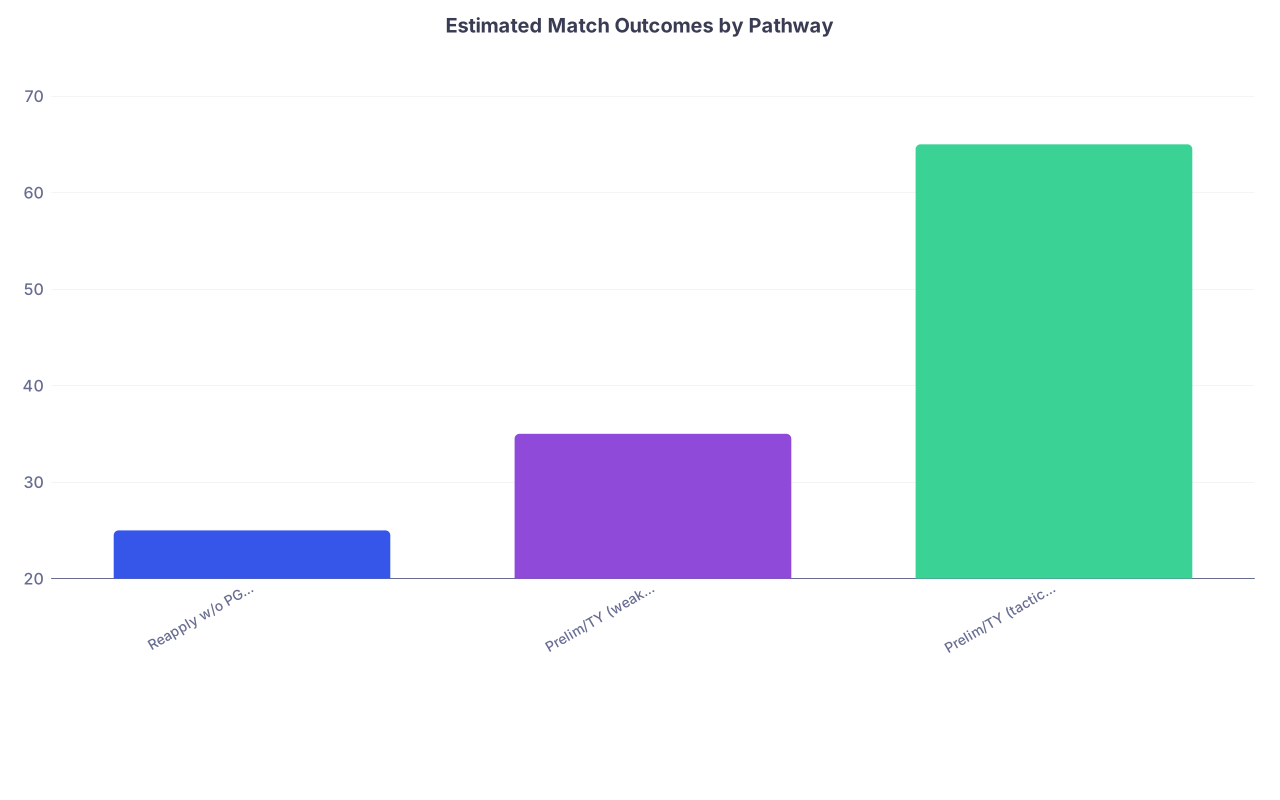
Visual Snapshot: How Prelim/TY Years Change Match Outcomes
| Category | Value |
|---|---|
| Reapply w/o PGY-1 | 25 |
| Prelim/TY (weak use) | 35 |
| Prelim/TY (tactical use) | 65 |
Interpretation (rough, based on program directors’ anecdotes rather than hard national data):
- Reapplying with no PGY-1 and minimal changes is often a losing game.
- Doing a prelim/TY but not using it strategically improves chances slightly.
- Using it tactically—with strong performance, letters, and targeted outreach—dramatically improves the odds of landing some categorical spot, even if not always in your original dream specialty.
11. If You Still Do Not Match After a Prelim/TY Year
It happens. Less often when people do everything above, but it happens.
If you gave it a true, all-out effort and still did not match:
- Accept that the market has given you feedback.
- Strongly consider:
- Broader specialties (FM, IM, Psych, Peds)
- Geographic flexibility (underserved areas, community programs)
- Alternative but still clinical careers (hospitalist routes after IM, etc.)
What you do not do:
- Repeat the same cycle exactly the same way.
- Pile on a second or third prelim year hoping magic happens.
One prelim/TY year is a tool. Two or three starts to look like drift and indecision.
Three Key Takeaways
- A prelim or TY year is not a consolation prize; it is a 12‑month, high-stakes audition. Treat it that way from day one.
- The combination that converts to a categorical spot is always the same: top-tier clinical performance, visible professionalism, 2–3 powerhouse letters, and active hunting for PGY-2 openings.
- You cannot control every outcome, but you can absolutely control whether you finish that year as “just another prelim who worked hard” or “the intern every PD would fight to keep.”