
You did not “kind of” miss your dream specialty. You got a clear signal from the system: this path, this year, at least this way, is closed. The worst move now is denial disguised as “staying positive.” The best move is a cold-eyed, structured pivot.
You are not done. But you cannot keep doing the same thing and hope the algorithm suddenly likes you.
This is a practical guide to what actually works after failing to match or not matching your top-choice specialty. Not inspirational fluff. A playbook.
Step 1: Stop the Emotional Bleed, Then Get Your Facts
You will not make good strategic decisions while rage-texting your group chat and doom-scrolling Reddit threads about “the match is broken.”
Give yourself 24–72 hours for the emotional hit. Cry. Swear. Sleep. Then switch to “Chief Resident of My Own Career” mode.
1.1 Clarify what actually happened
There is a big difference between:
- Did not match anywhere
- Matched, but not to your dream specialty
- SOAP’ed into something you do not want
- Still unmatched after SOAP
Each scenario has different options and timelines.
If you did not match or you SOAP’ed into something you hate, pull your ERAS and NRMP data:
- Programs applied to
- Interview numbers
- Where you were ranked (if any program shares this informally)
- Your Step/COMLEX scores
- Number of attempts
- Gaps or red flags (repeats, LOA, professionalism issues)
Do not “vibe” your way through this. You need a cold, accurate autopsy of this application cycle.
Step 2: Diagnose Why You Missed – With Brutal Honesty
Most unmatched applicants I talk to misdiagnose the problem. They blame competitiveness when the real issue was a weak application strategy, or they cling to “my scores” when the real problem was poor letters or vague personal statements.
Break it down into four buckets:
- Metrics
- Application quality
- Strategy
- Reputation/red flags
2.1 Metrics: Are you in the realistic zone?
Use hard data, not wishful thinking. Compare your numbers to your dream specialty norms.
| Specialty | Step 2 CK (mean matched US MD) | AOA/Top Quartile Common | Research Heavy? |
|---|---|---|---|
| Dermatology | 255+ | Yes | Very |
| Orthopedics | 250+ | Yes | High |
| Plastic Surgery | 255+ | Yes | Very |
| Neurological Surg | 255+ | Yes | Very |
| Internal Med (Academic) | 240–245 | Helpful | Moderate |
| Family Med | 225–235 | Not critical | Low |
If you are:
- 15–20 points below the mean for matched applicants in your dream specialty
- IMG with borderline scores
- Multiple Step failures/remediations
…then the issue is not bad luck. The market is telling you this specialty, as currently structured, is a long shot.
2.2 Application quality: Was your packet truly competitive?
Ask bluntly:
- Letters:
- Were they from known faculty in the specialty?
- Did at least one letter writer say they would “go to bat” for you?
- Personal statement:
- Did you write a generic “I love helping people” essay?
- Did your statement actually explain why this specialty and why you’re good at it with evidence?
- CV:
- Any specialty-relevant research, QI, leadership?
- Any dedicated sub-I or audition rotations with strong written evals?
If you are unsure, you probably had a mediocre packet. Good applications are not ambiguous.
2.3 Strategy: Did you apply like someone who really wanted to match?
Harsh truth: Many unmatched applicants under-apply, then blame the system.
Ask:
- How many programs did you apply to?
- Did you apply broadly across academic and community programs?
- Did you apply to “safety” specialties at all? Or just your dream?
- Did you only apply to “big name” places where you rotated?
If you went all-in on a hyper-competitive specialty with a narrow list, you did not have a backup strategy. That is not “passion.” That is poor risk management.
2.4 Red flags and “hidden” issues
These matter more than you think:
- Remediation, LOA, professionalism notes
- Failed Step/COMLEX attempt
- Visas, graduation year > 3–5 years for IMGs
- Questionable social media or reputation
If there is a red flag, you need a deliberate plan to counterbalance it. Ignoring it is how you end up here again next year.
Step 3: Decide: Reattempt or Pivot to an Alternative Specialty?
This is the core decision. Stay the course and try again, or pivot to something adjacent that actually wants your profile.
Let me be blunt: reapplying blindly with a minimally changed application is a waste of a year.
3.1 When it makes sense to reattempt your dream specialty
Reapplication can be reasonable if:
- You have borderline but not terrible metrics
- You are early in your career (fresh grad or 1 year out)
- You can significantly strengthen your case with 1–2 years of focused work in the specialty
For example:
- US MD, Step 2 CK 244, applied to Ortho with weak research and minimal away rotations, no backup
- You have access to a dedicated research year with a strong ortho department
- You can realistically add 2–3 pubs, 2–3 strong letters, and more targeted rotating
In that scenario, one more serious, retooled attempt is rational.
Reattempt is dumb if:
- You are 20+ points below mean and cannot change that
- You have multiple exam failures
- You are 3–5 years post-grad and not in a relevant role
- You are ignoring the mismatch between your metrics and the specialty
If that is you and you insist on reapplying the same way, you are choosing sunk-cost fallacy over realism.
3.2 When it is smarter to pivot
Pivoting is not “giving up.” Pivoting is aligning with reality to avoid permanent career limbo.
Consider pivoting if:
- Your dream specialty is consistently out of reach by objective numbers
- You already did a serious, optimized attempt and still struck out
- You feel burned out by the grind of chasing that one label
- You can see yourself content (not ecstatic, content) in 1–2 adjacent fields
Example:
- You wanted Dermatology
- You have 238 Step 2 CK, no strong derm research, and a prior Step failure
- Reasonable pivot: Internal Medicine with plan for outpatient/complex medical derm focus, or Allergy/Immunology later
- Another route: Family Medicine with a high-procedure outpatient derm emphasis
You can still shape a career around the patient population or procedures you love, even if the residency label changes.
Step 4: Map Out Realistic Alternative Specialties That Fit You
Do not panic-pivot into the first field someone says is “easy.” There is no truly easy specialty. There are only relatively less competitive ones.
You need a systematic way to assess alternatives:
- Interests: Procedures, continuity, acuity, patient population
- Lifestyle: Call intensity, hours, control over schedule
- Risk tolerance: How much more uncertainty can you tolerate?
- Timeline: Can you afford 1–2 extra years of research or prelim work?
Here is a comparison snapshot for context:
| Original Dream | Common Realistic Pivots | Maintains… |
|---|---|---|
| Dermatology | IM, FM, Med/Peds | Outpatient, chronic disease |
| Ortho | PM&R, General Surgery, FM + sports | MSK focus, procedures |
| Plastics | General Surgery, ENT | OR time, reconstruction |
| Neurosurgery | Neurology, PM&R | Neuro focus, complex patients |
| ENT | General Surgery, FM with procedures | Head/neck exposure, procedures |
You are looking for 70–80% overlap with what you loved about your dream field, not a perfect replica.
Step 5: Choose a Short-Term Role That Actually Improves Your Odds
You have three main functional goals for the next 12–24 months:
- Stay clinically active
- Fix the weaknesses in your application
- Generate strong, recent letters in your chosen field
5.1 Common roles that help (and some that do not)
Good options:
Prelim or Transitional Year:
- Strong if:
- You match into a prelim medicine/surgery year at an institution with the specialty or pivot field you want
- You impress them, get letters, maybe slide into a categorical spot that opens
- Weak if: you treat it as just “getting hours done” without strategic networking
- Strong if:
Dedicated Research Year (with clinical exposure):
- Strong if:
- In your target specialty or pivot specialty
- You are getting publications, presentations, and daily facetime with faculty
- Weak if: remote, no real mentorship, no chance of letters
- Strong if:
Non-designated preliminary training leading into another specialty (e.g., prelim surgery then PM&R):
- Good if your pivot specialty likes that background (PM&R, Anesthesia, Radiology, etc.)
Risky or low-yield options:
- Pure observerships, repeated for years
- Random non-clinical jobs not linked to your target field
- Unstructured “time off” with vague explanations
If you must take a non-training job (e.g., scribe, research assistant, hospitalist extender under supervision), fine. Just anchor it clearly to:
- Developing specific skills
- Staying clinically current
- Working with mentors in your target or pivot field
Step 6: Build a Concrete 12–18 Month Pivot Plan
Enough big-picture talk. Here is what an actual pivot plan looks like.
6.1 Month 0–1: Debrief and choose your path
Get specific feedback from 3 sources:
- A faculty member in your dream specialty
- A program director or APD (email politely; some will talk)
- A dean or advising office who sees many match outcomes
Make a binary decision:
- Reattempt dream specialty with major overhaul
- Pivot definitively to an alternative
Apply for:
- Research positions or prelim spots still open
- Clinical jobs that keep you near your target department
6.2 Month 2–6: Repair the application foundation
Your focus depends on what was weak:
If metrics are fine, but specialty-related content was weak:
- Dive into pivot specialty rotations
- Get 2–3 strong, recent letters
- Join at least one active research or QI project
If strategy was weak:
- Build a sane program list with a mentor
- Plan to apply VERY broadly (including community and less “prestige shiny” programs)
- Prepare a targeted, non-defensive explanation for being unmatched / reapplying
If red flags exist:
- Get clear documentation that the issue is resolved (e.g., dean’s letter addendum, successful remediation)
- Collect exemplary evaluations and letters that explicitly speak to the prior concern
6.3 Month 7–12: Execute on visibility and value
This is where most people just “keep working” and hope someone notices.
Be deliberate:
- Present at conferences (local, regional, national if feasible)
- Volunteer for resident teaching, journal clubs, QI teams
- Ask mentors directly:
- “Where do you think I would be competitive?”
- “Who do you know at other programs who might be open to my application?”
- Collect written feedback from rotations that you can refer to in your MSPE or letters
If you are serious about a pivot specialty, act like a resident in that specialty now. Show up early, read, own your patients, help the team breathe easier.
Step 7: Rebuild Your ERAS Strategically, Not Emotionally
Do not recycle your old application with minor edits. That screams “I learned nothing.”
Rework each part:
7.1 Personal statement: Tell the truth, strategically
You do not need to write a 3-page saga of heartbreak. You do need to answer:
- Why this specialty now?
- How have your experiences (including not matching) clarified your fit?
- What have you done in the past year to prove commitment and capability?
For a pivot, something like:
“After applying to neurosurgery last cycle, I completed a prelim medicine year and worked closely with the neurology service. I realized that my greatest satisfaction comes not from the OR itself, but from longitudinally managing complex neurologic disease, counseling families, and optimizing function over time. This led me to pursue neurology with a focus on stroke and neurocritical care…”
Honest, forward-looking, not self-pitying.
7.2 Letters of recommendation: Replace, do not just add
Aim for:
- 3 letters from your current or pivot specialty
- 1 can be from your research mentor or prelim PD, if they know you well
Weak, generic letters from big names are less helpful than strong, specific letters from mid-level but respected faculty who can say:
- “This applicant does senior-resident-level work on our service.”
- “They were the hardest-working intern I supervised in five years.”
7.3 Program list and application volume
You need to be realistic and aggressive.
For a reapplicant or pivoting candidate:
- Competitive specialty reattempt with improved profile: 60–80+ programs
- Moderate specialty (IM, Peds, Psych): 60–100
- FM or less competitive: still 40–70 if you have any risk factors
Do not self-reject from community hospitals because they “are not prestigious.” They are the ones most likely to take a well-prepared pivot applicant who will work hard and stay.
Step 8: Prep for the New Kind of Interview You Will Get
You are not a generic fresh applicant anymore. You are “the one who did not match last year” or “the reapplicant from X specialty.”
You must have crisp, non-defensive answers for:
- “Walk me through what happened with last year’s match.”
- “Why are you interested in [this specialty] now?”
- “Why should we believe you will stay in this field and not try to switch again?”
8.1 Framework for answering the “didn’t match” question
Use a 3-part structure:
Acknowledge reality briefly, without drama.
- “I applied to orthopedic surgery last cycle and did not match.”
Show insight and growth.
- “Looking back, my application was not as strong as it needed to be in terms of research and letters, and my program list was overly narrow. Since then, I have completed a prelim year, worked closely with [current specialty], and realized that…”
Re-focus on present competence and fit.
- “This year, my experiences on [service X] and [project Y] have shown me that I am best suited to [key values of this field], and my attendings in this department have encouraged me to pursue it.”
No long apology tours. No blaming the system. Show maturity and strategic adjustment.
Step 9: Do Not Wreck Your Life While Fixing Your Career
Here is where you can quietly destroy your health and relationships if you are not careful.
During your pivot year(s):
- Set a hard boundary on hours where you are not allowed to obsess about the match. Even 1–2 evenings a week phone-free.
- Tell 1–2 trusted people (partner, close friend) the full situation. Let them in, so you are not faking everything alone.
- Keep your finances on a leash. Avoid new big debts or lifestyle creep based on income you do not yet have.
A delayed or altered match is a major stressor, but it does not justify turning your entire life into a residency application shrine.
Step 10: Contingency Planning if You Still Do Not Match
You always need a Plan B. Even for the Plan B.
If you pivot and still do not match after an honest, improved attempt, you must protect yourself from permanent limbo.
Possible next steps:
- Look at less competitive specialties that still make use of your prelim/research background (FM, Psych, IM, PM&R in some cases)
- Consider geographic flexibility to the extreme: rural, less popular states, new programs
- Overseas options or non-residency clinical roles (limited, but sometimes possible)
- Transition to adjacent careers: clinical research, public health, pharma/biotech, health tech, medical education
Are these ideal compared to your M3 fantasy? No.
Are they better than spending 5–6 years reapplying into a brick wall while your skills and sanity erode? Absolutely.
Visualizing a Rational Pivot Path
Sometimes it helps to see this as a process, not chaos.

| Step | Description |
|---|---|
| Step 1 | Unmatched / Not Dream Specialty |
| Step 2 | Analyze Metrics & Application |
| Step 3 | Consider 1 more serious reattempt |
| Step 4 | Identify realistic pivot specialties |
| Step 5 | Secure research/prelim in dream field |
| Step 6 | Secure role in pivot field |
| Step 7 | 12-18 months: strengthen profile |
| Step 8 | Rebuild ERAS & apply broadly |
| Step 9 | Start Residency |
| Step 10 | Reassess: second pivot or alt career |
| Step 11 | Metrics near specialty norms? |
| Step 12 | Matched? |
Time and Effort: What You Are Actually Signing Up For
This is not a one-month fix. You are looking at a 12–24 month project.
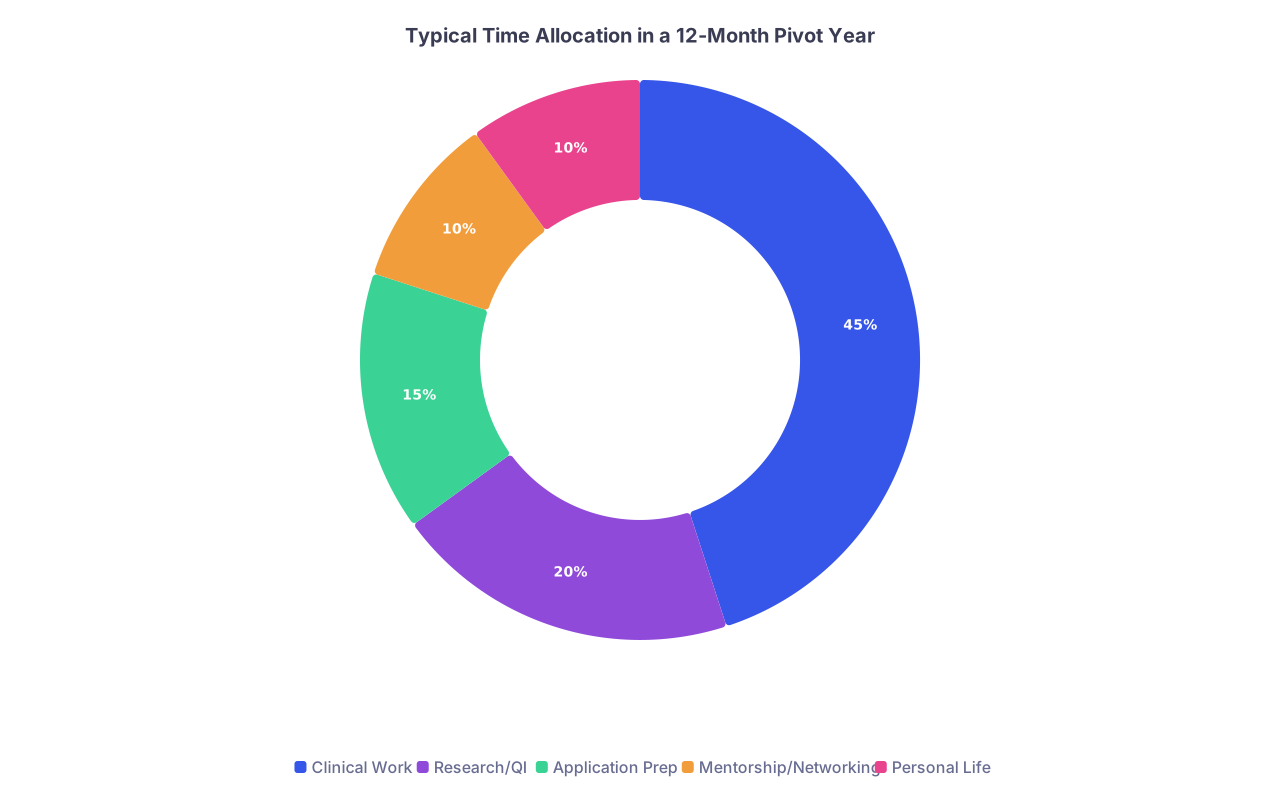
| Category | Value |
|---|---|
| Clinical Work | 45 |
| Research/QI | 20 |
| Application Prep | 15 |
| Mentorship/Networking | 10 |
| Personal Life | 10 |
You cannot control outcomes. You can control whether you look back and say, “I did everything a rational, committed adult could have done.”
Final Word: Stop Romanticizing the Original Plan
The most dangerous myth in medicine is that the only good career is the one you imagined at age 23.
You have one MD/DO degree. It can power:
- Multiple specialties
- Subspecialty fellowships that get you closer to your original interest
- Non-clinical careers where your training still matters
Your dream was not “Dermatology” or “Ortho” in itself. It was:
- A certain kind of work
- A certain kind of life
- A certain identity
You can build 70–90% of that through multiple paths if you are flexible and strategic.
Here is what I want you to do today, before this becomes just another thing you read:
- Open your ERAS PDF and write, in one sentence at the top:
- “My application failed primarily because of: metrics / application quality / strategy / red flags” (pick one or two).
- Email one faculty member you trust and ask for a 20-minute call to review that diagnosis.
- Commit, in writing, to either:
- One serious reattempt with a specific 12-month plan, or
- A pivot specialty that you will now treat as your actual goal, not a consolation prize.
Make the decision. Then build the plan around it.