
The worst mistake after not matching is to scramble blindly into any available specialty. You need a strategic backup, not a panic move.
You are not just trying to “get in somewhere.” You are trying to rescue your career and keep doors open for your future self. That requires a plan, not vibes.
Let me walk you through exactly how to construct a backup specialty strategy that is:
- Realistic
- Defensible to program directors
- Aligned with your skills and record
- Executable in 12–18 months
Not “dreams and prayers.” An actual protocol.
Step 1: Stabilize Your Situation and Collect Hard Data
You cannot build a strategic backup on guesswork and feelings.
You need a blunt assessment of why you did not match and what you are working with.
1.1 Get the real reason you did not match
Not your friend’s theory. Not Reddit’s opinion. Actual intel.
-
- From: your dean’s office / student affairs, your home program PD or advisor
- Ask for:
- Honest feedback on your application
- How you compared to matched applicants in your target specialty
- If they would support you reapplying, and to what
Ask 1–2 trusted faculty in your desired field
- Show them your ERAS, personal statement, score report, and list of programs.
- Ask very direct questions:
- “If you had to attribute my no-match to one primary factor, what is it?”
- “Would you rank me in your program as I am now?”
- “If not, what would need to change?”
If you cannot get a straight answer, that is an answer: your application was not competitive enough for the field you aimed for, or your interview performance/fit raised concerns.
1.2 Write out your current objective profile
Put everything on paper. No hiding.
Build a one-page snapshot:
- USMLE / COMLEX:
- Step/Level 1: ___ (P/F + school quartile if known)
- Step/Level 2: ___
- Step/Level 3 (if taken): ___
- Medical school: MD/DO, U.S. or IMG, graduation year
- Class rank / AOA / Gold Humanism (or equivalent)
- Research:
- Specialty of most projects
- Clinical performance:
- Honours in which core rotations
- Comments from MSPE if you have them handy
- Gaps / red flags:
- Leaves, failures, remediation, professionalism issues
- Visa or geographic constraints, if any
You are building the “PD view” of you. How they really see you on paper.
Step 2: Decide if You Are Pivoting or Rebuilding
Before you pick a backup specialty, you must answer one brutal question:
Are you primarily:
- A borderline but realistic applicant in your original field who had bad luck / strategy?
- Or structurally misaligned with that field (scores, timeline, red flags, etc.)?
Your path is different in each case.
2.1 If you were borderline but realistic in your original specialty
Example:
- Applied to Derm with 250+ Step 2, 5+ pubs, good LORs, but too few programs, late application, weak interview skills.
- Or applied to IM with 220–230, average application, but over-focused on top academic programs.
In this case:
- You can reasonably consider reapplying to your original specialty and building a backup strategy in parallel.
- The backup is an insurance policy, not a total career pivot.
2.2 If you were structurally misaligned
Example:
- Applying to Ortho with 205 on Step 2 and no ortho research.
- IMG with multiple exam attempts applying to Plastics or Derm without elite research.
- Graduated >3 years ago with no recent clinical work.
Here you must be honest: a second swing at the same hyper-competitive field is usually fantasy unless your profile changes dramatically (research year at a top place, major new LORs, strong connections).
In that case, your backup specialty is not “backup.” It is your new primary strategy.
Step 3: Choose a Backup Specialty Based on Data, Not Rumors
Stop thinking in vague terms like “less competitive.” You need a fit analysis between you and target fields.
3.1 Look at your alignment across 4 dimensions
For each potential backup specialty, rate your alignment (strong / moderate / weak) on:
Score Tolerance & Red Flags
- How forgiving is the field for:
- Lower Step 2
- Gaps or older YOG
- IMG status
- Example:
- Family Med, Psych, Peds, IM are generally more flexible.
- Ortho, Derm, Plastics, ENT are not.
- How forgiving is the field for:
Documented Interest
- Rotations, sub-Is, electives in that field
- Research, QI, case reports in that space
- Longitudinal volunteering related to common patient populations
Transferable Skills from Your Original Specialty
- Example:
- From Gen Surg → Anesthesia, EM, IM
- From Pediatrics → Psych (child/adolescent), FM
- From OB/GYN → FM, IM, sometimes Anesthesia
- Programs care whether your pivot makes sense or looks like desperation.
- Example:
Program Volume and Match Rates
- You want a field that actually has:
- Many positions
- A history of accepting applicants like you (late grads, IMGs, prior no-match)
- You want a field that actually has:
| Original Target | Strategic Backup Options | Why They Make Sense |
|---|---|---|
| Ortho, ENT, Plastics | General Surgery, Anesthesia, IM | Overlap in OR culture, acute care, procedures |
| Gen Surgery | Anesthesia, EM, IM | Strong critical care exposure, sick inpatients |
| Derm, Rad-Onc, Path | IM, FM, Neurology | Outpatient-heavy, internal medicine base |
| EM | IM, FM, Anesthesia | Acute care skills transfer, similar patient mix |
| OB/GYN | FM, IM | Women’s health continuity fits FM/IM clinics |
These are not rules. They are patterns I have seen work.
3.2 Use actual data, not hearsay
Do a quick, targeted review:
- NRMP Charting Outcomes (latest version)
- AAMC / ERAS data on:
- Fill rates
- IMG proportions
- Average scores where available
You are looking for specialties where:
- Fill rate is high, but
- There is evidence of non-traditional applicants matching (IMGs, older grads, lower scores)
Psych, FM, IM, and Peds still commonly serve this function. But you must check current numbers; these trends shift.
Step 4: Construct a Coherent Narrative for the Pivot
Programs hate randomness. They respect coherent stories.
If you are pivoting into a backup specialty, your job is to make the PD think:
“Given their background and reflection, this move makes sense. They are not just falling back; they are choosing us.”
4.1 Build your story in three beats
Initial Interest & Exposure
- When and how you developed your original interest (e.g., surgery, EM)
- What that early path taught you about your strengths and values
Critical Reflection after the No-Match
- Brief acknowledgment of not matching, framed as:
- A forcing function for reflection
- A chance to reevaluate where you fit best long term
- No whining. No blaming the system.
- Brief acknowledgment of not matching, framed as:
Reasoned Commitment to Backup Specialty
- Link your existing experiences to the new field:
- “My ICU and surgery rotations confirmed I like high-acuity physiology → now I see Anesthesia fits better with my strengths: careful planning, detailed monitoring, controlled environment.”
- Point to forward actions:
- New electives, observerships, research, QI in that specialty
- New mentors in the field
- Link your existing experiences to the new field:
This story must show intentionality, not collapse.
Step 5: Pick a Tactical Path for the Upcoming Year
You now know:
- Why you did not match
- How competitive you really are
- Which backup specialty is realistic
- How to articulate the pivot
Now you must choose a concrete lane for the next 12–18 months.
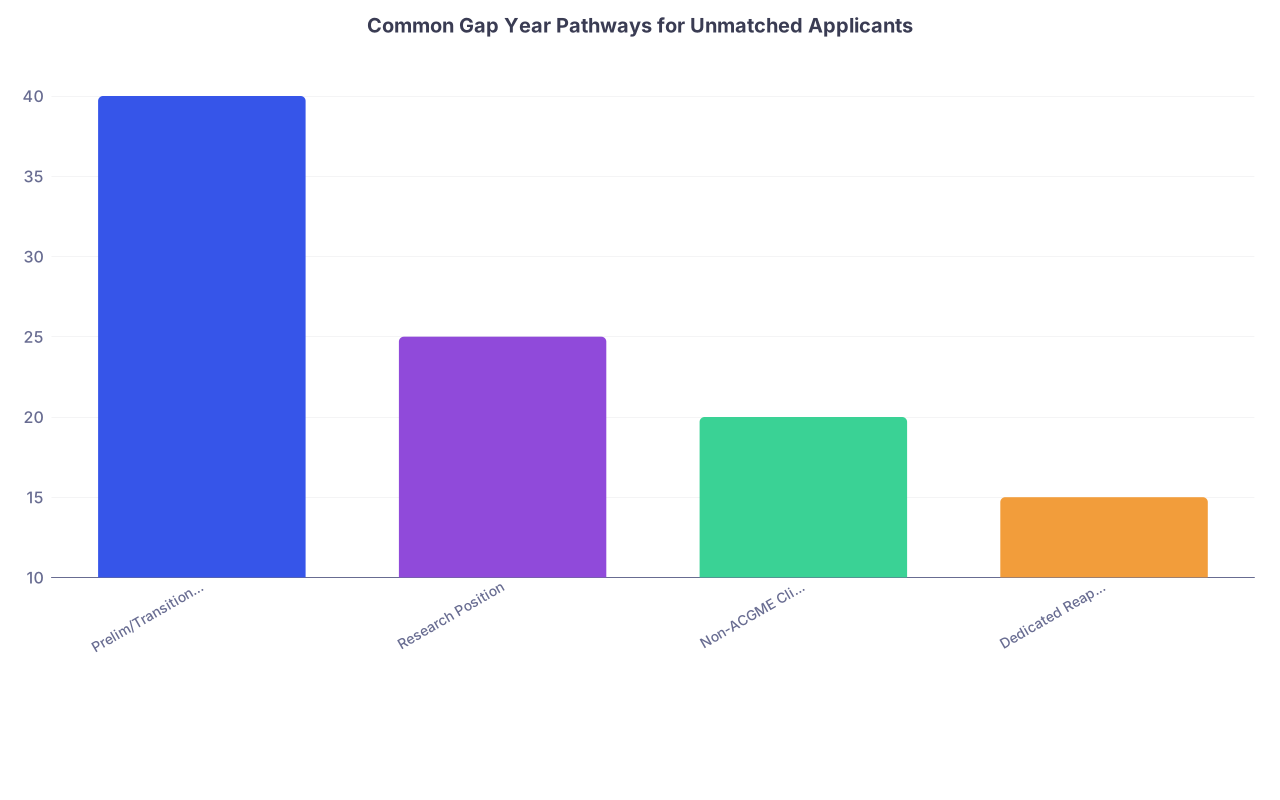
| Category | Value |
|---|---|
| Prelim/Transitional Year | 40 |
| Research Position | 25 |
| Non-ACGME Clinical Job | 20 |
| Dedicated Reapplication Year | 15 |
Those percentages are illustrative, but the categories are real.
5.1 Option A: Prelim or Transitional Year (If You Have One)
If you SOAPed into a prelim / transitional year:
Use that year like a weapon.
Maximize clinical performance
- Show up early, stay late, be teachable.
- Crush the in-service exams.
- Ask for mid-rotation feedback and adjust conspicuously.
Targeted networking
- Identify:
- PD and APDs in your prelim program
- Faculty in your backup specialty at your institution
- Ask them explicitly:
- “I am planning to apply to [X specialty]. How can I make myself a strong candidate this year?”
- Identify:
-
- You want at least:
- 2 strong letters from your prelim year
- 1–2 letters from faculty in your target backup specialty
- You want at least:
Strategic Electives
- Block out time for rotations in your desired backup field.
- Treat every day like an ongoing interview.
If planned well, a strong prelim year converts an average candidate into a credible one in IM, FM, Psych, and sometimes Anesthesia or EM.
5.2 Option B: Research Year with Clinical Exposure
If you did not secure a prelim or PGY-1:
A well-structured research year can be powerful if it is done right.
Non-negotiables:
- Research must be in or adjacent to your backup specialty
- Ideally at:
- A residency program in that specialty
- Or a large academic center with that department
Your goals during that year:
- 2–3 meaningful outputs (abstracts, posters, manuscripts)
- A daily presence in clinical conferences, grand rounds
- Shadowing/observerships with faculty who might later:
- Write letters
- Call PDs on your behalf
- Offer you interviews
If you just sit in a lab, rarely seen by clinical faculty, your year will be 50% wasted.

| Step | Description |
|---|---|
| Step 1 | No Match in March |
| Step 2 | Maximize clinical performance |
| Step 3 | Research or clinical gap year |
| Step 4 | Electives in backup specialty |
| Step 5 | Research in backup specialty |
| Step 6 | Strong LORs & networking |
| Step 7 | Apply widely in backup + consider reapplying original if realistic |
| Step 8 | PGY-1 spot secured? |
Step 6: Build a Targeted Backup Application, Not a Generic One
A “backup” specialty does not mean “lazy” specialty. PDs see that attitude instantly.
You need an ERAS package that proves you are genuinely oriented to that field.
6.1 Rebuild your application materials around the new specialty
Personal Statement
- Write a completely new statement for the backup field.
- Framework:
- One concrete clinical story that shows why you are drawn to the field
- How your prior path (even if in a different specialty) shaped your skills and insight
- Why this field fits your personality, strengths, and long-term plans
- Brief, matter-of-fact mention of your previous attempt if necessary, framed positively
Experiences Section
- Reorder items so that:
- Anything tied to the backup specialty is top 3
- Leadership and longitudinal commitments are highlighted
- Rewrite descriptions with language that matches the backup field’s priorities:
- FM: continuity, community, longitudinal care, prevention
- IM: complexity, diagnostics, inpatient management
- Psych: communication, alliance-building, longitudinal therapeutic work
- Anesthesia: physiology, acute interventions, procedural skill, OR teamwork
- Reorder items so that:
Letters of Recommendation
- Ideal mix:
- 2+ strong letters from the backup specialty
- 1 letter from your prior field showing good work ethic / team skills, if it is supportive
- Avoid weak letters from big names. You want enthusiastic, specific letters.
- Ideal mix:
6.2 Fix the exact weaknesses that blocked you before
Tie your backup plan to your earlier failure, intentionally.
Examples:
- If your problem was few interviews → you need:
- Earlier application
- Much broader program list
- Improved geographic flexibility
- If your problem was low scores → you cannot fix past scores, but you can:
- Take and pass Step 3 early (for some fields, for some IMGs this helps)
- Show strong in-service exam performance if in a prelim year
- If your problem was weak letters / no advocacy → this is your main KPI for the year:
- Build 2–3 relationships with faculty who will actually go to bat for you
Step 7: Apply Aggressively and Intelligently
Constructing the strategy is one thing. Executing it in ERAS is another.
7.1 Program list construction
For your backup specialty, you need to be very disciplined.
Think in tiers:
Tier 1 – Most realistic:
- Community programs
- Newer programs
- Programs with higher IMG percentages
- Less “desirable” locations geographically
Tier 2 – Stretch but reasonable:
- Mid-tier university programs
- Community/university affiliates in decent locations
Tier 3 – Reach:
- Big-name academic centers
The majority of your list should be Tier 1 and 2. 70–80% at least.
Do not repeat your original mistake of applying to only “nice” cities and big names.
7.2 Consider dual-application if appropriate
If you still want to swing at your original field:
- Apply:
- Primary: backup specialty (most programs)
- Secondary: original field (tightly curated set of programs where you have some connection or realistic shot)
But be smart:
- You must have separate personal statements.
- If asked in interviews, you own your story:
- “I applied primarily in [backup field] because I have come to see that my long-term interests fit it better. I applied to a small number of programs in my original field where I have close mentors and unfinished work. My priority is to train and grow; I would be fully committed wherever I match.”
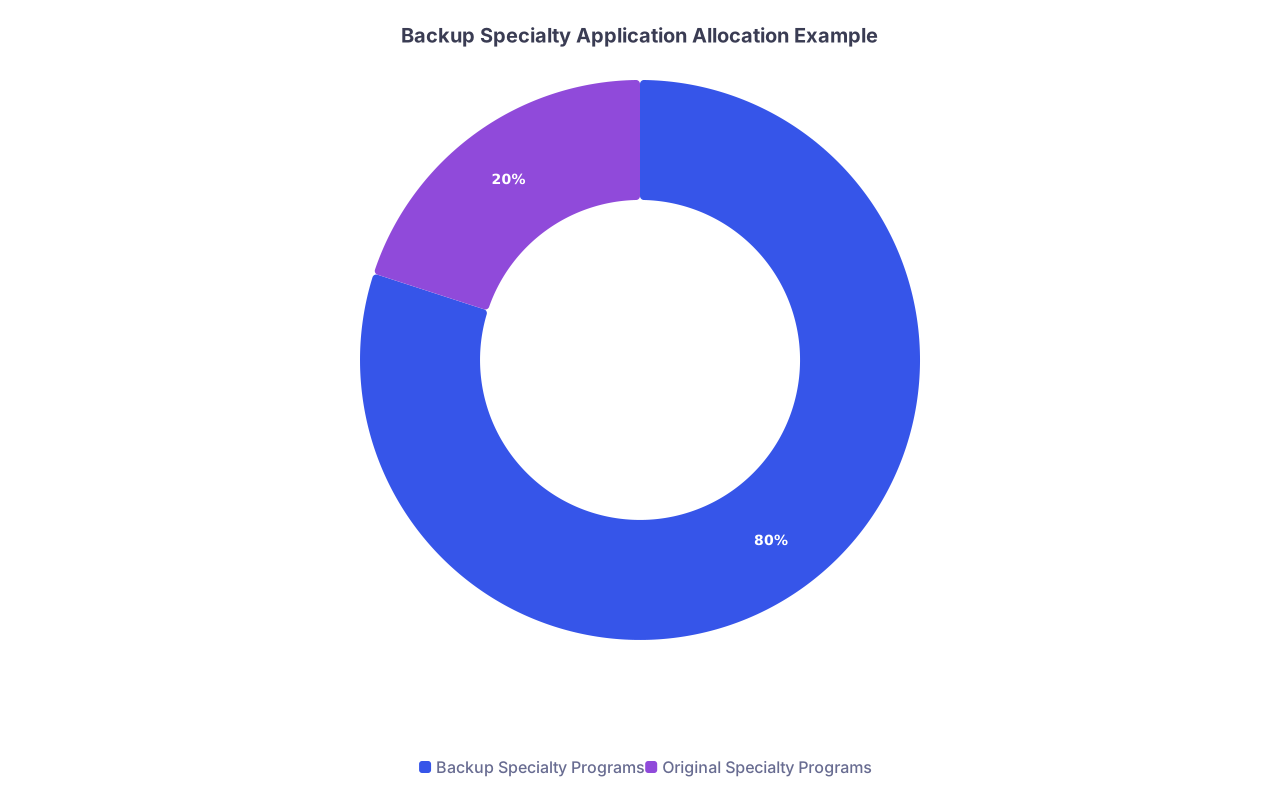
| Category | Value |
|---|---|
| Backup Specialty Programs | 80 |
| Original Specialty Programs | 20 |
Step 8: Manage the Psychological Side Without Letting It Ruin Strategy
You are dealing with real loss. I have seen excellent students spiral here and wreck their second chance.
You cannot afford that.
8.1 Allow a short “grief window,” then convert to structure
- Give yourself a real 3–7 days of being upset, venting, processing.
- After that:
- Decide your backup specialty
- Draft a 3–6 month plan with weekly targets:
- Application materials milestones
Structure beats anxiety. Every time.
8.2 Protect your references and reputation
Do not:
- Trash talk programs or the system on social media
- Send emotionally charged emails to PDs or coordinators
- Publicly blame others for your no-match
This stuff gets around. PDs remember.
Instead:
- Thank interviewers you had.
- Maintain a professional “I am regrouping and planning my reapplication” tone.
- Signal persistence and maturity, not bitterness.
Step 9: Example Scenario – How This Looks in Real Life
Let me make this concrete.
Case: Unmatched Ortho Applicant, US MD, Step 1 P/F, Step 2 = 230
Facts:
- 1 ortho research project, no publications yet
- 2 ortho away rotations, decent but not spectacular feedback
- 25 ortho applications, 2 interviews, did not match
- No SOAP position obtained
Raw read:
- For modern ortho, 230 and minimal research is a steep climb.
- Second try in ortho without elite research and new letters is low-yield.
Strategic backup choice:
- Backup specialty: General Surgery or Anesthesia
- Surgery: close to original field, many programs, acceptance of “hard worker” profiles
- Anesthesia: physiology focus, OR-based, large program counts
Year plan:
- Secure a 1-year research position in Ortho or Surgery at a strong institution that also has Anesthesia.
- While doing research:
- Attend OR cases, M&M, grand rounds in Gen Surg and Anesthesia
- Shadow anesthesia faculty regularly
- Ask: “I am planning to apply in Anesthesia. How can I get clinically involved now?”
- Produce:
- 2–3 abstracts/posters, ideally 1 manuscript in surgical/anesthesia-related topics
- Relationships with:
- 1–2 Anesthesia attendings
- 1 Surgeon who will vouch for your clinical work ethic
- Rebuild ERAS for Anesthesia:
- New personal statement focused on:
- OR environment
- Calm under pressure
- Interest in physiology/airway/critical care
- Letters:
- Two from Anesthesia
- One from Ortho or Gen Surg (emphasizing work ethic and team contribution)
- New personal statement focused on:
- Apply:
- 70–90 Anesthesia programs, heavy emphasis on community programs
- Possibly 10–15 Gen Surg as stretch/parallel path
This is what “strategic” looks like: not giving up on OR-based careers, but pivoting to a field where your numbers and timeline actually fit.

Step 10: What You Can Do This Week
Do not just nod and move on. Here is a one-week sprint that will move the needle.
Day 1–2
- Write out your full objective profile.
- List 2–3 possible backup specialties.
- Circle the single most realistic one.
Day 3–4
- Schedule meetings (email today) with:
- Your dean / advisor
- One faculty from your original specialty
- One faculty or mentor in the potential backup field
Day 5–6
- Draft a 1-page “pivot narrative”:
- Why you initially chose your original field
- What you learned after not matching
- Why your backup specialty now makes strategic and personal sense
- Outline a 12-month plan (even if rough).
Day 7
- Re-read that plan with a ruthless eye:
- Does this backup field actually accept applicants like you?
- Do you have a clear path to solid LORs?
- Are you prepared to fully commit, not treat it like a consolation prize?
If yes, you just built the skeleton of your strategic backup specialty.

FAQ (Exactly 4 Questions)
1. Should I tell programs I did not match previously, or keep it vague?
If you are reapplying after a no-match year, many programs will infer it from your graduation year anyway. You do not need to open with it, but you should be prepared to address it honestly when asked. In your personal statement, a brief, neutral line about using the last year to reassess and strengthen your candidacy is enough. In interviews, avoid emotional narratives; frame it as a growth period that clarified your fit with their specialty.
2. Is it realistic to match into a competitive field as a backup (e.g., Derm, Ortho, ENT)?
For most applicants who already did not match, no. Those fields demand either top-tier metrics, deep research portfolios at strong institutions, or both. If you missed once without those, you would usually need an extraordinary upgrade year (high-yield research at a name-brand center plus strong new LORs) just to be back in the game. For the vast majority, a truly strategic backup is in a field with more positions and historically more flexibility: IM, FM, Psych, Peds, Anesthesia, sometimes EM or Path.
3. Does taking Step 3 actually help for a backup specialty?
It can, but it is not magic. Step 3 helps most if:
- You had borderline Step 2 scores, and you now pass Step 3 comfortably.
- You are an IMG, and some programs explicitly prefer or require Step 3 for older grads.
It does not fix multiple failed attempts or poor clinical performance. Also, do not rush it. A failure on Step 3 is far more damaging than not taking it at all in many situations.
4. How many programs should I apply to in my backup specialty?
If you are coming off a no-match, err on the side of volume—strategic volume. For many backup fields (IM, FM, Psych, Peds, Anesthesia), that may mean 60–100+ programs depending on your risk factors (IMG status, older YOG, low scores). However, do not just shotgun randomly. Focus heavily on community and less competitive academic programs, in a wide set of regions, where your profile is realistically in their usual range. Wide but targeted beats narrow and wishful.
Open a blank document right now and title it “Backup Specialty Strategy – [Your Name]”. At the top, write your chosen backup specialty and then list three concrete actions you will complete in the next 7 days to move toward it. Then actually schedule those tasks on your calendar.