
You did not just “have bad luck.” Zero SOAP offers is almost never random. It is a systems failure. The good news: systems can be rebuilt.
I am going to walk you through exactly how to salvage your career from this point. No platitudes. No “keep your chin up.” A concrete, time-based protocol you can follow starting today.
You are not the first person this has happened to. Many of them are now practicing attendings. The difference between those who make it and those who fade out is very simple: who gets brutally honest, acts quickly, and follows a clear plan.
This is that plan.
Step 1: Contain the Damage (First 72 Hours)
Right now you are emotionally flooded and intellectually tempted to do something impulsive—mass emailing program directors, signing a random prelim year, or worse, doing nothing.
You need a 72-hour containment protocol.
1.1 Stop the panic moves
For the next 72 hours, do not:
- Fire off emotional emails to programs.
- Announce on social media that you are “done with medicine.”
- Sign any long-term contract (research, prelim, non-clinical job) out of desperation.
- Start a new personal statement or rewrite your entire ERAS in one night.
You are operating on adrenaline and shame. That is when people make career-ending decisions.
1.2 Tell the minimum right people, not everyone
You do need a small support team:
- A trusted faculty mentor (or two).
- Your dean’s office / student affairs / GME office contact.
- One or two close people who will not catastrophize (partner, sibling, friend).
Script this so you do not ramble:
“I did not match and got zero SOAP offers. I am upset, but I intend to reapply. I need help doing a structured post-mortem on my application and building a plan for the next 12 months.”
That sentence signals:
- You are serious.
- You are not asking for pity.
- You are focused on solutions.
1.3 Create a “Career Recovery” file
Open a new document and a dedicated folder. Name it something like Residency_Reapplication_2026.
Include sections:
- “What happened this cycle” – just the facts (specialty, number of programs, IVs, SOAP, etc.).
- “Data to obtain” – scores, rank, feedback requests, etc.
- “Action items” – you will fill this as we go.
This sounds trivial. It is not. The people who drift into a second failed cycle usually have everything scattered—emails, loose notes, vague plans. You are going to treat this like a project, not a vibe.
Step 2: Get the Hard Data on What Went Wrong
You cannot fix what you will not measure. Feelings like “I think my interviews were OK” are useless.
You need to build a rough diagnostic table on your application.
| Component | Your Data |
|---|---|
| Step 1 | |
| Step 2 CK | |
| Step 3 (if taken) | |
| USMLE failures | |
| COMLEX scores | |
| Attempts/Failures | |
| Specialty applied | |
| Total programs | |
| Interview offers | |
| Attended | |
| Rank list length |
Fill this out today.
2.1 Identify which bucket you are in
You are likely in one of these common scenarios:
Under-qualified for specialty, over-confident in numbers
- Example: 215–220 Step 2 CK, applied to 50+ categorical surgery or derm, few/no interviews.
- Reality: You aimed too high and too narrow.
Borderline scores + red flags
- Failed Step attempt, professionalism note, leave of absence.
- You may have been screened out or cut late in ranking.
Reasonable stats, poor strategy
- Good scores, but:
- Too few programs.
- Unwise specialty choice.
- Weak geographic strategy.
- Barely any back-up planning.
- Good scores, but:
Decent application, interview performance tanked
- Several interviews, but no match and no SOAP offers despite some prelim/less competitive programs on list.
- Often a communication or professionalism problem.
IMG/DO structural disadvantage
- Even with solid scores, late submission or weak U.S. ties can sink you.
You probably already know which one hurts to read. That is your likely category.
2.2 Build a feedback list
Make a short, targeted feedback plan:
- Dean’s office: Ask for a dedicated “reapplication strategy” meeting.
- 2–3 program directors or faculty who know you: Not cold-calling 50 PDs.
- 1–2 interviewers you felt went well: If appropriate, once emotions cool.
Email template you can adapt in a week or two:
Subject: Request for brief feedback on unsuccessful match
Dear Dr. [Name],
I hope you are well. I applied to [specialty] this past cycle and unfortunately did not match and did not receive a SOAP offer. I am committed to reapplying and improving my application.
If you have 10–15 minutes in the coming weeks, I would be very grateful for any candid feedback on the strengths and weaknesses you saw in my application or performance, so I can address them directly this year.
Thank you for your time and consideration.
Sincerely,
[Name], [School/Class Year]
Some will not respond. That is normal. You need just 2–3 honest voices, not universal validation.
Step 3: Choose Your Strategic Path (Not All Paths Are Equal)
The next 12–18 months are critical. You have to pick a primary lane, not dabble in everything.
Here are the main options, with pros, cons, and who they fit.
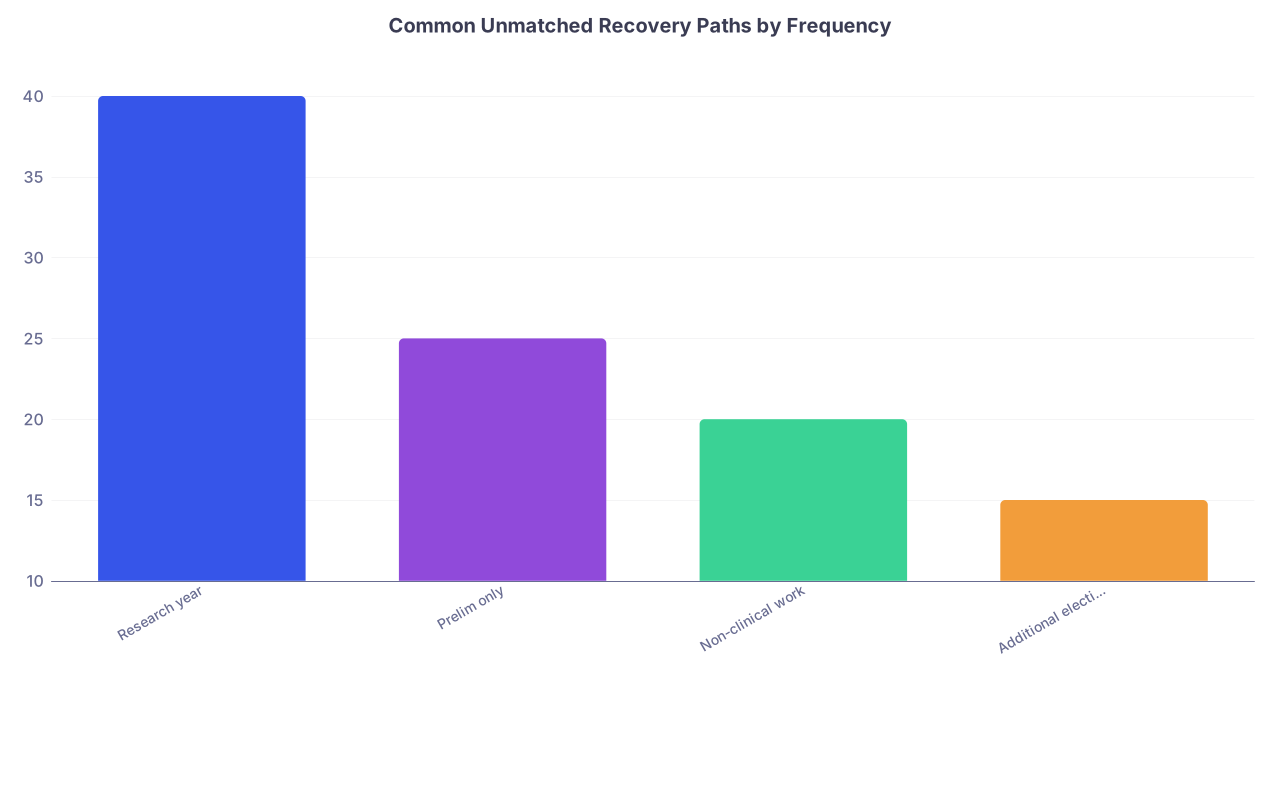
| Category | Value |
|---|---|
| Research year | 40 |
| Prelim only | 25 |
| Non-clinical work | 20 |
| Additional electives | 15 |
3.1 Path A: Reapply same specialty, significantly stronger
Best if:
- You love the specialty, not just the prestige.
- You were close: some interviews, decent scores, maybe SOAP interviews.
- You have a clear, fixable deficit (late app, weak LORs, no research, interview issues).
You must:
- Add one or both of:
- A strong, named research year in that field.
- Clinical year (prelim/TY) with real responsibility + strong letters.
- Widen your net geographically.
- Fix the application’s weakest two components in a big, obvious way.
This is not “let me tweak my personal statement and hope.” Programs must see a visibly different candidate.
3.2 Path B: Pivot to a less competitive specialty
Best if:
- Your scores are modest or include multiple failures.
- You applied to an ultra-competitive specialty (derm, ortho, plastics, ENT, etc.).
- You could be genuinely content in a different field.
Viable pivots, realistically:
- From surgical to:
- General surgery with prelim year.
- FM, IM, psych in some cases.
- From competitive cognitive to:
- IM with specific fellowship interest.
- FM, psych, path, neurology depending on your profile.
This is uncomfortable. Identity hits hard here. But I have seen many extremely happy physicians who pivoted from “dream specialty” to the one that actually gave them a career.
3.3 Path C: Do a prelim year now, reapply smarter
Best if:
- You have offers for a prelim or TY spot outside SOAP (or anticipate some post-SOAP).
- Your application is decent but needs time and clinical capital.
- You are willing to work hard and collect strong letters.
Risks:
- Prelim year can trap you if you do not aggressively reapply.
- It is exhausting to work 70–80 hours and run a reapplication campaign.
You must:
- Pick a prelim program with a track record of successfully placing people into PGY-2 or other specialties.
- From day 1, identify:
- PD
- APD
- 2 attendings who will likely write letters.
- Make your reapplication a structured part of your year, not an afterthought.
3.4 Path D: Dedicated research or non-clinical year
Best if:
- Your academic record is uneven but not disastrous.
- You are aiming for academic or research-heavy specialties (rad onc, neuro, IM subspecialties, etc.).
- You can secure a meaningful role, not just data entry.
Good signs in a research year:
- You are on at least 2–3 projects from the start.
- There is a realistic chance of 1–3 abstracts or posters in 12 months.
- You are in a visible lab or group; your PI is known in the field.
Bad signs:
- Vague promises.
- No protected time for interviews next cycle.
- You are the 5th “gap-year” student in a tiny lab with no track record.
Step 4: Build a 12-Month Recovery Timeline
You are not “waiting a year.” You are executing a 12-month project.
Here is a simple, aggressive timeline for someone reapplying next cycle.
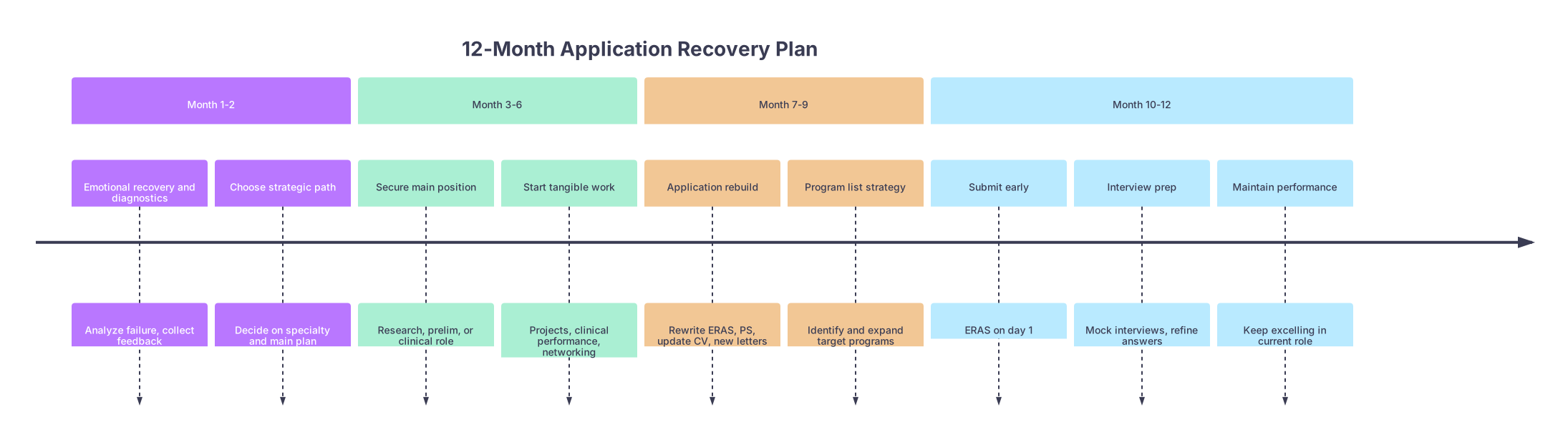
| Period | Event |
|---|---|
| Month 1-2 - Emotional recovery and diagnostics | Analyze failure, collect feedback |
| Month 1-2 - Choose strategic path | Decide on specialty and main plan |
| Month 3-6 - Secure main position | Research, prelim, or clinical role |
| Month 3-6 - Start tangible work | Projects, clinical performance, networking |
| Month 7-9 - Application rebuild | Rewrite ERAS, PS, update CV, new letters |
| Month 7-9 - Program list strategy | Identify and expand target programs |
| Month 10-12 - Submit early | ERAS on day 1 |
| Month 10-12 - Interview prep | Mock interviews, refine answers |
| Month 10-12 - Maintain performance | Keep excelling in current role |
Months 1–2: Diagnose and decide
Concrete tasks:
- Complete your diagnostic table and identify category of failure.
- Have 2–3 feedback conversations (dean, mentor, 1–2 PDs).
- Choose:
- Same specialty vs pivot.
- Prelim/clinical vs research vs non-clinical path.
- Update your
Residency_Reapplicationdocument with:- Chosen specialty.
- Chosen path (research year, prelim, etc.).
- Short statement: “Why this is my best strategic move.”
Months 3–6: Secure work that makes you more matchable
Your main job now: convert free-floating time into structured, CV-worthy experience.
Options, ranked roughly by impact:
- Accredited prelim/TY year with strong letters.
- Formal research fellowship in your target specialty, especially at a residency site.
- Clinical/research coordinator or hospitalist scribe-type roles at teaching hospitals.
- Remote or non-clinical jobs (only if absolutely nothing else is available; then supplement with local volunteering and observerships).

Your daily / weekly checklist in this phase:
- Weekly:
- Apply to at least 5–10 relevant positions (research, clinical).
- Email 2–3 targeted contacts (alumni, faculty, program coordinators).
- Daily:
- Spend 1–2 hours searching and applying for roles until you land one.
- Track every application in a spreadsheet: position, date, contact, result.
Do this ruthlessly. This is your job until you have a job.
Months 7–9: Rebuild the actual application
This is where many people fail. They do the work but present it poorly.
Key rule: Your new application must look obviously different from last year.
Areas to overhaul:
4.1 Personal statement
Your old personal statement is dead. Start over.
You need:
- A clear “why this specialty” that is not generic.
- A paragraph acknowledging your previous unsuccessful match briefly, if appropriate, framed as growth:
- “Last year, I applied to [specialty] and did not match. I used the past year to strengthen my skills in X, Y, Z…”
- Specific evidence of commitment: research, electives, patient cases, mentors.
Red flag content:
- Blaming programs.
- Over-explaining the failure.
- Sounding bitter or defensive.
4.2 Experiences and ERAS entries
Update:
- Titles
- Responsibilities
- Outcomes (abstracts, posters, QI projects)
Each major entry should have:
- 1 line: what the role is.
- 2–3 lines: what you did that shows initiative, reliability, and fit for specialty.
4.3 Letters of recommendation
You need fresh letters if at all possible, especially:
- From your current year (prelim, research, or job).
- From someone who can say:
- “I know they did not match last year, and I would strongly recommend them now.”
Ask explicitly for “a strong letter of support for residency reapplication”. If they hesitate, that is your answer. Find someone else.
Step 5: Fix the Interview Problem (If That Was You)
If you had interviews and still ended with zero match and zero SOAP offers, you cannot ignore interview performance.
Common problems I see:
- Talking too long.
- Rambling, unstructured answers.
- Over-sharing personal trauma without reflection.
- Coming off as negative about prior programs, school, or colleagues.
- Looking flat, disinterested, or “burned out.”
You need structured practice, not “I will just wing it better.”
5.1 Build a core answer bank
Write and refine answers to:
- “Tell me about yourself” – 60–90 seconds, not a life story.
- “Why this specialty?”
- “Why our program/this region?”
- “Tell me about a time you had a conflict on the team.”
- “Describe a mistake you made in patient care or training.”
- “You did not match last year. What did you do with this time?”
Use a simple structure like:
- Context (1–2 sentences)
- Action (what you did)
- Result (what changed)
- Reflection (what you learned or now do differently)
5.2 Get brutal mock feedback
Arrange at least:
- 1 mock interview with your dean’s office or career counselor.
- 1 with a resident or fellow in your target specialty.
- 1 recorded on your own (phone, laptop) that you watch back.
You are looking for:
- Verbal tics (“like,” “you know,” “um” every other word).
- Volume and speed.
- Eye contact and posture (even on Zoom).
- Whether your answers actually answer the question asked.
If multiple people tell you the same thing (“You sound defensive about last year”), fix that immediately.
Step 6: Apply Smarter, Not Just Harder
You cannot simply resubmit to the same 35 programs and hope.
6.1 Expand and diversify your program list
You need enough volume and diversity:
- More community programs.
- More geographically flexible options.
- Programs that historically take:
- DOs
- IMGs
- Reapplicants
- People with non-linear paths
This is where actual data helps.
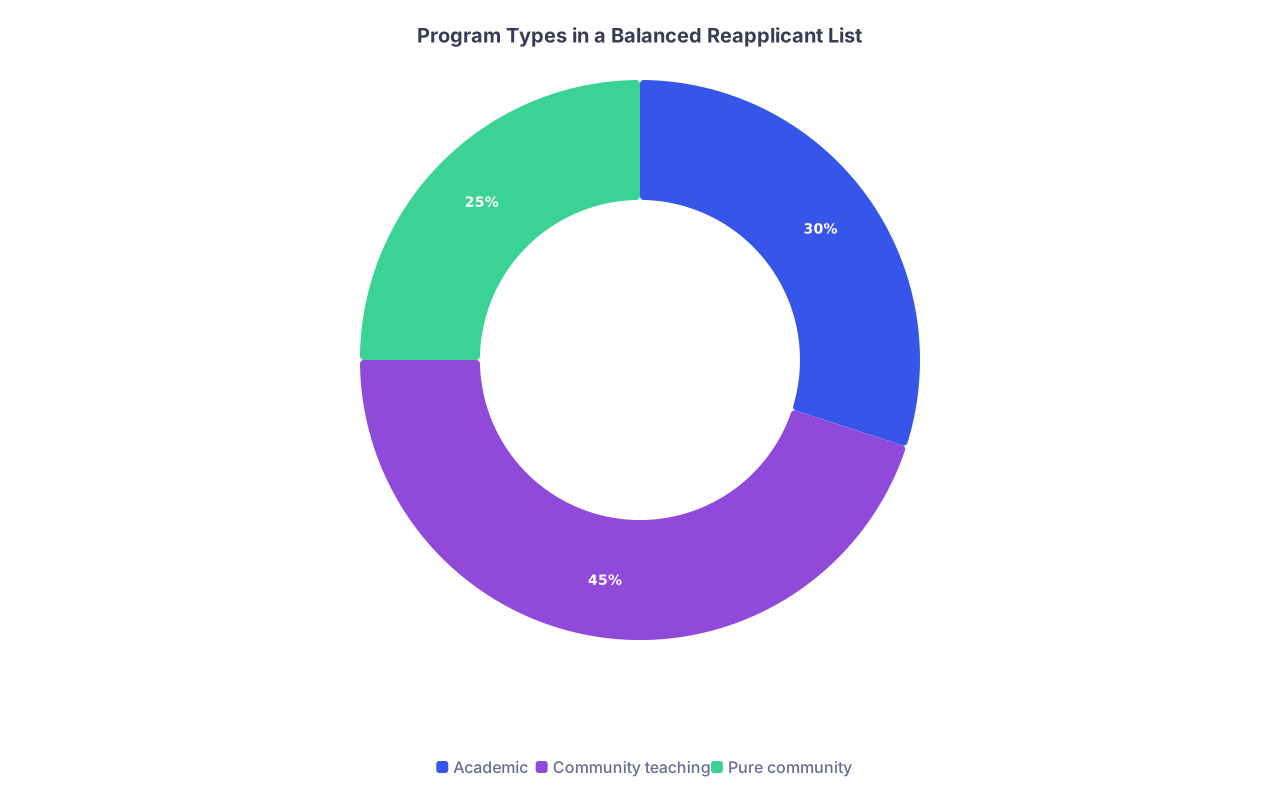
| Category | Value |
|---|---|
| Academic | 30 |
| Community teaching | 45 |
| Pure community | 25 |
Concrete steps:
- Use FREIDA and program websites to:
- Check % DO/IMG residents.
- See if they list minimum score cutoffs.
- Talk to current residents:
- Ask: “Does your program have reapplicants?” “Any PGY-1s who did a prelim year first?”
6.2 Submit early and clean
You are now on a tighter trust budget. Program directors will notice sloppiness.
Your checklist before submitting:
- ERAS:
- No typos.
- Dates consistent and believable.
- Gaps clearly labeled (“Unmatched graduate; research fellow at X”).
- Scores:
- All released.
- If you delayed Step 2/3, you now need them in hand.
- Letters:
- At least 3 specialty-specific letters.
- Prefer 1–2 from current year.
Submit on day one. Not week three. You no longer have the luxury of being “fashionably late.”
Step 7: What If You Strike Out Again?
Let me be blunt. It can happen. Zero SOAP offers once is painful. Twice feels catastrophic.
If that happens, do not lie to yourself. You now have to ask harder questions:
- Is there a different specialty where programs will see me as an asset, not a charity case?
- Am I willing to relocate widely, including less popular states and regions?
- Do I need to step away from direct patient care and use my degree differently?
Non-residency paths that are actually viable:
- Clinical research, especially if you already built that experience.
- Medical education roles (simulation centers, curriculum support).
- Industry positions (medical affairs, regulatory, clinical operations).
- Public health or informatics, with additional training.
I will be honest: these paths require just as much hustle as reapplying. But they are real careers, not failures.
A Quick Reality Check on Shame and Stigma
The match is brutal, opaque, and sometimes absurd. Good people get left out every year.
I have heard versions of:
- “I feel like I wasted my twenties.”
- “Everyone from my class is posting Match Day photos.”
- “My family is asking what went wrong.”
Here is the reality:
- Programs do not care that you are embarrassed. They care whether you look like a reliable, teachable PGY-1 this time.
- Peers move on shockingly fast. The memory of who matched where fades quickly.
- Faculty remember the people who recover and do well. Not the exact year they matched.
Your job is not to prove to the world that you are good enough. Your job is to build a file and a year that make it professionally foolish for a program director to ignore you.
That is all.

The Non-Negotiable Daily Protocol
If your brain is tired of paragraphs, here is the core protocol you can literally paste on your wall.
Every weekday until you secure a main position (research/prelim/clinical):
- Apply to 5–10 positions or reach out to 2–3 relevant contacts.
- Spend 30–60 minutes improving 1 part of your file (CV, ERAS draft, PS brainstorming).
Every weekday from securing position until ERAS opens:
- Do your actual job well enough that 2–3 people would happily write you a strong letter.
- Spend 30 minutes on:
- ERAS entries
- PS drafting
- Program list building
- Reading in your specialty
Every week from ERAS submission to rank list deadline:
- Review and refine your interview answer bank.
- Do at least 1 mini-mock (10–15 minutes) aloud.
- Track every interview, thank-you note, and follow-up in a simple spreadsheet.
You do not need to be perfect. You do need to be consistent.
What You Should Do Today
Do not “think about this later.” That is how people end up in the same spot next March.
Here is your next step for today, not “sometime this week**:
Open a blank document and write the header: “Why I Got Zero SOAP Offers – and What I Will Do Differently.”
Under it, force yourself to write:
- Three factual reasons this cycle failed (scores, strategy, interviews, red flags).
- One primary path you are leaning toward (same specialty + research, pivot, prelim, etc.).
- The names of three people you will email this week for feedback or support.
That is the start of your recovery plan. Once that is on paper, everything else becomes execution.