

Unmatched once… are you statistically dead in the water?
You’re staring at the NRMP screen, your stomach has dropped, and the line that matters is brutal: “You did not match to any position.” The myth hits instantly: No one matches after going unmatched. My career is over.
Let’s kill that.
Not with “stay positive” posters. With data. Because the story you’re probably telling yourself bears only a passing resemblance to what actually happens to unmatched applicants.
What the numbers really say about unmatched applicants
First, let’s look at what actually happens when people reapply. NRMP does not put this on a billboard, but it’s in their supplemental and outcomes data if you’re willing to dig.
Here’s the blunt version:
- Being unmatched once absolutely lowers your odds next cycle.
- It does not make it impossible.
- The single worst thing you can do is pretend nothing happened and reapply the same way.
Let’s frame this with some real numbers (rounded for clarity, US MD/DO focus, recent cycles):
| Applicant Type | Match Rate (Overall, all specialties) |
|---|---|
| US MD, first-time applicant | ~92–93% |
| US MD, previous unmatched | ~55–65% |
| US DO, first-time applicant | ~88–90% |
| US DO, previous unmatched | ~50–60% |
You can argue with a few percentage points depending on the year and specialty, but the pattern is stable: previous unmatched ≠ doomed. It means you’re now in the “needs a smart, strategic fix” category.
The myth says: “Unmatched once = never match.”
The data says: “Unmatched once = your odds drop, but a majority of serious re-applicants do match.”
Let me make that visual:
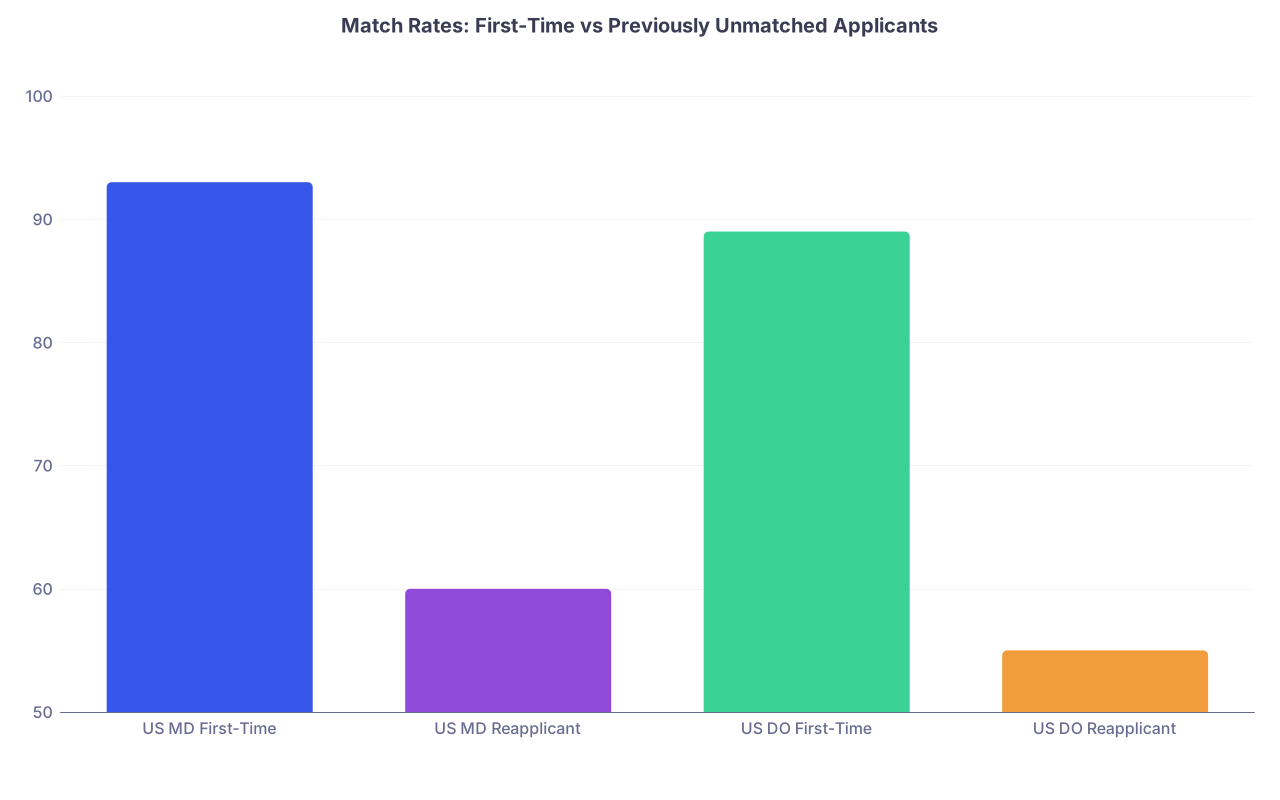
| Category | Value |
|---|---|
| US MD First-Time | 93 |
| US MD Reapplicant | 60 |
| US DO First-Time | 89 |
| US DO Reapplicant | 55 |
If you’re expecting 90% odds after an unmatched cycle, you’ll be disappointed. But if you think your chances are 0%? That’s just wrong.
The three actual problems after going unmatched
People love to blame a single thing: “It’s because I didn’t have research.” “It’s because my Step score wasn’t high enough.” It’s rarely that neat.
When I talk to unmatched grads who later match successfully, their first application attempt almost always failed for some combination of three issues:
Bad strategy
Not applying broadly enough, chasing unrealistic specialties, under-ranking programs, or skipping community programs. I’ve seen people apply to 30 derm programs with a 220 Step 1 equivalent and no publications, then act shocked. That’s not “bad luck.” That’s bad math.Unfixed profile deficits
Ugly red flags left unaddressed:- Fails or multiple attempts on Step 1/2.
- Big gaps in training.
- Weak or generic letters of recommendation.
- Completely missing US clinical experience (for IMGs) or very thin clinical exposure in the chosen field.
Invisible or sloppy application
The “I’ll just throw ERAS together the week before” crowd. Personal statement reads like ChatGPT wrote it in 30 seconds, experiences are bullet-point nonsense, no coherent narrative. Programs see hundreds of these. They remember none.
Here’s the part no one likes to admit: Reapplicants who fix all three—strategy, deficits, and presentation—match at very respectable rates. Those who fix none and just change the program list a bit? They usually repeat history.
What actually changes your odds the second time
Let’s separate fantasy from moves that reliably change outcomes.
1. Changing specialties (and which specialties you choose)
Switching specialties can move your odds more than almost anything else.
If you went unmatched in:
- Dermatology
- Plastic surgery
- Ortho
- ENT
- Neurosurgery
you are not “a failure.” You just aimed at the top 1–3% of competitiveness. The reapplication question is simple: are you willing to:
- Do a serious gap year with targeted research and a prelim/TY;
- or pivot to a less competitive field?
Plenty of people go:
- Derm → Internal Medicine
- Ortho → PM&R
- ENT → Anesthesiology
- Radiology → IM/FM
and have smooth, successful careers. The idea that this is “giving up” is a cultural problem, not a data problem.
To see the competitiveness gap:
| Specialty | Relative Competitiveness Tier |
|---|---|
| Derm, Plastics, ENT, Ortho, Neurosurg | Very High |
| EM, Anesthesia, Radiology, Ob/Gyn | Moderate-High |
| IM, Gen Surg, Psych, PM&R | Moderate |
| FM, Peds, Path | Lower (still not 'easy') |
If you reapply in the same very high-tier specialty with no major upgrade, your odds are low. That’s not fatalism. It’s statistical reality.
But pivoting from a hyper-competitive field to a moderate one, with a focused year of improved letters, clinical time, and a coherent story? I’ve watched that work again and again.
2. Fixing your story, not just your CV
Programs do not just evaluate your numbers. They evaluate your trajectory and your insight into why you missed.
You need to answer, implicitly or explicitly:
- What went wrong the first time?
- What have you concretely changed?
- Why are you more likely to succeed now?
I’ve seen this phrased well in personal statements and interviews as something like:
“Last cycle, I applied too narrowly and underestimated how much my lack of specialty-specific letters would impact my application. Over the past year, I completed a dedicated research year in pulmonary/critical care, took on ICU call, and earned strong evaluations from intensivists who saw my growth daily. I’m reapplying with a clearer understanding of the field and my place in it.”
That is much stronger than pretending the unmatched year is an awkward blank on your timeline and hoping nobody brings it up.
Quick translation:
If you act like nothing happened, programs will assume nothing changed.
3. Using the year intelligently, not just existing for 12 months
This is where unmatched applicants split into two groups: those who “take a year off” and those who treat it like an uncontrolled but fixable experiment.
Productive paths I consistently see pay off:
Structured research year in the same or closely related specialty
Especially with:- Real responsibility (not just pipetting in a closet).
- Abstracts/posters/papers where your name isn’t buried as #27 of 34.
- Exposure to faculty who can write credible, specific letters.
Prelim/TY year that actually builds your reputation
This is where a lot of people mess up. If you use a prelim year to:- Show up, be solid, get strong evals and letters;
- Network with PDs and associate PDs;
- Make it clear you’re committed to X specialty and not just passing time;
— your application can look very different the second time.
Dedicated clinical experience and remediation
For those with:- Exam failures: work with an actual learning specialist, get a clean Step 3, or a demonstrated turnaround on later exams.
- Weak clinical skills or professionalism comments: get into an environment where you can prove the opposite and get it documented.
Let’s be very clear on one thing:
A “research year” where you answer three emails, attend a meeting sometimes, and have no concrete output will not impress anyone. Programs can tell the difference.
4. Applying the right way the second time
You are no longer a first-time applicant. You don’t get to be cute with your application strategy.
Patterns that correlate with re-applicant success:
- Submitting early. Not “on time.” Early.
- Casting a wider net than your pride is comfortable with.
- Including community and smaller academic programs, not just brand-name places.
- Being honest with mentors and PDs about your last cycle and asking for targeted help.
I’ve seen US grads go from:
- 40 applications (mostly big-name academic centers) and 0 matches
to - 120 applications (mix of academic and community) and a solid match in a good, mid-tier academic program—
with essentially the same scores but a smarter plan and better letters.
Where the myth does have a grain of truth
Let’s be fair to the doomers. There are scenarios where going unmatched once really does tank your odds unless you dramatically change course.
These are the cases where the “you’ll never match” story is closer to reality:
- Multiple Step failures with no later, clean exam performance.
- Significant professionalism issues (documented) that you never address.
- Long, unexplained gaps with no clinically relevant work or growth.
- Reapplying in the exact same hyper-competitive specialty with no meaningful upgrade and no willingness to pivot.
I’ve seen grads insist on reapplying to ortho 3 cycles in a row with the same or worse application. At some point, programs don’t see dedication. They see inability to reassess reality.
But that’s not “unmatched once = never match.”
That’s “refuse to adapt = never match.”
Different problem.
SOAP vs reapply: the other misunderstood decision
Another place this myth grows is from what people do the week they learn they’re unmatched.
Some panic-SOAP into fields they:
- Don’t care about,
- Won’t be happy in,
- Will try to leave later.
Others refuse to SOAP for anything “beneath them,” then reapply with no stronger application and act stunned when outcome round two is the same.
Here’s the more honest breakdown of SOAP vs reapply:
| Path | When it Makes Sense | Main Risks |
|---|---|---|
| SOAP into any categorical spot | You want/accept that field, need income/visa, can see building a career there | End up in a specialty you resent, harder to pivot later |
| SOAP into prelim/TY | You absolutely need a position now, plan to reapply in different field | Stressful year, no guarantee of follow-up spot |
| Skip SOAP and reapply stronger | You can fund a year, have a realistic improvement plan and/or pivot | Wasting the year if you don’t actually strengthen your application |
The myth version:
“If you skip SOAP you’re done.” Or, “If you SOAP into any spot you’ll be trapped forever.”
Reality:
Both are tools. Both can be misused. Neither automatically ruins or saves your career.
I’ve seen:
- People SOAP into prelim medicine > crush the year > match into anesthesia or radiology.
- People skip SOAP, do a real research/clinical year, and match into solid categorical IM, peds, or psych.
- People SOAP into something they hate, do a miserable year, and fail to pivot because they didn’t plan.
The pattern isn’t SOAP vs reapply.
The pattern is: did you use your options strategically, or did you flail?
What actually predicts whether you will match next time
Let me be blunt. It’s not magic. It’s usually some mix of:
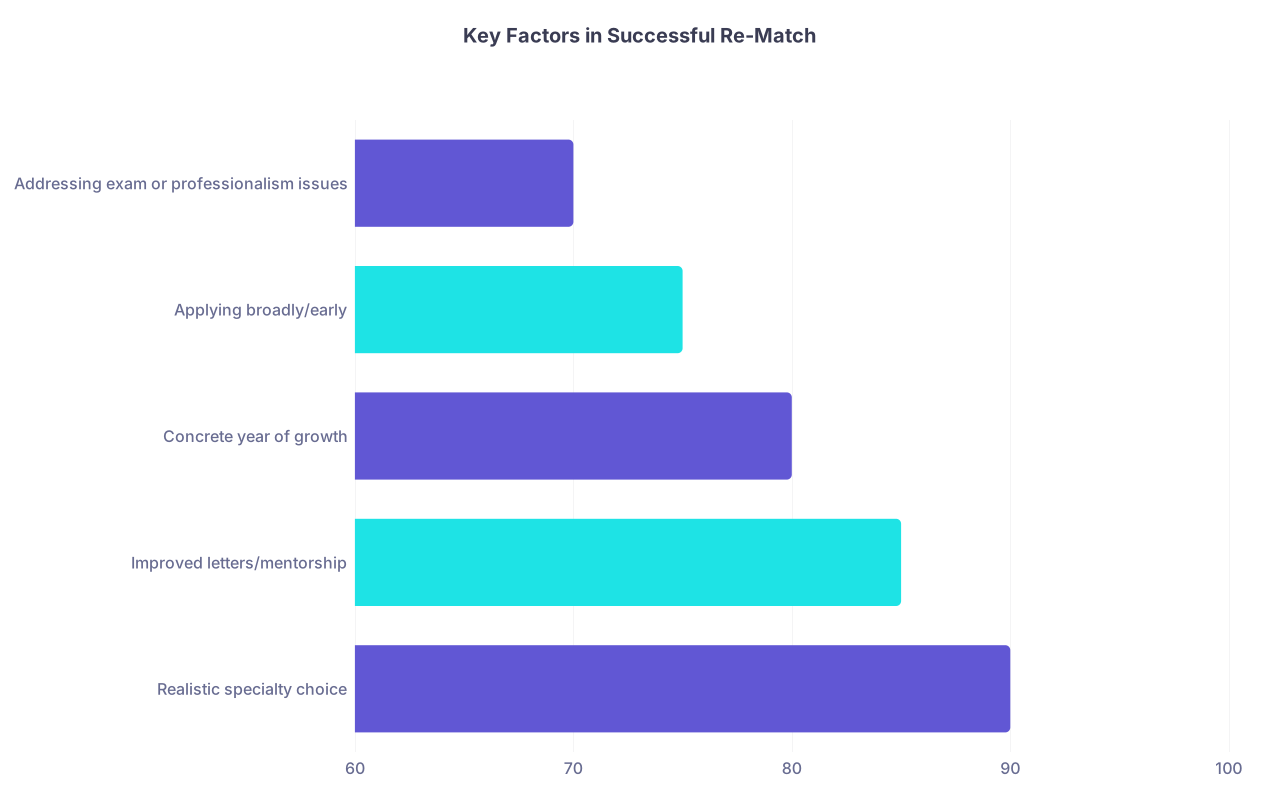
| Category | Value |
|---|---|
| Realistic specialty choice | 90 |
| Improved letters/mentorship | 85 |
| Concrete year of growth | 80 |
| Applying broadly/early | 75 |
| Addressing exam or professionalism issues | 70 |
Those percentages aren’t from NRMP; they’re my rough weighting from watching who actually succeeds. But the pattern is right.
You do not control that you went unmatched. You do control:
- Whether you get honest, sometimes harsh feedback from someone who has seen thousands of applications (PD, APD, dean, experienced faculty).
- Whether you’re willing to pivot specialties instead of clinging to a fantasy.
- Whether your gap year reads as dead space or measured, purposeful growth.
- Whether you pretend the first cycle didn’t happen—or you show you learned something from it.
I’ve sat in rooms where PDs discuss reapplicants. The phrases that get people ranked:
- “They really turned it around this year.”
- “Their letters are night and day better.”
- “They took responsibility for last cycle, no excuses.”
- “Colleagues I trust say they’re excellent on the wards.”
Not: “They were perfect all along and just got unlucky.” That’s not a convincing story; it’s denial.
How to think about your odds like an adult, not a catastrophizing MS4
If you went unmatched, do not ask, “Is my career over?” It’s a bad question.
Ask these instead:
Did I apply to a realistically appropriate specialty the first time?
If not, am I willing to change?Can I clearly state 2–3 big reasons my application failed last time—beyond “competition”?
Scores, letters, clinical experience, limited programs, late app. Be specific.What will be visibly different on paper and in letters next cycle?
Not internal mindset, not “I want it more,” but visible, verifiable changes.Who with PD-level experience has reviewed my full packet and given unfiltered feedback?
If the answer is “no one,” that’s your first fix.
You are not competing against an abstract idea of “perfection.” You’re competing against a large group of applicants, some of whom also have flaws but did a better job fixing or disguising them.
The goal is not to become flawless. The goal is to become clearly, credibly matchable.

| Step | Description |
|---|---|
| Step 1 | Unmatched |
| Step 2 | Get brutal feedback |
| Step 3 | Research/clinical year + strong letters |
| Step 4 | Choose realistic field |
| Step 5 | Fix app: PS, letters, program list |
| Step 6 | Apply early and broadly |
| Step 7 | Match more likely |
| Step 8 | Same specialty or pivot? |
The bottom line: what the evidence actually shows
Let’s strip this down to the essentials.
Unmatched once does not equal “never match.”
Your odds drop, but a well-planned reapplication—often with a specialty pivot and real growth—still gives you a very real chance.Doing nothing different is what kills people, not the first miss.
Reapplying to the same places, the same field, with basically the same CV, is how you turn one bad year into a permanent story.The applicants who match after going unmatched are the ones who treat it like data, not destiny.
They diagnose why they missed, fix what’s fixable, accept what isn’t, and build a visible, coherent story of growth.
You are not your Match outcome. You are what you do next year in response to it.


