

Being unmatched once does not brand you with a permanent scarlet letter. The idea that “once unmatched, always damaged goods” is wildly overstated and often flat-out wrong.
You will hear the opposite from panicked classmates, bitter seniors, and the occasional catastrophizing attending. “PDs never forget.” “You’re done.” “It follows you forever.”
I spend a lot of time looking at actual numbers, NRMP surveys, and PD behavior patterns. The data tell a much less dramatic story—and a more nuanced one:
Unmatched ≠ permanently stigmatized.
Unmatched + no growth / no plan / no transparency = big problem.
Let’s pick this apart properly.
What Program Directors Actually Say About Prior Unmatched Status
Program directors are annoyingly practical. They don’t sit around cackling over old SOAP lists. They care about three big things:
- Can you do the work safely?
- Are you likely to finish the program?
- Are you going to be a headache—for them, faculty, or patients?
Your prior unmatched status only matters insofar as it feeds those questions.
The NRMP keeps handing us free intel on this every couple years: the Program Director Survey. If you have not pulled up a PD Survey PDF and actually looked through the “factors in selecting applicants” tables, you’re operating mostly on rumor.
In those tables, you’ll see things like:
- USMLE Step 2 CK / COMLEX Level 2-CE score
- Failing Step/Level on first attempt
- MSPE narrative
- Clerkship grades
- Personal statement
- Gaps or unexplained time
But you’ll notice something interesting: there is no line item that says “Previously unmatched.”
Why? Because “previously unmatched” is not directly coded into ERAS. PDs infer it from:
- Graduation year misaligned with norm
- Multiple application cycles
- Gaps between graduation and residency without clear reason
They care about the why, not the mere fact.
Here’s the heart of it:
If you went unmatched, cleaned up your weaknesses, and present a clear trajectory, most PDs will not treat you as permanently tainted. Many will actually see resilience and persistence—if you make their risk calculus feel safe.
Is there stigma in some corners? Yes. But it’s more like a yellow flag, not a skull-and-crossbones.
The Numbers: How Often Do Unmatched Grads Eventually Match?
You’ll hear people say, “Nobody ever matches after going unmatched.” That’s not just wrong; it’s mathematically impossible given how many prelims, reapplicants, and SOAP survivors show up in intern classes every July.
From NRMP and related data (ballpark numbers across recent cycles):
- About 5–10% of US MD seniors and 10–20% of DO seniors in competitive years don’t match on the first try (depends on specialty choices and number of ranks).
- A non-trivial fraction of those eventually match in a later cycle, especially if they:
- Pivot to a less competitive specialty
- Fix test / application issues
- Get real clinical experience
A simple way to frame it:
| Scenario After Unmatched | Typical Outcome Trend | PD Perception Risk |
|---|---|---|
| No new activity, no new exams, same specialty | Poor match odds | High |
| Strong Step 2/3 or Level 2/3 improvement, solid gap year plan, target more realistic specialty | Reasonable match odds | Moderate |
| Meaningful US clinical work, strong letters from recent supervisors, transparent explanation | Often successful | Lower |
Is the second-time match rate as high as first-time seniors? No. You’ve lost the advantage of being a “fresh” senior. But “lower probability” is not “impossible” and definitely not “permanently stigmatized.”
How PDs Actually Judge Someone Who Went Unmatched
Let me translate the quiet part PDs say in small rooms:
“What burned them last time, and is it still burning?”
They look for a pattern. Here are the major lenses they use.
1. Did you learn anything, or did you just re-submit the same weak file?
If your second application looks like a screenshot of the first—same weak Step 2, same lukewarm letters, same unrealistic specialty choices—you’ve basically confirmed their worst fear: you don’t self-reflect and you don’t adapt.
That’s not “stigma.” That’s just a bad bet.
On the other hand, PDs notice when you clearly used the off-cycle time well:
- Step 2 or 3 retaken or taken late with a clear jump
- New, strong letters from recent supervisors
- Fresh clinical work (especially in the US, especially in the specialty you’re now targeting)
- A personal statement that actually owns the prior outcome and explains what changed
I’ve heard versions of this from PDs in IM, FM, and Psych:
“I don’t care that they went unmatched. I care that they spent the year as a glorified scribe and learned nothing, versus someone who showed me a strong Step 3 score, inpatient experience, and clear professional growth.”
2. Can you explain the gap without hand-waving?
PDs hate mystery. They do not need a dramatic story; they just want a coherent one.
Bad version:
“I had personal circumstances and was unable to match but I grew a lot.”
Translation: Nothing concrete. Red flag.
Better version:
“I applied to X specialty with an over-aggressive list, did not match, and realized I needed more robust clinical experience and a stronger Step 2 CK. Over the past year I have worked as a medicine intern in my home country/clinical fellow/NRMP-approved research position, completed Step 3 with a score of 240, and obtained new letters that reflect my recent performance.”
That kind of story reduces the feeling of risk. And PDs are in the risk-management business.
Data from PD Priorities: What Actually Hurts More Than Being Unmatched
Here’s where the stigma narrative really falls apart. There are things PDs rate as huge red flags far above “this person previously went unmatched.”
From PD surveys and what they reliably report as “major” negative factors:
- Failure of Step/Level on first attempt
- Multiple exam failures
- Unexplained or poorly explained time gaps
- Unprofessional behavior / professionalism issues
- Negative comments in MSPE or prior evaluations
- Poor interview performance
If you stack these, going unmatched one cycle due to overly competitive specialty choice is a minor sin compared to:
- A failed Step 1 and Step 2 that still look weak
- A professionalism write-up in the MSPE
- A vague year “off” doing nothing clearly related to medicine
In other words: if you went unmatched but used that time to improve, PDs may view your overall profile more favorably than a “first-time” applicant with chronic issues and no upward trajectory.
Here’s a simple risk lens they use:
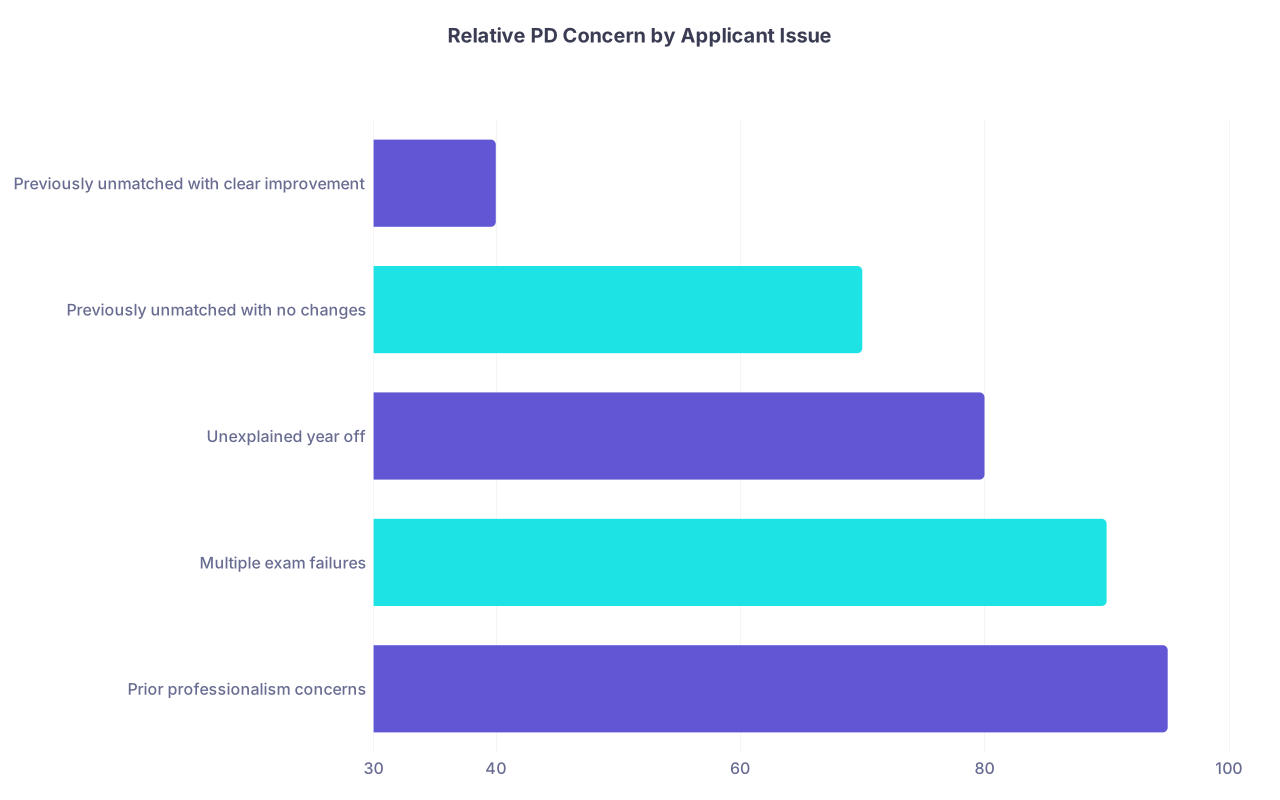
| Category | Value |
|---|---|
| Prior professionalism concerns | 95 |
| Multiple exam failures | 90 |
| Unexplained year off | 80 |
| Previously unmatched with no changes | 70 |
| Previously unmatched with clear improvement | 40 |
You’d rather be in the last category than the first three. Every time.
Where Stigma Is Real: Patterns That Do Haunt You
Let’s be honest: there are scenarios where being unmatched does follow you around and seriously hurts.
Multiple unmatched cycles with minimal change each time.
At some point, PDs conclude you’re not realistic or coachable. Now it’s not about the original miss; it’s about your judgment.Weak or non-existent recent medical activity.
If you’ve been out of hands-on medicine for 2–3+ years with nothing but a vague research assistant gig or unrelated jobs, they worry your clinical skills are rusted and your transition will be painful.You lie or spin obviously.
PDs compare your story with documents. If your MSPE, timeline, and explanation do not match, trust evaporates fast.You cling to ultra-competitive fields with no corresponding improvement.
Reapplying to Derm or Ortho with the exact same CV and no new publications/Step scores is a red flag for poor insight. The stigma then is “this person won’t adapt,” not “they went unmatched once.”
So yes, repeated cycles without transparent growth can create a sustained negative impression. But that’s not some mysterious meta-stigma; it is the natural consequence of behavior.
Why People Believe the “Permanent Stigma” Myth
This is the part where I get slightly blunt: most of the loudest voices about matching are people who have never sat on a selection committee.
The myth survives because:
Students see patterns in tiny samples.
“I know one guy who went unmatched and never matched anywhere.” Cool. I can show you one guy with a 260 who didn’t match Derm. Anecdotes are not policy.Faculty repeat old narratives from a different era.
The match landscape in 2005 is not the match landscape now. USMLE Step 1 going pass/fail alone reshuffled risk calculations.It feels safer to catastrophize.
Telling students “if you don’t match the first time you’re done” is a crude way to scare them into over-applying and over-studying. Fear is lazy pedagogy.Shame loves permanence.
When someone doesn’t match, it feels like a personal verdict. That emotion then gets retrofitted into a story: “This will always define me.” The data just do not back that up—if you act strategically afterwards.
Practical Reality Check: What Actually Improves Your Chances After Unmatching
You want to know what PDs actually respect in reapplicants? Not inspirational quotes. Concrete moves.
The reapplicants who turn things around usually have a combination of:
A specialty pivot that makes sense.
Dropping from ENT to IM with Step 2 225 and strong medicine letters? Rational. Applying again to ENT with nothing new? Magical thinking.New, strong letters from recent supervisors.
An IM PD will take a 2025 letter from a hospitalist who supervised you on wards over a stale 2022 letter from an attending who barely remembers you.Step 2 or Step 3 that changes the risk profile.
A jump from 220 to 240 on Step 2 or a solid Step 3 can quiet a lot of anxiety, especially in IM, FM, Psych, Peds.Clear, honest framing in the personal statement.
Two to three sentences. Own the miss. Show what you did about it. Move on. No drama.Evidence of functioning in a system similar to residency.
Transitional-year spots, prelim medicine, clinical fellow posts, structured research with call and patient exposure—these all matter more than some random “observer” experience.
Here’s how PDs often mentally categorize reapplicants:
| PD Bucket | Description | Typical Outcome |
|---|---|---|
| “Learner” | Clear improvement, realistic pivot, good recent letters | Often interviewed, frequently matched |
| “Static” | Same scores, same specialty, vague gap usage | Rarely ranked, often unmatched again |
| “Risky” | Long gaps, professionalism questions, inconsistent story | Almost never taken unless desperate |
Your job after going unmatched is straightforward: make it painfully obvious you belong in the “Learner” bucket.
The One Thing You Cannot Do: Hide It
Some applicants try to camouflage the fact they went unmatched. They downplay the year. They omit details. They hope PDs won’t connect the dots.
They will. They do this for a living. They are suspicious of gaps like radiologists are suspicious of unexplained densities.
Strategically, it’s far better to:
- Acknowledge the prior outcome briefly and professionally
- Anchor the conversation on what changed: skills, scores, maturity, clarity about fit
- Make your recent performance impossible to ignore
No, you do not need a one-page essay on your emotional journey. PDs are not your therapist. They simply need to understand: “Is this person now ready, and did they use that year like a professional?”
Visual Reality: Where the Real “Damage” Comes From
Let me make this brutally clear with a simple conceptual graph.
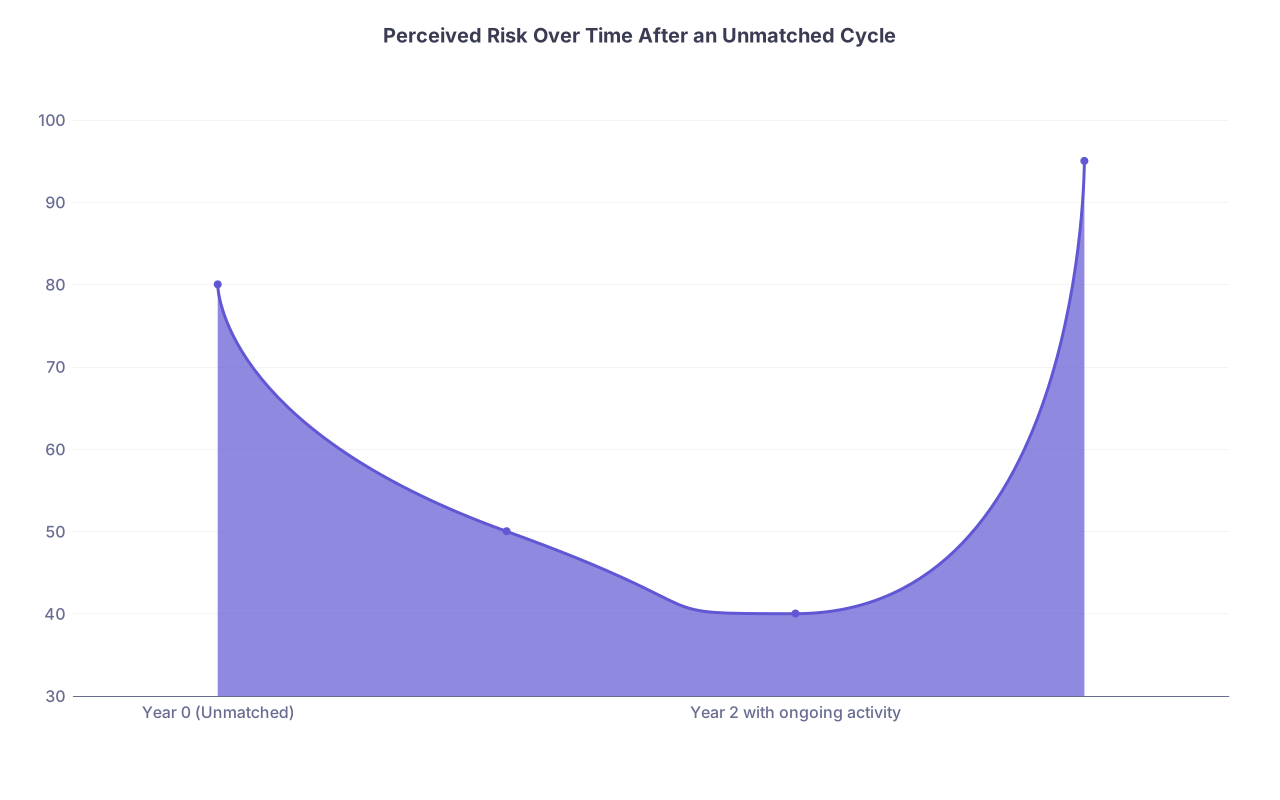
| Category | Value |
|---|---|
| Year 0 (Unmatched) | 80 |
| Year 1 with strong improvement | 50 |
| Year 2 with ongoing activity | 40 |
| Year 2 with inactivity | 95 |
Translation:
- Immediately after going unmatched, PDs see you as higher risk (they just watched the system reject you).
- If you respond with clear gains—scores, work, letters—that risk perception drops sharply.
- If you drift, the risk perception actually climbs because now it looks like you cannot recover or maintain your skills.
The “permanent stigma” isn’t from the unmatched label itself. It’s from inactivity, denial, and weak narratives afterwards.
Bottom Line: What Actually Matters
Strip away the noise, and here’s what the data and PD behavior actually show:
Going unmatched once is not a permanent stain.
It’s a yellow flag that PDs re-evaluate in context of what you did next. Plenty of people match on a second attempt—with the right adjustments.PDs care far more about your recent trajectory than the old verdict.
New scores, new letters, credible clinical work, and a realistic specialty pivot matter more than the mere fact you previously failed to match.The real “stigma” comes from failing to change, not from failing to match.
If you treat the unmatched year like a wake-up call and not a life sentence, most PDs will treat it the same way.


