

You do not have to abandon your specialty after one failed Match. The blanket “just switch to something less competitive” advice is lazy, fear-driven, and often wrong.
Let me be blunt: I’ve watched people panic-switch into a specialty they do not like based on one bad match cycle—and then spend the next decade trying to rationalize it. I’ve also seen others double down on the same competitive specialty, clean up their application, add one smart gap year, and match into exactly what they wanted.
Same initial problem. Two completely different trajectories. The difference was not “competitive vs less competitive.” It was strategy vs reflex.
Let’s dissect the myth properly.
The Myth: “You Didn’t Match, So You Must Go Lower”
The unspoken algorithm people use goes like this:
Did not match → Specialty is too competitive → You are not good enough → Switch to something “easier” → Problem solved.
It sounds rational. It’s not. It ignores three huge realities:
- “Competitiveness” is relative and context-specific.
- There are multiple distinct reasons for not matching, and they don’t all mean “you’re outclassed.”
- One extra year can radically change your odds—without changing specialties.
Let’s start with the competitiveness lie.
What “Competitive” Actually Means (And Why It’s Misused)
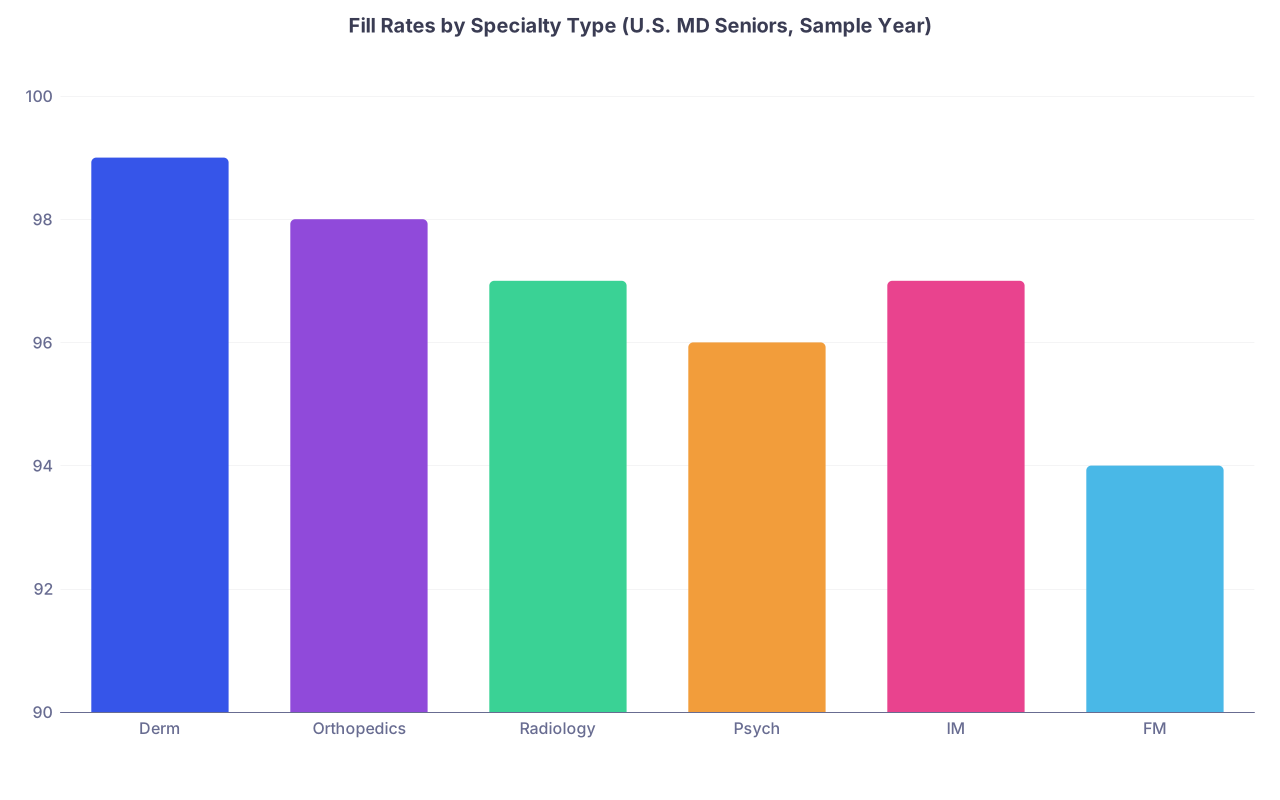
People throw around “competitive” like it’s a ranking of human value. It is not. It’s a function of supply, demand, and self-selection.
| Category | Value |
|---|---|
| Derm | 99 |
| Orthopedics | 98 |
| Radiology | 97 |
| Psych | 96 |
| IM | 97 |
| FM | 94 |
The fill rates for U.S. MD seniors in many specialties are all clustered in the 94–99% range. The difference is in:
- Applicant-to-position ratio
- Typical Step 2 scores
- Proportion of applicants with research, AOA, home programs, etc.
“More competitive” usually means: more applicants with strong metrics fighting for fewer spots. It does not automatically mean your individual odds are terrible, especially if you’re close to the median applicant profile.
Now, here’s the important part: Match failure is often less about the specialty’s overall competitiveness and more about your application strategy and signal quality. I’ve seen people go 0/15 interviews in internal medicine (supposedly “less competitive”) and then match radiology the next year. Same human. Different plan.
So when somebody tells you, “Just switch to family or psych, it’ll be easier,” they’re skipping the only question that matters:
Why did you not match?
First Question After a No Match: What Actually Went Wrong?
You cannot answer “switch vs stay” until you perform a post-mortem. No exceptions. And no, “It’s super competitive” is not an analysis.
The main buckets:
Application volume and range problem
- You applied to 20 ortho programs when the average serious applicant applies to 60+.
- You only applied to coastal academic programs with no geographic ties.
- Your list was prestige-driven, not probability-driven.
Red flag / filter problem
- Step 1 or Step 2 score below many programs’ interview automation cutoffs.
- Failed a rotation, gap in training, professionalism concern.
- IMG/DO status with no adjustment in school list strategy.
Signal and content problem
- Weak letters (generic “pleasant to work with” nonsense).
- Poorly aligned experiences (e.g., zero psych exposure but applying psych).
- PS and ERAS content that look generic or confused.
Interview performance problem
- Good interview volume but almost all pre-match rejection.
- Feedback like “a bit rigid,” “not sure about fit,” “uncertain commitment.”
True profile–specialty mismatch
- Repeated, consistent feedback across multiple years and settings that your performance or temperament is out of line with expectations in that field.
Only the fifth scenario strongly points toward switching specialties. The rest are fixable—sometimes more fixable than people want to admit.
Data Reality: Many Successful Matchers Are Reapplicants
You rarely hear this publicly because nobody loves announcing they failed the first time. But reapplying—sometimes to the same field—is common.
The NRMP’s reapplicant data (varies by year, but the pattern holds) shows:
- Reapplicants do have lower match rates than first-timers.
- But a meaningful fraction still match into the same competitive specialties when they address specific weaknesses.
So the question isn’t “Is it riskier to reapply to derm/ortho/ENT/etc?” Yes, of course it is. The question is: does your actual profile put you in that reapplicant group with a solid chance after improvement, or in the group that’s basically dead in that field?
That’s not emotional. That’s a numbers and content audit.
The Wrong Way to React: Panic-Switching After One Miss
I’ve seen this too many times:
Someone goes unmatched in something like EM or radiology, spends five panicked days in SOAP, gets a prelim medicine year, and in the background everyone is whispering: “Next cycle, just apply IM and be done with it.”
So they do. Not because they want IM. Because they’re embarrassed and exhausted.
Fast forward: They’re PGY‑2, doing continuity clinic, hating chronic disease management, scrolling job postings for the specialty they actually wanted, feeling trapped. They technically “fixed” the no-match problem but created a career problem.
You cannot treat a one-year setback like a lifelong verdict.
When It Makes Sense to Stay in the Same Specialty
Let me be crystal clear: staying in the same specialty after a no match is not delusional if certain conditions are true.
You should strongly consider reapplying to the same field if:
Your metrics are close to competitive medians
- Step 2 is within ~5–10 points of the field’s matched median for your degree type.
- No catastrophic failures or professionalism red flags.
You had some interview traction
- You got, say, 4–10 interviews but did not match.
- This often points to interview or ranking strategy issues, not hopeless candidacy.
You can materially improve your application in 1 year
- Targeted research in that specialty with real output (posters, pubs).
- Strong, specific new letters from known faculty.
- A tailored prelim or TY year that keeps you in the game clinically.
You actually like the work enough to grind another year for it
- If you’d gladly trade 12 more months and some uncertainty for a good shot at the field, you’re in the “reapply is reasonable” camp.
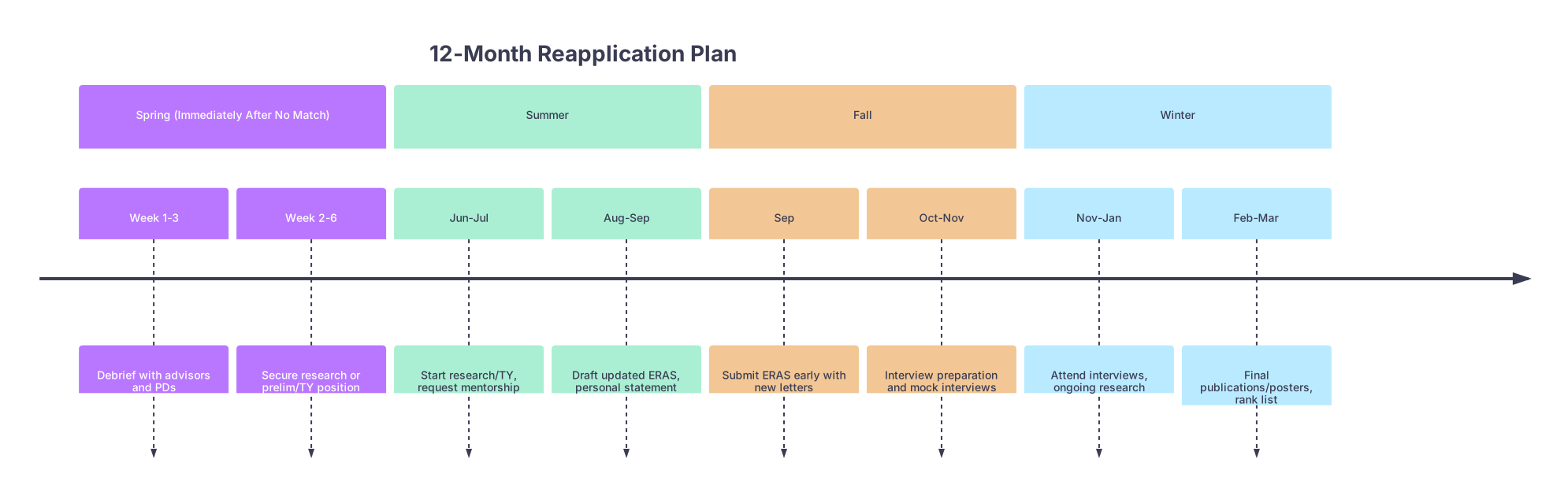
Here’s what a smart same-specialty gap year can look like.
| Period | Event |
|---|---|
| Spring (Immediately After No Match) - Week 1-3 | Debrief with advisors and PDs |
| Spring (Immediately After No Match) - Week 2-6 | Secure research or prelim/TY position |
| Summer - Jun-Jul | Start research/TY, request mentorship |
| Summer - Aug-Sep | Draft updated ERAS, personal statement |
| Fall - Sep | Submit ERAS early with new letters |
| Fall - Oct-Nov | Interview preparation and mock interviews |
| Winter - Nov-Jan | Attend interviews, ongoing research |
| Winter - Feb-Mar | Final publications/posters, rank list |
Key difference from wishful thinking: you are not “just trying again.” You’re entering as a clearly upgraded applicant with real, verifiable changes.
When It Makes Sense to Switch to Another Specialty
Switching is not failure. It’s only failure if you do it thoughtlessly. There are situations where it’s the rational move.
Consider switching if:
Your objective metrics are far below field norms
- Step 2 in the 210s for a field where the average matched U.S. MD is in the mid‑250s and DOs or IMGs are rare.
- Multiple exam failures in a hyper-screened field.
You had zero or near-zero interview traction despite broad applications
- You applied widely (including community, lower-tier, and different regions) and got 0–2 interviews.
- Your school list was realistic, not fantasy.
You cannot realistically improve the weak points in 1–2 years
- Serious professionalism or evaluation issues that programs openly flagged.
- Visa constraints, financial constraints, or personal factors that limit an extra dedicated year.
You find another specialty you genuinely like, not just “less competitive”
- You’ve done rotations and have seen the day-to-day, not just rumor-based takes.
- You can articulate why you see yourself there beyond “I just want to match.”
This is where strategic “switch but still be happy” thinking matters. Not all “less competitive” options feel the same in reality.
Smart Switching: Not All Alternatives Are Created Equal
If you do decide to switch, you still need to avoid lazy thinking. “Just go into internal medicine” is not a plan.
Think in terms of fit plus probability. Something like this:
| Specialty | Competitiveness Level | Fit for Applicant | Realistic Match Chance (Reapp) |
|---|---|---|---|
| Dermatology | Very High | Moderate | Low |
| Radiology | High | High | Moderate |
| Anesthesiology | Moderate-High | High | Good |
| Psychiatry | Moderate | Medium | Good |
| Family Med | Lower | Low | High |
You’re better off in a “moderate” field you actually like and can sell convincingly than a “low” field you resent. Programs feel that resentment in your application and interview.
A few “switching smart” principles:
- Do at least 1–2 rotations or electives in the new specialty.
- Get at least two strong letters from that field.
- Rewrite your narrative: do not try to erase your past; explain your pivot cleanly.
- Avoid dead giveaways of desperation like wildly applying to 4 completely unrelated specialties in the same cycle with copy-pasted narratives.
SOAP and Prelim Years: Not Just Consolation Prizes
You can use SOAP and prelim / TY years strategically instead of as “whatever spot I can get.”
Three main rational plays:
Prelim year aligned with original specialty
- Example: unmatched general surgery applicant takes a surgery prelim year at a solid program, does well, gets to know faculty, and either gets converted to categorical or receives strong backing for reapplication.
Transitional year as a bridge while you decide
- Gives you clinical continuity, income, and time to gather real information and experiences before locking in a new specialty.
SOAP into a related or moderately competitive field that you could live with long-term
- If you match there and genuinely like it, great.
- If you still want your original specialty, you can occasionally still pivot later (though the door narrows).
The worst pattern is: soap into something you dislike → tell yourself it’s temporary → get financially and logistically locked in → wake up 5 years later wondering what happened.
Evidence vs Emotion: What the Data Tends to Show
General trends from NRMP and specialty-specific data (plus what PDs quietly tell you over coffee):
- Programs like seeing meaningful improvement in reapplicants—scores going up, new publications, better letters.
- A single no-match is rarely a permanent red flag if addressed head-on and explained.
- Multiple reapplications to the same field with minimal change and no insight do start to look bad.
- DOs and IMGs have a narrower margin for error in ultra-competitive specialties—but not a zero chance if they plan aggressively and honestly.
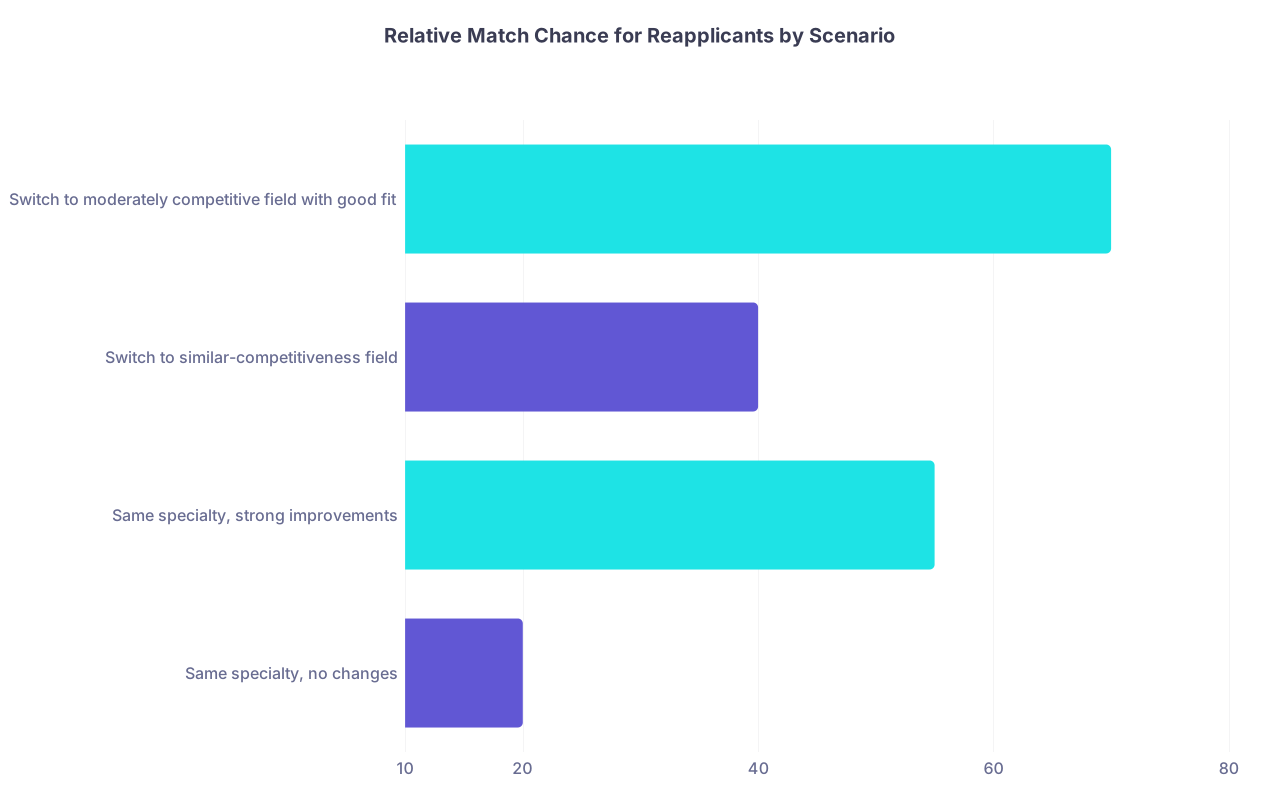
Here’s a simplified mental model of your reapplication risk:
| Category | Value |
|---|---|
| Same specialty, no changes | 20 |
| Same specialty, strong improvements | 55 |
| Switch to similar-competitiveness field | 40 |
| Switch to moderately competitive field with good fit | 70 |
Not actual percentages, but the relative pattern is real. Repeat the same thing? Low odds. Improve or align better? Much higher.
How to Actually Decide: A Practical Framework
You want a decision tree, not vibes. Here’s a stripped-down version.
Ask yourself, honestly:
Did I get at least 3–4 interviews in my desired specialty?
- If yes → you’re on the radar. Focus on interview and narrative issues.
- If no → look very hard at metrics, red flags, and school list.
Am I within striking distance of typical metrics for matched applicants in this field for my degree type (MD/DO/IMG)?
- Within 5–10 Step 2 points and no major professionalism issues → maybe stay.
- Way below, or multiple failures → switching becomes more rational.
Can I realistically improve my application in one strong year?
- If you can add research, LORs, and a clinical year that all signal commitment: staying is defensible.
- If constraints make that impossible, switching is smarter.
If I woke up 10 years from now in Specialty X vs Specialty Y, which day would I rather live?
- If the original specialty still wins by a large margin, it’s likely worth another shot.
- If you’re already rationalizing, that’s your answer.
The One Thing You Cannot Outsource
You can get opinions from PDs, advisors, mentors, Reddit, and strangers on the internet who love telling people “just go into primary care.”
But none of them will live your actual day-to-day life as an attending.
The myth says: no match = you must drop down to something less competitive.
Reality says: no match = you must do a brutally honest post-mortem, then either:
- Reapply to the same field with documented, meaningful improvements, or
- Pivot to a different field you can genuinely commit to, not just tolerate.
Bottom Line
- A single no-match does not automatically mean you must switch to a “less competitive” specialty. That’s lazy advice.
- The real decision hinges on why you did not match, how close your profile is to typical matched applicants, and whether you can make tangible improvements in one year.
- Switching can be smart—but only when it’s based on honest fit and realistic odds, not panic or shame.


