

You’re not actually afraid of wasting a year. You’re afraid this year proves everyone was right to doubt you.
Let’s just say it out loud. Not matching feels like public failure. It feels like your worst med school nightmares are now your LinkedIn reality. You’re picturing classmates starting intern year while you’re at home refreshing Gmail, wondering if your career just… stalled out permanently.
I’m going to be blunt: the fear that “a gap year after no match will ruin everything” is exaggerated. Not made up. Not trivial. Just exaggerated.
Programs absolutely will look at what you did with that year. They will judge it. They will ask about it. But they are not sitting around thinking, “No match = automatic reject forever.” They’re thinking, “Show me you didn’t collapse and stay there.”
That’s the whole game this year: don’t collapse and stay there.
Let’s walk through this like someone who can’t stop running worst-case scenarios in their head. Because that’s you. And honestly, that’s fair.
First: Let’s Acknowledge the Panic You’re Actually In
You’re not just disappointed. You’re spiraling:
- “If I didn’t match this year, who says I’ll ever match?”
- “Programs will see I’m reapplying and assume I’m damaged goods.”
- “Everyone else will be a PGY‑1 and I’ll be… what? Living at my parents’ house?”
- “I only had 4 interviews. Next year it’ll be 0.”
- “Did I just burn my last real chance at being a doctor?”
People around you keep saying unhelpful things like, “It’s not the end of the world,” or “Everything happens for a reason,” which mostly makes you want to scream.
Here’s the thing I’ve watched play out in real life, more than once:
Two people don’t match. Same specialty. Same approximate stats. Same level of devastation.
One of them treats the year like a holding pattern. Casual research. Maybe a few shifts. Half-hearted rewrite of the personal statement three days before ERAS opens again. They reapply with a slightly shinier version of the same application.
The other treats the year like a mission. Structured job. Letters. Real improvement. They don’t just “stay busy.” They create a story:
“I hit a wall. I regrouped. I came back stronger and more prepared.”
Guess which one actually matches next cycle.
Not because life is perfectly fair. But because programs can see the difference between “unlucky” and “unprepared,” and between “learned from it” and “hoping it’ll magically work out this time.”
What Programs Actually Think When They See a Reapplicant
Let’s get inside their heads for a second, because right now, your imagination is inventing monsters.
When a PD or faculty sees a reapplicant, these are the quiet questions in their brain:
- “Why didn’t this person match the first time?”
- “What did they do with the time since then?”
- “Are they actually better prepared now, or is this the same applicant in new font?”
- “Can I trust that they’ll show up, work hard, and not crumble under stress?”
They don’t expect perfection. But they do expect growth.
What they do not like to see:
- A year of essentially nothing clinical.
- Vague “research assistant” jobs with zero clear output.
- A personal statement that barely acknowledges what happened.
- No new letters of recommendation.
- Same test profile, same red flags, same everything.
What calms them down:
- You stayed in the clinical world in some real way (research with patient contact, full-time scribe, prelim year, transition‑to‑practice role if you’re an IMG).
- You can clearly explain what you learned about yourself and your specialty choice.
- Your letters are updated and specifically say you’d be a strong resident.
- Your application shows maturity, not bitterness.
A gap year is not the problem. An empty year is.
First 1–2 Months: Stabilize, Then Strategize (Not the Other Way Around)
The temptation is to panic-apply to random jobs, sign up for 6 research projects you’ll never finish, and rewrite your personal statement 12 times in a week.
Don’t.
The first couple of months should be brutally honest assessment plus basic emotional triage.
Step 1: Let yourself feel it — but put a timer on the freefall
You got punched in the gut. Mentally and physically. Give yourself a couple of weeks to be devastated. Sleep. Cry. Go offline. Hate everything.
But set a date—literally on a calendar—when “pure coping” shifts into “planning.” That might be 2 weeks after Match Week. Maybe 3. Not 3 months.
Step 2: Postmortem your application like an attending tearing apart an H&P
Look at your app the way a skeptical PD would:
- Scores: Were they average for your specialty, or significantly below? Did you fail a step exam?
- Clerkships: Any fail or conditional pass? Any professionalism dings?
- Specialty choice: Were you aiming for something brutally competitive (like derm, ortho, plastics) with middle-of-the-road stats and minimal research?
- Interview numbers: Did you have 0–3 interviews? That usually means systemic issues (late app, poor communication, weak letters, narrow school list).
- Geography: Did you apply too regionally? Too top-heavy? Not enough programs?
- Letters: Did you have strong, specific clinical letters from people who really know you?
- Personal statement: Did it actually sound like you, or like a thesaurus-generated robot trying to impress?
If you’re not sure where you went wrong, that’s a sign to get outside feedback. Not from your class group chat. From:
- A trusted advisor at your school.
- A PD or APD willing to review honestly.
- A faculty mentor in your specialty (or the one you’re considering pivoting to).
You need someone who will say, “These scores make X specialty an uphill climb,” or “Your app doesn’t read committed to this specialty,” or “You applied to 30 programs when you needed 80.”
Step 3: Decide: same specialty, different specialty, or strategic pivot
Sometimes the worst-case scenario actually happens: your dream specialty may not be realistic with your stats and timeline.
That doesn’t mean “give up on medicine.” It means, “Do I double down with a stronger app, or do I pivot to a field where my odds are actually decent?”
This part is agonizing. You might need several conversations with people who are not trying to protect your feelings.
The “Make It Count” Year: What Actually Moves the Needle
Here’s where your fear of “wasting a year” can actually help you. Because you’re right: random busywork won’t help.
Programs care most about three buckets: clinical engagement, competence signals, and narrative.
1. Clinical engagement: You stayed close to patients and teams
If you disappear from clinical medicine for a year, programs get spooked. They wonder if you’re rusty. Or ambivalent.
Depending on your location and status, think about roles like:
- Full‑time research assistant on a clinical team, where you attend rounds, help with patient-facing projects, or at least work in a hospital system.
- Scribe in ED, primary care, or specialty clinics (for IM/FM/peds/EM applicants, this can actually help a lot).
- Teaching-focused roles that still keep you grounded in medicine (clinical skills tutor, anatomy TA, etc.), ideally combined with some shadowing.
If you’re an IMG, sometimes there are formal research fellowships or “observer” roles tied to big academic centers. Those can be gold if they come with real mentorship and eventual letters.
The main question to ask before accepting a role:
“Can this position realistically lead to a strong letter from someone who has seen me show up consistently and work like a resident?”
If the answer is no, reconsider.
2. Competence signals: Scores, research, letters, and actual output
Programs are wary of people who look identical to last year.
You want your next application to scream: “New data. New proof.”
This can look like:
- Step improvement (for DO or IMG applicants still taking Step 3 or COMLEX, or if you had a fail to redeem).
- Solid research output: an abstract, poster, or paper with your name on it. Doesn’t have to be NEJM. It just has to be real and relevant.
- New letters from this gap year: “In the time they worked with us, they consistently behaved like an intern.”
- Teaching evaluations if you’re in a medical education role.
Don’t sign up for 8 projects with no clear mentor and no timeline. Take 1–3 projects with a realistic path to completion and a PI who’s known for actually getting stuff published or presented.
3. Narrative: Why this year wasn’t just a holding pattern
This is the part nobody tells you to work on, but it’s what PDs listen for in interviews.
You need to be able to say, clearly and without self-pity:
- Why you think you didn’t match.
- What you did to address those weaknesses.
- What this year taught you about yourself as a future resident.
There’s a big difference between:
“I didn’t match, so I worked as a research assistant.”
and
“I realized my application didn’t show enough depth in [specialty]. I took a full-time research position on a [specialty]-focused team, where I attended conferences, joined rounds, and worked directly with residents and attendings. It confirmed that this is where I fit, and let me contribute to two projects we’re presenting at [conference]. I also learned how to manage workload, respond to feedback, and communicate in a busy clinical environment.”
Programs care about that second version. Not because they want a speech. But because it shows insight and agency instead of defeat.
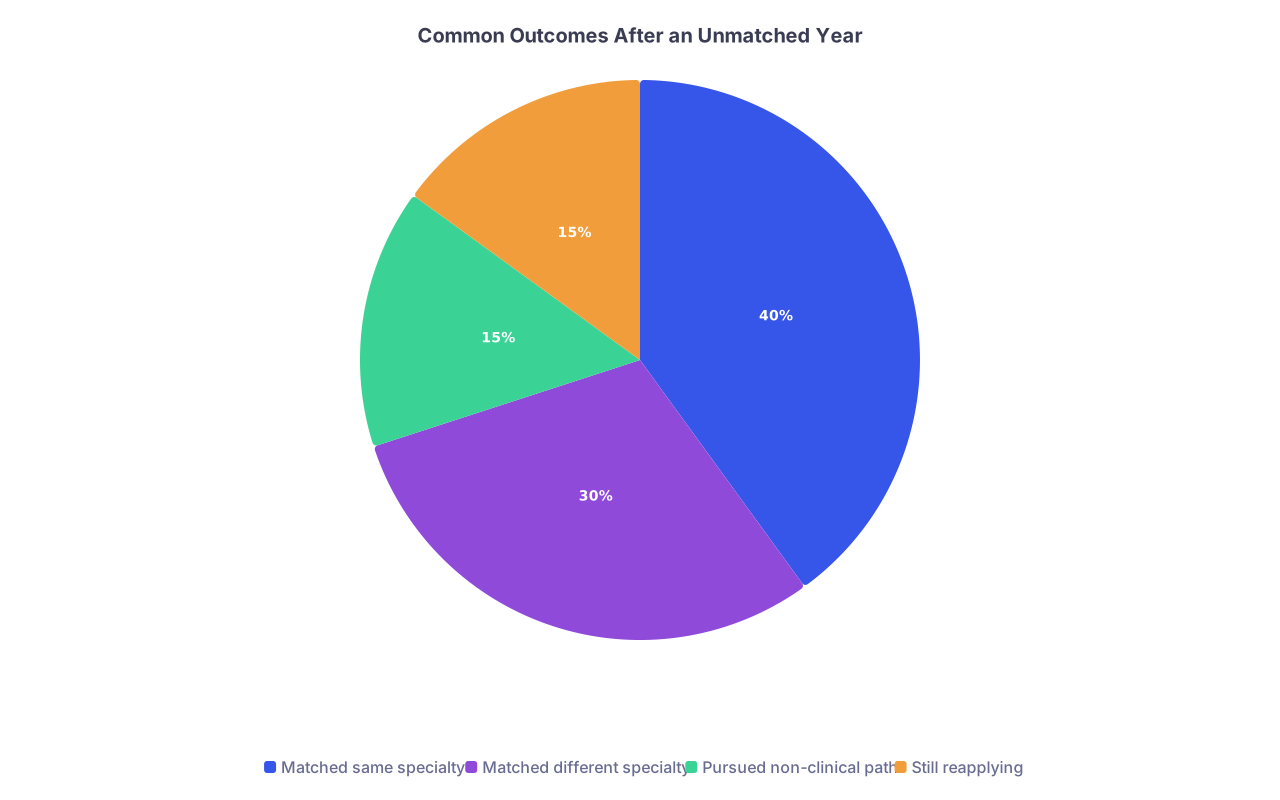
| Category | Value |
|---|---|
| Matched same specialty | 40 |
| Matched different specialty | 30 |
| Pursued non-clinical path | 15 |
| Still reapplying | 15 |
What If You’re Terrified You’re Too “Behind” Now?
You can feel the timeline sliding away, right? Everyone else moving forward, you stuck.
You’re doing mental math:
“If I match next year, I’ll start residency at [age]. Then fellowship would be [age]. What if I want kids? What about loans? What if I never catch up?”
Here’s the part that takes a while to believe: nobody inside residency cares if you’re 1–3 years older than your co-interns. They barely know how old anyone is. They care if you show up on time, follow through, don’t crumble, and aren’t a jerk on nights.
I’ve watched people start residency at 24 and fall apart. I’ve watched people start at 34 and crush it.
Being “behind” is mostly a story in your own head.
That said, the fear is useful if it keeps you from wandering through this year half-asleep. If you’re going to lose a year on paper, you want to gain five years of maturity in how you present yourself.
Money, Immigration, and All the Stuff That Makes This Even Scarier
There’s the emotional fear. And then there’s the very real practical dread.
You might be thinking:
- “I can’t afford a year with no real income.”
- “I’m on a visa. I literally might have to leave the country.”
- “My loans are coming due. This is not hypothetical.”
This is where the “just do research” advice becomes insulting. Not all research roles pay enough. Not all IMGs can just hop into another year easily.
You might need to:
- Take a paid clinical or research job that’s not perfectly aligned but keeps you in the ecosystem and pays the bills.
- Talk to your loan servicer early about deferment, forbearance, or income-based plans.
- If you’re on a visa, speak with an immigration attorney who actually understands the medical training pathway. Don’t crowdsource this from Reddit.
And yeah, you may end up working more hours than feels ideal because you need the paycheck. You may not have the perfect “I did this prestigious research fellowship.” That doesn’t mean the year is wasted.
Programs are not stupid. They get that people have to eat. I’ve seen PDs be impressed by someone who said:
“I worked full-time as a scribe/MA to support myself while also joining one research project and staying involved in clinical shadowing.”
Real life responsibilities don’t disqualify you. They often make you more relatable.

How to Talk About Not Matching Without Sounding Broken
You’re terrified someone will ask, “So… why didn’t you match?” and your brain will explode.
Here’s what programs are listening for in that answer:
- Ownership without self-destruction.
- Insight without oversharing trauma.
- Growth without sounding like you read a self-help script.
A solid structure for your answer:
Brief, factual reason
“My initial application was weaker in [X: scores / number of programs / timing / experience]. As a result, I had fewer interviews and ultimately didn’t match.”What you did about it
“Over the past year, I addressed that by [role, research, exam, mentoring, additional clinical time].”What you learned and how it makes you a better resident
“This experience really forced me to develop [resilience, time management, humility, communication], which I’ve been applying in [specific work examples].”
What you don’t want to do:
- Blame specific programs.
- Blame your school.
- Blame “the system” in a way that sounds bitter and fatalistic.
You can acknowledge systemic issues—especially as an IMG or someone from a non-traditional path—but anchor your story in what you controlled.

| Step | Description |
|---|---|
| Step 1 | No Match |
| Step 2 | Emotional Recovery 2-3 weeks |
| Step 3 | Application Postmortem |
| Step 4 | Targeted Gap-Year Role in Specialty |
| Step 5 | Explore Alternative Specialties |
| Step 6 | Clinical/Research + New Letters |
| Step 7 | Update Personal Statement & ERAS |
| Step 8 | Reapply with Stronger Narrative |
| Step 9 | Same Specialty? |
Signs You’re Actually Making This Year Count (Even If It Feels Like You’re Drowning)
You probably won’t feel “on track” at any point this year. You’ll just feel behind in a different way.
So here are quieter signs you’re actually using the year well:
- A real human being (PI, attending, supervisor) sees you consistently enough to write you a detailed letter.
- You can describe your daily work in concrete terms: “On a typical day I…” instead of “I’m kind of helping with…”
- You can clearly answer, “Why this specialty, again, after all this?”
- You’re actually getting better at something measurable: data analysis, presenting at journal club, running a patient list, teaching junior students.
- When you look at next year’s version of your ERAS, there are at least 3–4 things you can point to and say, “That wasn’t there before—and it matters.”
If you can’t name those things by late summer, that’s your cue to adjust, not a sign you’re doomed.
| Plan Type | Weak Version | Stronger Version |
|---|---|---|
| Clinical | Occasional shadowing, loosely scheduled | Full-time scribe or MA with consistent schedule and supervisor |
| Research | Volunteering on many projects, no clear role | 1–3 projects with defined tasks, PI mentorship, and timeline for output |
| Education | Casual tutoring a few classmates | Formal role as TA or course instructor with evaluations |
| Narrative | “I just kept busy this year” | Clear story: specific goals, actions, and lessons learned |
You’re Not Wasting a Year. You’re Living the Part Nobody Posts About.
This is the unglamorous part of becoming a doctor.
Not the white coat photo. Not the Match Day envelope. The part where you get knocked flat, and there’s no guaranteed comeback story yet, and you still decide to act like someone who will eventually be responsible for real lives.
You’re terrified this year will define you. It won’t.
What will define you is whether you treat this as proof you’re a failure—or as one brutal, expensive, exhausting, character-revealing training block before residency ever starts.
Years from now, you won’t remember every email you sent or every shift you worked in this gap year. You’ll remember that at the very moment it felt easiest to give up or coast, you chose to build a life you’d be proud to explain in an interview—and to yourself.


