

It’s March. Your phone buzzes with the email from NRMP. You already know that horrible cold feeling in your chest before you even open it. You didn’t match your chosen specialty. Now you’re sitting on your bed, your suit still hanging on the closet door from your last interview, staring at your rank list like it personally betrayed you.
And the question that keeps looping, louder than anything else:
“Did I pick the wrong specialty? Did the Match just prove that I’m not meant for this?”
Let me say this clearly, because your brain is going to fight me on it:
Not matching your chosen specialty does not automatically mean you picked wrong.
But I also won’t sugarcoat it: it does force you to ask some hard questions. And your anxious brain is going to ask all the wrong ones first.
Let’s untangle this.
First: What Not Matching Actually Means (And What It Doesn’t)
Your brain is probably doing the dramatic version:
“I didn’t match → Programs saw I was a terrible fit → I chose the wrong field → My career is doomed.”
That chain is garbage. Here’s what “I didn’t match” can mean:
- You applied to a very competitive specialty (or combo, like ENT or Derm or Ortho with specific locations)
- You under-applied (not enough programs, too geographically restricted, too late)
- Your Step/COMLEX scores or clinical grades were below the mean for that specialty
- Your application had gaps (weak letters, limited research for research-heavy fields, no narrative that tied things together)
- The interview season was brutal (fewer spots, more applicants, virtual weirdness)
And here’s what it doesn’t automatically mean:
- “You don’t belong in that specialty”
- “You’re not good enough to ever practice in that field”
- “You misread your personality and interests”
The Match is a numbers game mixed with a fit game mixed with a vibes game. It’s not a perfect moral judgment on whether your soul is aligned with anesthesia or psych or surgery.
Still, the fear is valid: “What if the fact that I didn’t match is actually a sign I picked wrong and just ignored it?”
Let’s get more concrete.
Was It the Specialty… or the Strategy?
You need to separate two things:
- Your career choice (specialty)
- Your application execution (how you approached the Match)
Most people blend them into one emotional collapse: “I didn’t match → my whole plan is wrong.” No. You have to do the annoying, granular breakdown.
Here’s the kind of brutally honest table I’d have you fill out on paper, not just in your head:
| Area | How Competitive Was I Really? |
|---|---|
| Scores vs specialty average | Above / At / Below |
| Number of programs applied | Aggressive / Average / Too Low |
| Geographic flexibility | Anywhere / Region-only / City-only |
| LOR strength | Outstanding / Solid / Generic |
| Research for this field | Strong / Some / Almost none |
| Clinical exposure in field | Deep & focused / Okay / Thin |
If most of those land in the “below / too low / too limited / thin” categories, that points way more toward a strategy/application problem than “I chose the wrong specialty.”
On the other hand, if your stats, letters, exposure, and strategy were actually solid and you still didn’t match, then we ask a different set of questions:
- Did your narrative actually show why you belong in this specialty, or did it sound generic?
- Did you get interviews but then not rank enough broadly?
- Did you get almost no interviews? (That’s often a signal issue somewhere in your file.)
None of this equals “you picked wrong.” It might equal:
- You underestimated how cutthroat this specialty is
- You didn’t fully understand what programs in this field prioritize
- You aimed only for “name” or highly desirable locations and got squeezed out
Annoying? Yes. Fatal to your dream? No.
The Million-Dollar Question: Do You Still Actually Want This?
Here’s the part you probably don’t want to admit out loud.
There’s a difference between:
“I didn’t match and I’m devastated because I still deeply want this specialty”
vs.
“I didn’t match and a part of me is… relieved?”
If you feel 100% crushed, can’t imagine letting go of this field, and you still perk up when you talk about those patients/procedures/days on that rotation—then no, you probably didn’t “pick wrong.” The system just didn’t pick you this time.
If you feel mixed—some sadness, but also a quiet sense of “maybe this is my out?”—then you owe it to yourself to listen to that. Not panic-react to it, but actually sit with it.
Ask yourself, away from Instagram, classmates, family expectations:
- When I picture doing this specialty every day for 30 years, does my chest feel tight or calm?
- If it were equally competitive, would I still choose it—or was I chasing prestige, lifestyle, external validation?
- On my rotations, did I like the actual day-to-day or did I mostly like saying “I’m going into ____”?
I’ve seen plenty of people not match their “dream” field, pivot to something they barely considered before, and later say, “Honestly, I’m glad the Match forced the issue. I’d picked for the wrong reasons.”
I’ve also seen people not match, double down with a smart reapplication plan, and land in exactly the specialty they wanted on the second try.
Both situations exist. Your job now is to be painfully honest about which lane you’re in.
Common Scenarios: Where Do You Fit?
Let me walk through a few patterns I’ve seen over and over. You’ll probably recognize yourself in one of these.
Scenario 1: The “Competitive Field, Average Applicant” Story
You applied to something like Derm, Ortho, ENT, Plastics, Rad Onc, maybe even highly selective EM or Anesthesia this year.
Your stats:
- Step 2: roughly at or a little below the national average for that specialty
- Not much research or not in that specific field
- Decent but not rockstar letters
- You applied to, say, 40–60 programs and mostly in certain cities/regions
You got some interviews. Or maybe only a couple. You didn’t match.
Does this mean you picked the wrong specialty? No. It means you took a pretty big swing in a saturated field and the numbers didn’t break your way.
If you still love the field, your choices are:
- Pursue a gap year with research, prelim year, or a transitional year and reapply stronger
- Broaden your geographic range and program list massively next cycle
- Make peace with the risk that even then, there’s no guarantee (which sucks, but is true)
Scenario 2: The “Strong Application, No Interviews” Red Flag
This one stings differently. You had:
- Great scores
- Solid research
- Strong clinical performance
- Still barely any interviews or none at all
Now I’d be suspicious of:
- A red flag in your file (failed exam, professionalism issue, weird dean’s letter)
- A truly bad personal statement or confusing narrative
- Limited or generic letters that didn’t actually endorse you
- Extremely narrow geographic preferences
Does this mean you chose wrong specialty-wise? Not necessarily. But it does mean:
You can’t just reapply with the same exact package and “hope.” Something structural is off.
Scenario 3: The “I Kind of Knew…” Whisper
You applied to a field because:
- Your school culture pushes it (“everyone wants Derm/Ortho/Optho here”)
- Your mentor is in it and you didn’t really explore much else
- You got early praise on a rotation and locked into that identity
But if you’re honest, on those rotations you were thinking things like:
- “I can tolerate this”
- “Well, the lifestyle/compensation is great”
- “It’s respectable and my parents will be happy”
Then you didn’t match. And now that the illusion cracked, you’re realizing: you never truly loved it. You liked the idea of it.
Here, the question “Did I pick wrong?” might actually be yes. And that doesn’t make you a failure. It means you made a very human call under pressure with incomplete self-knowledge. Welcome to the club.
SOAP, Gap Years, and Pivoting: Are You “Giving Up” or Being Smart?
The panic in the back of your head: “If I SOAP into another specialty or take a prelim year, is that me abandoning my dream? Will programs see me as indecisive or weak?”
Honestly? Programs see:
- Reality
- Resilience
- Whether you made sense of the setback or just spiraled
Let’s roughly lay out what people actually do after not matching:
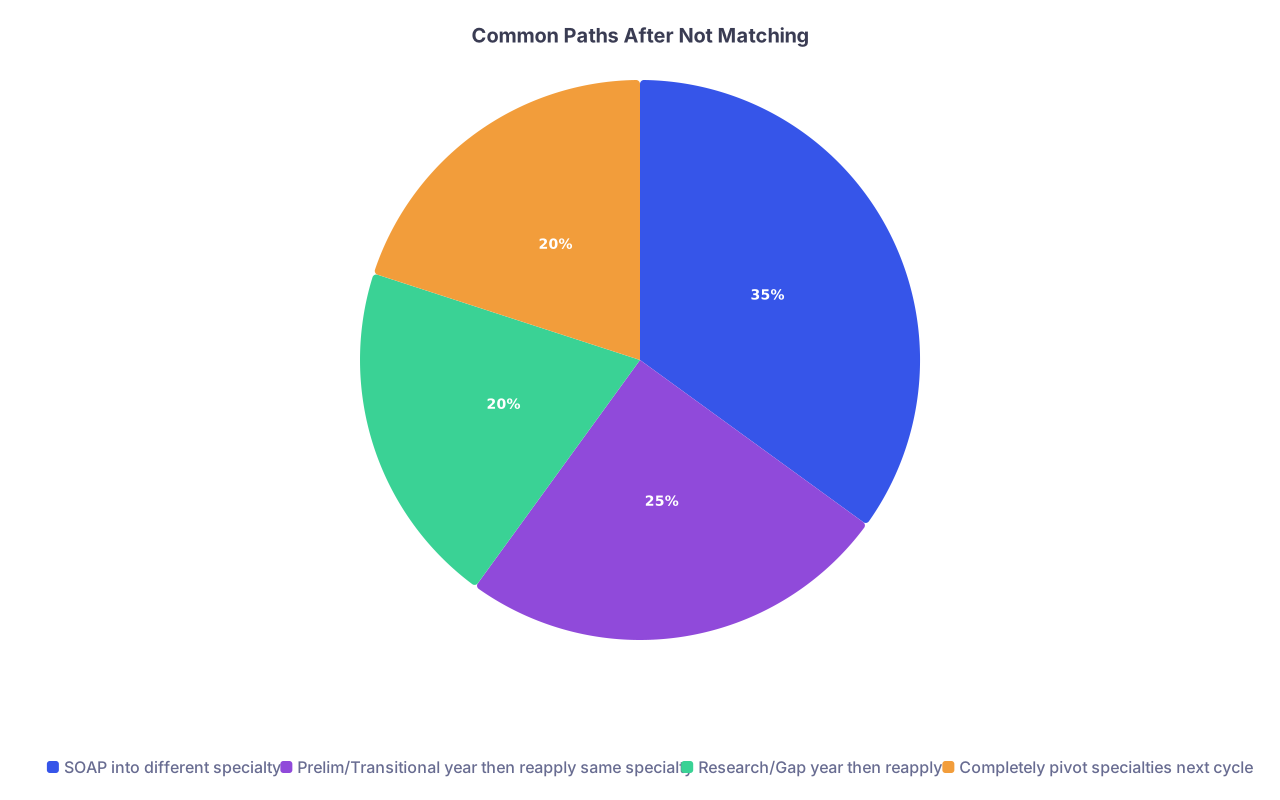
| Category | Value |
|---|---|
| SOAP into different specialty | 35 |
| Prelim/Transitional year then reapply same specialty | 25 |
| Research/Gap year then reapply | 20 |
| Completely pivot specialties next cycle | 20 |
Is that data exact? No, but it’s realistic from what I’ve seen.
Here’s the part your anxious brain twists: “If I pivot or SOAP into something else, I’m admitting my first choice was wrong.” Not true.
You’re making a triage decision in a crisis, with limited options and time. That’s survival, not confession.
You can:
- SOAP into a different field and discover you actually like it more (this happens a lot, especially IM → subspecialty later, FM with lifestyle, psych when burnout was looming).
- SOAP into something as a bridge, then reapply to your original field with more experience and a clearer narrative.
- Take a non-clinical year: research, MPH, extra degree, or teaching → then reassess from a calmer headspace.
None of that proves your first specialty choice was “wrong.” It just proves the path wasn’t linear. Welcome to medicine.
How to Actually Answer “Did I Pick Wrong?” For Yourself
Here’s the messy internal audit I’d push you to do over the next 1–2 weeks, not in one frantic evening.
- List what you loved about your chosen specialty. Not generic stuff. Specific days, patient types, procedures, clinic vibes, team culture.
- List what you hated or dreaded about it. Again, specific. Call schedules, types of consults, personality types, documentation, lifestyle, training length.
- Circle the things that are unique to that specialty vs. common to many fields (e.g., every field has charting, some level of call, annoying patients).
- Ask: If another specialty could give me 80% of what I loved with less of what I hated, would I seriously consider it?
- Talk to 2–3 residents or attendings outside your original field about their actual daily life—not the brochure version.
If you keep coming back to: “I can’t shake how much I liked [specific parts of that field],” then you didn’t pick wrong. You’re just in the frustrating “path blocked” phase.
If you keep finding yourself drawn to the way other specialties describe their work and feel slightly sick imagining another Try #2 in the original one—that’s real data too.
Your Fear: “What If I Waste Years Chasing the Wrong Thing?”
Let’s be blunt: you’re terrified of sinking more time, money, and effort into a second attempt—only to:
- Still not match
- Or match and then realize, “I don’t even like this”
That fear is rational. But doing nothing is also a choice—with its own risks.
Here’s how I’d frame it:

| Step | Description |
|---|---|
| Step 1 | Didnt Match |
| Step 2 | Explore other specialties seriously |
| Step 3 | Plan reapplication with gap/prelim year |
| Step 4 | Shadow, talk to residents, honest self-check |
| Step 5 | Decide: pivot specialty or bridge via SOAP |
| Step 6 | Still deeply want this specialty? |
| Step 7 | Competitive path with realistic upgrades? |
You’re not choosing between “perfect safe path” and “disastrous one.” You’re choosing between several imperfect paths with different types of risk.
If you can clearly see what you’d change and improve for a second try—and you still want it—that’s not delusion. That’s strategy.
If you honestly can’t see a path to being competitive, or your gut doesn’t want it enough to endure another year of uncertainty, then pivoting is not failure. It’s adjusting course with new information.
What You Can Do This Week To Calm the Spiral
Your brain is probably sprinting 10 years into the future and writing horror fanfic about your life. Pull it back.
This week, do three very concrete things:
Talk to someone objective in advising. Not just your friend who also didn’t match and is spiraling with you. Someone a bit blunt who sees the whole picture—dean, PD, advisor in your chosen field. Ask directly:
- “If I reapply to the same specialty, what exactly has to change?”
- “If I switched to X or Y field, how would my current application look?”
Shadow or revisit your chosen specialty once more. Even a single full day can be clarifying. Watch yourself. Are you energized? Bored? Resentful? Nostalgic?
Pick one realistic backup specialty and research it like a serious option, not a consolation prize. Look at lifestyle, fellowship options, training length, compensation, daily work. You might surprise yourself. Or you might confirm, “No, I really do want my original field.”
The Ugly Truth: Matching ≠ “You Chose Right,” and Not Matching ≠ “You Chose Wrong”
There are miserable residents out there who matched their first choice specialty at top-tier programs. On paper, they “won.” In real life, they’re asking, “Did I pick wrong?” every night on call.
There are also insanely happy attendings who SOAPed into a specialty they never planned on and now can’t imagine doing anything else.
Matching or not matching is data, not a verdict.
You might have picked right and executed the application wrong.
You might have picked wrong and the system exposed it early.
You might be somewhere in between and need a year to sort it out.
You’re not behind. You’re not permanently labeled. You’re just at a fork in the road most people pretend doesn’t exist.
FAQ (Exactly 4 Questions)
1. If I reapply to the same specialty after not matching, will programs assume I’m desperate or a weak candidate?
No. What they’ll assume depends on what’s changed. If you reapply with basically the same application, then yes—they’ll see you as someone who didn’t grow. If you reapply with stronger letters, more targeted research, clearer narrative, broader list, maybe a prelim year under your belt, programs see persistence and maturity. I’ve seen reapplicants get respect when they can clearly say, “Here’s what went wrong, here’s what I did about it, and here’s why I still want this field.”
2. If I SOAP into another specialty, am I closing the door forever on my original choice?
Not automatically. In some fields, it’s harder to come back (e.g., switching into super competitive surgical subs after doing something totally unrelated). But I’ve seen people go IM prelim → reapply to anesthesia, TY → reapply to radiology, psych → later fellowships that change their practice. What matters: how you frame your path and whether your story makes sense. The door doesn’t slam shut just because you took a detour, but each step affects how realistic that door is.
3. How do I know if I’m clinging to a specialty for ego vs. genuine fit?
Ask yourself: if salaries, prestige, and competitiveness were identical across all fields, would I still choose this one? If the answer is shaky, you might be more hooked on the status, lifestyle, or narrative you built around it. Another test: when you talk to residents actually living that life, do you mostly envy how others perceive them, or do you envy the work they’re doing day to day? That distinction is huge.
4. Is taking a research or gap year after not matching going to make me look worse?
Not if you use it intentionally. A dead year where you do almost nothing meaningful? Yes, that looks bad. A focused year where you get involved in that specialty’s research, strengthen mentorship, maybe pick up teaching, and fix application weaknesses? That can absolutely make you a stronger candidate. Programs care less that you took a year and more about what story that year tells: running from the problem, or aggressively working on it.
Today, do one specific thing:
Open a blank page and write two lists—“What I truly loved about my chosen specialty” and “What I honestly didn’t.” No filtering, no writing what you think you’re supposed to say. Just you and the truth.
That’s your starting point. Not the Match result.


