

You close the NRMP email. “We are sorry to inform you…”
Your stomach drops. You stare at your student loan balance, your checking account (two digits before the decimal, that’s fun), and all those nice “research year” and “reapplication strategy” blog posts that quietly assume you have a financial cushion and maybe a supportive family who can float you for 12 months.
Except you don’t. You’ve got rent. Maybe a kid. Maybe you’re supporting parents. Maybe you’re already behind on a credit card.
And now everyone keeps saying, “Maybe just take a research year,” like that doesn’t usually mean: move to a big city, live on peanuts (or nothing), and smile appreciatively at “a small stipend” that doesn’t even cover parking.
So what if you actually can’t afford a “traditional” gap year? What now?
Let’s walk through this like someone who has to eat and pay rent. Not like a fantasy applicant with infinite savings.
First, Ugly Truth: The System Assumes You Have Money
Residency application “alternatives” are usually built for people with:
- Parents who’ll cover living expenses
- Savings
- A partner with a steady income
If you don’t have that, you’re not failing at being an applicant. The system just wasn’t built with you in mind.
I’ve seen people feel ashamed they can’t take an unpaid research year at Some Fancy Academic Center. That’s insane. You’re not broken because you can’t donate a year of your life for free.
So let’s mentally throw out the “standard” advice:
- Unpaid full‑time research in a HCOL city? Probably no.
- $5k worth of “reapplication consulting”? No.
- Another year of just “studying” while you burn savings you don’t have? Definitely no.
You need paths that either:
- Pay you enough to stay afloat
- Are part-time enough that you can work and keep your application alive
- Don’t trap you in something that makes you look less committed to medicine
Those do exist. They’re just less advertised.
The Main Fear: “If I Work, They’ll Think I Gave Up”
Let me hit the biggest anxiety first.
You’re probably thinking:
“If I take some random job because I need money, will programs assume I’m not serious about medicine and blacklist me forever?”
Programs are not clueless. They know people have bills. But they’re also not psychic. You have to frame what you’re doing.
Your situation is only “bad” to programs if it looks like:
- You vanished for a year with no explanation
- You did nothing even vaguely clinical or academic
- You can’t articulate why you did what you did and what you learned
If you instead can say something like:
“I didn’t match last year. I still wanted to stay connected to patient care and keep growing clinically, but I also had financial obligations. So I worked as an [X job] in [Y setting], picked up extra shifts, and used that time to strengthen my application by [A, B, C].”
That doesn’t look like quitting. That looks like being a functioning adult under pressure.
You’re not competing with the person whose parents paid for them to do a cushy research year at Hopkins. Honestly, different bucket. Many PDs understand people come from very different backgrounds.
Realistic Gap-Year Alternatives You Can Actually Afford
Here’s where most people get stuck:
“I need money, but if I work full-time in something non-medical, my application will rot.”
So aim for “financially survival + medically adjacent.” Not perfect prestige, but not random either.
1. Clinical Jobs You Can Get Fairly Quickly
These are decent for money and application:
- Medical assistant (MA)
- Scribe (in ED, outpatient, some inpatient)
- Clinical research coordinator (CRC) with salary
- Patient care tech/Nurse tech
- Telemedicine support roles (triage assistant, remote scribe, etc.)
No, they’re not glamorous. They also show:
- You stayed in clinical environments
- You worked on communication, teamwork, dealing with EMRs
- You didn’t disappear
You can literally say: “I worked full-time as an ED scribe to support myself after not matching, which also let me work closely with attendings and residents, improve my documentation skills, and continue learning.”
That’s not a red flag. That’s exactly what many PDs want to see: resilience, humility, and zero entitlement.

2. Paid Research, Not the Instagram Version
People hear “research year” and picture unpaid or tiny-stipend positions in Manhattan or Boston.
But there are other flavors:
- Clinical research coordinator at a community hospital or smaller academic center (actual salary, sometimes benefits)
- Industry-sponsored study coordinator roles (oncology, cardiology, etc.)
- Biotech or pharma assistant roles for MDs/IMGs
It’s not always easy to find, and some areas are terrible for this. But don’t just search “research fellow” (which = often unpaid). Look for “clinical research coordinator,” “research associate,” “clinical trials assistant.”
Frame it like: still in medicine, still working with patients or data, getting letters, and getting paid.
But What If I Have to Take a Totally Non-Medical Job?
This is the part people are terrified to say out loud.
What if you end up working:
- At Starbucks
- As an Uber/Lyft driver
- In retail
- In a nonclinical office job
Will that destroy your chances? No. But you’ll have to be more deliberate.
Here’s how I’d structure it if this is your reality:
- Core income job: whatever actually pays your bills
- Add something small but clinical/academic:
- 4–8 hours/week volunteering in a clinic, free clinic, hospice, ED, anything
- Unpaid (or low-pay) part-time research if you can swing it
- Occasional per diem shifts in some patient-facing role (if available)
Then, for programs, your story becomes:
“I needed a stable income to manage my financial obligations, so I worked as [X]. At the same time, I volunteered at [clinic] and worked on [small research / QI project], because I still knew I wanted to reapply in [specialty].”
Is that ideal compared to a funded prestigious research fellowship? No.
Is it game over? Also no.
I’ve seen people match from that situation. Not every specialty, not every program, but it happens. Especially if you apply smart (we’ll get to that).
Comparing Major Paths: What’s Actually Feasible?
Here’s a quick comparison so you’re not guessing in the dark.
| Option | Money | Medically Relevant | Prestige/Signal | Feasible If Broke? |
|---|---|---|---|---|
| Unpaid full-time research | $0–small | High | Medium–High | Usually no |
| Paid clinical research job | Modest–Good | High | Medium | Yes, if available |
| Full-time MA/scribe/PCT | Modest | Medium–High | Medium | Yes |
| Non-medical full-time job + clinic volunteering | Varies | Low–Medium | Low–Medium | Yes, if structured |
| Doing nothing “to study” | $0 | Low | Low | No (financially & for apps) |
You’re trying to land in one of the middle three rows, not the top one, not the bottom one.
“But Programs Want Research / Publications / Immaculate CVs…”
Some do. Not all.
Here’s the part people downplay: the majority of residency spots in the U.S. are not at the brand-name places everyone brags about on social media. Community programs, smaller academic centers, less glamorous locations – that’s where a lot of people build perfectly solid careers.
Those programs tend to care more about:
- Reliability
- Work ethic
- Decent Step/COMLEX scores (or at least passing, depending on specialty)
- Clear commitment to the specialty
- People who will actually show up to work and not be drama
If your “research” is thin but you spent a year working nights as a hospital tech, showing up on time, dealing with hard patients, and your manager writes a killer letter about you? Many PDs will take that person over the shiny-abstracts-but-no-real-world-grit person.
Are there specialties where you probably do need that “traditional” research year? Yeah:
- Derm
- Plastics
- Ortho (often)
- ENT
- Neurosurgery
If you’re aiming for those and you also can’t afford a year of unpaid or low-paid research, you’re in a brutal spot. I won’t lie. In those cases, you may need to:
- Broaden to slightly less competitive but related specialties
- Consider prelim + reapply strategy
- Seriously evaluate your long-term goals vs reality
That doesn’t mean give up. It does mean you might need to adjust the plan to something survivable.
Structuring a “Non-Traditional” Year So It Doesn’t Look Random
You don’t want your gap year to look like chaos. Even if it feels like chaos right now.
Think in terms of:
- Money anchor: job that keeps you alive
- Medicine tether: something that keeps you in the orbit of your specialty or at least clinical care
- Narrative: how you’ll explain it in your personal statement and interviews
Example for someone aiming IM who can’t afford unpaid research:
- Job: Full-time ED scribe at a community hospital
- Medicine tether: Ask an IM hospitalist there if you can help on a small QI project (readmission rates, discharge summaries, something humble but real)
- Narrative:
- Didn’t match, needed income
- Stayed clinical as a scribe
- Worked directly with IM attendings
- Did a small QI project → poster at local/regional meeting
- Grew in communication, documentation, systems-based practice
That sounds intentional. Even if it was half survival.

Don’t Forget: The Logistics That Quietly Wreck People
Couple of unsexy but critical points that anxious, broke applicants overlook:
1. Health Insurance
You can’t be heroic about this. One emergency, and you’re crushed.
If your gap job doesn’t provide benefits, look at:
- Marketplace plans with income-based subsidies
- Medicaid (depending on your state and income)
- Short-term plans as a last resort (worse protection, but still something)
Programs will not be impressed if you blew up your finances with a single uninsured ER visit.
2. Loans
Talk to your servicer. Apply for income-driven repayment if you’re eligible. Do not just ghost them. They will find you, and the interest will keep quietly growing while you’re trying to fix your application.
Anxiety brain says: “Ignore it, it’s too much.” That makes it so much worse.
3. Where You Live
If at all possible:
- Move somewhere cheaper
- Share housing
- Live with family if that’s not toxic or impossible
Your ego doesn’t match; it doesn’t pay rent either. You’re not a failure if you move home at 28 to regroup after not matching. You’re someone trying not to drown.
How You Talk About This Year Matters a Lot
You can do the same exact job and sound either:
- Desperate and ashamed, or
- Grounded and purposeful
Programs will pick up the vibe.
Unhelpful framing:
“I couldn’t match so I just took whatever job I could find and I’m just working at [X], it’s not really related but I had no choice.”
Better framing (still honest):
“I didn’t match last cycle, and I had significant financial obligations I couldn’t ignore. I chose to work as [X] because it allowed me to support myself, and I made sure to stay connected to medicine by [volunteering/research/clinical role]. It’s been a humbling year, but it reinforced that I still want to [specialty] and taught me [concrete lessons].”
Programs don’t actually expect you to be invincible. They do like seeing:
- Responsibility
- Zero blame attitude
- Insight about how you grew
- Clear explanation of what changed since last application
Reapplying Strategically So You Don’t Waste Another Year
You can do everything “right” financially and still blow the reapplication by repeating the same mistakes.
Bare minimum, you need to:
- Talk to someone honest who will review your whole app: PD, advisor, mentor, not just a friend saying “you’re amazing”
- Identify your real weaknesses: scores, red flags, late application, poor letters, unrealistic list
Then use this year, however scrappy, to hit at least 1–2 of these:
- Strong new letter from someone who’s seen your work this year
- Concrete evidence of commitment to your specialty (clinic, QI, research, something)
- Cleaner personal statement that doesn’t sound generic or bitter
- Smarter, broader, more realistic program list
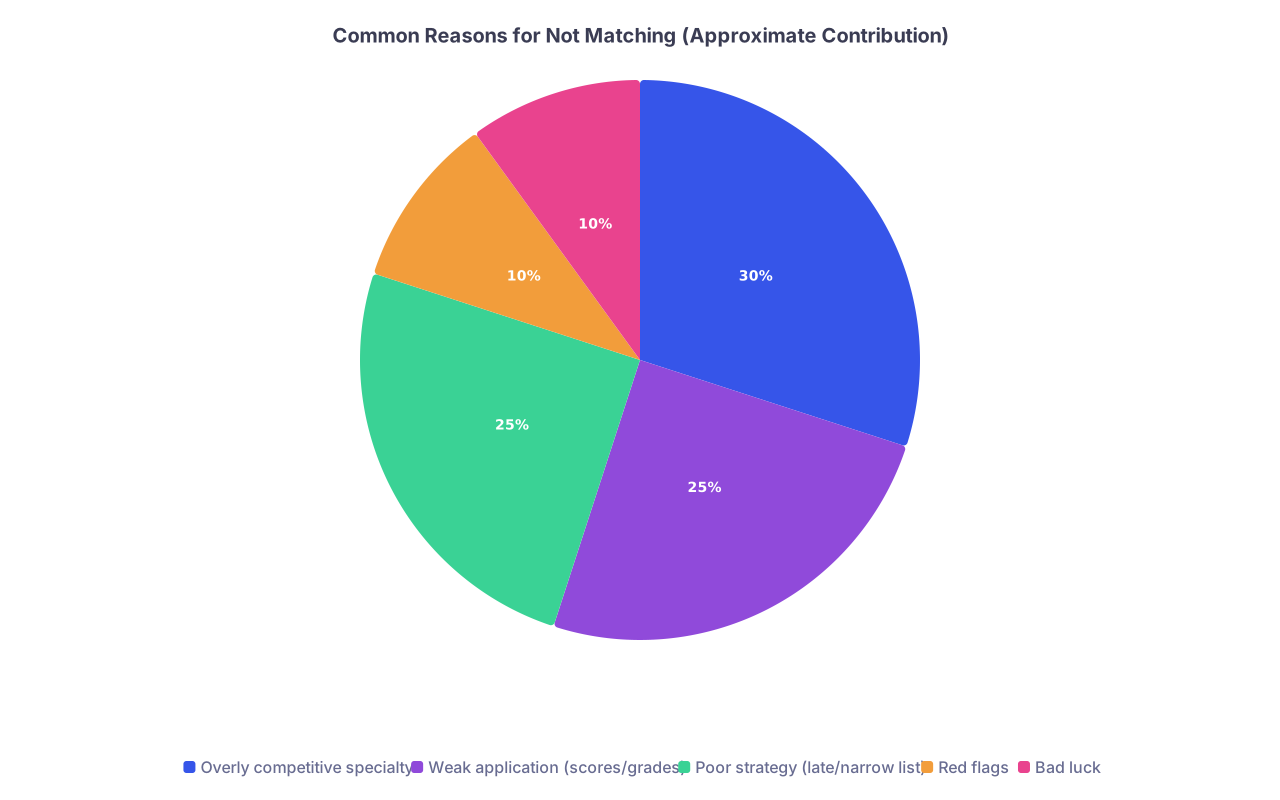
| Category | Value |
|---|---|
| Overly competitive specialty | 30 |
| Weak application (scores/grades) | 25 |
| Poor strategy (late/narrow list) | 25 |
| Red flags | 10 |
| Bad luck | 10 |
If you can’t change your Step score or your school, you lean hard on what you can change: letters, narrative, specialty choice, and your program list.
Emotional Side: Feeling “Behind” and Broke at the Same Time
This is the part that doesn’t show up on CVs.
You’re not just fighting logistics. You’re fighting:
- Shame seeing classmates post Match Day photos
- Family asking “So now what?” with that look
- The quiet panic: “If I don’t match again, I am actually screwed”
You’re not dramatic for worrying about that. It’s a real risk. But you can’t plan from panic. You plan from data.

| Step | Description |
|---|---|
| Step 1 | Unmatched |
| Step 2 | Find paying job |
| Step 3 | Clinical/Research job |
| Step 4 | Non-medical job + clinic volunteering |
| Step 5 | Secure new LORs |
| Step 6 | Revise application + program list |
| Step 7 | Reapply next cycle |
| Step 8 | Can you afford unpaid year? |
| Step 9 | Medical-adjacent possible? |
You’re allowed to be scared and still make rational moves:
- One step: stabilize income
- One step: keep a foot in medicine
- One step: get real feedback on your application
- One step: fix the biggest weaknesses
That’s how you slowly dig out of this, even if you’re not doing some Instagram-worthy “research year at [Top 5 Hospital].”

If You Remember Nothing Else
- Not being able to afford a “traditional” research or gap year doesn’t end your chances; it just means your path will look less glossy and more survival-based — which is fine if you can explain it.
- Anchor yourself with a paying job, then bolt on something medically adjacent (clinical work, volunteering, small QI/research) so your story is still clearly pointed toward residency.
- Don’t waste this year repeating the same application: get blunt feedback, improve 1–2 major weaknesses, and be brutally realistic with your specialty and program list.
You’re not behind because you’re broke. You’re just playing on “hard mode.” And people do win on hard mode.


