

What if the word “unmatched” sticks to your name like a scarlet letter for the rest of your career?
That’s the fear, right? Not just “I didn’t match this year,” but, “Did I just ruin my future? Will every program, every PD, Google me and see ‘unmatched once’ in fluorescent letters and quietly move my file to the no pile?”
Let me say this out loud so you can actually hear it:
Being unmatched once is not a career death sentence.
But if you believe it is and act like it is, you can absolutely make things worse.
Let’s walk through this like adults who are both low-key panicking.
What Programs Actually Think When They See “Reapplicant”
They don’t think, “Trash.”
They think, “Explain this.”
That’s it. They want a story that makes sense.
Here’s how most PDs and selection committees mentally sort someone who has been unmatched before:
| Category | PD's Basic Reaction |
|---|---|
| 1. Redo with no changes | Why would this year be different? |
| 2. Clear growth and plan | Ok, they learned and adapted. Interesting. |
| 3. Big professionalism concerns | This is the only ‘forever’ danger zone. |
| 4. Slight mismatch last cycle | Reasonable risk, worth considering. |
They’re not out here with a blacklist of “unmatched people to never touch.” They’re asking:
- Did this person figure out what went wrong?
- Did they do anything meaningful in the gap time?
- Are they realistic now about specialty, geography, and programs?
- Are there behavioral or professionalism issues under the surface?
They judge the pattern, not the single event.
The thing no one tells you: PDs see unmatched applicants every single year. It’s not some shocking scandal. It’s just… part of the ecosystem.
Is There Such a Thing as a “Permanent Stain”?
Here’s the brutally honest version.
There are a few scenarios that can follow you for a long time:
You were unmatched because of serious professionalism issues
Examples: you got dismissed from a program, had documented harassment or cheating issues, or had a meltdown during rotations that led to a formal report.
Those don’t vanish. Programs care about this a lot more than “low Step score.”You keep reapplying in a way that screams denial
Year after year, applying to ultra-competitive specialties with the same weak app, no plan, no growth, no backup. That builds a reputation as “doesn’t self-assess, doesn’t adapt.”You badmouth programs, attendings, or prior institutions
Medicine is small. People talk. If you rage-quit a prelim year or talk trash in interviews or on social media, that kind of thing lasts way longer than “they went unmatched once.”
But being unmatched once because:
- You shot too high on specialty
- You applied too narrowly
- Your Step scores were just okay
- You were late in the cycle
- You had weak letters that year
…does not put you on some eternal blacklist.
It’s like failing your first driving test. Annoying, scary, embarrassing. Not permanent.
The Part That Hurts: You’ll Probably Have to Explain It
And yeah, that sucks. You just want to move on, but the application asks. The interviewer asks. The PD asks.
You’ll need a short, non-defensive, clear explanation.
Not:
“I didn’t match because the process is broken and it’s all a crapshoot and they just like US MDs with 260s and research in med school labs.”
Try something more like this:
“I applied very narrowly and late in the season to a competitive specialty with research but a weaker Step score. I didn’t fully appreciate how important program breadth and geographic flexibility were. After going unmatched, I spent the year doing clinical work in [field], strengthening my letters, improving my application, and applying more strategically to [X] specialty that aligns with both my interests and my metrics.”
Programs are listening for a few things:
- Do you take responsibility for your part?
- Do you avoid blaming everyone else?
- Do you show growth, not excuses?
- Can you talk about it without sounding angry or bitter?
You don’t have to grovel. But you do have to own your story.
Are Some Specialties Less Forgiving Than Others?
Short answer: yes. Some are snobby. Let’s not pretend.
In ultra-competitive specialties (Derm, Ortho, Plastics, ENT, some Rads, some Neurosurg), going unmatched once can be a big red flag… if you reapply with no real change.
In more moderately or less competitive fields (IM, Peds, FM, Psych, Path, some community EM), I’ve seen reapplicants match every year who:
- Went unmatched once
- Did a research year, prelim year, or strong gap year
- Applied broadly and realistically
- Fixed obvious weaknesses (letters, CS/OSCE issues, Step 2, etc.)
So yeah, if you:
- Went unmatched in Derm
- Have 220s scores
- No PhD, minimal research
- And you’re still only applying Derm…
Then no, programs are not going to magically forgive that. They’re going to question your judgment. That’s not about the unmatched label; that’s about ignoring reality.
But if you pivot to IM, Peds, Psych, or FM with a well-explained story and real work in the gap year? Different ballgame.
Here’s a rough idea of how “forgiving” some fields can be if you reapply smartly:
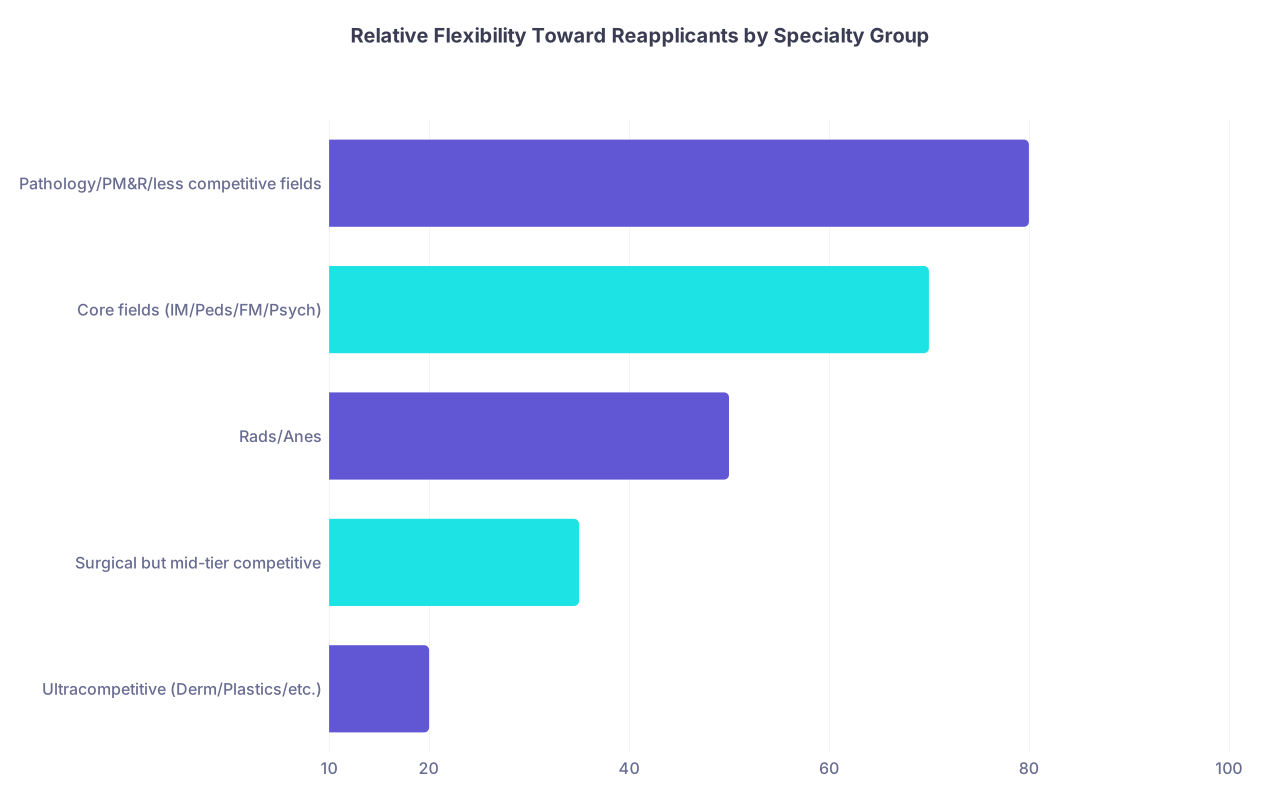
| Category | Value |
|---|---|
| Ultracompetitive (Derm/Plastics/etc.) | 20 |
| Surgical but mid-tier competitive | 35 |
| Rads/Anes | 50 |
| Core fields (IM/Peds/FM/Psych) | 70 |
| Pathology/PM&R/less competitive fields | 80 |
This is not scientific data, just the general vibe I’ve seen. But you get the idea.
How Long Does “Unmatched Once” Matter?
You’re imagining it following you forever — residency interviews, fellowship, job, every single step.
Reality is more boring.
Here’s roughly how it tends to fade:
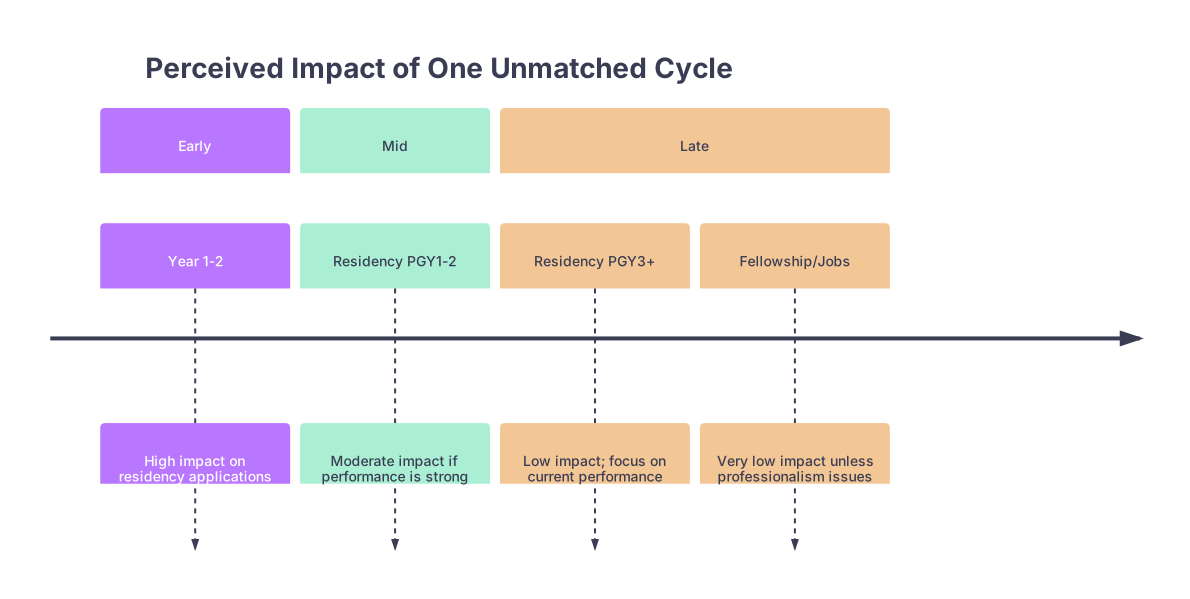
| Period | Event |
|---|---|
| Early - Year 1-2 | High impact on residency applications |
| Mid - Residency PGY1-2 | Moderate impact if performance is strong |
| Late - Residency PGY3+ | Low impact; focus on current performance |
| Late - Fellowship/Jobs | Very low impact unless professionalism issues |
If you:
- Eventually match into a residency
- Perform well
- Get strong letters
- Don’t collect new flags (disciplinary actions, failed exams, etc.)
Then by PGY2–PGY3, almost no one cares you went unmatched once.
Fellowships and jobs mostly care about:
- Your current PD’s letter
- Your reputation in your program
- Your skills and work ethic
Not what ERAS said about you three years ago.
What Makes Programs Actually Willing to Take a Chance on You
Let’s talk about what flips the script from “unmatched once, risky” to “unmatched once, but now clearly stronger.”
Things that genuinely move the needle:
A strong, recent clinical year
- A prelim IM/TY year with good evaluations
- A non-ACGME clinical job with real attending-level supervision and a letter
- Solid performance in a transitional or supplemental program
Upgraded letters
If your old letters were “nice but generic,” and now you have:- A PD letter from a prelim year saying you’re reliable, teachable, hardworking
- A specialty-specific letter (e.g., from a Psych attending if you’re switching to Psych)
That changes how people see you.
Clear specialty realignment
Example:- Last year: applied EM with marginal scores, no SLOEs, no backup.
- This year: applying IM with solid IM rotations, new IM letters, and an honest explanation.
That looks like growth, not desperation.
Step 2 or equivalent improvement
If your Step 1/COMLEX 1 was weak but Step 2/Level 2 is stronger, programs notice. It proves you’re not stuck.No drama
This is underrated. A reapplicant who:- Answers questions calmly
- Doesn’t blame their school, PD, or “the system”
- Sounds like a normal, grounded person
…is honestly appealing. Because programs hate drama.
What You Should Avoid If You Don’t Want to Be Quietly Blacklisted
This is the part nobody warns you about and then people accidentally walk into it.
Avoid:
Rewriting history
Don’t say, “I chose not to match” when you clearly didn’t match. People can tell. Just be honest.Shotgun chaos applications
Applying to 12 specialties randomly to “see what sticks” makes you look unfocused and clueless. It’s better to have 1–2 well-argued paths than 8 desperate ones.Oversharing your emotional breakdown
You can say, “It was a tough year” or “It was very humbling.”
Don’t turn the interview into a therapy session about how devastated you were.Trash-talking your prior institution
Even if they were awful. Even if you were right. Once you start phrases like, “My dean really screwed me…” interviewers mentally check out.Staying stagnant in your gap year
If your year between attempts is literally: “I stayed home, helped family, and thought about my options” with nothing else, it’s very difficult to sell.
You don’t have to become a research machine or save the world. But “I sat still for 12 months” is hard to spin.
So… Will They Judge You Forever?
They’ll judge you for a while. Let’s be real.
They’ll look at:
- Why you went unmatched
- What you did about it
- How you explain it now
But forever? No.
The people who struggle long-term aren’t cursed by the word “unmatched.” They’re trapped by no change in trajectory, or by real red flags that never get addressed.
You, right now, are stuck in the worst part: the shame/what-if spiral that happens immediately after not matching or scrambling. The part where your brain says:
“I’m done. I’m marked. I’m ruined.”
You are not. You’re just in the ugly middle of the story, not the ending.
Tiny Reality Check Before You Spiral Further
Take a breath and really look at this:
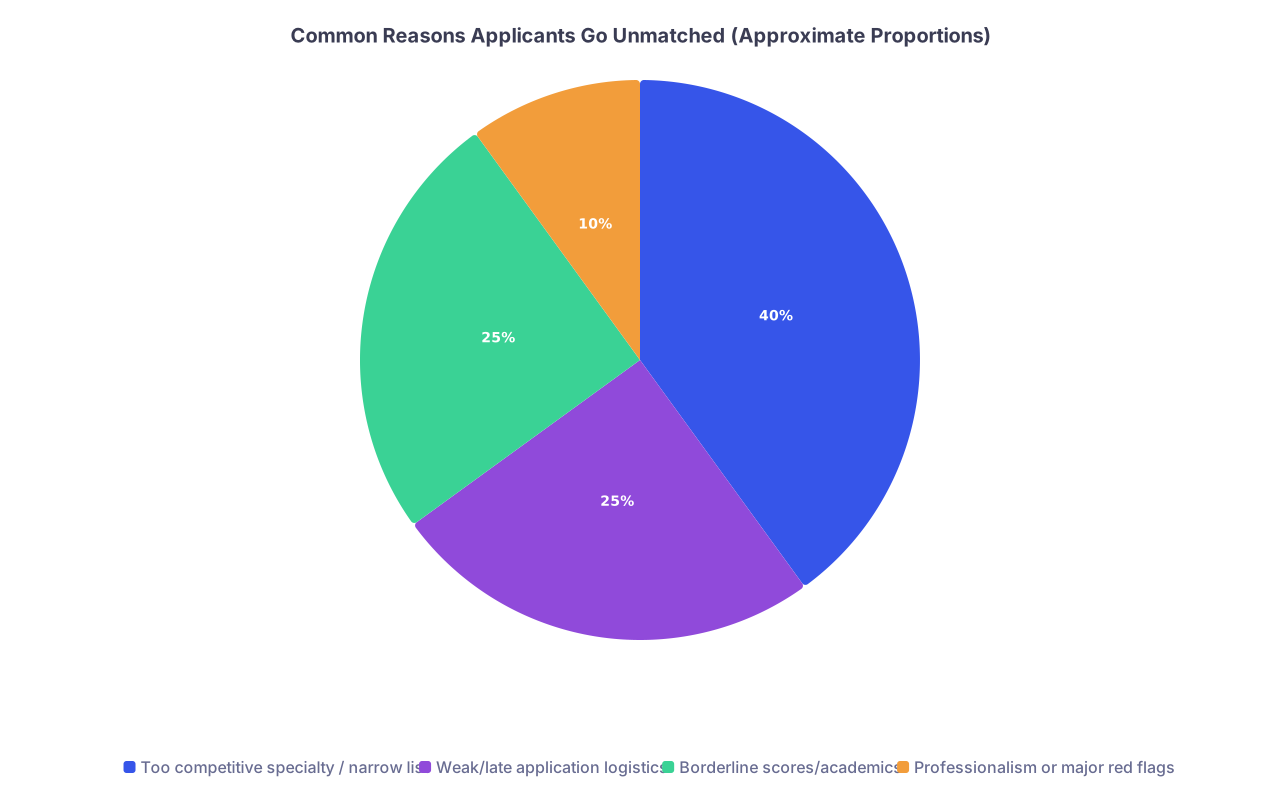
| Category | Value |
|---|---|
| Too competitive specialty / narrow list | 40 |
| Weak/late application logistics | 25 |
| Borderline scores/academics | 25 |
| Professionalism or major red flags | 10 |
Most of those categories are fixable or at least improvable.
The only one that genuinely can haunt you is major professionalism issues. And even then, I’ve seen some people come back from very ugly situations with brutal honesty, strong mentorship, and years of consistent performance.
You having one unmatched year doesn’t make you broken. It makes you… like a decent number of residents who just don’t talk about it loudly later.
FAQs
1. Should I always disclose that I went unmatched before?
Yes. Lying or “forgetting” is worse than the truth. ERAS and program communications usually make this clear anyway. If asked, answer honestly and briefly. If not asked directly, it’ll still often be apparent from your timeline, so have a clean explanation ready.
2. Does SOAP make me look worse than just going unmatched and trying again?
No. SOAP doesn’t = damaged goods. Programs understand SOAP is chaotic and brutal. If you didn’t land something in SOAP, that may raise questions, but again, explainable. If you did SOAP into a prelim or transitional year and did well, that can actually help you.
3. Is it better to take a prelim year or do research if I want to reapply?
Depends on your situation and specialty, but in general:
- If your clinical evaluations / hands-on experience are weak: prelim or TY year helps more.
- If you’re reapplying to a research-heavy or competitive specialty: a legit, productive research year can matter.
What programs hate is a “nothing” year. Either clinical or research + clear mentorship is better than drifting.
4. Will fellowship directors care that I once went unmatched to residency?
Mostly, no. By the time you’re applying for fellowship, they’re judging:
- Your residency performance
- Your PD’s letter
- Your specialty letters
- Your research/clinical profile in that field
If you’re a solid resident with good reputations and letters, “unmatched once” several years ago is usually background noise.
5. Does applying to an easier specialty now mean I’ll be stuck forever?
Not necessarily. People switch. Plenty of folks started in IM, FM, or Psych and then pivoted into cards, GI, anesthesia, rads, etc. Matching somewhere and performing well usually opens more doors than holding out for the perfect specialty and staying unmatched.
6. How do I talk about going unmatched without sounding pathetic or bitter?
Use a simple three-part structure:
- What happened – “I applied to [specialty] with [context] and went unmatched.”
- What you learned/did – “Since then, I’ve done [clinical/research/work] and realized [insight].”
- Where you’re going now – “That’s why I’m applying to [specialty/program type] now, which aligns better with [skills/goals].”
Short. Calm. No drama. No blaming. That’s what sounds mature—not pathetic.
Key Takeaways:
- Being unmatched once is not a permanent blacklist; programs care more about your response than the event itself.
- What helps you most is a gap year with real work, clear growth, and an honest, non-defensive explanation.
- The further you get into a residency and perform well, the less that old “unmatched” label matters—unless you keep repeating the same mistakes.


