

Last March, I watched a classmate stare at a blank email inbox at 3:01 PM on SOAP Thursday. No offers. Not one. She’d already cried herself dry after the “We are sorry to inform you that you did not match” email on Monday. By Thursday, she just looked…empty.
If you’re here, you’re probably asking yourself the same question she whispered to me: “What if I don’t match and I also fail SOAP? Is this it? Am I done?”
First: The Worst-Case Picture You’re Probably Seeing in Your Head
Let me just say it out loud, because I know your brain is screaming it anyway:
- “I’ll never be a doctor.”
- “I wasted 4+ years of my life and a ridiculous amount of money.”
- “Everyone will move on with their lives while I’m stuck.”
- “No program will ever take someone who didn’t match AND didn’t SOAP.”
This is the mental horror movie. And it feels real because it’s so specific.
But here’s the thing I’ve actually seen over and over: people who didn’t match and struck out in SOAP still end up:
- Matching the next year
- Pivoting specialties
- Or building a career that, a few years later, doesn’t look like “failure” at all
Is it easy? Absolutely not. Is it automatic? No.
Is it impossible? No. Not even close.
You don’t need fake positivity. You need a brutally honest set of realistic next steps so you’re not just sitting in the ruins of Match Week with no plan.
Let’s build that.
Step 1: Survive Match Week Without Destroying Your Future Self
The week you don’t match and don’t SOAP is dangerous. Not just emotionally, but strategically.
You’re going to want to:
- Fire off angry emails to programs that “should have” ranked you
- Panic-apply to random jobs
- Tell yourself you’re done with medicine forever
Don’t. Not yet.
Focus on three things in the immediate aftermath:
Stabilize your mental health.
You’re not weak for being wrecked by this. People literally have panic attacks in bathrooms at noon on Monday.
Talk to someone who’s seen this before: trusted faculty, school counselor, therapist, or at least one honest friend who won’t say, “It’s fine, you’ll be okay” and then change the subject.Protect your relationships with your school and mentors.
They are your lifeline for the reapplication cycle, prelim options, research years, letters, all of it.
Don’t disappear. Don’t ghost your dean’s office because you feel ashamed.Gather data, not vibes.
You need to know, concretely:- Your Step/COMLEX scores
- Your med school performance issues (if any)
- How many programs you applied to, in what specialties
- How many interviews you had, and where
You can’t fix a vague “I guess programs didn’t like me.” You can fix numbers, patterns, and specific problems.
Step 2: Figure Out Why You Didn’t Match (Brutally, Not Emotionally)
This part hurts. Because your brain wants to make it all about your worth as a person. It’s not that. It’s usually a mix of objective risk factors and strategic mistakes.
Here are the big buckets I see again and again:
| Factor Type | Example Issue |
|---|---|
| Academic | Low Step 1/2 or COMLEX, failed course/rotation |
| Application Strategy | Applied to too few or too competitive programs |
| Specialty Choice | Ultra-competitive field without backup (e.g., Derm, Ortho) |
| Interview Volume | Fewer than ~10 interviews in a competitive specialty |
| Interview Performance | Red flags, poor communication, awkward fit |
Things to do now:
- Schedule a brutally honest meeting with your Dean or advisor. Ask:
“If you had to guess why I didn’t match, what would you say? Don’t sugarcoat it.” - Email 2–3 trusted faculty/mentors who know you reasonably well. Ask them to review your application and be direct.
If multiple people say the same thing, that’s your starting point.
Example patterns I’ve heard:
- “You applied to 35 EM programs. That’s just not enough now.”
- “Your Step 2 is below the median for this specialty.”
- “Your personal statement didn’t really explain your story.”
- “You had only 3 interviews. That’s not a realistic match probability.”
Harsh? Yes. But this is the only way to avoid doing the same thing next year and living this nightmare twice.
Step 3: Decide: Reapply, Pivot, or Pause?
You have three main paths, and none of them are automatically wrong. But some are wrong for you.
Option 1: Reapply Next Cycle (Same Specialty or Similar)
This makes sense if:
- You were close to matching (decent number of interviews)
- Your red flags are addressable in 6–12 months
- You’re willing to adjust strategy (more programs, different geographic spread, better personal statement, stronger letters)
You’ll probably need something to do next year that keeps you clinically or academically relevant. I’ll get there in a second.
Option 2: Pivot Specialty
This one hurts ego-wise. Especially if you had your heart set on something competitive like Ortho, Derm, Plastics, or EM in a saturated market.
But I’ve seen people who:
- Didn’t match EM → Matched IM or FM next year and are now critical care, hospitalist, or urgent care docs
- Didn’t match Ortho → Did a prelim surgical year → Matched PM&R or Anesthesia
- Tried Derm → Did an IM prelim → Matched IM and later did outpatient derm-heavy primary care
Will you have to grieve the old dream? Yeah.
But you don’t lose everything you loved. You’re just finding a different angle to the same core motivations.
Option 3: Step Back From Residency – At Least Temporarily
This is the one nobody talks about because it sounds like quitting.
Sometimes it’s not. Sometimes it’s:
- Taking a research year
- Doing a non-ACGME clinical role
- Working in a public health, quality, or clinical research job
- Fixing personal issues, mental health, family problems, or burnout that honestly would wreck a residency year
This path is scary because it feels like drifting away from medicine. The key is to choose something that either:
- Strengthens your application, or
- Builds a parallel career you’d actually be okay with long-term, if you truly don’t reapply
Step 4: Realistic Gap-Year Options That Aren’t Just “Do Research Maybe?”
You know that vague advice: “Just do a research year.” As if those jobs materialize out of thin air.
Here are the main categories and what they actually look like:
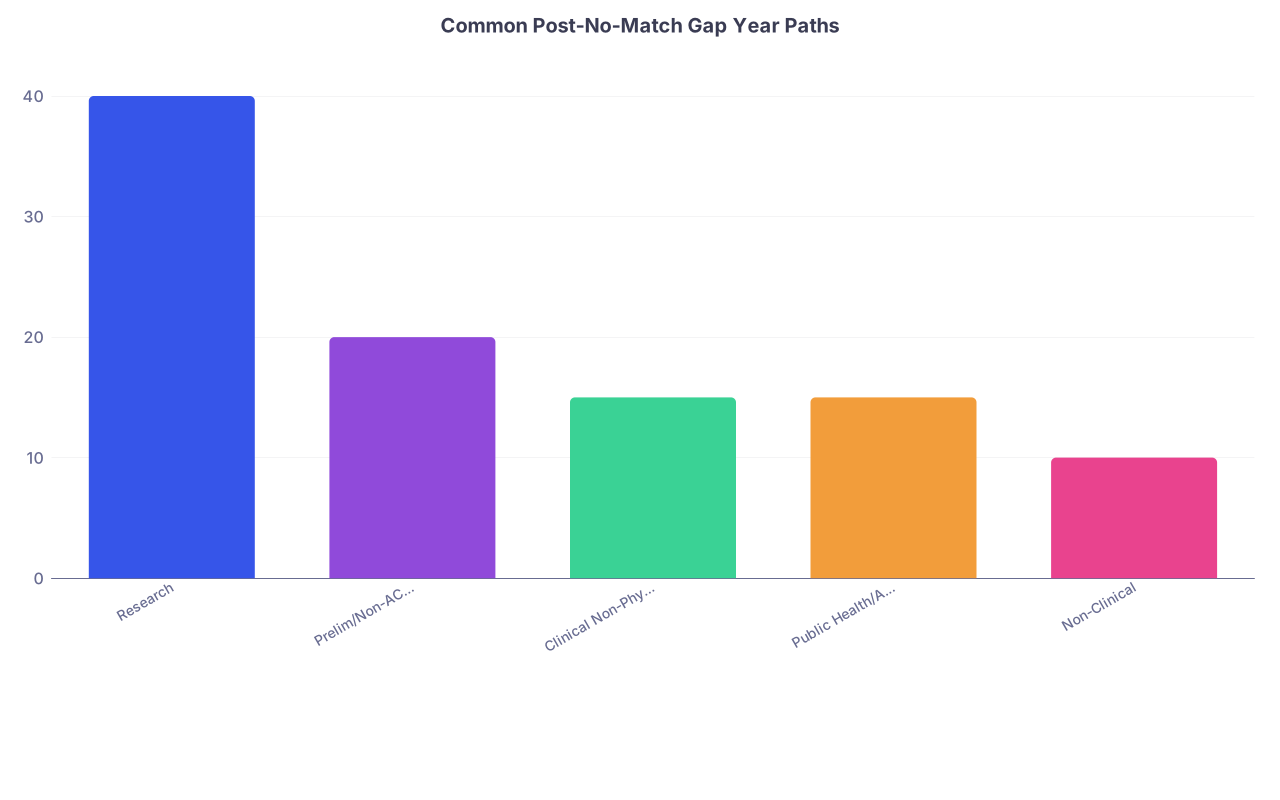
| Category | Value |
|---|---|
| Research | 40 |
| Prelim/Non-ACGME | 20 |
| Clinical Non-Physician | 15 |
| Public Health/Admin | 15 |
| Non-Clinical | 10 |
1. Research Positions (Paid or Unpaid)
Best if:
- You need publications/academic signal
- You’re aiming for academic programs or competitive specialties (even on a second try)
You’d typically:
- Email PIs at your own institution or others: “I’m a recent graduate seeking a research year in [field]. I’m very interested in [specific topic]. Are you accepting full-time research assistants or volunteers?”
- Attach CV. Be clear that you’re on a gap year post-graduation.
Red flag: Purely data entry roles where you never interact with the team, never present, never write. That helps your bank account, not your application.
2. Prelim / Transition Year / Non-ACGME Spots
Sometimes positions open last-minute after Match/SOAP. Not commonly, but enough that it’s worth watching:
- Program websites
- Word of mouth from your Dean’s office
- Listservs and specialty organizations
These spots can:
- Give you real clinical experience
- Generate strong letters
- Let you pivot to another specialty (e.g., medicine prelim → IM, neuro, anesthesia)
Caveat: You need a concrete plan. A prelim year isn’t a “win” if you do it aimlessly and still don’t reapply strategically.
3. Clinical Roles Without Being a Resident
Things like:
- Clinical research coordinator with patient interaction
- Scribe roles for academic physicians
- Some hospital-based jobs for MD/DO grads (varies by institution)
They keep you in the clinical world and help with networking. But they’re not equal to residency. Programs will still ask: “What did you do after graduation and why?”
4. Public Health / Quality / Admin / Industry
Not fake careers. Not consolation prizes. Real jobs:
- MPH programs + related work
- Quality improvement coordinator
- Medical writing or medical education work
- Pharma or biotech clinical trial roles
I’ve seen people do this after not matching, fall in love with it, and never go back. Others do 1–2 years, strengthen their CV, and successfully match later.
Step 5: Plan a Stronger Reapplication, Not Just a Louder One
If you decide you are reapplying, your next year can’t just be waiting around reusing the same ERAS with one new bullet point.
You need to systematically fix the weak links.

| Step | Description |
|---|---|
| Step 1 | Didnt Match + No SOAP Offer |
| Step 2 | Meet with Dean/Advisors |
| Step 3 | Identify Weak Areas |
| Step 4 | Strengthen via Exams, Remediation, Clear Explanation |
| Step 5 | Apply Broader, Safer, Different Specialty Mix |
| Step 6 | Research, Clinical, or Prelim Year |
| Step 7 | Update ERAS & Personal Statement |
| Step 8 | Reapply Next Cycle |
| Step 9 | Main Issue? |
Think of it like this: if a program director looked at your previous application next to your new application one year later, what would make them say:
“Oh. They actually did something serious with this year.”
That can be:
- A research year with posters/pubs
- A prelim year with strong evals
- Step 3 taken with a solid score (if you’re eligible)
- Clear, honest explanation of prior struggles that shows growth, not excuse-making
And yes, you probably need to:
- Apply to more programs
- Be less picky about location
- Have a real backup specialty, not a fantasy one
Step 6: Tell the Story Without Sounding Like a Walking Red Flag
Programs will ask: “Why didn’t you match last year?” You can’t just say, “I don’t know, it was competitive.”
You need something like:
“I applied to [X specialty] last year and received [Y] interviews, but unfortunately didn’t match. After a lot of discussion with mentors and my dean, I realized that [specific issues: late application, limited geographic range, not enough programs, weaker letters, etc.]. Over the past year, I’ve done [research/clinical/prelim] in [field], which has strengthened my skills in [A, B, C]. It also confirmed that I’m committed to [this specialty or this type of practice]. I feel much better prepared to contribute as a resident now because [concrete reasons].”
Programs care less that you missed the first time and more that:
- You’re self-aware
- You learned something
- You didn’t fall apart and stay on the floor
Step 7: The Dark Thought You’re Afraid to Say Out Loud
“What if I never match? Like ever.”
Hard truth: that is technically possible. I’ve seen it. Usually in folks who:
- Have multiple severe academic or professionalism red flags
- Refuse to change specialty or strategy
- Drift for years without doing anything remotely related to medicine
- Let shame paralyze them into doing nothing
But that’s not automatic just because you didn’t match and didn’t SOAP this year.
The people who claw their way back:
- Ask for help early and often
- Are willing to pivot specialties
- Are willing to leave their comfort zone geographically
- Treat this as a serious project, not “we’ll see what happens next September”
What You Can Actually Do Today (Not Next Month)
Right now, today, when your stomach is still in knots:
- Email your Dean’s office and ask for a dedicated meeting about next steps. Put it on the calendar.
- Make a simple doc with: exam scores, number of programs, interviews received, any failed classes/rotations. Just the facts.
- Write down, privately, the three sentences you’re most afraid are true about yourself because you didn’t match. Then ask: “Are these facts or just fears?”
You’re not done. You’re in an ugly, inconvenient, emotionally brutal detour. But a detour is still part of the route, not the end of the road.
Open your ERAS PDF or old application right now and look at it like a program director who doesn’t know you. If you had to bet money on one thing that made them hesitate, what would it be? That’s where your next move starts.
FAQ: 6 Questions You’re Probably Too Afraid to Ask Out Loud
1. Does not matching AND not getting a SOAP spot mean I’m a bad candidate forever?
No. It means in this cycle, with this specialty choice, this strategy, and this specific version of your application, you weren’t competitive enough. That’s different from being permanently unmatchable. Programs judge what you look like now, not just what happened one March.
2. Is it true that once you don’t match, programs will always see you as damaged goods?
Some will be wary. That’s reality. But many programs have taken people who didn’t match the first time. They just want a story that makes sense: what happened, what you did about it, and what’s different now. If your reapplication looks exactly the same, yeah, they’ll pass. If you show real growth and a clearer fit, a lot of them genuinely don’t care that you missed once.
3. How long can I be out of medical school before my chances really drop?
Once you’re 3+ years out, it gets harder. Not impossible, but harder. By then, programs want to see continuous, relevant medical involvement—research, clinical work, prelim years, something. If you vanish into unrelated jobs for years, it’s a steep climb back. The first 1–2 years out are usually the most realistic window to fix and reapply.
4. Should I take Step 3 before reapplying?
If you’re eligible and your Step 1/2/COMLEX scores are borderline, Step 3 with a solid score can help, especially for IM, FM, psych, peds, etc. It shows you can pass boards and be safe for licensing. But don’t take it underprepared just to “show effort.” A poor Step 3 can hurt more than not having it.
5. Is it worth switching to a less competitive specialty just to match somewhere?
Depends on why you want that specialty. If you genuinely could see yourself satisfied in FM, IM, psych, peds, etc., then yes, switching may be smart. If you’d be absolutely miserable and resentful in that field, forcing yourself into it “just to match” can backfire later. But be honest with yourself: sometimes people are surprised to find they actually like their “backup” more than the dream.
6. What do I tell family and friends who keep asking, “So where did you match?”
You’re allowed to set boundaries. Something like: “This year didn’t go the way I wanted, and I’m working with my school on next steps. I don’t want to get into details right now, but I’ll share when I have a clearer plan.” You don’t owe them your emotional autopsy while you’re still bleeding from it.


