

It’s Monday of Match Week. Your email says what you were dreading: “We are sorry to inform you that you did not match to any position.”
Your heart drops. But honestly, that’s not even the part that scares you the most anymore. What’s eating you alive is this thought on repeat:
“How the hell am I supposed to tell my parents? My partner? My friends who all matched? The attendings who wrote my letters? What do I even say?”
You’re replaying their reactions in your head. The slightly-too-long pause. The forced “I’m so sorry.” The subtle “What went wrong?” question you’re not ready to answer. Maybe your mom has already texted “Any news??” with a smiley face and it just makes you feel sick.
You’re not only dealing with not matching. You’re dealing with shame, fear, and the feeling that you’ve somehow publicly failed at the one thing everyone knew you were working toward. It feels like a verdict on your entire worth.
Let’s walk through this. Not in some rah-rah “everything happens for a reason” way. In a real, practical, “how do I get through these next 72 hours without completely falling apart” way.
First: Your Reaction Is Completely Normal (Even If It Feels Like You’re the Only One)
Let me just say it straight: the fear of telling people you didn’t match often feels worse than the actual news.
Because this isn’t just about a job. This is your identity. For years, every holiday, every family call, you’ve been “the future doctor.” Now you feel like you’ve ruined the narrative.
You might be thinking:
- “They spent so much money on my education, and for what?”
- “Everyone’s going to think I’m dumb or lazy.”
- “People in my class with worse scores matched. So it must be me.”
- “If I have to say ‘I didn’t match’ out loud, it makes it more real. I’d rather just hide.”
I’ve seen people literally avoid answering their phones the entire Match Week. Silent mode. Social media deleted. Group chats muted. Not because they don’t love their people, but because their nervous system can’t handle one more “So… how did it go??”
Let me be blunt:
Not matching does not mean you’re incompetent. It means you lost in a deeply screwed-up, numbers-driven game that rejects thousands of completely capable people every year.
But your brain doesn’t care about logic right now. It cares about shame. And shame loves secrecy. It tells you: “If I say nothing, I can pretend this isn’t happening.”
The problem is, you do have to tell some people. So the question isn’t “How do I avoid this?” The question is “How do I get through it with the least trauma possible?”
Before You Tell Anyone: Stabilize Yourself First
You do not have to respond to anyone immediately. I don’t care if it’s your mom, partner, or PI.
Take a beat. A few hours. Even a day if you can. You’re allowed to pause.
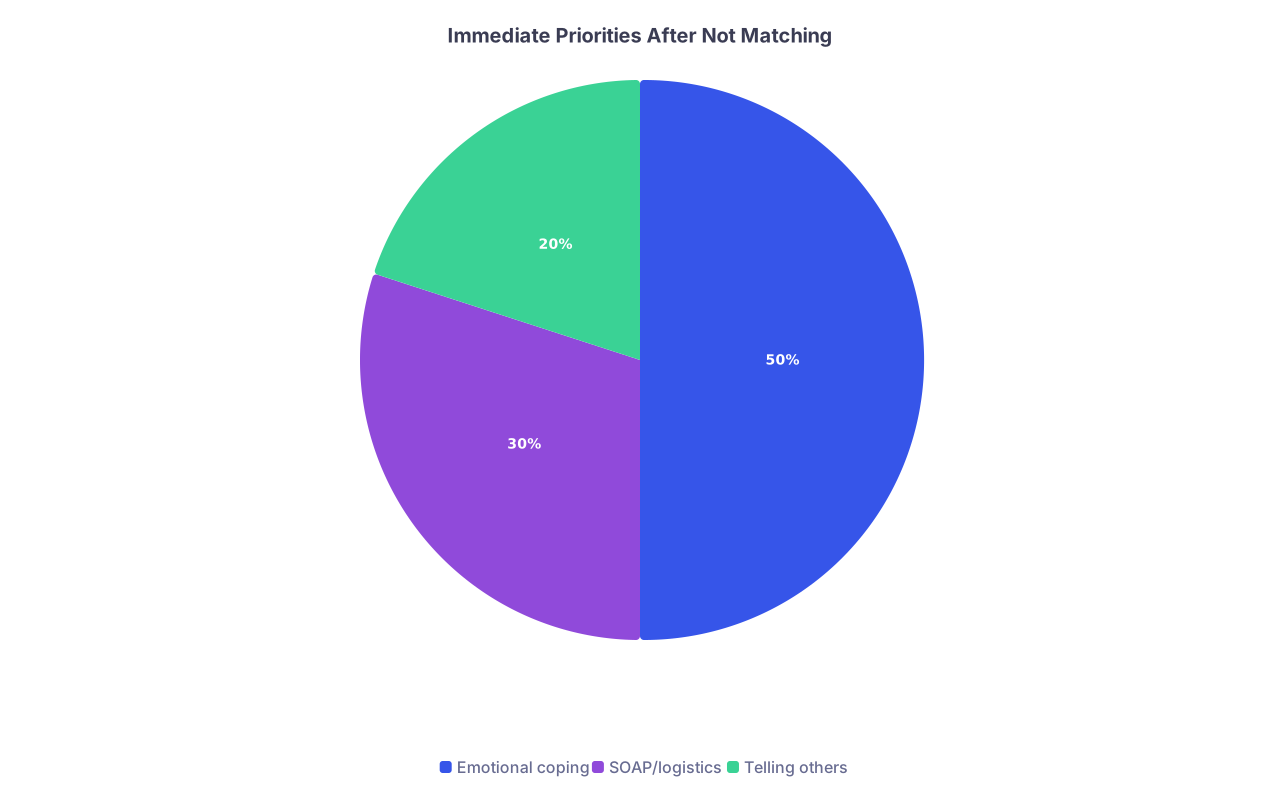
| Category | Value |
|---|---|
| Emotional coping | 50 |
| SOAP/logistics | 30 |
| Telling others | 20 |
For right now, there are three jobs:
- Protect your mental state enough to function
- Get a basic next-step plan (even a messy one)
- Then, and only then, tell people
Some things that actually help (not just the Instagram-therapy nonsense):
- One person first. Tell one safe person before you blast it to the world: a friend who didn’t apply this year, a partner, or that classmate everyone trusts. Saying the words out loud once makes round two slightly less brutal.
- Script it. When your brain is mush, words are hard. Write a one- or two-sentence explanation you can copy-paste or say. Example:
“I didn’t match this year. I’m working with my dean to figure out next steps, and I’ll share more when I’ve processed a bit.” - Decide your boundary now. You do not owe anyone a detailed post-mortem. You can repeat: “I’m still processing and working with faculty; I’m not ready to go into details yet.”
If you’re in SOAP, you’re juggling a full-on emergency plus social pressure. That’s brutal. For SOAP week, you’re allowed to basically go on “low contact” with everyone except absolutely essential people.
How to Tell Different Groups (Without Falling Apart)
Telling Parents or Family
This is the one that screws with people the most. Because family can be… complicated.
Maybe your parents sacrificed a lot for you to get here. Immigrant parents. First-gen college student. The “we told everyone in the community you were going to be a doctor” situation.
You might be expecting disappointment. Or anger. Or “But what happened?!” interrogation.
You need a script and boundaries. Something like:
“I got my Match result, and I didn’t match this year.
I’m upset and still processing, but I’m already talking with my school and figuring out next steps.
I know you might have questions, but I’m not ready to go into details yet. What I need most right now is support, not analysis.”
Then stop talking. Let the silence be awkward. That’s fine.
If they start with the questions:
- “But why?” → “There are a lot of factors. It’s a very competitive process. I’m working with my advisors to review everything, but I’m not up for breaking it all down right now.”
- “Did you apply to enough programs?” → “I applied broadly. This year was just very competitive. We’re going to adjust strategy for next cycle once I regroup.”
- “What are you going to do now?” → “Short term, I’m focusing on immediate options with my school. Longer term, probably reapplying with a stronger application. I’ll update you when I know more.”
You do not have to soothe their anxiety at the expense of your own. You are not their therapist. You do not need to manage their disappointment gently while you’re bleeding out emotionally.
If they’re supportive? Great. Let them be. But if they’re not, mentally file this interaction as “unhelpful” and don’t keep going back to that well.
Telling Your Partner
If you have a partner, you probably feel guilty on top of everything. Especially if they structured their life around your Match. Or if you were planning a couples match and it didn’t work out.
Be honest about two things: the situation and what you feel capable of.
You can say:
“I didn’t match. I’m devastated and also trying to think through what this means for us.
I really need you with me in this, but I might not have answers yet about timelines or locations. Can you just sit with me in the uncertainty for a bit?”
If they jump straight to logistics, gently redirect:
“I know we have to think about that, and we will. But today I just need to be allowed to be sad without fixing it yet.”
If they’re also in the process and did match, you might feel jealous or ashamed. That’s normal and also ugly-feeling. Give yourself some grace. You’re human, not a robot.
Telling Friends and Classmates
This part is tricky because everyone’s asking everyone: “Where did you match??” and you’re just trying not to cry during rounds.
You don’t owe a speech to the entire class. Decide who needs to know now and who can find out eventually.
For close friends:
“I didn’t match. I’m pretty raw about it, so I’m not up for a big breakdown right now. I just wanted you to hear it from me and not through the grapevine.”
For acquaintances / group chats:
You can honestly just send:
“Hey all, I didn’t match this cycle. I’m working with my school on next steps and probably staying quiet for a bit.”
Then mute the chat if needed. Seriously.
And if someone hits you with the well-meaning but clumsy stuff like “Everything happens for a reason” or “You’re so smart, it’ll be fine” — you’re allowed to just not respond.
Telling Faculty, Letter Writers, and Mentors
This one makes people want to crawl under a rock. Because you feel like you’ve “wasted” their letters or embarrassed them.
They’ve seen this before. You are not their first unmatched student. You are not their last.
Send a short, professional email like:
“Dear Dr. X,
I wanted to let you know that I did not match this cycle. I’m disappointed, but I appreciate your support and advocacy for me throughout this process.
I’m working with my dean and advisors to determine next steps, including options for SOAP and potentially reapplying next year.
If you have any thoughts or advice, I’d be grateful to hear them once I’ve had a bit of time to regroup.
Thank you again for your support,
[Name]”
They might offer research, a preliminary plan, or to talk. Or they might just say “I’m sorry to hear that — let’s connect later.” Either way, you’ve handled it like a professional.
How Much Do You Have to Share? Short Answer: Less Than You Think
You don’t need to discuss your Step scores, number of interviews, or the specialty’s competitiveness in detail with anyone except advisors.
People love post-game analysis: “Maybe you should’ve applied to more prelims” or “You were too competitive, programs assumed you’d rank elsewhere” or “It’s because you didn’t do away rotations at X place.”
Most of that is noise. You are not obligated to sit there while everyone plays armchair NRMP analyst.
Here’s a line you can memorize:
“I’m still going through it with my advisors and reviewing my application. I’m not ready to dissect it yet with other people.”
Repeat as often as needed.
If someone pushes (and they will):
“I appreciate that you’re curious / trying to help, but this is actually making me feel worse right now. I’d rather not get into the weeds.”
Yes, that feels confrontational. Yes, you’re allowed to say it anyway.
Social Media: To Post or Disappear?
This one can spiral in your head for hours. Everyone else is posting “Blessed to have matched at X!!!” and you’re just… stuck.
You have three real options:
- Go silent
- Post something very vague
- Post something honest but contained
All three are valid. You are not obligated to “make a statement.”
If you want to post something but keep it minimal:
“Didn’t get the Match result I hoped for this year. I’m working with my school on next steps and will be regrouping. Grateful for the people who are supporting me through this. Please be kind to your classmates — not everyone got good news this week.”
Then log out. Delete the app for a week if you have to. No one’s going to fail you for not liking their Match post.

You’re Not Ruined. Even If It Feels That Way Right Now.
Let’s talk about the worst-case scenario spiraling in your head:
- “I’ll never match.”
- “Everyone will always remember I was the one who didn’t match.”
- “This means I’m not cut out for medicine.”
Here’s the reality from what I’ve seen:
Lots of people don’t match the first time and then match the next cycle — often into solid programs. They get board certified. They practice. Patients don’t know or care. Colleagues forget. It becomes a painful story, not your defining feature.
| Path | Rough Likelihood (Anecdotal) |
|---|---|
| SOAP into a position | Fair if you have some interviews and flexibility |
| Reapply next cycle, match | Common with improved strategy |
| Research year then reapply | Very common in competitive fields |
| Change specialty, match | Happens a lot, especially from super competitive to less so |
| Leave clinical medicine | Less common, but not failure |
But I know that doesn’t fix how it feels in this moment. Right now it feels like your entire social world is going to collapse as soon as you say the words “I didn’t match.”
So the goal is smaller:
Get through each disclosure with your dignity intact and your nervous system only moderately fried — not shattered.
A Simple Plan You Can Actually Follow
To keep your brain from spinning into chaos, have a super basic plan for telling people.

| Step | Description |
|---|---|
| Step 1 | Get unmatched result |
| Step 2 | Tell 1 safe person |
| Step 3 | Stabilize & script |
| Step 4 | Go low contact, focus on SOAP |
| Step 5 | Schedule meeting with dean |
| Step 6 | Inform parents/partner briefly |
| Step 7 | Email mentors/faculty |
| Step 8 | Decide social media approach |
| Step 9 | Gradually tell others as ready |
| Step 10 | Need to SOAP? |
You can literally do this:
- Tell one safe person
- Write your 1–2 line script
- Tell parents / partner using the script
- Send faculty the brief email
- Decide: social media silent or short statement
- Everyone else = “I’m not ready to talk details”
That’s it. That’s the plan.

You’re Allowed to Feel Humiliated AND Still Ask for Help
Here’s the paradox: you feel so ashamed you want to disappear, but this is exactly the moment you most need support and advocacy.
You might think: “If I tell my dean or PD, they’ll judge me.” Honestly? The decent ones won’t. They’ll flick into problem-solving mode. You are not their first unmatched student. If they sound too casual, it’s not because they don’t care — it’s because they’ve done this many times.
And friends? Some of them will disappoint you. They’ll say the wrong thing. Or they’ll make it about them. Or they’ll ghost because they don’t know what to say. That hurts, and you’re allowed to be angry about it.
Others will surprise you:
The classmate you barely talked to who quietly checks in.
The attending who says, “You’re exactly the kind of person who should be in this field, and we’ll figure this out.”
The friend who doesn’t offer a single piece of advice and just says, “This really sucks. I’m here.”
So yes, be scared. But tell people anyway — the ones who matter. Because going through this completely alone is worse.

FAQ: The Stuff You’re Probably Still Worrying About
1. What if my parents react badly or make me feel worse?
It might happen. Some parents panic, guilt-trip, or interrogate. That’s about their anxiety, not your worth. Keep your responses short and repeat your boundary: “I’m not ready to go into details.” After the first conversation, limit contact a bit if every call turns into a Match inquisition. You’re allowed to protect yourself, even from family.
2. Do I have to tell people right away, or can I wait weeks?
You can absolutely wait. The only people who need timely info are your school, mentors, and anyone directly involved in SOAP or planning. For others, you can say later: “Match Week was really rough. I didn’t match and needed time before talking about it.” You’re not lying. You’re pacing yourself.
3. What do I say when classmates ask ‘Where did you match?’ to my face?
You can say, calmly: “I actually didn’t match this year. I’m working on next steps.” If they stare or fumble, you can help them out with: “Yeah, it’s been a lot. Anyway, how are you feeling about your match?” You’re not obligated to justify, explain, or comfort them about your result.
4. I feel like everyone’s going to see me as less-than forever. Is that real?
No. People have the memory of goldfish when it comes to other people’s careers. In a year, they’ll be drowning in their own intern chaos. The fact that you didn’t match on your first try will be, at most, a passing footnote. It feels gigantic now because it’s fresh and public. That fades. I’ve worked with attendings I later found out didn’t match their first cycle — years after the fact. No one cares.
5. How do I stop replaying conversations and obsessing over what people think?
You probably won’t stop immediately. Your brain’s in crisis mode looking for social threats. But you can interrupt the loop. Every time you catch yourself thinking “They must think I’m a failure,” replace it with: “They probably thought about it for 30 seconds and then went back to their own life.” Because that’s what people do. Also, keep your team small: a few people who know the full story and actually deserve access to your vulnerability.
Key points to walk away with:
- You control how much you share and when. “I’m not ready to talk about details” is a complete sentence.
- Not matching is a painful event, not a final verdict on your career or your value.
- Tell a small circle of safe people, set boundaries hard, and let the rest of the world wait.


