

You refresh your email, even though you already know there’s nothing new. Your Match result is what it is. And in the back of your mind, there’s this sick, heavy question: “What if I go through all of this again next year… and still don’t match?”
Let me say the part you’re probably afraid to say out loud: you’re not just worried about this year. You’re terrified of wasting years of your life chasing something that might not happen.
Let’s walk through that worst-case scenario on purpose—what if you still don’t match next year—and then build an actual plan around it, so it doesn’t own you.
Step 1: Admitting the Scariest Version Out Loud
Most people around you are saying things like, “You’ll get it next time,” “You’re smart, it’ll work out,” “Just apply more broadly.”
Nice. Not helpful.
You’re probably thinking something closer to:
- “What if this is who I am now—the person who never matches?”
- “What if I waste another year and end up back in the same place but even older and more behind?”
- “What if I ruin my chances forever by reapplying badly again?”
- “What if I have to explain two unmatched cycles to every interviewer?”
Those aren’t irrational thoughts. I’ve watched people live those questions in real life.
Let’s do something most people refuse to do: assume the worst happens next year. You reapply. You try hard. And you still don’t match.
If you can look that in the eye and have a plan, everything between now and then becomes a lot less paralyzing.
Step 2: Know Exactly What Two Failed Cycles Actually Mean
It feels like two unmatched cycles = game over.
It’s not “game over.” It’s just “the game is no longer standard.”
Residency programs will absolutely see:
- Your graduation year is getting farther away
- You’ve applied before (possibly more than once)
- You’re now a “non-traditional” or “reapplicant” with a story to explain
Does that make life harder? Yes. Does it make it impossible? No.
Here’s the unvarnished version:
- Matching into ultra-competitive specialties (derm, plastics, ortho, ENT, ophtho, etc.) after two unmatched cycles as an IMG or lower-tier US grad? Brutally unlikely unless you radically transform your application and have insane connections.
- Matching into moderately competitive specialties (EM, anesthesia, radiology, OB, some surgical prelims) after two misses? Hard, but not universally impossible if you pivot strategically (program selection, geography, prelims, contacts).
- Matching into primary care (FM, IM, psych, peds) after two misses? Still doable for some applicants, especially if they:
- Tighten their story
- Have strong US clinical experience
- Get backing from faculty who will actually pick up the phone
The bigger issue isn’t just program bias. It’s time since graduation and what you did with that time.
That’s the piece you can control now—before next cycle—and also in a worst-case where you don’t match again.
Step 3: Build a “If I Don’t Match Again” Career Map Now, Not Later
This sounds backwards, but it helps: design your life assuming the worst, then work backward.
If you still don’t match next year, you will be in one of three mental places:
- “I still want clinical medicine badly enough to keep pushing.”
- “I think I still want medicine, but not at any cost.”
- “I’m done. I can’t keep doing this.”
You don’t have to pick one right now. But you do need options that fit each of those, so you’re not stuck in panic mode.
Here’s how those can look in reality.
Path A: I Still Want Clinical Medicine (Even After Two Misses)
If you get to the worst case and still want to keep going, these are the levers people actually pull, not the fantasy ones:
- Flipping to a less competitive specialty (even if it hurts your ego)
- Leveraging prelim or transitional year spots
- Using research/clinical/re-entry fellowships or “assistant” roles to stay close to patient care

Some realistic “I’m not giving up yet” options if you don’t match again:
Clinical-adjacent / re-entry roles:
- Research fellow in a clinical department (IM, FM, psych, etc.)
- “Clinical research coordinator” in a hospital where attendings know you
- Postgraduate clinical “observer” / non-ACGME fellow roles some institutions quietly offer to IMGs or unmatched grads
- Hospitalist scribe or advanced scribe roles where you work closely with one team
Routes that sometimes eventually lead back to residency:
- Doing a prelim year in surgery or medicine, then reapplying into IM/FM/psych with fresh LORs and new clinical performance
- Taking a non-ACGME fellowship (e.g., in hospital medicine, medical education, research) tied to a specific department that occasionally pulls fellows into residency slots when they open up
- Matching outside the US (Canada is tough, but places like the UK, Ireland, Australia, New Zealand, certain Middle Eastern systems have pathways—complicated, but real)
None of this is clean. None of it is fast. But I’ve seen people match IM/FM/psych after 2–3 years of this sort of grind.
The key question: Are you willing to live those years? With the uncertainty, the hit to pride, the geographic flexibility you’ll likely need?
If the real answer is yes, then your “worst case” plan is: keep one foot in clinical medicine—no gaps—so that if an opportunity opens, you’re still a believable candidate.
Path B: I Want a Stable Healthcare Career Even If I Never Match
This is where a lot of people end up mentally after one or two failed cycles:
“I want stability, I want income, I want to use my training, but I can’t keep burning years chasing residency.”
You’re not betraying medicine by feeling that way. You’re being honest.
There are several “doctor-adjacent” careers that many unmatched graduates move into and actually build satisfying lives around.
| Path Type | Time to Re-Train | Clinical Patient Contact |
|---|---|---|
| Clinical Research | 0–1 year | Low–Moderate |
| Pharma/Med Affairs | 0–2 years | Low |
| Public Health/MPH | 1–2 years | Low–Moderate |
| Health Tech/Startups | 0–1 year | Low |
| Consulting | 0–1 year | None |
Examples of realistic transitions:
Clinical research:
You already know how to read papers, talk to patients, understand protocols. You can become a clinical research coordinator, then senior CRC, then project manager, then maybe move to industry. Some hospitals basically live on people like you.Industry (pharma, devices, med tech):
Medical science liaison (MSL), safety physician assistant roles, medical affairs, regulatory roles. You might need a stepping-stone job first (like in clinical research or med writing) before they trust you with higher-level positions.Public health:
An MPH plus your MD/DO can land positions in epidemiology, health policy, government agencies, NGOs. It’s not instant glamour, but it’s real work with impact.Medical writing / education:
Writing CME content, test prep materials, clinical summaries, guideline digests. If you’re actually good at explaining complex things simply, this is underrated.Tech / digital health:
Startups love people who understand medicine but aren’t stuck in residency schedules. Product, operations, clinical solutions roles. You’ll have to learn some business language, but it’s doable.
This isn’t “plan B is you become a barista.” It’s “plan B is still a professional, financially stable career with your medical background baked in.”
The emotional barrier is bigger than the practical one.
Path C: I Might Be Done With Medicine Entirely
Nobody says this out loud, but I’ve heard it in quiet rooms more times than I can count:
“I don’t even know if I want this anymore. I just don’t know who I am without it.”
If you go through two cycles, burn your savings, put your life on hold, and feel completely done—like the idea of another application makes you want to puke—that’s not failure. That’s data.
It might mean your worst-case plan is: use your intelligence and work ethic in a completely different domain. Coding, finance, design, law, business. People have left medicine and found their second life.
Will it hurt? Yes. Will people judge you? Some will. Will they be living your life? No.
You don’t have to decide now. But it’s allowed to be on the menu.
Step 4: Use the Worst-Case Plan to Shape What You Do This Year
Here’s the real benefit of planning for not matching next year: it changes how you use your time now.
If you know that even in the worst case, you might want:
- Path A (stay clinical-adjacent),
- Path B (pivot but stay in health/biomed),
- or Path C (leave medicine entirely),
then this year isn’t “wasted” no matter what happens.
Before you commit to anything for your “bridge year” or reapplication year, ask:
“If I still don’t match next cycle, does this make my life better or worse?”
Concrete examples:
Observership vs structured research position
Observerships can help for next Match, yes. But if you end up unmatched again, they’re often not very marketable outside residency. Meanwhile, a paid clinical research job builds a CV line that matters for:- Residency (research, letters, institutional connections)
- Industry (project management, trial experience) So research might be the smarter worst-case hedge.
Unpaid “volunteer” vs actual employment
Unpaid roles might help you get LORs, but if you don’t match again and you have nothing but “volunteer” for two years, that’s rough—emotionally and financially. A lower-prestige but paid clinical facing job + some networking often ages better.Doing an MPH now vs later
If you genuinely like public health and can see yourself doing it as a career even if residency never happens, an MPH can be a very rational hedge. But doing it solely to “fix” an application? Risky. Because if you don’t match again, you’re left with debt and no clear next step.
You’re not just planning for Match. You’re future-proofing yourself against the worst.
Step 5: Geography, Ego, and the “Anywhere, Anything” Question
At some point you have to ask the ugliest version of the question:
“If the only way I ever match is in a specialty I don’t love, in a place I don’t like, would I still want it?”
Because if your answer is “I want any residency at any cost,” that points you one way. If your answer is “I want a life I recognize, not just a title,” that points you another way.
I’ve seen people:
- Move to rural programs in states they’d never heard of and end up surprisingly happy.
- Take prelim surgery just to stay in the game, then leverage it into IM or anesthesia later.
- Refuse to compromise on geography and specialty—and stay unmatched for multiple years, then quit.
- Pivot to FM or psych after two failed EM or surgery cycles and finally match and thrive.
You’re allowed to care about specialty. You’re allowed to care about location. You’re also allowed to say: if I’m still unmatched next year, I’ll open those doors wider—or I won’t, and I’ll walk away.
But make that rule ahead of time, not from a place of panic.
Step 6: The Psychological Part Nobody Preps You For
If you don’t match next year, the worst thing won’t be the CV damage. It’ll be the identity damage.
You’ll see classmates moving forward: PGY-2, then attending, posting pictures in white coats while you’re rewriting your CV again or sitting in a non-residency job. It can feel like your life is stuck in a loop.
Here’s what I’ve watched work for people:
Set a hard limit on doom spirals.
You get 30 minutes to cry, rage, spiral, then you have to do one concrete thing: update a document, email a mentor, research a job option.Have 2–3 people who know the full story.
Not just “I’m reapplying,” but “I have a worst-case plan and I’m terrified.” The shame gets lighter when at least one other person is sitting in it with you.Separate “I failed at matching” from “I am a failure.”
Call it what it is: a failed attempt in a cruel, overloaded system. Not a moral verdict on who you are or how smart you are.Give yourself a decision date.
For example: “If I don’t match next year, I’ll spend six months actively exploring non-residency careers before deciding whether to keep trying.” It stops the endless limbo.
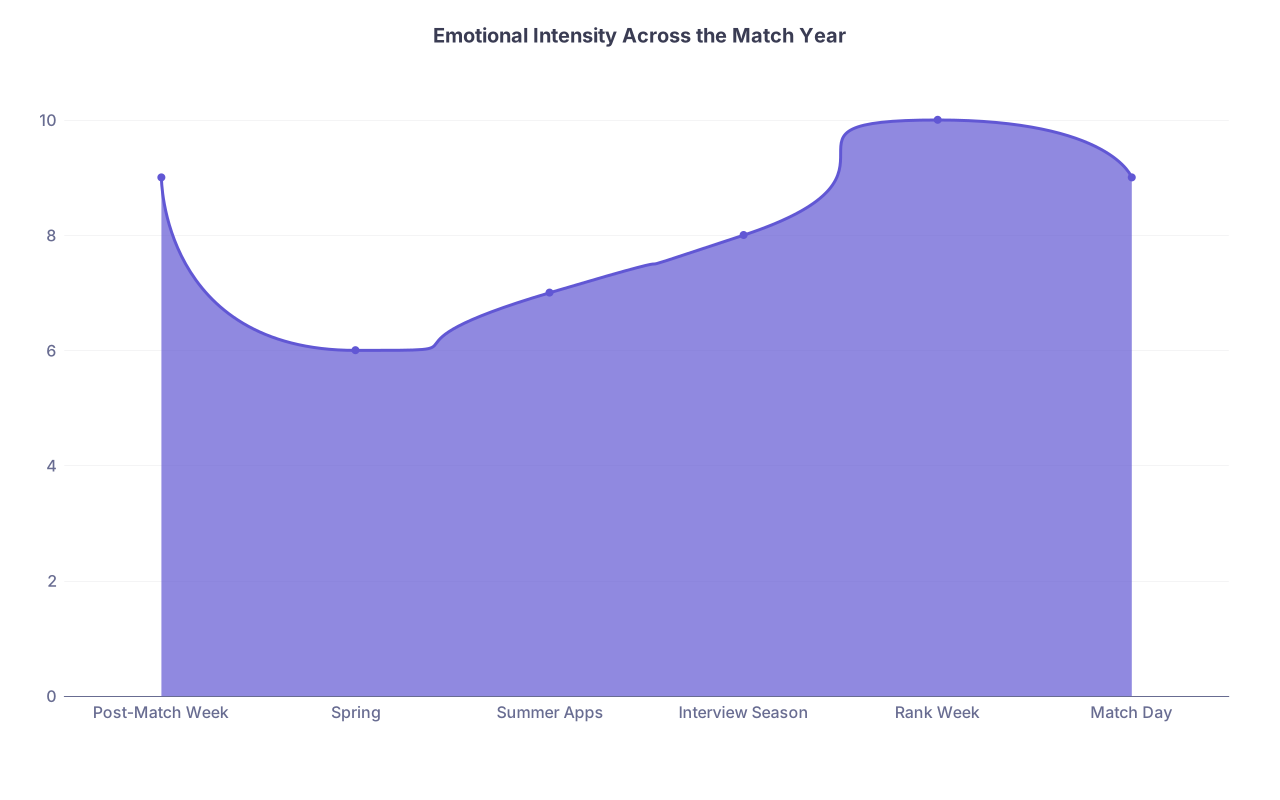
| Category | Value |
|---|---|
| Post-Match Week | 9 |
| Spring | 6 |
| Summer Apps | 7 |
| Interview Season | 8 |
| Rank Week | 10 |
| Match Day | 9 |
You don’t have to be endlessly resilient. You just have to not let the fear make every decision for you.
Step 7: A Quiet but Important Point About Money
Nobody likes to talk about this, but planning for the worst-case means talking about money too.
If you end up unmatched again, you don’t want to also be:
- Drowning in new degree debt you took on just to “strengthen the app”
- Living off high-interest credit cards because you refused to take any job that wasn’t “doctor enough”
Run the numbers now:
- How long can you realistically float if you don’t match?
- How many cycles are you financially willing to attempt?
- At what point does taking a stable non-residency job actually help your life more than rolling the dice again?
It’s not selling out to care if you can pay rent.
Step 8: What Planning for the Worst Actually Does for You
Here’s the twist: once you have a real, concrete worst-case plan, you usually start performing better in the present.
Because you’re no longer gripping every decision like, “If this goes wrong, my life is over.” You’re choosing from several survivable paths, not from a cliff edge.
You’re allowed to make a “Plan If I Still Don’t Match Next Year” document. Literally write it out:
- If I don’t match next year, I will:
- Apply for X type of jobs in Y fields.
- Reach out to A, B, C people for introductions.
- Decide by [date] whether to try again or pivot permanently.
Then do your absolute best this cycle and next—but knowing that, even in the worst case, there is still a life on the other side.
Years from now, you won’t remember the exact wording of your rejection emails. You’ll remember the moment you stopped letting them define what came next.
FAQ (Exactly 5 Questions)
1. Is it even worth reapplying if I’ve already gone unmatched once?
It can be, but only if something real changes between cycles: stronger letters from people who actually pick up the phone, more targeted program list, meaningful US clinical experience, better Step/COMLEX scores (if that’s still an option), or a specialty pivot. Reapplying with the same application plus “more time” is how people end up unmatched repeatedly. Before you reapply, you need a brutally honest appraisal from someone who actually reads applications (PD, APD, seasoned faculty), not just friends telling you you’re great.
2. Will programs secretly blacklist me after two unmatched cycles?
There’s no universal blacklist, but there is skepticism. Some programs will pass on anyone with multiple failed cycles, yes. Others care more about what you’ve done recently—fresh clinical work, strong off-cycle letters, how compelling your “what happened?” story is. The further you get from graduation and the more cycles you go through, the smaller your realistic program pool becomes. That’s not spite. It’s just how risk-averse they are. But “smaller” is not the same as “zero.”
3. Is doing an MPH or another degree a good backup if I don’t match again?
It depends on why you’re doing it. If you genuinely like public health or policy and can see yourself in those careers even if you never match, an MPH can be a smart hedge. If you’re doing it purely to “look better” for residency, it’s a gamble—and a potentially expensive one. Programs are not automatically impressed by extra degrees. They want to see clear clinical relevance, continuity, and a coherent story. Always ask: “If I never match, will this degree still pay off in my life?”
4. Will leaving medicine after two failed cycles mean I wasted all these years?
No, though it will feel like that for a while. The sunk cost fallacy is strong in medicine: “I already invested X years, so I have to keep going.” But staying in a path that’s destroying your mental health or financial stability just to justify the past is how people lose another five or ten years. The knowledge, discipline, and resilience you built don’t vanish if you pivot. You’ll use them in other fields—healthcare-related or not. The “waste” isn’t walking away; it’s staying only out of fear.
5. How many times should I realistically try to match before I consider other paths?
There’s no universal number, but most people who’ve sat on both sides of this agree: once you’re talking about a third full cycle, you need to seriously, actively explore alternatives—not as an afterthought, but as real contenders. For some, that means two tries total. For others, especially those willing to change specialty and location and who keep strong clinical ties, three might be reasonable. The real turning point is when each additional cycle costs you more (emotionally, financially, professionally) than it’s likely to return. That’s when you owe it to yourself to ask, “If I still don’t match next year, who else can I be—and could that life actually be okay?”


