
Your application red flag will not sink you. Mishandling your away rotations will.
Let me be blunt. For most applicants with red flags, the personal statement and “I’ve grown from this experience” paragraph do not move the needle. Program directors have read thousands of those. The only thing that reliably changes minds is how you perform in front of them and their residents for 2–4 weeks.
That is what the inside-out strategy is: using away rotations from the inside of programs to rebuild how you are seen on the outside of your paper file.
You are not begging for forgiveness. You are giving programs something more powerful than a narrative: current, direct, observable evidence that you are safe, reliable, and trainable.
Here is how you do it, step by step.
1. Get Ruthlessly Clear On Your Red Flag
You cannot fix what you are half-admitting.
Common red flags I see:
- Failed Step/COMLEX attempt
- Low Step 1 or Step 2 CK score relative to specialty
- Failed or repeated course/rotation
- Gap in training, leave of absence
- Disciplinary action or professionalism concern
- Late specialty switch with weak home letters
- IMG / DO aiming for highly competitive specialties with limited research
You are not just “a little weaker on paper.” You are carrying a specific liability in the eyes of program leadership:
- Failed exam → “Will this resident pass boards? Are they safe with knowledge?”
- Failed rotation / professionalism note → “Will this person be a headache? Will I get emails about them?”
- Gap / LOA → “Is this person stable enough to survive residency?”
- Poor clinical evals → “Will they make more work for everyone else?”
Write this out clearly for yourself on paper:
- “My primary red flag: _______”
- “What a PD logically worries about because of this: _______”
Now your away strategy has a target.
2. Design Your Away Rotation Strategy Around Your Weakness
Most students pick aways based on “prestige” or location. That is the wrong lens for you.
You are using aways as rehabilitation, not tourism.
Pick the right types of programs
You are looking for programs where:
- They actually watch rotators and use their input for rank lists
- They have a history of taking non-traditional applicants or those with bumps
- The culture values work ethic and team fit, not just test scores
You are not looking for:
- Hyper-elite programs that do not care about away students unless they are 270s with multiple publications
- Places that routinely overfill with home students
- Programs that explicitly avoid ranking rotators (yes, some do)
| Program Type | Rehab Value | Why |
|---|---|---|
| Mid-tier academic, resident-heavy | High | Residents advocate, PDs listen |
| Strong community with teaching | High | Clinical performance highly valued |
| Top 10 research powerhouse | Low | Numbers & research dominate |
| Brand-new/unaccredited program | Variable | Less stability, unclear support |
If you have:
- Step failure / low scores → Target programs that pride themselves on “clinically strong residents,” not just board stats.
- Professionalism concerns → Target tight-knit programs where culture fit is everything; they will notice your improvement.
- Gap / LOA / mental health concerns → Target programs with explicit wellness initiatives and reasonable duty-hour culture.
Use aways sequentially, not randomly
If you have multiple red flags or a serious one, you want a built narrative:
- Early short rotation at home or nearby → clean evals, proves baseline.
- First away at a “friendly” program → practice your system, get a strong letter.
- Second away at a realistic match target → this is where you want to absolutely nail it.
Avoid stacking 3–4 aways unless your specialty expects that (e.g., ortho, derm, neurosurgery). Each away is a massive stressor. Too many aways → you underperform on all.
3. Engineer Your On-Rotation Behavior To Directly Counter The Red Flag
Away rotations are not improv. You do not “just be yourself and hope.” You run a very specific playbook that addresses the exact concern they have about you.
If your red flag is test scores or failed exams
What programs are scared of:
- You cannot retain or apply knowledge
- You will struggle with in-service/boards
- You are slow on the uptake
On the rotation, you must:
Be radically prepared for rounds.
- Pre-read your patients in detail.
- Have labs, imaging, and overnight events already pulled up.
- Anticipate 2–3 likely questions per patient and have answers ready.
Show active learning in real time.
When you are pimped and do not know:- Say: “I am not sure, but I think it might be X because… I will read on it and get back to you tomorrow.”
- Then actually return tomorrow with a brief, relevant explanation:
“I read the UpToDate article and one review on X. The key point is…”
Use a simple daily learning log. One page per day:
- New topic I saw
- What I reviewed that night
- One line summary
If a resident or attending asks what you are reading, you open the log. It signals seriousness and structure. I have seen PDs visibly relax when a “red flag” student shows this kind of system.
If your red flag is professionalism / prior incident
What programs are scared of:
- You are a future HR problem
- You do not take feedback
- You get defensive or disappear when stressed
Your job for 2–4 weeks is to be boringly reliable with three behaviors:
Relentless punctuality and presence.
- 10–15 minutes early. Every day. No exceptions.
- Do not be the first to vanish at the end of the day.
- Answer pages/texts promptly (within minutes, not hours).
Make feedback easy for them.
At the end of week 1, say to a senior:- “I know I had an issue in the past with X. I am working hard to improve. Can you tell me one thing I should do differently next week?”
Then do it. And circle back: - “I tried what you suggested about pre-rounding earlier. Does that look better to you?”
- “I know I had an issue in the past with X. I am working hard to improve. Can you tell me one thing I should do differently next week?”
Be aggressively low-maintenance.
- Do not complain. About hours, food, other students. Save the venting for your friends at home.
- Own small mistakes quickly:
“I missed that lab result this morning. I have already added it to my pre-round checklist so it does not happen again.”
That kind of measured humility is exactly what redeems a professionalism flag.
If your red flag is a gap, LOA, or mental health history
What programs are scared of:
- You will not tolerate residency stress
- You might disappear mid-year
- They will have to scramble to cover your shifts
You must show stability and sustainability, not bravado.
Build and follow a visible routine.
- Look consistently rested (not destroyed)
- Eat, hydrate, step out briefly when appropriate
Attending notices when a student is a wreck at 3 pm daily. That screams “fragile.”
Signal insight and durability without oversharing.
If it comes up (and it often will, gently):- “I had a rough period in the past and took deliberate time to get healthy and build better systems. The last 18 months have been very stable for me, and I am careful now to manage stress proactively.”
Then your daily behavior must match that sentence.
- “I had a rough period in the past and took deliberate time to get healthy and build better systems. The last 18 months have been very stable for me, and I am careful now to manage stress proactively.”
Never weaponize your difficulties as an excuse.
If you are late, disorganized, or unprepared, do not reach for your history as explanation. That kills trust immediately.
4. Use The “Triangle of Proof”: Performance, Advocacy, Documentation
One good rotation does not automatically erase a red flag. You need three things working together.
1. Live performance (how you show up daily)
This is the foundation:
- Reliable pre-rounding
- Accurate notes and orders drafts
- Good relationships with nurses and ancillary staff
- No visible drama
Remember: nurses talk. If a nurse says “That student is fantastic,” attendings hear it.
2. Resident and attending advocacy
You want multiple people in the program willing to say, in a rank meeting:
- “I know their exam history, but on our service they were excellent.”
- “I would absolutely take them as an intern; they held their own.”
You earn this by:
- Asking for feedback early (day 3–4)
- Making seniors’ lives easier:
- Carrying the list, tracking tasks
- Volunteering for scut quietly, not performatively
- Not trash-talking other students or your home program
At the end of the rotation, do not mumble. Ask directly:
- “I am very interested in this program. Based on how I have done, would you feel comfortable supporting me with the PD or in rank discussions?”
You will get a real-time read on how you are perceived.
3. Documentation: The letter that rewrites your narrative
The most powerful thing for a red-flag applicant is a letter that directly and explicitly counters the concern.
Example for a Step failure:
“While [Name] had difficulty with their first board exam, their performance on our busy inpatient service demonstrated strong clinical reasoning and steady knowledge growth. I have no concerns about their ability to pass future exams and function safely as an intern.”
That single sentence, from a respected PD or core faculty, does more than your 500-word explanation ever will.
You guide this by:
- Briefly and calmly explaining your situation to the letter writer:
“You will see in my ERAS that I had a Step failure in 2022. I have since passed on retake and worked hard to address knowledge gaps. If your experience of my performance supports it, any comment you can make about my clinical reliability and learning curve would be extremely helpful.”
No groveling. No drama. Just clarity.
5. Plan Aways Around Your Specialty And Risk Level
Different fields treat aways differently. You must play by each specialty’s rules while still running your rehabilitation plan.
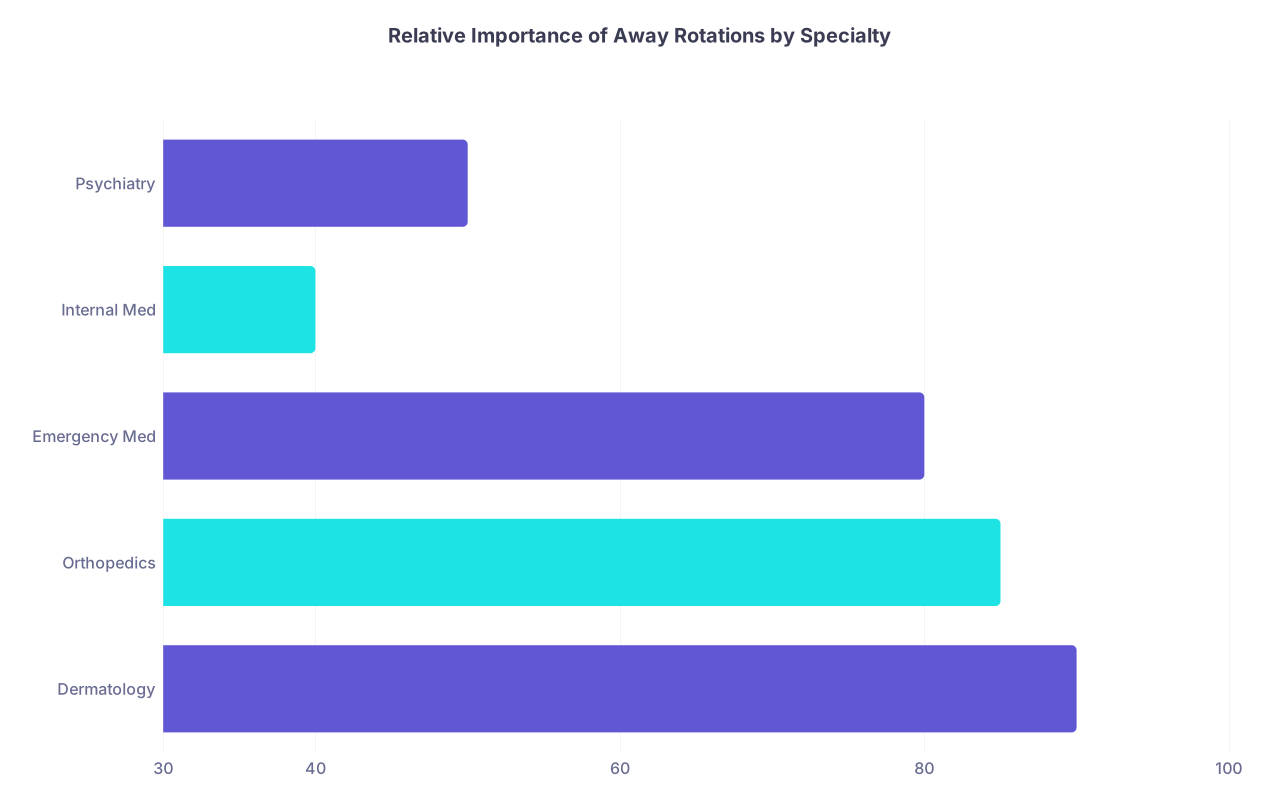
| Category | Value |
|---|---|
| Dermatology | 90 |
| Orthopedics | 85 |
| Emergency Med | 80 |
| Internal Med | 40 |
| Psychiatry | 50 |
Surgical specialties (ortho, ENT, neurosurgery, plastics)
- Aways are almost mandatory anyway.
- Your red flag (especially scores) will hurt. But a killer away can put you back in the game at select programs.
For you:
- Limit to 2–3 aways max. More and you burn out.
- Prioritize programs where you have some connection (home alumni, mentor contacts).
- Crush the basics: show up early for cases, know the anatomy cold, close well, anticipate instruments.
Competitive non-surgical (derm, rad onc, some subspecialties)
- Here, numbers and research dominate. Aways matter, but less than in ortho.
- If your red flag is scores, away performance can help at a few programs, but not everywhere.
For you:
- Pair aways with 1–2 concrete academic/research products (case report, poster).
- Use your away to show “this is not a cognitive issue; I can handle complex thinking and follow-through.”
Core specialties (IM, FM, peds, psych, EM)
- Aways are not always required, but they are your biggest lever with a red flag.
- Especially powerful for IMGs, DOs, or students from lesser-known schools.
For you:
- 1–2 aways is usually enough.
- Focus on programs where you truly want to match; you are auditioning, not sightseeing.
- EM specifically: SLOEs are king. A strong away SLOE that addresses concerns can override a lot.
6. Script Your Red Flag Conversation Before It Blindsides You
You will get asked about it. On rounds. In the workroom. In a random hallway conversation. If you ramble, get defensive, or overshare, you lose credibility.
Use a tight three-part script:
- Own it
- Explain it briefly
- Show what has changed
Example – failed Step 1:
- “I did fail Step 1 on my first attempt. That was my responsibility. I underestimated the exam and did not have a structured study plan.”
- “I met with our academic support office, rebuilt my approach, and treated my retake like a full-time job.”
- “Since then I have passed Step 1 and Step 2, and my recent clerkship and rotation evaluations reflect the stronger habits I built. I now use a consistent review system to keep my knowledge base current.”
Total: 20–30 seconds. Then you stop talking.
If they ask more, answer more. But do not volunteer a five-minute monologue.
For professionalism incidents, same pattern:
- Clear ownership (no blaming)
- Specific but not lurid explanation
- Concrete behavior changes since
If you are not sure how to phrase yours, write it out and practice it with a trusted advisor or faculty member before your aways start.
7. Protect Yourself From Self-Sabotage On Away
The danger with a red flag is that you overcompensate and create new problems.
Three common self-sabotage patterns I see:
1. Over-trying and annoying everyone
- Answering every question, talking over co-students
- Constantly volunteering to stay late but doing nothing useful
- Name-dropping your red flag explanation to every attending unprompted
Fix:
- Decide daily: “What are 2–3 high-yield ways I can help today?” Then do those well and quietly.
- Let residents finish their sentences. Offer help, then back off if declined.
2. Under-disclosing and seeming evasive
If asked about your gap or exam and you say:
“I had some personal issues; it’s all resolved now” with a flat affect, people smell avoidance.
Fix:
- Have the 20–30 second script. Use it.
- Respected programs are not looking for perfection; they are looking for insight and maturity.
3. Collapsing under stress because you did not prepare your life
An away is stressful. New city, new hospital, no support system. If you are already anxious about your red flag, this can push you over.
Fix the logistics before you arrive:
- Decent housing with reasonable commute
- Groceries and basic meal plan for the month
- Simple exercise or movement routine 3x/week
- One or two friends you can call to vent so you do not dump on your team
Red flags are not what kill most applications. Ongoing dysfunction does.
8. Turn A Strong Away Into Post-Rotation Leverage
Too many students vanish after an away and hope the program “remembers them fondly.” Weak strategy.
You want to deliberately convert that rotation into:
- 1–2 targeted letters
- Documented support from residents/faculty
- A mental “this is one of ours” label in the PD’s head
Specific steps, week by week
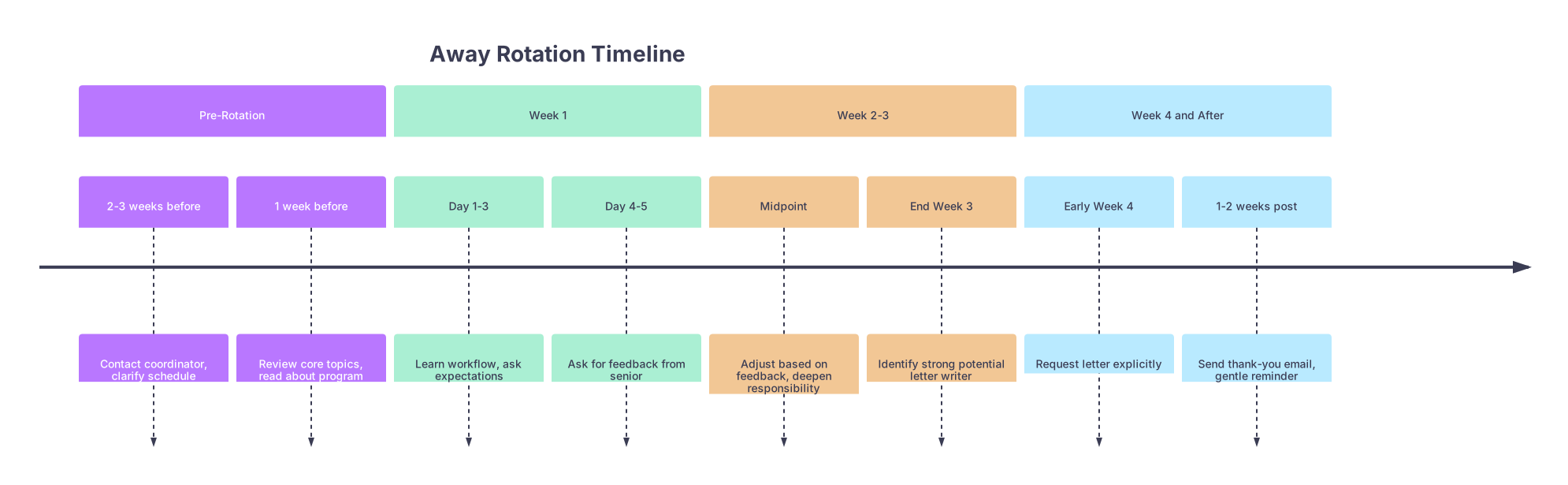
| Period | Event |
|---|---|
| Pre-Rotation - 2-3 weeks before | Contact coordinator, clarify schedule |
| Pre-Rotation - 1 week before | Review core topics, read about program |
| Week 1 - Day 1-3 | Learn workflow, ask expectations |
| Week 1 - Day 4-5 | Ask for feedback from senior |
| Week 2-3 - Midpoint | Adjust based on feedback, deepen responsibility |
| Week 2-3 - End Week 3 | Identify strong potential letter writer |
| Week 4 and After - Early Week 4 | Request letter explicitly |
| Week 4 and After - 1-2 weeks post | Send thank-you email, gentle reminder |
Sample letter request (in person or by email, if in-person is not possible):
- “I have really appreciated working with you. I am applying in [specialty] this cycle and this program is one of my top choices. If you feel you know my work well enough, I would be honored to have a letter from you, especially because I am working to show programs that my earlier [red flag] is not representative of how I perform now.”
Follow-up 1–2 weeks after the rotation:
- Thank you email
- Short bullet list of 3–4 cases or activities you were involved in to jog their memory
- Your CV + ERAS photo attached
This is not pushy. It is professional.
9. When Aways Are Not Enough (And How To Know)
Harsh truth: some combinations of red flags and super-competitive specialties are not fixable in one cycle using aways alone.
Clues you are in this group:
- Multiple Step failures with only marginal improvement
- Serious professionalism or disciplinary actions within the last 12–18 months
- Applying to ultra-competitive specialties (e.g., derm, ortho) with weak research AND red flags
- Consistently lukewarm feedback even after you have “tried your best” on home and early away rotations
In that case, use your away rotations to do two things:
Get brutally honest feedback from someone who has watched you work:
- “If I apply to [specialty] this year, given my record and performance, what do you think my chances are?”
- “If I were your son/daughter, what would you advise?”
Build relationships that support a pivot:
- Into a slightly less competitive but related field
- Into a research year, prelim year, or non-match year of clinical experience to rebuild your file
A “failed” path is the one where you double down blindly and burn 2–3 cycles. A strategic pivot, informed by away feedback, is not failure. It is damage control and long-game thinking.
FAQ (Exactly 4 Questions)
1. Should I disclose my red flag to everyone on the away, or only if asked?
Do not lead with your red flag as your introduction. Residents and attendings will often see it in your ERAS or MSPE summary anyway. Have a clear, concise explanation ready. Use it when asked directly or when you are discussing your background with someone likely to write your letter or advocate for you. Oversharing to every intern and student in the workroom usually backfires.
2. Is it better to do an away at a “big name” program or a realistic mid-tier target if I have a red flag?
For rehabilitation, realistic mid-tier targets almost always beat brand-name programs. You need a place that will genuinely consider you for a rank list and where your performance can move the needle. A glowing letter and strong internal support from a solid, match-realistic program is worth far more than being anonymous at a top-10 institution that never intended to rank you.
3. Can a single outstanding away rotation completely erase a failed Step attempt?
Erase? No. Reframe? Yes. The failure will stay on your record, but a strong away can demonstrate that the underlying problem has been fixed. When a respected faculty member or PD writes that they have no concern about your clinical reasoning or future exam performance, many programs will reconsider you. The red flag moves from “hard stop” to “risk with documented mitigation.”
4. What if I get mixed or negative feedback on my first away—should I still do a second one?
If your first away is shaky, do not just power ahead. Sit down with someone who supervised you and ask for very specific, behavior-level feedback: what you did well, what you did poorly, and whether they think a second away right now is wise. If you can identify concrete, fixable issues (organization, presentation skills, basic knowledge gaps) and have time to address them, a carefully chosen second away can still help. If the concerns are more global (professionalism, attitude, insight), you are better off fixing those at home first before going back into another high-stakes audition.
Open your calendar right now and block 30 minutes. In that block, write down your exact red flag, the fear it creates for programs, and three specific behaviors you will use on your next away to counter that fear. That is the inside-out strategy in practice—not vague hope, but a concrete plan.