
Exactly How to Script and Practice Your Red Flag Explanation
Most applicants destroy their chances not because of the red flag itself, but because they wing the explanation. That is the mistake you cannot afford.
You can absolutely match with a “bad” transcript, a leave of absence, a failed Step, a professionalism citation. I have seen it—multiple times—at strong university programs. What kills applicants is:
- rambling
- defensiveness
- oversharing
- blaming
- breaking down emotionally in the room
You are not going to do that. You are going to treat this like a high‑risk procedure: clear plan, rehearsed steps, controlled execution.
Here is exactly how to script and practice your red flag explanation so it stops being a minefield and becomes a quiet, controlled moment in your interview.
Step 1: Clarify Your Actual Red Flag and Its Risk Level
Before you script anything, you need brutal clarity about what you are dealing with. Not every “bad thing” is a serious red flag. Some are yellow. Some are barely beige.
A. Identify the concrete red flag
Typical categories:
Academic
- Failed course / clerkship
- USMLE/COMLEX failure
- Repeated year
- Remediation for poor performance
Professionalism / conduct
- Professionalism citation
- Remediation for behavior
- Incident with staff / peers
- Social media issues
Personal / health
- Leave of absence
- Long unexplained gap
- Major health or family crisis that impacted performance
Legal / disciplinary
- DUI / criminal charge
- University disciplinary action
Write the shortest, most factual description possible on paper:
- “Failed Step 1 on first attempt, passed on second with 228.”
- “Received professionalism remediation in MS3 year for repeated late arrivals to clinic, now resolved.”
- “Nine‑month leave of absence during M2 for major depressive episode, back in full standing since 2023.”
If you cannot state it clearly in one sentence, your explanation will be a mess. Fix the sentence first.
B. Estimate how much programs will care
Not all red flags are equal. You need a realistic sense of risk, so you do not under‑ or over‑react.
| Red Flag Type | Typical Risk Level | Must Be Proactively Addressed? |
|---|---|---|
| Single failed Step/COMLEX | Medium–High | Yes |
| Failed course/clerkship | Medium | Yes |
| Repeated year | High | Yes |
| LOA for health/family | Medium | Yes, briefly |
| Minor professionalism note | Medium | Yes |
| Major professionalism / legal | Very High | Yes, very carefully |
You do not need a 5‑minute monologue for a single B on your transcript. You do need a polished, tight story for a failed Step 1 or a professionalism remediation.
Step 2: Use the 4–Sentence Core Script Template
You need one thing: a core script that you can deliver in about 30–60 seconds under stress.
Here is the structure that works across almost every red flag:
- The fact, stated calmly and precisely
- The context, without self‑pity or drama
- The corrective actions you took
- The durable outcome and what you do differently now
That is it. If you cannot fit your answer inside that skeleton, it is too long.
A. Core template
Write this down, then fill in your details:
- “During [time], I [what happened] – specifically, [1 very brief clarifying detail].”
- “The main factors were [own your part clearly], and at the time I [one sentence of context].”
- “Since then, I have [specific concrete actions to fix/improve/repair].”
- “As a result, [evidence of improvement], and now I [1 sentence about how you operate differently going forward].”
B. Example: Failed Step 1
Bad, common version:
“Yeah, Step 1 was rough. My school did not give us great prep resources, and that was also during COVID when everything was a mess and family stuff was happening, so I did not really have time to study and I just went in and did my best but I did not realize how hard it would be…”
You can feel the excuses and chaos.
Tight version using the template:
- “During my dedicated period for Step 1, I failed on my first attempt with a 193.”
- “I underestimated the exam, over‑relied on passive studying, and I did not ask for help early when my practice scores were plateauing.”
- “I met with our academic support team, built a structured schedule focused on question‑based learning, tracked performance weekly, and studied consistently for 8 weeks before my retake.”
- “I passed Step 1 comfortably on my second attempt with a 228, and the study strategies I learned there are exactly what I used to honor Medicine and score 244 on Step 2.”
Notice:
- No drama.
- Clear ownership.
- Concrete numbers and behaviors.
- Ends on strength and evidence.
C. Example: Professionalism Remediation
- “Early in my third year, I was placed on a professionalism remediation plan for repeated late arrivals to clinic.”
- “I was over‑committed, trying to juggle a research project, leadership role, and clerkship, and I did not communicate honestly with my team about my limits.”
- “I met with my clerkship director, created a schedule that prioritized clinical duties, set earlier personal arrival times, and checked in weekly with my attending to make sure expectations were being met.”
- “I completed the remediation successfully, have had no further professionalism concerns, and my attendings since then have consistently commented on my reliability and early arrivals.”
If you are not this direct, interviewers will probe until you are.
Step 3: Write Three Versions: Long, Medium, Short
You cannot walk into an interview with only one length of explanation. Different situations require different cuts:
- Some programs will ask vaguely: “Anything else on your application you want to explain?”
- Others will go straight for it: “Tell me about the Step 1 failure.”
- Time constraints will vary—some will give you room; some will cut you off.
So you prepare three versions of your script.
A. Short version (1–2 sentences, 15–20 seconds)
Use this when:
- you need to answer in passing (e.g., casual conversation, pre‑interview dinners)
- the interviewer is clearly rushing
- the red flag is minor but must be acknowledged
Example (failed clerkship shelf):
“I failed my Surgery shelf during third year because I tried to compress studying into the last week. I met with our learning specialist, completely changed my approach, and passed all subsequent shelves with solid scores.”
This is the “acknowledge and move on” answer.
B. Medium version (30–60 seconds, your default)
This is your 4–sentence core script. You will use it 80% of the time. Enough detail to show insight; short enough that you do not hijack the interview.
C. Long version (90–120 seconds, only if they clearly want more)
This is where you add:
- a brief additional sentence of context
- 1–2 specific examples of your corrective actions
- 1–2 numeric or concrete outcomes that demonstrate change
You only use this when:
- they say “Tell me more about that”
- they ask multiple follow‑up questions on the same issue
- it is a serious red flag (e.g., legal or repeat failures) and they are clearly concerned
You do not lead with the long version. You earn it if needed.
Step 4: Get the Tone Right – This Is Where Most People Fail
The same words, delivered badly, can still sink you. Your tone has to land in a very narrow window:
- Responsible but not self‑flagellating
- Calm but not indifferent
- Honest but not confessional
Here are the exact tone targets.
A. Non‑negotiables
No blaming
Never lead with:- “Our school does not prepare us well for…”
- “The attending was unfair…”
- “USMLE changed the exam format…”
You can mention system/context as secondary factors, but you must own your part first.
No melodrama
You are not writing a personal statement here. Avoid:- long stories about every detail
- describing your emotions in depth
- trying to make the interviewer feel sorry for you
No minimization or avoidance
Do not call a failed exam a “hiccup” or a professionalism remediation “a misunderstanding.” Use the actual word and then show what you did.
B. Concrete language choices
Switch from:
“I kind of struggled with time management…”
to
“I was routinely late and did not prioritize clinic properly.”“The circumstances were tough…”
to
“I was caring for a sick parent and made poor decisions about my study plan.”“Things are better now…”
to
“Since then, I have [specific action] and my [grades/feedback/scores] have been [concrete result].”
You need sharp, specific verbs: misjudged, underestimated, over‑committed, avoided, delayed, ignored. These sound like insight, not excuses.
Step 5: Build Evidence Into Your Script
You cannot just say you “learned and grew.” Everyone says that. Program directors trust patterns and numbers, not declarations.
Look at your situation and ask: What objective data shows that this is fixed?
Common types of evidence:
Later strong performance in the same domain
- Failed Step 1 → solid Step 2
- Failed Medicine clerkship → honored IM sub‑I
Formal completion of remediation/plan
- Letter from dean stating “completed satisfactorily”
- No further incidents
Long track record since the event
- “This happened early M2; in the three years since then, [X].”
Supervisor comments (you can paraphrase)
- “My Surgery clerkship director specifically commented on my punctuality and teamwork on the final evaluation.”
Integrate at least one piece of evidence into sentence #4 of your core script.
Example:
“Since then, I have passed all subsequent shelves on first attempt, scored 241 on Step 2, and received strong comments on clinical reasoning from my Medicine and Neurology attendings.”
That line does more work than three paragraphs of “growth.”
Step 6: Script for the Actual Questions You Will Hear
Interviewers rarely say, “Please explain your red flag.” They ask normal‑sounding questions that require you to pivot into your script.
Here are the ones that catch applicants off guard.
Common question stems and how to answer
“Walk me through your academic record.”
You: quick overview → brief red flag explanation → return to strengths.“Overall my performance has been [brief summary]. The main negative point is [1‑sentence red flag], which I addressed by [1‑sentence corrective action]. Since then, [1‑sentence outcome].”
“Tell me about a time you failed.”
Use your red flag if:- it is substantial enough
- you have a strong resolution story
Just deliver your medium script, then add one sentence connecting it to how you would function as a resident.
“Is there anything concerning in your application that you want to explain?”
You answer yes, not “No, everything is great.”“Yes. The main concern is [X]. During [time], I [what happened]…”
“Can you explain this leave of absence/gap?”
You keep it simple, factual, and protect your privacy, especially with health issues.Acceptable frame:
“During M2 I took a 9‑month leave of absence for a health issue. It was fully treated and cleared by my physician and the school. I returned to full‑time coursework and have completed all requirements without further interruption.”
If they push for personal details about mental health or sensitive issues, you do not have to disclose more than you are comfortable with. Stay professional:
“I prefer to keep the specific diagnosis private, but I am fully treated, cleared without restrictions, and I have built the support systems and routines to maintain that stability.”
Step 7: Move From Script to Muscle Memory
Reading a script is not enough. You need to be able to deliver it calmly when your heart rate is at 120 and the attending across from you looks bored.
Here is the practice protocol that actually works.
A. Write it out by hand first
Yes, by hand. There is something about handwriting that forces you to commit to the words.
- Long, medium, and short versions
- For each major red flag
- On separate pages
Then put the pages away for a day.
B. Record yourself on video
Use your phone. No fancy setup. Just:
- Sit as you would in an interview.
- Start recording.
- Ask out loud: “Can you explain [red flag]?”
- Deliver your medium script from memory.
Watch the video and grade yourself harshly:
- Did you ramble or drift away from the structure?
- Did you say “uh” or “like” every other word?
- Did you smile inappropriately or look crushed?
- Did you apologize excessively?
Then adjust the script to match what you can say cleanly. Do not rely on the perfect written sentence you can never reproduce live.
C. Stress test with mock questions
You need at least 2–3 sessions of targeted pressure testing:
- Ask a blunt friend, mentor, or resident to interview you.
- Print your transcript and ERAS for them.
- Tell them: “I want you to drill me on [red flag]. Be direct. Be a little skeptical.”
Have them ask variations:
- “Why should I trust you will not fail Step 3?”
- “How do I know the professionalism issue is not going to repeat?”
- “My concern is that residency is harder than med school. How will you handle the stress this time?”
Your job is to stay inside your structure:
- Restate the concern to show you heard it.
- Acknowledge it as valid.
- Re-anchor to your core script, especially #3 and #4 (actions and outcomes).
Example response to “Why should I trust you will not fail Step 3?”:
“That is a very fair concern. I failed Step 1 once, and you do not want to see that repeated in residency. What changed since then is [1–2 key process changes], and the result has been [Step 2 score / later performance]. I apply the same process to my current studying for Step 3: [brief example of your ongoing system].”
You are showing you have a system, not just a one‑off miracle performance.
Step 8: Decide What You Will Not Say
You need hard boundaries before you walk into the room. Otherwise, under pressure, you will overshare or go down a rabbit hole you regret.
A. Set your privacy line for health/mental health
Pre‑decide:
- Exactly how you will name (or not name) a diagnosis
- Which details are off limits (specific meds, hospitalizations, family trauma details)
- How you will redirect if pushed
Example boundary response:
“I am comfortable sharing that I had a major depressive episode in M2 that required a leave of absence. It has been effectively treated, I have been in consistent care, and I have had no functional impairment since returning. I prefer not to go into more personal detail than that, but I am happy to talk about how I manage stress and maintain my health now.”
You stay respectful. But firm.
B. Avoid emotional re‑litigation
You are not there to process your trauma. You are there to show competence under stress.
Make a list (literally) of details you will not bring up unless directly asked and required:
- Specific family conflicts
- Divorce details
- Financial hardship narratives beyond a single sentence
- “And then my faculty mentor betrayed me…” type stories
If it does not help them trust you as a future resident, it does not belong in the first 60 seconds of your answer.
Step 9: Integrate Your Explanation Across the Application
Your interview script cannot contradict your written application. Program directors hate surprises.
Check three things:
Dean’s letter / MSPE
- Does it describe the event in a certain way? Match the language.
- If the MSPE calls it “professionalism remediation,” do not call it “a small misunderstanding.”
Personal statement
- If you mention the red flag there, keep the story consistent.
- Do not invent a different context or timeline for the interview.
Letters of recommendation
- Ideally, at least one letter subtly confirms the “since then” improvement.
- If your Medicine letter mentions your “outstanding reliability and punctuality,” that backs your professionalism story nicely.
Think of it like this: your script is the spine. Everything else (MSPE, PS, LORs) should hang off that same spine, not contradict it.
Step 10: Measure Your Readiness Honestly
You are ready when:
- You can deliver your medium script three times in a row without major variation, rambling, or new random details.
- You can answer a blunt, skeptical follow‑up without getting defensive or flustered.
- Your mock interviewer says, “That felt straightforward; I am not worried about it anymore.”
If your test audience still looks confused, concerned, or overly sympathetic, you are not done.
To be objective, rate yourself from 1–5 on each item:
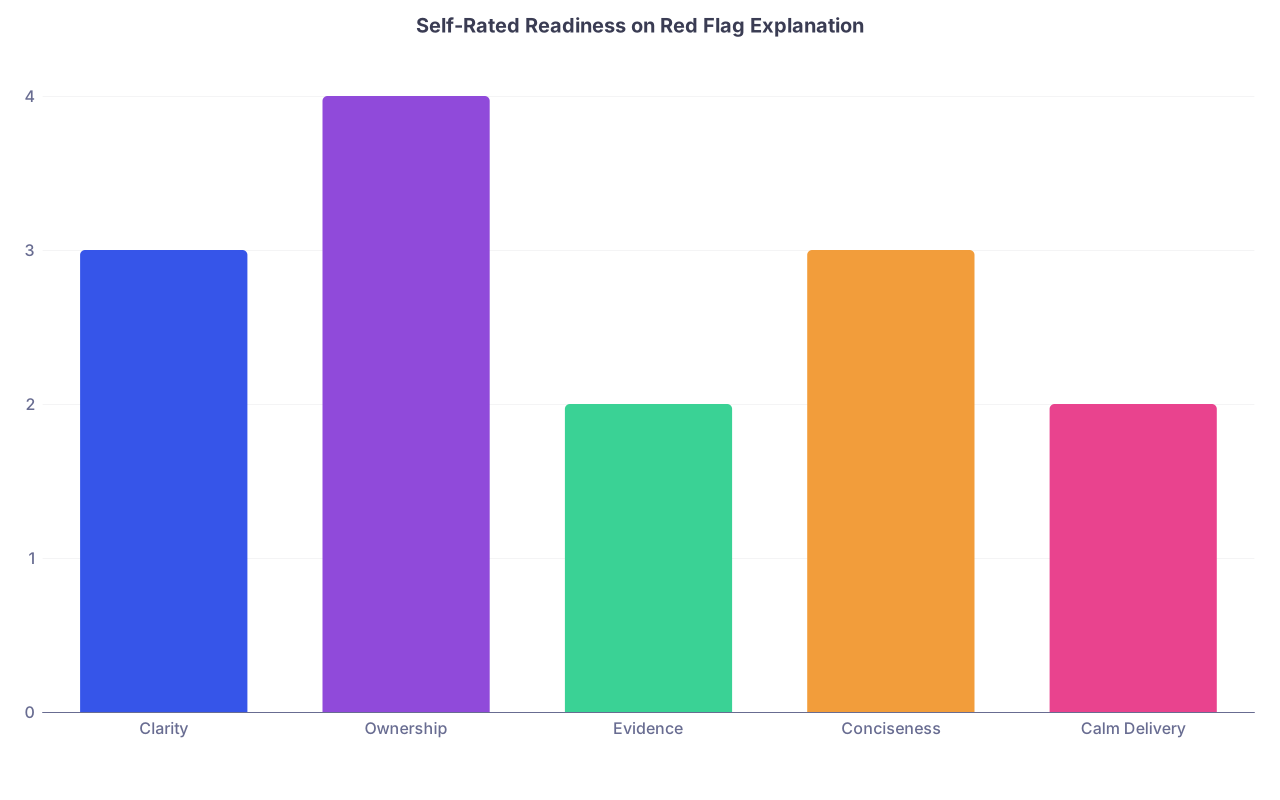
| Category | Value |
|---|---|
| Clarity | 3 |
| Ownership | 4 |
| Evidence | 2 |
| Conciseness | 3 |
| Calm Delivery | 2 |
Anywhere you are below 4, you go back and tighten that part of the script.
Example Before/After Transformations
Let me show you what “fixed” actually looks like.
A. Leave of absence – weak vs strong
Weak:
“So, during M2 I had to take time off for some personal stuff. It was just a really rough period and there was a lot going on with my family and my own health, so I ended up being away for like almost a year. But I am better now and things are ok.”
Problems: vague, evasive, no actions, no evidence.
Strong:
“During my second year, I took a 9‑month leave of absence for a health issue. It was a serious episode, but I engaged fully in treatment, worked closely with my physician and the school, and was cleared to return without restrictions. Since coming back, I have completed my pre‑clinical and clinical requirements on time, passed Step 1 and Step 2 on first attempt, and maintained consistent attendance and performance. I also have ongoing supports in place—regular follow‑up care and specific routines for sleep and exercise—to ensure I can sustain that stability during residency.”
Notice: clear, bounded, specific, and future‑oriented.
B. Professionalism – vague vs precise
Vague:
“There was a professionalism thing during third year but it was kind of a misunderstanding about expectations and communication, and it got sorted out eventually.”
Precise:
“Early in my third year, I received a professionalism concern for being late to pre‑rounding multiple times. I had taken on too many commitments and did not communicate honestly with my team about my limits. My clerkship director put me on a remediation plan that required meeting weekly, arriving 15 minutes early every day, and getting feedback directly from residents and attendings. I completed the plan successfully, have had no further concerns, and in my last two clerkships my attendings specifically highlighted my reliability and preparation in their written comments.”
That is the difference between “risk” and “resolved problem.”
A Quick Visual: Your Red Flag Strategy Flow

| Step | Description |
|---|---|
| Step 1 | Identify Red Flag |
| Step 2 | Write 1-Sentence Fact Statement |
| Step 3 | Create 4-Sentence Core Script |
| Step 4 | Build Short & Long Versions |
| Step 5 | Add Objective Evidence |
| Step 6 | Practice on Video |
| Step 7 | Mock Interview Stress Test |
| Step 8 | Use in Interviews & Application |
| Step 9 | Clear, Calm, Consistent? |
This is the loop. You iterate until you hit “Yes.”
Final Check: Common Mistakes to Eliminate
Scan this list and be honest with yourself. If you catch any of these in your answers, fix them now:
- Talking longer about the red flag than about your strengths
- Saying “it was just bad luck” or anything equivalent
- Crying or visibly losing composure every time you describe it
- Avoiding the actual word: fail, remediation, leave of absence
- Bringing it up repeatedly when they did not ask
- Trying to make the interviewer your therapist
If you are doing any of those, your script needs another pass.
Three Things To Remember
- The red flag itself is often survivable; a chaotic, defensive explanation is not.
- A strong answer has four parts: clear fact, owned cause, concrete corrective actions, and objective evidence of change.
- You must practice until your explanation is boringly consistent, under pressure, and the people grilling you stop caring about it. Once they stop caring, you have done your job.