
A remediated clerkship does not end your chances at residency. Mishandling it does.
I have seen applicants with a failed core rotation match into competitive programs. I have also seen people with a single remediated clerkship get quietly screened out at dozens of places because their approach was sloppy, defensive, or vague. The difference is not the “red flag.” The difference is strategy.
Let me walk you through the strategy.
Step 1: Get Ruthlessly Clear on What Actually Happened
You cannot fix what you cannot describe clearly. And if you cannot describe it clearly, no serious program director will trust you.
Pull together every piece of objective data related to that clerkship:
- Original evaluation (attending, residents, preceptor)
- Narrative comments, not just the grade
- Any professionalism or conduct notes
- Email documentation about remediation
- The remediation plan itself and outcome evaluation
Now answer these questions on paper. Not in your head. On paper.
What exactly triggered remediation?
- Failed shelf?
- Below expectations in clinical performance?
- Professionalism / reliability concerns?
- Communication / teamwork problems?
Was this a pattern or a one-off?
- Any prior warnings?
- Any similar comments in other rotations?
What changed between the first attempt and remediation?
- Concrete behaviors, not vague “I worked harder.”
You should be able to write something like this in 3–4 sentences:
“During my initial Internal Medicine clerkship, I received a failing grade due to inconsistent preparation for pre-rounding and delays in note completion. Residents also expressed concern about my ability to prioritize tasks. I remediated the clerkship two months later with a structured study plan, daily feedback check-ins, and earlier arrival times. I passed the remediation with strong comments on reliability and improved organization.”
If you cannot do this yet, you are not ready to talk to programs. Fix this first.
Step 2: Identify the Real Problem (Not the Comfortable One)
Most students blame the safest thing: “I had test anxiety.” “I was overwhelmed that month.” “Personality clash with the attending.”
Sometimes true. Often partial. Almost never the entire story.
Look at your documentation and ask bluntly: what category did your issue actually fall into?
| Primary Issue Category | Typical Examples | Core Fix Focus |
|---|---|---|
| Knowledge / Test | Failed shelf, weak presentations | Study systems, test strategy |
| Clinical Skills | Slow, disorganized, weak plans | Structure, repetition |
| Professionalism / Reliability | Late, missing tasks, poor follow-up | Systems, accountability |
| Communication / Teamwork | Abrupt, withdrawn, poor SBAR | Scripts, feedback loops |
| Insight / Adaptability | Ignoring feedback, defensive | Coaching, reflection |
Be honest with yourself:
- If you failed the shelf but your evals said “works hard, great with patients,” that is a test preparation problem.
- If the shelf was fine but the feedback says “unreliable, disorganized,” that is a professionalism and execution problem.
- If you keep seeing “needs to be more receptive to feedback,” you are in insight territory. That one scares programs the most and must be addressed directly.
You cannot rebuild trust with a generic “this made me stronger” narrative. You rebuild trust by showing you understand what went wrong in specific, unflattering terms—and fixed the right thing.
Step 3: Build a Concrete Remediation Protocol (Even After the Fact)
Whether your school gave you a formal remediation plan or not, you need your own plan. Programs care far more about your response than about the initial failure.
You are going to design a personal “protocol” that you can:
- Actually use.
- Clearly describe in interviews and your application.
Let’s break it down by common problem types.
A. If Your Issue Was Knowledge / Shelf Exam
You need a replicable study and assessment system:
Create a rotation-specific study spine
- 1 primary resource (e.g., OnlineMedEd, Clerkship textbook like Case Files)
- 1 question bank (e.g., UWorld, NBME/AMBOSS, specific clerkship QBanks)
Daily minimum standard
- 20–40 practice questions per day during the rotation
- 1 focused content block each evening (cards, videos, or chapters)
Formalize assessment
- Weekly self-quiz (NBME-style blocks)
- Track scores on a simple spreadsheet
Exam week protocol
- Stop learning new content 3 days before
- Only review missed questions and weak topics
- Sleep and schedule protected
You want to be able to say:
“After failing my first shelf, I implemented a structured system with daily questions, weekly NBME-style assessments, and proactive review of weak areas. On subsequent clerkships, my shelves were all >70th percentile, and I have maintained that system ever since.”
B. If Your Issue Was Clinical Performance / Organization
You need structure. Residents and attendings do not trust disorganized interns.
Build a concrete system:
Pre-rounding checklist
- Vitals, overnight events, new labs, imaging, I/O, current meds
- Jot down 1–2 key issues per patient (e.g., “hypoxia improving,” “need diuresis plan”)
Progress note template
- Same basic framework for every patient
- Decision points clearly articulated
- Use templates in the EMR smartly, not blindly
Task tracking
- Paper list, index card, or digital note with checkboxes
- Every verbal request becomes a line item with time
- Review list at:
- Post-rounding
- Midday
- Before sign-out
Feedback loop
- Ask your senior at midday: “Can we quickly review my patient plans to make sure I am prioritizing the right things?”
- Adjust immediately based on feedback
Being able to say:
“I realized my biggest gap was organization on busy inpatient services. I created a standardized pre-rounding checklist and a task-tracking system I use for every patient. My later evaluations specifically mention ‘organized’ and ‘manages patient load effectively,’ which is a direct result of these changes.”
That is how you rebuild trust.
C. If Your Issue Was Professionalism / Reliability
This is the red flag that scares programs the most. You must over-correct and prove a track record of reliability.
Your protocol:
Time discipline
- Arrive 15–20 minutes before the team’s stated start time. Every day. No exceptions.
- Set 2 alarms with backup on another device.
Communication standard
- If you are going to be late or miss anything: notify your senior by text or call as soon as you even suspect it.
- Use a simple script: “I am running 10 minutes behind due to [reason]. I will be there at [time] and I have already [covered tasks if possible].”
Accountability practice
- When you slip: own it, name it, correct it.
- No excuses. Direct language: “I misjudged the time required. I am now planning X to prevent this from happening again.”
Documentation trail
- Ask your clerkship and site directors to comment specifically on your reliability in subsequent rotations once it has improved.
- Save those comments; they are gold when you need a letter.
You want to be in a position where a letter writer can quietly tell a PD: “Yes, that note was from M3. I have worked with them since—zero professionalism issues and honestly one of the most reliable students on our service.”
D. If Your Issue Was Insight / Feedback Resistance
You need to show that you actively seek and apply feedback.
Protocol:
Request structured feedback
- At the end of week 1 and 2 on each rotation: “Could you share 1–2 things I should specifically improve by next week?”
- Write down what they say. Literally, in a notebook or your phone.
Demonstrate follow-through
- Circle back the next week: “Last week you mentioned I needed to tighten my differential. I have been practicing that by [specific behavior]. Have you noticed improvement or is there more I should do?”
Stop arguing with feedback in real time
- You do not need to agree in the moment.
- Response template: “Thank you for telling me that. I am going to work on [repeat back the key point].”
Ask a trusted mentor for brutal honesty
- “What concerns would a program director have about me based on how I show up on rotations?”
- Then do not defend. Just write.
Being able to say:
“Earlier in my training, I reacted poorly to constructive feedback and did not always implement it. I now ask for structured feedback weekly on every rotation, document it, and explicitly revisit it with my supervisors. My last three evaluations highlight ‘eager to improve’ and ‘very coachable,’ which reflects that change.”
That is what programs want to hear.
Step 4: Fix the Paper Trail Before You Apply
A remediated clerkship without context reads like: “Something bad happened. We do not know what. Risky.”
Your goal is to make that same line read like: “This was addressed, remediated, and the underlying issues are resolved and stable.”
You are going to build a coherent, aligned paper trail:
1. Official Dean’s Letter / MSPE
You may not control the wording, but you can influence clarity.
- Meet with your Dean or Student Affairs.
- Ask directly: “How will my remediated clerkship be described in my MSPE?”
- If the description is vague or ominous, respectfully request more neutral, factual language:
- “Initial performance in [clerkship] did not meet expectations in [area]. The clerkship was successfully remediated with improved performance documented in [specific areas].”
You want specificity and closure.
2. Targeted Letters of Recommendation
You need at least one strong letter that indirectly (or directly) reassures programs.
Ideal letter writer profiles:
- Clinical supervisor from the same specialty as your remediated clerkship (if it is not your target field, even better to show it is fixed broadly).
- Someone who has watched you over time and seen improvement.
- A faculty member who is not afraid to be candid on the phone if a PD calls.
When you ask for the letter:
- Be transparent: “I had to remediate my [X] clerkship early in third year due to [brief factual reason]. Since then I have made [specific changes]. If your experience with me supports it, I would be grateful if you could comment on my growth, reliability, and readiness for residency.”
You are not asking them to hide it. You are asking them to contextualize it.
3. Personal Statement Placement (If Needed)
You do not always need to mention a remediated clerkship in your personal statement. You should if:
- It is clearly visible and concerning (failed or repeated core).
- It connects directly to your growth and why you are now prepared.
Keep it short and surgical:
- 2–4 sentences.
- Name the issue.
- State the response.
- Highlight lasting changes and evidence.
Example:
“Early in my third year, I did not meet expectations on my Internal Medicine clerkship due to disorganized pre-rounding and incomplete follow-up on tasks. Remediation forced me to build a structured patient-tracking and feedback system that I have used on every subsequent rotation. Since then, I have consistently received strong evaluations for reliability and patient ownership, and this process has become the backbone of how I manage clinical responsibilities.”
Then move on. Do not make your whole personal statement a confessional.
Step 5: Decide When and How to Disclose in Applications
You will likely face explicit questions:
- School-specific addenda or “academic difficulty” text boxes.
- Supplemental ERAS questions for some programs.
- Interview questions like “Tell me about any challenges in your clinical training.”
Your rule: Answer cleanly, own it, show the fix, then stop talking.
Use a simple structure:
- Brief factual description.
- Clear ownership (no blame shifting).
- Specific changes you made.
- Evidence of sustained improvement.
Example for an application text box:
“During my third-year Surgery clerkship, I initially received a grade of ‘Fail’ due to incomplete pre-operative note documentation and delays in task completion. I took full responsibility and completed a formal remediation which included weekly coaching with the clerkship director, a task-tracking system, and structured sign-out practice. I successfully passed the remediation, and my subsequent clerkships reflect consistent comments on reliability, follow-through, and effective team communication.”
Short. Complete. Not defensive.
Step 6: Prepare Your Interview Answer Word-for-Word
If you had a remediated clerkship, you will get a version of this question at some point:
- “Walk me through what happened with your [X] clerkship.”
- “I see you remediated [clerkship]. Can you tell me about that?”
- “What should I take away from that experience?”
You cannot improvise this. You will either overshare, get defensive, or undersell the fix.
Use a 4-part spoken script:
- One sentence: what happened.
- Two to three sentences: what you learned and changed.
- One to two sentences: proof of improvement.
- Stop and wait.
Example:
“Early in my third year, I did not meet expectations on my Pediatrics clerkship due to disorganized patient follow-up and incomplete notes, and I received a failing grade that required remediation. That was a wake-up call that my informal ‘keep it all in my head’ approach was not acceptable for patient care or team reliability. I worked with my clerkship director to build a structured checklist for pre-rounding, a written task list I use all day, and a routine for confirming completed tasks at sign-out. Since then, I have passed all clerkships on the first attempt, my evaluations consistently highlight organization and follow-through, and my Sub-I attending specifically commented on my readiness to manage a full patient load.”
Then stop. Let them ask for details if they want them.
Key mistakes to avoid in the room:
- Long backstory about personal stress unless it directly impaired function and you have since stabilized it (and have evidence).
- Blaming “personality conflicts.”
- Vague “I worked harder” or “I tried my best” language.
- Sounding like you still disagree with the original decision.
Your tone should be: calm, matter-of-fact, accountable.
Step 7: Choose Programs Strategically (Not Emotionally)
Some programs will not care much about a remediated clerkship, especially if:
- It is early in training.
- There is a clean record afterwards.
- Your scores and letters are strong.
Others will quietly screen you out. No point getting angry about that. Work the odds.
Think in three tiers:
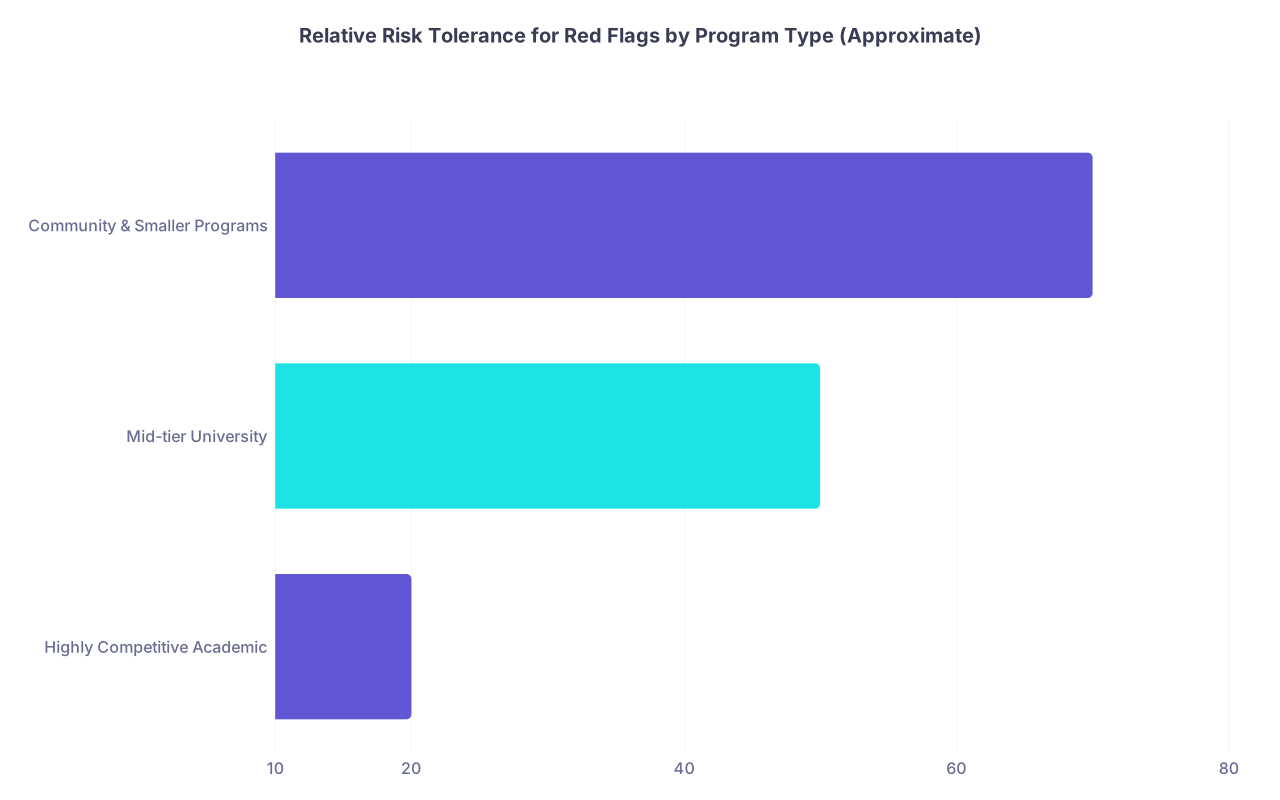
| Category | Value |
|---|---|
| Highly Competitive Academic | 20 |
| Mid-tier University | 50 |
| Community & Smaller Programs | 70 |
This is not exact data, but it reflects reality I have seen:
- Highly competitive academic programs (e.g., top 10–20 in your specialty) have a deep applicant pool. They often just avoid risk if they can.
- Mid-tier university programs often care more about clinical performance and fit. A well-explained, clearly resolved issue can be acceptable.
- Community and smaller programs may be more open, especially if you have strong work ethic, local ties, or can rotate there and prove yourself.
Your strategy:
- Apply broadly, including some reach programs, but do not build your whole plan on being “the exception” everywhere.
- Prioritize aways or Sub-Is at programs that actually get to see you work. Performance there can override old paper red flags.
- Look for places that explicitly say they consider “the whole applicant” or are “mission-driven” rather than purely numbers-obsessed.
Step 8: Rebuild Trust Day-to-Day on Rotations and Sub-Is
Nothing beats live performance. Your best move is to become the student that residents fight to have on their team.
On every rotation from now on:
Show up early.
- Not on time. Early. Quietly working, not looking at your phone.
Own your patients.
- Know their labs without checking.
- Anticipate next steps.
- Follow through on orders and updates.
Ask for work.
- “What can I take off the team’s plate right now?”
- Then do it well and report back.
Close the loop. Every time.
- “Ms. X’s CT was done, results are back, and I updated the team note.”
Ask for feedback before evals are due.
- “Is there anything I should change this week to be more effective for the team?”
That is how residents talk about you to attendings and how attendings write about you in letters:
“Early concern in M3 year, but on our service this year they were one of the most reliable, proactive students I have worked with.”
Which is exactly what you need.
Step 9: Protect Your Own Confidence While Staying Realistic
One under-discussed problem: a remediated clerkship can wreck your confidence. That can show up as hesitancy, over-apologizing, or passivity in interviews and rotations.
You have to walk a narrow line:
- Clear-eyed about what happened.
- Unapologetic about existing in this process.
A few practical moves:
Build a small “win file.”
- Screenshots or PDFs of good eval comments.
- Notes from attendings who praised your work.
- Use this before interviews or hard rotations as a reality check: you are not your worst month.
Practice your red-flag answer out loud 10–20 times.
- With a friend, mentor, or just your phone camera.
- The goal is a calm, steady delivery. No shake, no rush.
Have one mentor who knows the full story.
- Someone you can be blunt with: “I am worried programs will only see the failure.”
- Let them reality-check your performance and trajectory.
Your goal is not to erase the mistake. Your goal is to show that your trajectory is clearly upward and that the systems you built after the failure are exactly what make you safe and reliable as an intern.
Step 10: Translate All of This into One Clean Narrative
By the time you apply, everything should tell the same story:
- MSPE: Factual description + successful remediation + no lingering concerns.
- Letters: Comments on reliability, growth, responsiveness to feedback.
- Personal Statement / Addenda: Brief, precise, accountable description and resolution.
- Interview Performance: Calm, structured answer that matches the above.
If those four pieces align, many programs will think: “Yes, there was an issue. They addressed it. It seems fixed. And now they are strong clinically.”
If they see inconsistency—vague MSPE, defensive interview answer, no letters mentioning reliability—that is when the red flag glows.
Your Move Today
Open a blank document and write a 4-sentence answer to this prompt:
“Tell me about your remediated clerkship—what happened, what you changed, and how I can be confident it will not be an issue in residency.”
Do not stop until you have:
- Named the problem directly.
- Listed at least 2 specific, behavioral changes you made.
- Pointed to concrete evidence of improvement.
Once you have that draft, you have the backbone of your entire “rebuild clinical trust” strategy. Everything else—letters, MSPE, interviews—will build around that clear, honest, specific explanation.