
The worst thing about a gap in your record is not the gap itself. It is three different people explaining it three different ways. That is how you turn a manageable red flag into a glowing siren.
You need alignment. On paper, on ERAS, and in every conversation. Here is how to actually coordinate your dean, advisors, and letter writers so your story hangs together instead of falling apart.
Step 1: Get brutally clear on what “the gap” actually is
Before you talk to anyone, define the problem precisely. Vague thinking here leads to vague explanations later.
Common “gap” or red-flag scenarios:
- Time off or leave of absence
- Extended graduation (5+ years for MD)
- Failed course or clerkship
- Step/COMLEX failure or large score drop
- Research year that does not obviously connect to your specialty
- Disciplinary or professionalism issue
- Significant switch in specialty very late
Write your situation out in 4 parts:
Facts (no spin)
- Dates
- What was failed / when
- Exact leave type (personal, medical, academic)
- Any official remediation or status changes
Cause (one clear, honest driver)
- Health issue
- Family crisis
- Burnout / overextension
- Maturity / judgment problem you have since addressed
- Structural issue (bad fit, toxic environment, etc.) — carefully framed
Actions taken
- Formal remediation
- Therapy / counseling / coaching
- Study overhaul
- Schedule restructuring
- New support systems
Outcome / current status
- Subsequent passes / honors
- Strong clinical comments
- Board pass on retake
- Consistent performance since the gap
Now condense that into a 3–4 sentence core narrative in plain language. Example for a Step failure:
“During my dedicated Step 1 period, I underestimated how much my test anxiety and poor study structure would impact my performance and I failed on my first attempt. I worked with our learning specialist, changed to a question-first strategy, and met weekly with a mentor to keep me accountable. I passed on my second attempt with a substantial score increase and have since honored two core clerkships. I now use structured planning and regular feedback for all of my major exams and rotations.”
This “core narrative” becomes the backbone for everything else.
Step 2: Decide who should say what
Not everyone should explain everything. That is where many students go wrong.
Here is the division of labor that usually works best:
| Issue Type | Best Primary Explainer |
|---|---|
| Leave of absence / time gap | Dean / MSPE |
| Course or clerkship failure | Dean + you (PS / Essay) |
| Board exam failure | Dean + you |
| Mild professionalism concern | Dean only (brief, factual) |
| Major professionalism action | Dean + you (carefully) |
| Research or extra year by choice | You + research mentor LOR |
Core rule:
- Official status changes or disciplinary events → dean/MSPE must address
- Your insight, growth, and motivation → you and your letter writers
You want a coherent picture:
- The dean: factual, institution-level, neutral tone
- You: reflective, accountable, future-focused
- Letter writers: third-party verification that the “new you” is real
Step 3: Script your “alignment packet” before you talk to anyone
You are going to need to send essentially the same story multiple times. Do the work once.
Create a short “alignment packet” with:
One-page summary (max)
- 2–3 line factual description of the gap
- 3–5 bullet points: what you did about it
- 2–3 bullet points: evidence of improvement (grades, comments, scores)
Core narrative paragraph (from Step 1)
This is what people can echo with small adjustments.Key phrases you prefer not to see
Examples:- Avoid: “struggled repeatedly”, “ongoing difficulty”, “barely passed”
- Prefer: “initial setback”, “responded to feedback”, “subsequent strong performance”
You are not censoring them. You are giving them language that is accurate and non-damaging.
Save this as a PDF you can share with dean, advisors, and letter writers.
Step 4: Start with the dean’s office and your MSPE
The MSPE is where program directors look first for red flags. If the dean’s explanation and your explanation conflict, interviews disappear.
A. Request a focused MSPE meeting
Email something like:
“I would like to schedule 30 minutes to discuss how my [leave of absence / Step failure / extended time] will be described in my MSPE and to ensure my other application materials are consistent with that explanation.”
Come in with:
- Your 1-page alignment summary
- A printed MSPE template or last year’s version if your school shares it
- A list of specific questions:
- Will the leave/failure be mentioned in the “Academic History” or “Summary” sections?
- What exact language is typically used for this situation?
- Can I review the wording for factual accuracy and alignment with my other materials?
B. Get clarity on the exact wording
Deans have their own constraints, but you can usually influence phrasing.
What you want:
- Factual, brief, and forward-looking
- No speculation about motives or psychological state
- No inflammatory or redundant adjectives
Bad version:
“Student failed Step 1 on the first attempt due to poor preparation and only passed on the second attempt after remediation.”
Better version:
“Student did not pass Step 1 on the first attempt. The student completed a formal remediation plan and passed on the second attempt. Subsequent clinical performance has been satisfactory.”
You are listening for key themes your dean uses:
- “Remediation completed”
- “No further concerns”
- “Has since demonstrated”
Those phrases should echo subtly in your own materials and your letters.
C. Lock in what you will and will not address elsewhere
Ask directly:
- “Given how this is described in the MSPE, where do you recommend I address it in my ERAS materials?”
- “Is there anything I should not discuss that is already fully and appropriately covered here?”
Then decide:
- Short clarification in ERAS experiences or additional info box?
- One paragraph in personal statement (if it connects to your motivation / growth)?
- Or leave it solely in MSPE for minor issues?
You want to avoid over-explaining. Over-explaining smells like guilt.
Step 5: Align your advisor(s) to the same story
Your specialty advisor or career advisor is your bridge to programs’ expectations. Many students underuse this.
A. Have a blunt planning session
In that meeting, do three things:
Present your dean’s/MSPE wording
“Here is how the dean’s office is describing my Step failure / LOA.”Share your core narrative
“Here is how I am thinking of explaining it in my personal statement or interviews.”Ask for program-director-level feedback
- “If you were a PD reading this, what would bother you?”
- “What part is unnecessary or sounds like an excuse?”
- “How short can we make this explanation without being evasive?”
Good advisors will cut out the fluff and excuses. Let them.
B. Decide where to place the explanation
You have limited real estate. Use it strategically.
Common placements:
Personal Statement
Use only if the gap genuinely changed your path or motivation. One tight paragraph, not the whole essay.ERAS ‘Education Interrupted’ / ‘Explain’ sections
Clean, factual, 3–5 sentences. No emotion, no backstory.Supplemental application questions
If a specialty asks explicitly about academic difficulties, your answer must match MSPE, PS, and interview story.
Your advisor should help you decide combination and length. Then you lock it in and do not improvise later.
Step 6: Coordinate your letter writers intentionally
Most students just ask for “a strong letter” and hope for the best. That is how mixed messages happen.
You will do something different.
A. Decide which letter writers should touch the gap
Not everyone should talk about it.
Better distribution:
- One letter writer (max two) directly references the gap and your improvement
- Remaining letters focus purely on your current performance and strengths
Types of writers who can safely mention it:
- Clerkship director who saw your performance before and after
- Faculty who supervised you during/after remediation
- Research mentor who can talk about your consistency and reliability over time
B. Send a targeted “LOR brief” to each writer
Not a generic CV dump. A 1-page, writer-specific brief.
For the writer who will address the gap, include:
2–3 bullet points: context of the gap as they saw it (keep it factual)
3–5 bullet points: how you have changed, with concrete examples
Your dean/MSPE wording snippet (so they do not accidentally contradict it)
A suggested single sentence they can adapt, for example:
For Step failure:
“Although [Name] experienced an initial setback with the first Step 1 attempt, the way they reorganized their study approach and subsequently performed on the wards has been impressive.”For LOA:
“[Name] took an approved leave during the pre-clinical years and has since returned to complete clinical rotations at a high level of performance, with no concerns regarding reliability or professionalism.”
You are not writing their letter. You are guarding against casual, harmful phrases like “struggled for a long time” or “still working to overcome” that wreck applications.
For writers who should not discuss the gap, be explicit:
“The MSPE and one other letter will briefly address my [leave / exam issue]. For your letter, I would appreciate a focus on my performance on your service and my readiness for residency.”
C. Confirm alignment without micromanaging
You will not see all the letters. That is fine. Your job is to align inputs, not control outputs.
Good sign:
- They ask follow-up questions.
- They echo your core narrative language in emails or conversations.
Red flag:
- They seem confused about what happened.
- They bring up unrelated past issues you have already closed with the dean.
If you sense confusion, clarify once. If it still feels off, quietly choose a different writer.
Step 7: Make your story bulletproof in interviews
You have coordinated documents. Now you have to speak about the gap the same way under pressure.
This is where people slip. They add new details. They improvise. They contradict the paper trail.
Anchor yourself to a 3-part spoken script:
Plain description (1–2 sentences)
“In my second year, I took a one-semester medical leave related to a health issue that affected my ability to keep up with coursework.”Ownership + action (2–3 sentences)
“I worked with student health and our learning specialist, addressed the underlying issue, and created a more sustainable study and support structure. When I returned, I passed all subsequent courses and have had no further interruptions.”Result + connection to residency (2–3 sentences)
“That experience forced me to build better systems for stress management and time control. On my clinical rotations I have been able to maintain consistency even during high-demand blocks, which I know will be essential in residency.”
Practice it until it is boring to you. Boring is good. Boring sounds consistent and honest.
You must also be ready for the follow-up question program directors actually care about:
- “How do I know this will not happen again in residency?”
Answer that directly:
- Point to time elapsed since the gap without recurrence
- Mention systems you now use (study plans, therapy, regular check-ins, scheduling boundaries)
- Reference third-party validation (strong clerkship performance, improved scores, rising responsibilities)
Example:
“It has been three years since that leave, with continuous clinical work and no further interruptions. I still meet monthly with a mentor to review workload, I use structured weekly planning to avoid last-minute crises, and my attendings have consistently commented on my reliability, even on demanding services like ICU.”
Step 8: Keep a consistency checklist
Before you certify and submit, run a quick consistency audit. You are looking for contradictions or unnecessary rehashing.
Use this checklist:
- MSPE description of gap
- ERAS entries (education, leaves, exam history)
- Personal statement (if it mentions the gap)
- Supplemental essays about adversity or academic issues
- Any emailed communication with programs (rare but sometimes relevant)
- Your spoken script
Ask:
- Are dates identical everywhere?
- Is the cause described the same way, without switching stories?
- Does the level of detail increase as you move from dean → written explanation → interview? (It should not. More detail only in interviews if asked directly.)
- Are you avoiding melodramatic or minimizing language?
If you have an open advisor you trust, have them read the full set and try to “poke holes” like a skeptical PD. Fix whatever they flag.
Step 9: Special protocols for different types of gaps
Not all gaps are equal. Here is how I would handle a few common ones.
A. Step/COMLEX failure
Key risks: Assumptions about test-taking ability, work ethic, or stability.
Protocol:
- Dean/MSPE: Brief mention of failure and remediation; highlight ultimate pass.
- You (written): One short paragraph max in supplemental or PS if relevant; focus on structural change in study approach.
- LOR: One writer references that your clinical performance and day-to-day medical reasoning are strong, underscoring that the test is not reflective of your ceiling.
Focus your message on:
- Concrete changes (QBanks per day, NBME tracking, spaced repetition)
- Performance since then (shelf scores, clinical comments)
- No ongoing pattern of failures
B. Leave of Absence for personal/medical reasons
Key risk: Concerns about recurrence, resilience, and reliability.
Protocol:
- Dean/MSPE: Neutral, non-specific cause if possible; clear statement about return in good standing.
- You: Acknowledge you needed that time, focus on what you learned about your limits and systems you now use. Do not overshare diagnoses.
One trusted LOR writer can say:
“[Name] has been completely reliable on our service, with no concerns about attendance or follow-through.”
That single sentence does a lot of work.
C. Clerkship or course failure
Key risk: Concerns about clinical ability or professionalism.
Protocol:
- Dean/MSPE: Explain failure and remediation.
- You: Short explanation of what went wrong (study habits, adjustment to clinical environment, communication issues you have fixed).
- LOR: Strong letter from a later rotation in the same or related area showing substantial improvement.
Focus on:
- Specific feedback you received
- How you implemented it
- Direct evidence of improvement (“later achieved honors in X rotation with strong evaluations in the same domains”)
Step 10: Do not chase perfection. Chase coherence.
Programs are not stupid. They know people have real lives and rough patches. What they will not tolerate is:
- Inconsistency
- Evasion
- Drama
- Blame
If your dean, your advisors, your letter writers, and your own materials all tell the same simple story—“there was a problem, it was handled, performance since then has been solid”—most programs will move on and look at the rest of your file.
You cannot erase the gap. You can keep it from defining you.
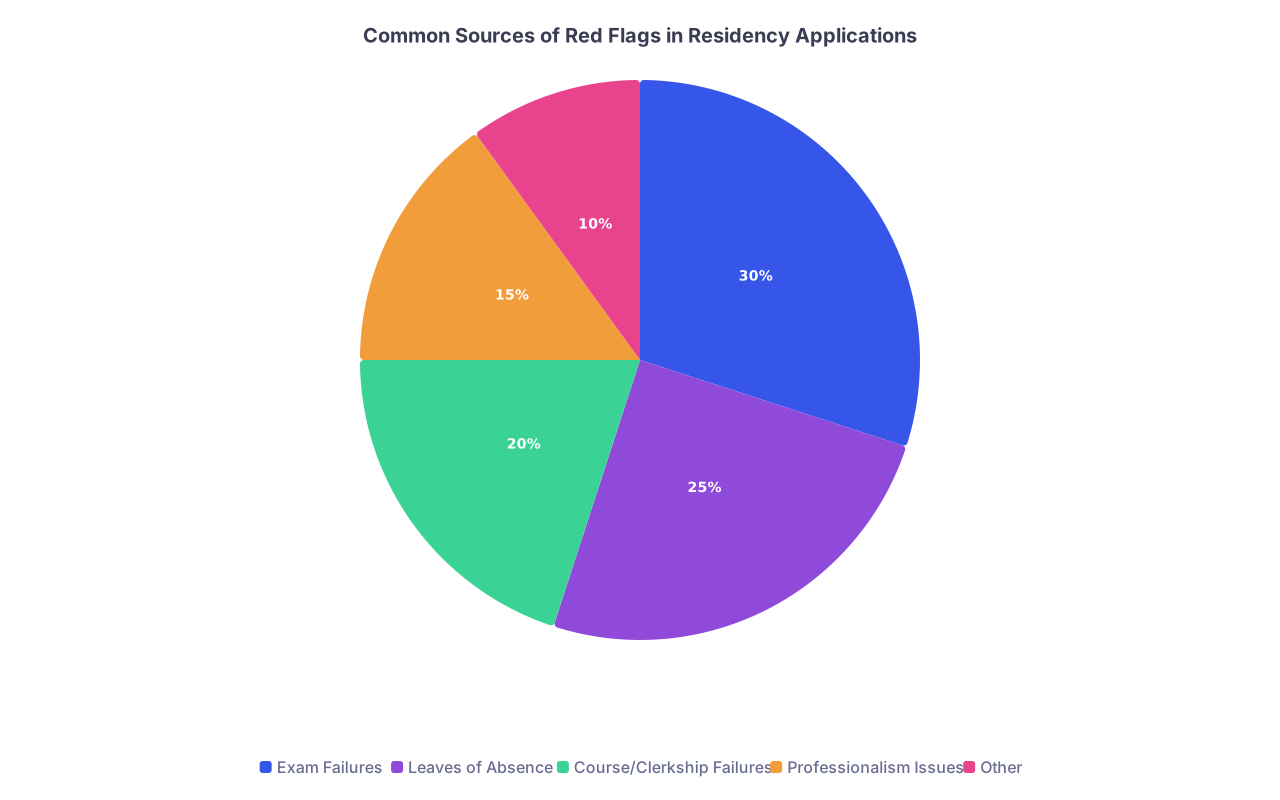
| Category | Value |
|---|---|
| Exam Failures | 30 |
| Leaves of Absence | 25 |
| Course/Clerkship Failures | 20 |
| Professionalism Issues | 15 |
| Other | 10 |

| Step | Description |
|---|---|
| Step 1 | Define Gap & Core Narrative |
| Step 2 | Meet with Dean/MSPE |
| Step 3 | Align with Specialty Advisor |
| Step 4 | Brief Letter Writers |
| Step 5 | Finalize ERAS & PS Language |
| Step 6 | Prepare Interview Script |
| Step 7 | Run Consistency Checklist |