The worst thing you can do with a personal leave of absence is hide it and hope no one notices. They will. The best thing you can do is turn it into a controlled, coherent story that shows judgment, insight, and reliability. That is exactly what you are going to do.
You are not the first applicant with a leave of absence. You will not be the last. Programs are not automatically allergic to it. They are allergic to confusion, vagueness, and drama. So your job is simple: remove confusion, avoid drama, and demonstrate that the risk is over.
Here is how to do that, step by step.
Step 1: Understand What Program Directors Actually Worry About
Before you write a single sentence, you need to see this from a PD’s chair.
When a program director sees “Leave of Absence” in ERAS, three questions fire immediately:
Is this going to happen again during residency?
- Will this resident disappear mid-year?
- Will I be stuck scrambling to cover call schedules?
Is this a professionalism or reliability problem?
- Was this about misconduct, honesty, or poor judgment?
- Did the student handle it responsibly?
Is this person stable and ready for residency now?
- Health, mental health, family, financial, immigration – is it controlled?
- Are they able to handle the intensity of residency training?
Notice what is missing: they are not primarily fixated on why you “failed at life.” They are doing risk management. Your story must answer their risk questions directly.
Here’s the basic rule: The more clearly you show that the cause is resolved and your functioning is strong now, the less your LOA hurts you.
Step 2: Identify Your Real LOA Category (No Spin, Just Facts)
You cannot craft a coherent story if you are not honest with yourself about what happened. Most leaves of absence fall into a few recognizable buckets:
- Health-related (physical or mental)
- Family or caregiving responsibilities
- Academic difficulty or remediation
- Professionalism or conduct issues
- Financial or logistics (immigration, housing, life chaos)
You probably know which bucket you are in. Stop trying to pretend it is a different bucket. Program directors have seen every variation. When the title and the timeline do not match, they start guessing. That is not what you want.
Ask yourself:
- What actually triggered the leave?
- What did my school officially record as the reason?
- Did I return in good standing and at full capacity?
- What changed between then and now?
Write down a blunt, one-sentence version for yourself:
- “I took a one-year LOA after M2 for severe depression that is now well treated.”
- “I took a six-month LOA in clinicals to care for a terminally ill parent.”
- “I took an LOA after failing M2 and repeated the year with improved habits.”
- “I took an LOA after a professionalism incident; I completed remediation and have had no further issues.”
That sentence, cleaned up and tightened, will become the spine of your explanation everywhere else.
Step 3: Control the Information: Where to Address the LOA
You have three main levers in the residency application:
- ERAS “Education” and “Experience” timeline
- Personal statement
- MSPE / Dean’s Letter and possible school addendum
You may also have:
- A Program Director’s letter if you have done a prelim year or another residency.
- Interview answers (and this part is make-or-break).
You must decide where the primary explanation will live, and how much detail each place will get.
The rule of thumb
- ERAS timeline: Neutral, factual, minimal.
- MSPE: Outside your control, but you need to know what is in there.
- Personal statement or dedicated ERAS text box (if available): Short, clear context and resolution.
- Interview: More nuance, more tone, more reassurance.
If your LOA is mild, clearly documented, and already well explained in the MSPE, your personal statement may only need one or two sentences. If it is bigger (long duration, academic/professionalism, multiple leaves), you need a more explicit, structured paragraph or two.
Step 4: Build a Clean, Coherent Timeline
Gaps kill trust. A leave of absence with a crisp timeline is manageable. A messy, confusing timeline raises flags.
You want your education timeline to look intentional and understandable, not like you vanished.
Create a private master timeline with:
- Start of med school
- Each year/phase (M1, M2, clinical, etc.)
- Exact dates of LOA
- What you did during that time (if anything structured)
- Return date and graduation
Then compress that into clear entries in ERAS. For many applicants with an LOA, this is the structure I use:
Education section
- “Medical School, Year 1–2: 2018–2020”
- “Leave of Absence: 07/2020–06/2021”
- “Medical School, Clinical Years: 07/2021–05/2023”
Experience section (if applicable)
- If you worked, did research, or had defined responsibilities, list it. Avoid leaving the year blank.
Do not try to hide the LOA by stretching dates to cover it. That looks dishonest once the MSPE lands on the PD’s desk.
Step 5: Use a Simple, Proven Framework to Explain the LOA
Your explanation needs structure. Otherwise you ramble, over-share, or under-share.
Use this 4-part framework:
- Brief cause – What happened, in one or two neutral sentences.
- Concrete actions – What you did during that time to address it.
- Resolution and current status – Why it is not an ongoing instability.
- Positive takeaway – What you learned and how it improved your functioning.
Keep it short and businesslike. Not confessional. Not defensive.
Example 1: Health-related LOA (mental or physical)
Personal statement paragraph (2–4 sentences is enough):
During my second year of medical school, I took a one-year leave of absence to address a health condition that had significantly affected my functioning. I worked closely with my physicians, completed a structured treatment plan, and returned to school with full clearance. Since my return, I have completed all clinical rotations and required coursework on time, without further interruption, while maintaining strong evaluations. This experience forced me to build sustainable habits and boundaries, and I now approach patient care with a deeper respect for the vulnerability of being on the other side of the exam table.
Notice: no graphic details, but clear that it was serious, treated, and stable with evidence (performance).
Example 2: Family/caregiver LOA
I took a six-month leave of absence during my third year to serve as the primary caregiver for a close family member with advanced illness. With support from my school, I paused my rotations and relocated to provide full-time assistance. After my family member passed away and arrangements were settled, I returned to my clinical training and completed the remainder of my rotations without delay. The experience solidified my commitment to [specialty] and sharpened my empathy for families making difficult decisions under stress.
You are showing responsibility, not unreliability.
Example 3: Academic difficulty LOA
After struggling academically in my second year and failing two courses, I took an academic leave of absence to remediate the material and overhaul my study strategies. During this period, I worked with academic support services, adopted structured study schedules, and practiced test-taking skills. I returned to repeat the year and passed all subsequent courses and board examinations on the first attempt. This setback forced me to confront my weaknesses early, and the disciplined approach I developed has carried through into strong performance in my clinical rotations.
You name the issue, own it, and point to objective improvement.
Example 4: Professionalism-related LOA
This is harder, but still salvageable if:
- The incident is isolated.
- Remediation was completed.
- There has been clean behavior since.
Early in medical school, I was placed on a leave of absence related to a professionalism concern involving poor judgment in [very brief context, e.g., social media use]. I completed a formal remediation process, including professionalism coursework and ongoing faculty mentoring, before being allowed to return. Since then, I have had no further incidents and have consistently received positive comments on my professionalism and teamwork in clinical evaluations. This experience forced me to confront the responsibilities that come with our role, on and off the wards, and has made me far more deliberate about how I represent myself and my institution.
You do not argue with the system. You do not litigate it. You show that the risk has been addressed.
Step 6: Align Your Story Across Every Document
Incoherence is a bigger problem than the LOA itself.
Your:
- ERAS dates
- Personal statement explanation
- MSPE narrative
- Interview answer
all need to tell the same basic story. Same cause category. Same time frame. Same resolution.
Do this:
- Get a copy of your MSPE and any school letters as early as you can.
- Note the exact words your school uses for the LOA and any related issues.
- Adjust your own language so it does not contradict or sound like you are telling a different story.
Example:
- If the MSPE calls it a “medical leave of absence,” do not call it “personal reasons.”
- If the MSPE mentions “academic remediation,” do not pretend it was solely about family.
You do not need perfect word-for-word match, but the narrative must be obviously consistent.
Step 7: Prepare and Rehearse Your Interview Answer Now
You will be asked about your LOA. Not at every program, but at enough of them. If you wing it, you will ramble, overshare, or look defensive. That hurts you more than the leave itself.
Use a tight, spoken version of the same 4-part framework:
- Cause
- Actions
- Resolution / current stability
- Takeaway
Spoken answer length: 45–90 seconds. If you are going past 2 minutes, you are saying too much.
Example Spoken Script (health-related)
During my second year, I took a one-year medical leave of absence to address a health issue that was significantly impacting my ability to function at the level I expect of myself. I worked with my physicians, completed treatment, and was cleared to return without restrictions. Since then, I have completed all of my clinical rotations and required examinations on schedule, without further interruptions, and with strong feedback on my reliability and performance. The experience forced me to build sustainable habits and gave me a better appreciation of what it means to be a patient, which I think has made me a more empathetic and grounded trainee.
Practice this out loud until you can say it calmly, without rushing or apologizing in your tone.
If they want more details, they will ask. Many will not.
Step 8: Quantify and Prove That the Problem Is Resolved
Words help. Data convinces.
You want to show, with actual numbers and outcomes, that whatever caused your LOA is not currently undermining your performance.
Think in three buckets:
- Academic/clinical performance after return
- Board scores and exam timing
- Consistency and reliability (no further interruptions)
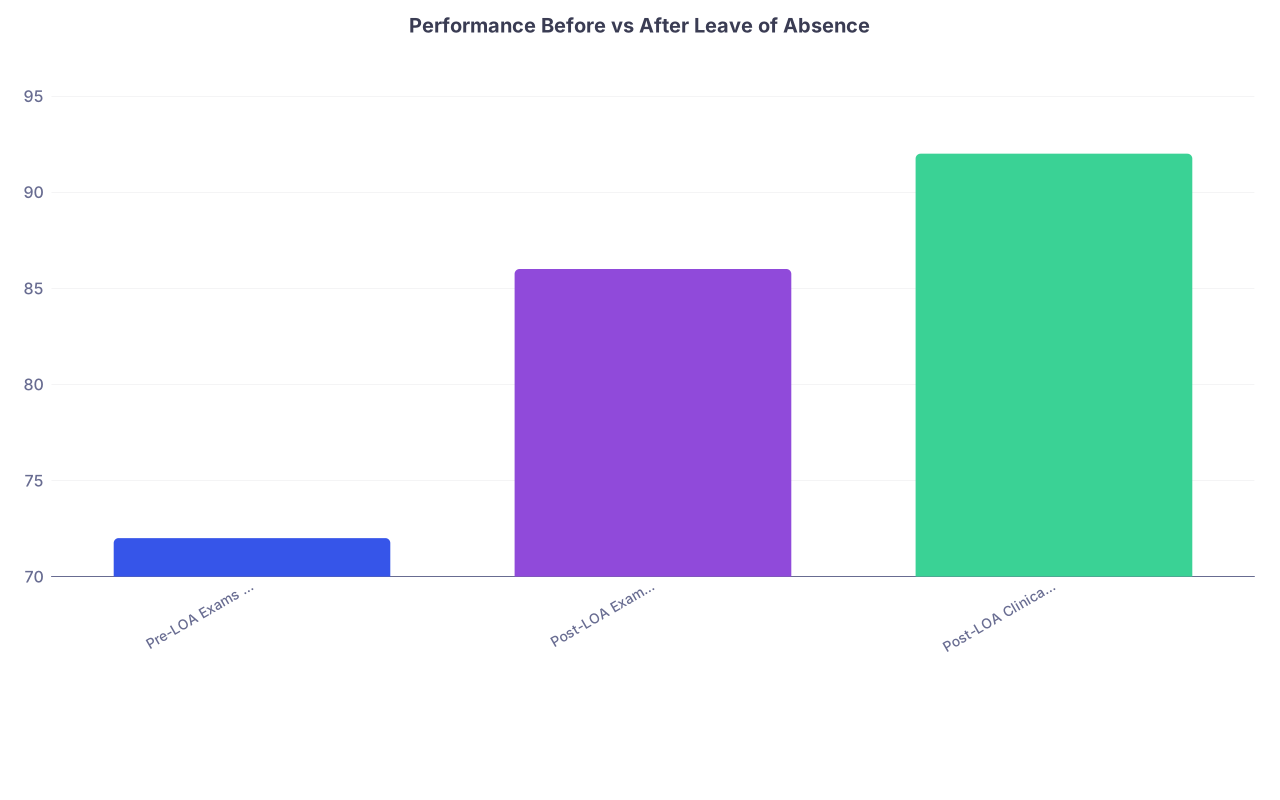
| Category | Value |
|---|---|
| Pre-LOA Exams Avg | 72 |
| Post-LOA Exams Avg | 86 |
| Post-LOA Clinical Eval Score | 92 |
Obviously you are not inserting a graph into ERAS, but this is how you should think about it.
Then you translate it into sentences:
- “After returning from my leave, I completed all remaining clerkships on time and received Honors in 5 of 6 core rotations.”
- “My Step 2 CK score of 248 reflects the improved study strategies I developed during my academic leave.”
- “Since returning from my professionalism-related leave in 2020, I have had three consecutive years of clean, positive evaluations without any further concerns raised.”
You are drawing a thick line: before vs after. The problem is on the “before” side.
Step 9: Decide How Much Space to Give It in Your Personal Statement
Common mistake: either ignoring the LOA completely or turning your personal statement into a 1,000-word confessional about it.
You need balance.
Use this rough guide:
Minor, brief LOA, well-explained in MSPE, clearly resolved:
- 1–2 sentences in personal statement.
- The rest focused on your genuine interest in the specialty.
Longer LOA, major health issue, academic/professionalism concern:
- One short paragraph (3–5 sentences) with full explanation and resolution.
- Do not return to it again and again in the statement.
Multiple LOAs or complicated trajectory:
- One well-structured paragraph.
- Possibly an additional brief mention if it clearly connects to your interest in a particular field (psychiatry often sees this with mental health narratives), but do not make your entire identity “the leave.”
The test: If I remove the LOA paragraph, does your statement still convincingly explain why you want this specialty and what you bring to it? If not, you are over-fixating on the red flag instead of your strengths.
Step 10: Leverage Letters of Recommendation and Advocates
A clean story helps. External voices help more.
If a letter writer knows about your LOA and can credibly say:
- You are reliable and stable now.
- You have excelled in clinical settings.
- Whatever the issue was, it does not show up in your work with them.
…that is gold.
Ask yourself:
- Which attending has seen me consistently after my return from LOA?
- Who has commented on my growth, maturity, or improved habits?
- Does my school have an advisor or dean who is willing to advocate in a supplemental letter or phone call for borderline programs?
You do not need every letter to mention your LOA. In fact, you probably want:
- One letter from someone who can honestly speak to your post-LOA growth.
- Other letters that simply portray you as a strong, dependable applicant without harping on the past.
Step 11: Match Your Story to Specialty Competitiveness and Program Type
Some specialties are more skittish about red flags. Some are more forgiving if the story is strong and performance is excellent afterward.
| Specialty Type | General Flexibility with LOA | Notes |
|---|---|---|
| Family Med / Psych | Higher | Strong story often accepted |
| IM / Peds | Moderate | Depends on academic record |
| Neurology / PM&R | Moderate | Context matters |
| Gen Surg / OB/GYN | Lower | Worry more about reliability |
| Derm / Ortho / ENT | Very Low | LOA is a significant obstacle |
And program type:
- Community programs often look at whole-person fit and real-world reliability. A clear, honest explanation plus solid performance can go far.
- Highly academic or super-competitive programs have enough applicants with no red flags that your LOA may quietly move you down unless your story and performance are exceptional.
So you adapt:
- Apply more broadly.
- Include a significant proportion of community and mid-tier academic programs that have historically matched applicants with some bumps.
- Use your story to show that, if they take a chance on you, they are getting a resident who has already been “stress-tested.”
Step 12: Avoid These Common, Costly Mistakes
I have watched applicants with LOAs sabotage themselves by doing one of these:
Being vague to the point of suspicion
- “I took time off for personal reasons” is not enough. It sounds like you are hiding something worse.
Over-sharing intimate details
- Graphic descriptions of mental health crises, family trauma, or conflict with the school. Programs do not want that level of detail.
Sounding angry or victimized
- Trashing your school, advisors, or “the system” makes you look like a future headache.
Centering your entire application on your LOA
- If every paragraph, every answer, every angle circles back to your leave, you are defining yourself by your worst moment.
Failing to connect the dots to current stability
- “I took a leave, it was tough, I came back.” That is incomplete. You must explicitly say: here is why it will not disrupt residency.
Step 13: If Your LOA Is Very Recent or Ongoing
This is the hardest category: applicants who took a leave close to graduation, or who only recently returned.
Programs worry that there has not been enough “runway” to prove stability. You cannot time-travel, but you can do three things:
Maximize the strength of your post-LOA period
- Crush your sub-internships.
- Gather strong, recent letters.
- If possible, take and do well on Step 2 after your return.
Be extremely explicit about current supports and treatment continuity (for health-related LOAs)
- Without oversharing, make it clear that:
- You are in ongoing care if needed.
- You have a stable treatment plan.
- You have considered how to maintain that during residency.
- Without oversharing, make it clear that:
Be realistic with your rank list and expectations
- You may need to cast a wider net this cycle.
- In some cases, doing a transitional year or prelim year with strong performance can partially “clean” the record.
Step 14: Today’s Concrete Action Step
Open a blank document and write three paragraphs:
- Paragraph 1: One to three sentences giving a neutral, factual cause of your leave and the dates.
- Paragraph 2: Two to four sentences on what you did during the leave and what changed.
- Paragraph 3: Two to three sentences proving your stability and performance since returning, with at least one specific metric (grades, rotations, Step score, evaluations).
Then read it out loud and ask yourself:
- Would a busy program director understand what happened without guessing?
- Would they see why this is unlikely to disrupt residency?
- Does the tone sound mature, responsible, and forward-looking?
If the answer to any of those is “no,” revise until it is “yes.”
Once you have that core narrative, everything else—your ERAS entries, personal statement, and interview answers—will finally line up around a coherent, controlled story instead of a mysterious red flag.