
Failed Step 1 and Step 2? A Structured Recovery Plan for Residency
It is January. You just opened your Step 2 CK score report in the call room. Failed. Again. Step 1 was already a pass-on-retake story. Now you are staring at two failures on your transcript, a half-finished ERAS CV, and a nagging question you do not want to say out loud: “Did I just end my shot at residency?”
Let me be blunt. Your application now has one of the biggest red flags there is: multiple USMLE failures. Many programs will screen you out automatically. Some PDs will never look past it. But that does not equal “you are done.”
You are not going to fix this with positive thinking. You fix it with a disciplined, brutally honest recovery plan that:
- Gets you to a clean pass on your next attempt
- Rebuilds your credibility with program directors
- Targets the right programs and specialties strategically
That is what I will walk you through.
Step 1: Get Clear About Where You Actually Stand
Before you start planning, you need a realistic map of your situation. Not vibes. Data.
1. Inventory your USMLE record
Write this down in one place:
Step 1:
- Attempt 1: Fail (include date and score if available)
- Attempt 2: Pass (if done; note date and performance profile)
Step 2 CK:
- Attempt 1: Fail (date and score)
- Attempt 2: Pending / Not scheduled / Passed (if applicable)
If Step 3 is in the mix (for IMGs, prelims, or gaps), track that too.
Now you know exactly what a PD will see at a glance.
2. Identify your “offsets”
With multiple fails, you need offsetting strengths. Non-negotiable. List:
Clinical performance:
- Core clerkship grades (Honors/High Pass/Pass)
- Sub-I performance, especially in your chosen specialty
- Any “intern-level” comments in evaluations
Academic record:
- Pre-clinical failures, repeats, leaves of absence
- Class rank or quartile, if your school reports it
Extras:
- Research (posters, pubs, even small QI projects)
- Leadership positions
- Teaching or tutoring roles
- Meaningful non-traditional background (prior career, military, etc.)
Your reality: with Step 1 and 2 fails, you are not competing as “average applicant with a few dings.” You are competing as “major red flag + something compelling enough to justify a risk.” That “something” must be specific and clear.
3. Accept that specialty choice may need to change
If you failed both Step 1 and Step 2, aiming for derm, plastics, neurosurg, ENT, ortho, or urology is fantasy. You can find the one anecdote online, but you will not be that outlier unless you are bringing Nobel-level research.
You are now in a risk-managed specialty strategy. Think:
More realistic:
- Family Medicine
- Psychiatry
- Internal Medicine (community-heavy focus)
- Pediatrics (borderline, but possible in right settings)
- Pathology in certain settings
Much harder but possible for rare applicants with strong offsets:
- OB/GYN, EM, Anesthesia, Neurology, etc., usually with serious mentorship and an unusual story
You need to decide: Do you want a residency or this specific competitive specialty? With two fails, you rarely get both.
Step 2: Diagnose Why You Failed (For Real This Time)
“I just had test anxiety” is not a diagnosis. It is a label. You need a granular, uncomfortable analysis of why you failed twice.
Break it into four buckets:
1. Content knowledge
Ask yourself, and be brutal:
- Did you complete a full content review at least once for each exam?
- Did you use high-yield core resources (e.g., UWorld, NBME, AMBOSS, Boards & Beyond/Sketchy for Step 1 content, dedicated CK resources for Step 2)?
- Could you explain core topics out loud to someone else? Or did you just recognize them vaguely in questions?
If the honest answer is “I never fully mastered the foundation,” then your next prep must be content-first, not “just do more questions.”
2. Question strategy
Look at old practice blocks if you kept them, or recreate your behavior from memory:
- Did you frequently narrow to 2 choices and guess wrong?
- Did you miss questions by misreading stems or not tracking keywords?
- Did you rush and finish blocks with lots of time left? Or always run out of time?
Common failing pattern I see: students treat UWorld like a passive learning resource, clicking through and then skimming explanations, instead of treating every question as a diagnostic tool.
3. Timing and stamina
On the actual tests:
- Did you run out of time on multiple blocks?
- Did your performance drop sharply in last 2–3 blocks?
- Did you sleep poorly, have major caffeine crashes, or go in already mentally exhausted from “cramming”?
Timing failure is fixable. But it requires a specific drill plan, not just “hope I focus better next time.”
4. Psychological and life factors
This is where people like to gloss over reality:
- Were you in the middle of a breakup, family crisis, or financial mess?
- Any untreated anxiety, ADHD, depression?
- Any medication changes close to exam day?
- Did you study in constant panic, or were you reasonably calm until test week?
If you do not address this part, you will simply re-enact the same failure with a different calendar date.
Now, take your findings and write a short “root cause” summary. One paragraph. Example:
“I failed Step 1 and Step 2 because I never built a solid content foundation, rushed through question banks without deep review, had serious pacing issues on long stems, and went into both exams sleeping 4–5 hours per night with uncontrolled anxiety.”
That sentence is not for your personal statement. It is for you. Your whole recovery plan must attack that list directly.
Step 3: Build a Pass-First, Score-Second Study Plan
At this point, your next attempt is not about impressing programs with a 260. It is about proving you can clear the bar safely and decisively.
1. Choose a realistic timeline
Two scenarios:
- You have not yet re-taken Step 2 CK
- You already failed both Step 1 and Step 2 twice (nightmare scenario, but it happens)
In both, you need:
- 10–16 dedicated study weeks if your base knowledge was weak
- 6–8 weeks if your prior practice NBMEs were within 10–15 points of passing and you mainly had execution problems
If your school is pressuring you to retake in 3–4 weeks “to stay on track,” push back. A third failure is a career-killer. I have seen students “rush to keep schedule” and then spend two years trying to fix the damage.
2. Lock in your core resources
Do not drown yourself in resources. Choose a tight set and commit:
For Step 1 (if you still need to fix foundation):
- Primary:
- UWorld Step 1 (full pass, then targeted second pass as needed)
- One structured content resource (Boards & Beyond, Pathoma, or similar)
- Add-ons:
- Anki decks (ONLY if you will actually do them consistently)
For Step 2 CK:
- Primary:
- UWorld Step 2 CK (non-negotiable)
- NBME practice exams + Free 120
- Optional:
- AMBOSS for extra questions if time allows
- Online MedEd or similar for weaker clerkship topics
Your rule: Do fewer things, better. I would rather see you master UWorld and NBMEs than half-finish every resource ever posted on Reddit.
3. Daily structure: What your days should actually look like
Sample 6-day week for someone rebuilding Step 2 CK:
Morning (3–4 hours):
- 2 timed blocks of 40 questions each (UWorld)
- Full exam conditions: breaks timed, no phone, no pausing
Midday (3–4 hours):
- Deep review of those 2 blocks:
- For every incorrect and every guess:
- Why did I miss this? (content, misread, timing, overthinking)
- What is the core concept?
- What will I do differently next time?
- Create minimal notes or flashcards for recurring patterns
- For every incorrect and every guess:
- Deep review of those 2 blocks:
Late afternoon/evening (2–3 hours):
- Focused content review on topics you repeatedly miss
- One weaker subject per day (e.g., OB, neuro, nephro)
Weekly:
- 1 full-length practice exam (NBME or 4–6 UWorld blocks back-to-back)
- 1 half-day off for sanity (non-negotiable)
You are not just “doing more questions.” You are doing deliberate practice and building exam-day endurance.
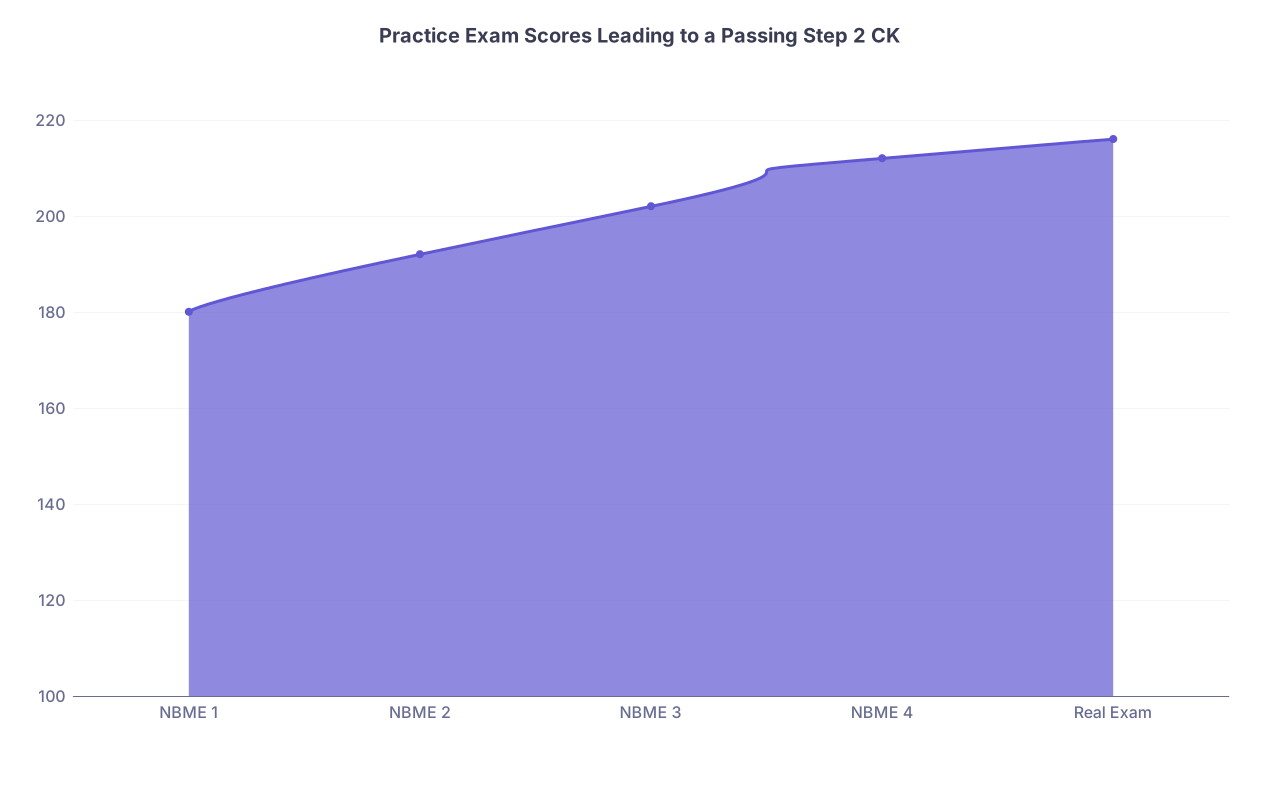
| Category | Value |
|---|---|
| NBME 1 | 180 |
| NBME 2 | 192 |
| NBME 3 | 202 |
| NBME 4 | 212 |
| Real Exam | 216 |
4. Set clear go/no-go criteria before scheduling the retake
Do not schedule “because my eligibility window is ending.” Schedule when the data says you are ready.
Reasonable minimums for a retake after failure:
- At least 2 NBME scores above the passing mark (preferably 5–10 points above)
- Consistent improvement across 4+ weeks of practice
- Full-length test simulations where:
- You finish all blocks on time
- Your performance does not crash in final blocks
- Your mind does not melt down halfway through
If you are hovering at or just below passing on NBMEs, you are not ready. Pushing the exam back by 4 weeks is less harmful than another fail on your transcript.
Step 4: Document and Fix the “Meta” Problems (Accommodations, Health, Attention)
Two failures raise questions in faculty minds: “Is there an undiagnosed learning or health issue here?” If the answer is yes and you ignore it, you are making life harder than it needs to be.
1. Screen for learning and attention issues
If any of this sounds like you:
- Chronic trouble finishing timed tests since high school
- Clear mismatch between knowledge and test performance
- Family history of ADHD, learning disabilities
- Teachers or attendings saying “You know this; why are your exams so low?”
Then you should:
- Get a formal evaluation with a neuropsychologist or learning specialist
- Do it early, not 3 days before the retake
- Bring prior score reports and examples of failed tests
If you qualify for accommodations (extra time, separate room, frequent breaks), apply through NBME/USMLE as soon as possible. Yes, it is bureaucratic and slow. But if valid, this can be the difference between “always almost finishing” and “finishing calmly.”
2. Address mental health honestly
Two fails often sit on top of:
- Untreated anxiety or panic
- Major depression
- Burnout, often silent
- Perfectionism turned into paralysis
Your move:
- Get your own physician or mental health provider
- Be explicit: “I have failed high-stakes exams twice and need help stabilizing for a retake.”
- If medication is involved, stabilize your regimen well before dedicated study (no major med changes in the last 4–6 weeks before the test if avoidable)
Residency programs care less that you saw a therapist and more that you keep failing without insight or help.
Step 5: Reposition Your Application After the Failures
Now assume the following: you retook Step 2 CK and passed. You still have:
- Step 1 – fail then pass
- Step 2 CK – fail then pass
Can you still match? Yes. But not by submitting a “normal” application and hoping someone ignores your transcript.
1. Decide your actual target specialties and program tiers
With 2 failures, your strategy is volume + fit, not prestige.
| Specialty Type | Competitiveness Now | Realistic? With 2 Fails |
|---|---|---|
| Dermatology, Plastics | Ultra-high | No |
| Ortho, ENT, Neurosurg | Very high | No |
| EM, OB, Anesthesia | High | Rare, case-by-case |
| IM (university-heavy) | Moderate-high | Difficult |
| FM, Psych, Community IM | Moderate-low | Realistic focus |
You should be applying:
- Broadly within realistic specialties
- Especially to community programs, smaller cities, and less glamorous locations
- To prelim/transitional year spots if you need a “foot in the door” strategy
2. Use a dedicated “red flag explanation” paragraph (not an essay-length apology)
You will need to own your failures. The personal statement is not the place for a 2-page confession. Keep it tight and professional.
Structure:
- One sentence stating the fact (no dancing around it)
- 2–3 sentences with concrete causes and corrections
- One sentence tying the experience to current performance
Example:
“Early in medical school, I struggled on standardized exams and failed both Step 1 and Step 2 on my first attempts. At the time, I did not yet have effective test-taking strategies and was balancing significant family responsibilities without asking for help. Since then, I have worked with a learning specialist, overhauled my study methods, and completed dedicated question-based preparation, resulting in passing scores on both exams and strong clerkship evaluations. This experience forced me to build more reliable systems, which I now apply consistently in my clinical work.”
You can also use your MSPE or dean’s letter to carry part of this explanation, especially if your school supported your remediation.
3. Optimize letters of recommendation to offset concerns
Program directors will ask: “If this person struggles with exams, can they at least function clinically at an intern level?”
Your letters must answer that with a loud “yes.”
Aim for:
- 3–4 strong letters, with at least:
- 1 from your chosen specialty
- 1–2 from core rotations (IM, surgery, etc.) that describe:
- Work ethic
- Reliability
- Ability to learn and improve
- Professionalism under pressure
Ask your letter writers explicitly:
- “Would you feel comfortable strongly recommending me despite my USMLE history?”
If they hesitate, do not use them. Bland letters will sink you.
4. Consider a targeted research year or additional clinical year
If your clinical record is also weak, or your graduation timing no longer lines up, a “bridge” year can help—but only if you use it properly.
Good options:
- Research year in your realistic specialty, with:
- Real output: abstracts, posters, a paper or two
- Strong connections to faculty who can vouch for you
- Additional clinical exposure:
- Substantial hands-on observerships (for IMGs)
- Extended sub-internships or acting-intern roles if your school allows
Avoid:
- Generic “research years” with no clear deliverables
- Random jobs completely unrelated to medicine unless absolutely necessary for survival
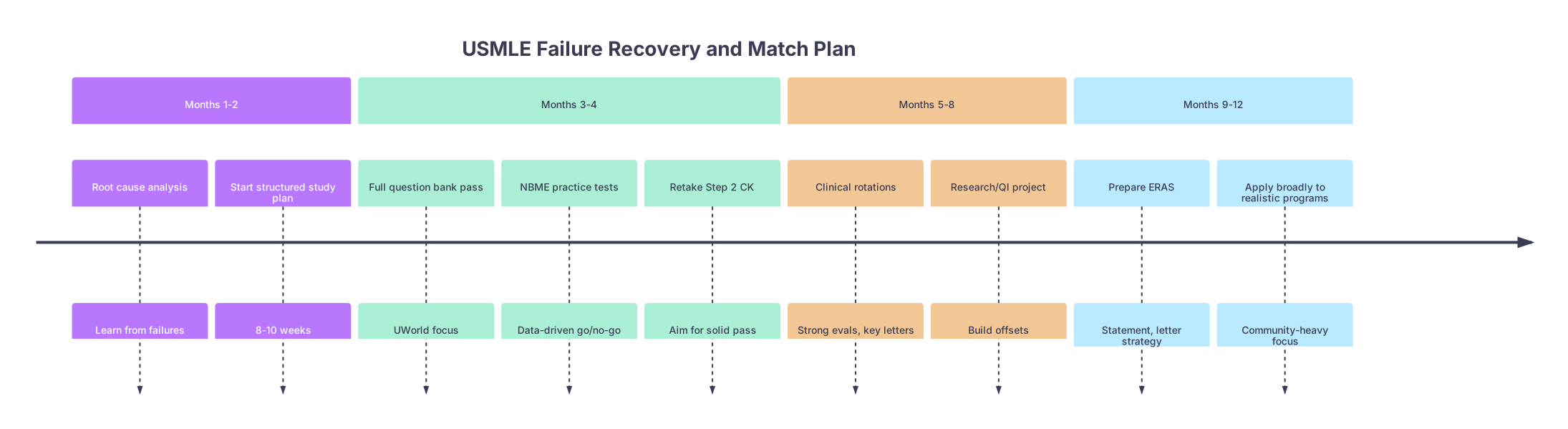
| Period | Event |
|---|---|
| Months 1-2 - Root cause analysis | Learn from failures |
| Months 1-2 - Start structured study plan | 8-10 weeks |
| Months 3-4 - Full question bank pass | UWorld focus |
| Months 3-4 - NBME practice tests | Data-driven go/no-go |
| Months 3-4 - Retake Step 2 CK | Aim for solid pass |
| Months 5-8 - Clinical rotations | Strong evals, key letters |
| Months 5-8 - Research/QI project | Build offsets |
| Months 9-12 - Prepare ERAS | Statement, letter strategy |
| Months 9-12 - Apply broadly to realistic programs | Community-heavy focus |
Step 6: Application Strategy: How to Actually Play the Match with Red Flags
Now we are at the part everyone cares about: matching.
Passing your retakes is step one. Getting a PD to rank you is a different game.
1. Apply early and very broadly
You do not have the luxury of being selective. With 2 USMLE fails, your application should look like this:
- Submit ERAS on opening day
- Apply to:
- 60–120+ programs in FM, Psych, or community-heavy IM, depending on specialty and geography flexibility
- Include smaller cities, less popular states, and community-based programs
- Do not anchor on “dream programs.” You need yeses, not fantasies.
You are trying to get past a lot of automated and manual screens. Volume is part of your survival strategy.
2. Use your network and cold outreach intelligently
This is where many students give up too early. You need to get actual humans to look at your file.
Actions:
Talk to:
- Your clerkship directors
- Program alumni
- Any attendings with connections in your target specialties
Ask directly:
- “Are there any programs where my application might get a fair look despite my exam history?”
- “Could you send an email to Dr. X introducing me?”
For cold outreach:
- Short, respectful email to PDs or APDs:
- 3–4 sentences total:
- Who you are
- Your interest in their program
- A single line acknowledging your USMLE history with assurance about your current readiness
- Attach CV
- 3–4 sentences total:
- Do not send a life story. No one has time.
- Short, respectful email to PDs or APDs:
This will not magically bypass every screen. But I have seen applicants with clear red flags get interviews at places specifically because someone advocated for them.
3. Crush every rotation and interview like it is your only shot
Once you get a foot in the door, your job is simple: convince them you will be a safe, hardworking, low-drama intern who will not fail boards again.
On rotations and sub-Is:
- Show up early, leave late
- Volunteer for the unglamorous work and do it well
- Read nightly on your patients
- Ask for mid-rotation feedback and fix issues visibly
On interviews:
- Have a clear, rehearsed narrative:
- What happened with Step 1 and Step 2
- What changed
- Why these failures will not recur on in-training exams or boards
Deliver this narrative calmly, without oversharing or self-pity. Programs will tolerate past failure much more if they are convinced it is truly past.
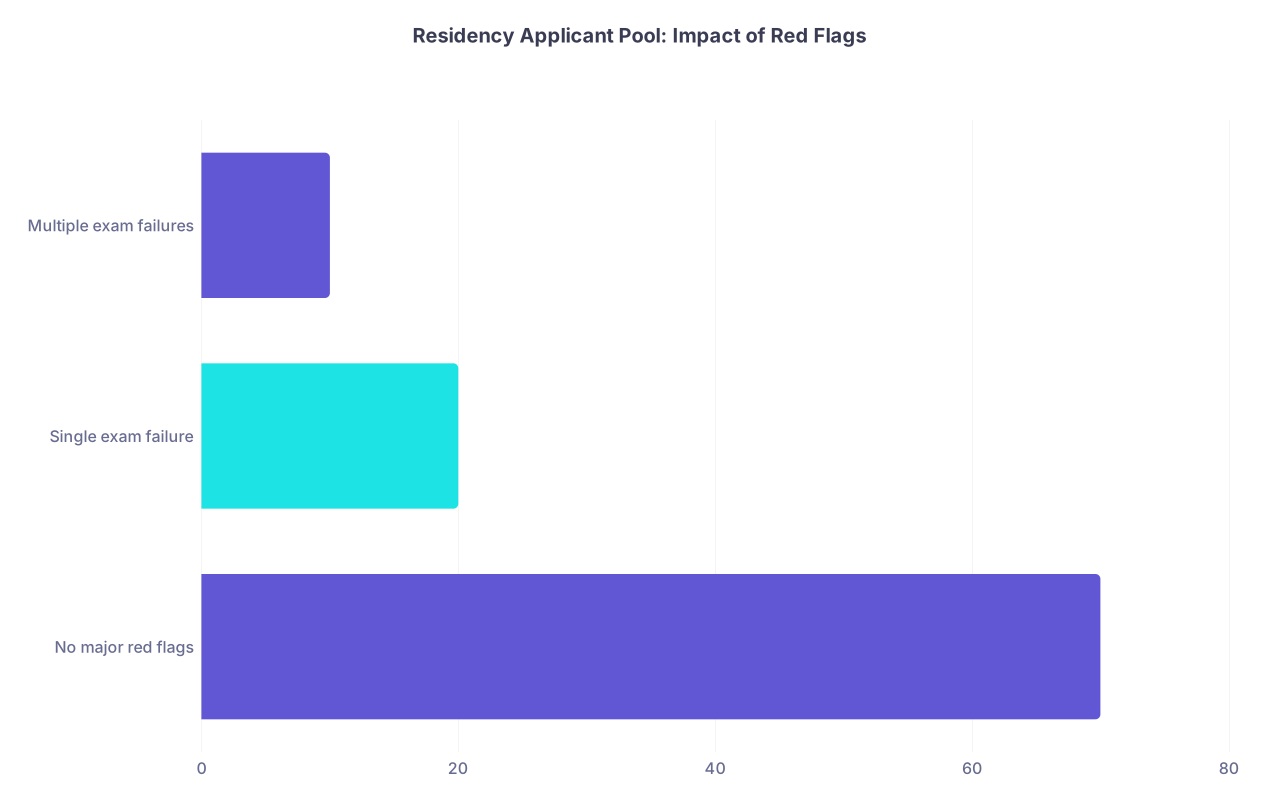
| Category | Value |
|---|---|
| No major red flags | 70 |
| Single exam failure | 20 |
| Multiple exam failures | 10 |
Step 7: Worst-Case Planning: If You Do Not Match
You always hope for the best. You plan for the worst.
If you reach Match Week and you are unmatched:
1. Go hard in SOAP, with ego set aside
In SOAP:
- Apply to every acceptable prelim IM, FM, psych, and transitional position
- Have a crisp 30-second explanation of your USMLE history ready for phone calls
- Have your advisor or dean help place targeted calls if possible
Your first priority is getting a position that keeps you moving. A prelim IM or transitional year can be a strong foothold if you then:
- Pass Step 3 early in your intern year
- Get glowing evaluations
- Reapply into categorical spots from a position of “proven intern performance”
2. If you still end up without a spot
Then the next 12–24 months need to be structured, not aimless.
Solid paths:
- Research fellowships tied to a residency department
- Full-time clinical work in another licensed role if you have one (RN, PA, etc.) while maintaining connection to medicine
- Non-ACGME fellowships or structured observerships that:
- Produce letters
- Keep you clinically relevant
You also need:
- Step 3 passed (if eligible) to signal “exam chapter finally closed”
- Very clear documentation of what you have done since graduation
I have seen people come back from an unmatched year with a better story, stronger letters, and eventual success. The ones who disappear for 18 months with no plan rarely recover.
Step 8: What You Must Stop Doing Right Now
A lot of outcomes with multiple USMLE failures come down to what you stop doing.
Stop:
- Pretending this is a minor bump that programs will ignore
- Switching resources every week because of something you saw on Reddit
- Scheduling retakes based on arbitrary timelines instead of practice data
- Hiding your situation from advisors and then expecting them to fix it last minute
- Writing long, emotional personal statements about “test anxiety” without any concrete changes
Start:
- Owning the problem
- Running your prep and your application like a project, with timelines and metrics
- Building relationships with faculty who can vouch for what you are actually like on the wards

| Step | Description |
|---|---|
| Step 1 | USMLE Step Failure |
| Step 2 | Structured Study Plan |
| Step 3 | Retake Exam |
| Step 4 | Reassess Career Paths |
| Step 5 | Reposition Application |
| Step 6 | Start Residency |
| Step 7 | SOAP or Gap Year with Structure |
| Step 8 | Identify Root Causes |
| Step 9 | NBME Scores Above Pass? |
| Step 10 | Pass? |
| Step 11 | Match? |
Final Thoughts: What Actually Matters Now
You failed Step 1 and Step 2. That reality is not going away. But it does not have to be the end of your path.
Three things I want you to walk away with:
Your next exam attempt must be data-driven and carefully timed.
No more rushing, no more hope-as-strategy. Use NBMEs, full-length simulations, and clear readiness thresholds.You must repackage your story for program directors.
Own the failures briefly, point to concrete changes, and back it up with strong clinical performance and letters.Your specialty and program list need to match your new reality, not your old fantasy.
Broad applications, realistic targets, and an ego-free approach to SOAP and backup plans will keep doors open.
You are not the only one who has been here. The difference between those who move on and those who stall is not luck. It is whether they treat this as a solvable problem and execute a disciplined plan.