
Failing to match twice is not the end of your medical career. It is the end of doing things the same way and expecting a different result.
If you are a two‑time unmatched applicant, you do not need more generic encouragement. You need a brutal, structured audit and a concrete rebuild plan. The good news: I have seen people come back from worse. The bad news: almost nobody does it by “just reapplying stronger” without a major reset.
This is the playbook I use when I sit down with someone who has gone 0 for 2 in the Match and is trying not to derail the last decade of their life.
Step 1: Get Out of Denial and Into Data
You do not “have a bad application.” You have specific, fixable problems hiding inside that vague statement. First job: surface them.
1. Do a hard, written post‑mortem
Open a blank document and answer these, in writing, not in your head:
- How many programs did you apply to each year (by specialty)?
- How many:
- Interview invites?
- Interviews attended?
- Categorical vs prelim offers/interest?
- Any SOAP participation? Outcomes?
- Step/COMLEX scores (first attempt vs retakes)?
- Any gaps, leaves, failures, professionalism issues?
- Visa issues? Graduation year > 5 years ago?
If your answers are “I don’t remember” or “I did not track,” that is part of the problem. Residency recruitment is data‑driven. You have to match that discipline on your side.
2. Identify where the pipeline breaks
You did not match for one of three broad reasons:
- Screen‑out problem – you are not getting enough interviews.
- Interview problem – you are getting interviews but not ranking high enough.
- Structural red flag – something big (scores, gaps, professionalism, visa, timing) poisons the whole file.
Be very specific:
- If you applied to 150+ programs and got 0–2 interviews → screen‑out / structural problem.
- If you got 8–15 interviews and still did not match → interview performance / rank list / fit problem.
- If you got SOAP offers but declined them for “better fit next year” and then failed again → strategy problem.
Do not gloss over this. Write down your conclusion:
“Main issue appears to be: __________.”
You will come back to that sentence.
3. Get external, brutally honest review
You are too close to your own story. You need two or three people who have sat in rank meetings:
- Program director or APD in your target specialty
- Faculty heavily involved in recruitment
- GME office or dean for unmatched graduates
Send them:
- ERAS application PDF
- Personal statement
- CV
- List of programs applied to and interviews received over both cycles
Ask explicitly:
“If you were on a selection committee, what are the top 3 reasons you would not rank me?”
If you only ask “How can I improve?”, they will soften the message. You want the reasons not to pick you.
Step 2: Diagnose Your Actual Red Flags
Let me be direct: two failed cycles almost always means more than “the match is competitive.” You almost certainly have at least one real red flag. Sometimes several.
Here are the usual culprits and what they really mean on the other side of the table.
| Red Flag Type | Typical Impact on Match Chances |
|---|---|
| Step 1/2 < 220 or fail | Major screen-out in competitive specialties |
| >3 years since grad | Strong downward pressure, especially for IMGs |
| Failed courses/rotations | Serious concern about reliability/safety |
| No recent US clinical experience | Hard to rank confidently |
| Unexplained gap > 6 months | Triggers concern about judgment/health/professionalism |
1. Academic and exam red flags
These are the ones you already know, but you may be underestimating their weight:
- Step/COMLEX failures
- Low first‑time scores far below specialty norms
- Multiple shelf failures
- Required remediation, especially in clinical years
If your USMLE/COMLEX story looks like this:
- Step 1: Fail then 205
- Step 2: 214
- COMLEX: similar pattern
…and you have been applying to dermatology, orthopedic surgery, or even mid‑tier EM programs, the issue is not mysterious. You are playing in the wrong league for your paper stats.
2. Time since graduation
This is brutal but real: after 3–5 years from graduation, a lot of programs quietly downgrade or auto‑screen. They worry about:
- Erosion of clinical skills
- Difficulty adjusting back to training
- Why you have been out so long
If you are an IMG 6+ years out, no US residency, no consistent clinical work, and you have now failed two cycles, your “hidden” red flag is no longer hidden. It is big and flashing.
3. Professionalism, conduct, or narrative red flags
These are the ones applicants often minimize:
- Leave of absence without a coherent, documented reason
- Dismissal or withdrawal from a program
- Failed background check, disciplinary violation, or serious professionalism episode
- Multiple short‑term jobs with awkward endings
- Letters hinting at attitude, reliability, or teamwork issues
I have heard this in rank meetings:
“He is clearly smart, but there is something off in the narrative. I do not want to risk it.”
If you know you have one of these, pretending it is “minor” is a fast track to a third failure.
4. Strategy and fit red flags
Sometimes the red flag is not your profile. It is your strategy:
- Too few programs (e.g., 30 IM programs as an average candidate)
- Too narrow geography (“I only applied to California”)
- Unrealistic specialty for your numbers (e.g., 210s trying for Ortho with no research)
- No backup or fake backup (e.g., “I applied to 5 FM programs as backup”)
If you are not sure whether your past two cycles were realistic, put your stats next to actual specialty competitiveness.
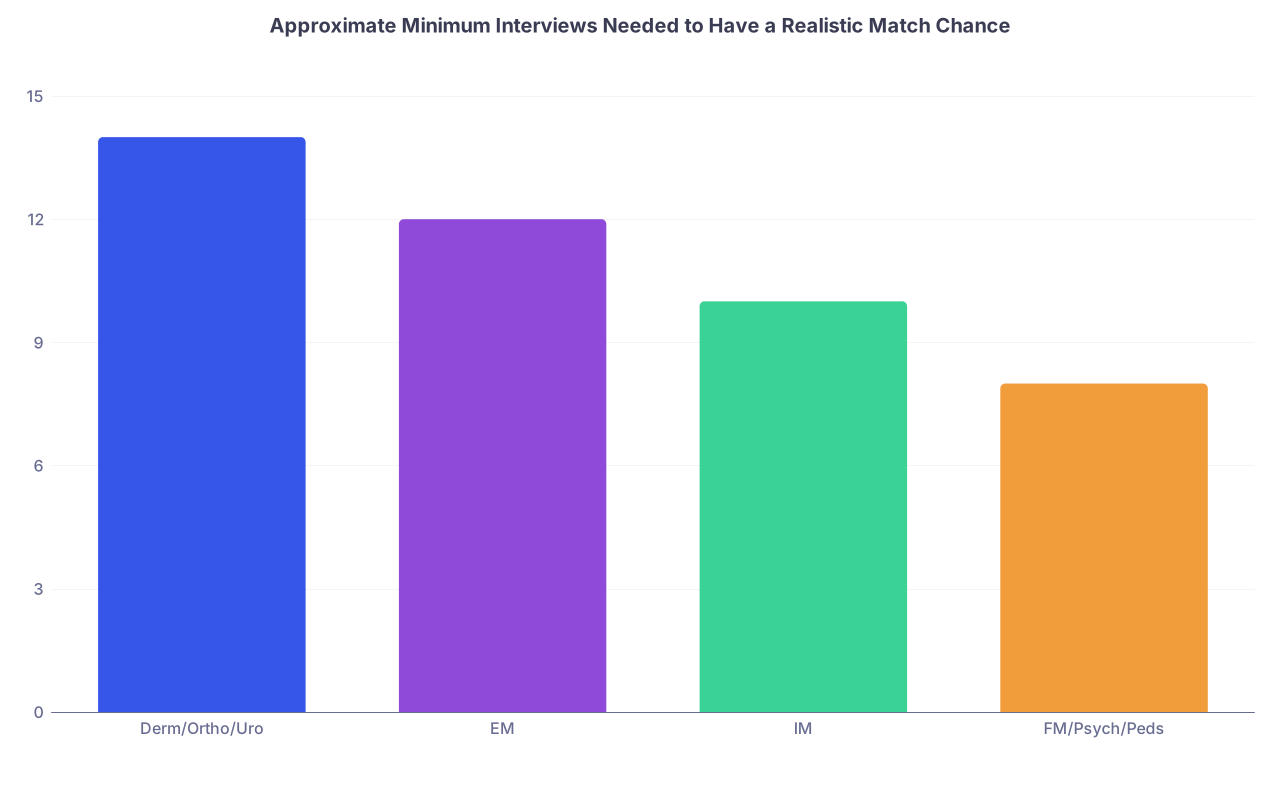
| Category | Value |
|---|---|
| Derm/Ortho/Uro | 14 |
| EM | 12 |
| IM | 10 |
| FM/Psych/Peds | 8 |
If you had 3–4 interviews in IM or FM and did not match, the problem is not that the Match is “random.” Your file, your interview performance, or your rank strategy is off.
Step 3: Decide: Pivot, Pause, or Persist (But Not Blindly)
Once you know your red flags, you have to decide whether you are:
- Staying in the same specialty but changing your approach
- Pivoting to a less competitive specialty
- Taking a deliberate gap to fix structural issues before trying again
- Choosing a non‑residency clinical or non‑clinical path (yes, this is legitimate)
1. If you stay in the same specialty
You only stay if all three are true:
- Your academic metrics are within a realistic range
- You had some interviews in that specialty previously
- At least one PD‑level person has told you, “You are viable in this field, but need X, Y, Z.”
Then you do not just “reapply with hope.” You create a 12–18 month overhaul plan:
- Full‑time or near full‑time clinical work aligned with that specialty
- New letters from respected faculty/programs in that field
- A rewritten personal statement that directly addresses your prior attempts and shows actual growth
- Aggressive broadening of your program list (community, smaller, less‑known regions)
2. If you pivot to another specialty
This is not failure. It is recognizing opportunity.
Real talk:
If you have 205/210 scores, average MS evaluations, 2 unsuccessful EM cycles with 1–2 EM interviews each time, and no strong EM research, you have a much better chance of becoming an excellent family physician or internist than forcing a third EM attempt.
When pivoting:
- Pick a specialty where your current profile is at or slightly below average, not far below.
- Get direct clinical experience in that field for at least 6–12 months (observerships do not cut it alone).
- Secure at least 2 strong letters specifically naming that specialty.
- Be transparent in your new personal statement: why the change, what you learned, what you now bring.
3. If you take a deliberate “repair” year (or two)
Sometimes you have to stop reapplying and actually fix the engine.
You should do this if:
- You have multiple fails / low scores with no strong redemption
- You are >3 years out from graduation and losing ground each year
- You have a professionalism story that needs context and time
- You have weak or generic letters and no program knows you well
A “repair” year is not a random research year you hope looks good. It is structured:
- 50–80% of your time in hands‑on clinical work (hospitalist extender, scribe with floor presence, clinical fellow roles where allowed, etc.).
- At least one longitudinal mentor who will commit to writing a blunt, supportive letter.
- Targeted performance: show up, be early, be useful, be the person teams ask for.
Step 4: Build a Concrete 12-Month Recovery Plan
Here is where most unmatched second‑timers fail: they spend the year “doing things” instead of executing a plan. You need a calendar, not a wish.
Month 0–1: Full Audit and Decision
- Finalize your diagnosis (why you did not match).
- Decide specialty direction (stay, pivot, or exit).
- Identify geographic flexibility (be brutally honest: if you “must” stay in one city, your chances drop).
- Meet with at least one PD or senior faculty in your target field to sanity‑check your plan.
Month 1–3: Secure Position and Mentorship
- Lock in paid clinical work if at all possible:
- Clinical research coordinator in your target department
- Hospitalist extender roles
- Outpatient clinic positions with high patient contact
- If you are an IMG with visa restrictions, look for:
- Observerships that can evolve into stronger roles
- Non‑ACGME fellowships some hospitals offer
Your goal: embed yourself with a team that can see you day after day.
Month 3–9: Produce Tangible Upgrades
During this window, you are building evidence that you are not the same applicant:
-
- At least 2 new letters from US faculty who supervised you recently.
- Push for specifics: reliability, patient care, teamwork, improvement over time.
Clinical narrative
- Ask for more responsibility consistently.
- Volunteer for the grim work: discharges, follow‑up calls, late‑day admissions. Rank committees love the resident who “just gets it done.”
If exams are part of your red flag
- Schedule and crush Step 3/COMLEX Level 3 if eligible.
- Do a serious prep block (6–8 weeks with question banks and full‑length practice), not scattered questions on your phone.
Address professionalism / gaps
- Work with your mentor to craft a clear, concise explanation for any prior issues.
- If mental health or family crises were involved, you do not need to expose every detail, but you must show:
- You understand what happened
- You took concrete steps to prevent recurrence
- You have been stable and reliable since
Month 9–12: Application Rebuild
You do not just tweak your old ERAS. You rewrite it like a new person.
Key pieces:
Personal statement
- Address the reality: you applied previously and did not match. Briefly.
- Focus the majority on:
- What you did in the interim
- What you learned about yourself and the specialty
- How that translates into being a safe, hardworking intern
Experiences section
- Elevate your recent, longitudinal work.
- Show progression: observer → coordinator → core team member.
Program list
- Use data, not vibes.
- Include a significant number of:
- Community programs
- Newer or smaller programs
- Less desirable locations (to most people)
If you applied to 80 programs before, you probably need 120–150 now, skewed toward places that actually interview candidates like you.
Step 5: Fix the Interview and Rank Side
If you had ≥ 8–10 interviews and still did not match, your problem is downstream.
1. Get real feedback on your interview style
You do mock interviews with:
- Someone who sits on actual resident selection committees
- Or at least someone senior who will not sugarcoat
Red flags in your interview behavior:
- Overemphasizing how much you were “wronged” by prior cycles
- Vague answers to “So what happened?” around gaps or failures
- Overly rigid expectations about location or program type
- Lack of concrete examples when talking about teamwork, conflict, errors
Script, do not wing, your responses to:
- “Tell me about your previous attempts to match.”
- “What did you do in the time since?”
- “Why should we believe this time is different?”
You answer those clearly, succinctly, and without defensiveness. If you sound bitter or chaotic, you slide down the rank list. Every time.
2. Rank list discipline
You cannot afford “luxury ranking” after two failures.
Rules:
- Rank every program where you would not be actively unsafe or grossly miserable.
- Do not game where you think you are “more competitive”; rank in actual preference order, but be honest about what you can live with.
- If you are applying in a more competitive specialty with a realistic backup (e.g., EM + IM), be clear on your priority and structure your rank list accordingly.
Step 6: Consider Non-Traditional or Transitional Paths That Do Not Waste Your Training
Reset does not always mean “third ERAS cycle.” For some people, the smartest move is lateral, not straight ahead.
1. Preliminary or transitional year
If you can secure a prelim internal medicine or surgery spot:
- You get US experience, real evaluations, and new letters.
- You prove you can function as a PGY‑1.
- You create a more compelling story for categorical applications later.
But be careful:
- Do not assume a prelim spot automatically converts to categorical. Ask explicitly.
- Plan from Day 1 how you are going to use this year:
- Meet PD
- Join QI projects
- Impress senior residents and attendings regularly
2. Non-ACGME fellowships or hospital roles
Some hospitals offer:
- Non‑ACGME “fellow” roles in hospital medicine, research, or specialty clinics.
- These can give:
- Clinical exposure
- Structured supervision
- Strong letters
They do not count as residency, but they absolutely can rehabilitate your application.
3. Alternative careers that still use your training
For a subset of two‑time unmatched applicants, the healthiest move is to stop chasing residency and build a different path:
- Clinical research career
- Public health / MPH → health systems work
- Industry roles (pharma, medtech, clinical ops)
- Medical education, simulation, or informatics roles
Is that a loss compared to the original vision? Of course. But it is not “throwing away your MD/DO.” It is redirecting it where the door is actually open.
Step 7: Track Progress Like a Clinician, Not a Hopeful Applicant
You know how to manage chronic disease. Apply the same mindset to your career:
- Baseline data (your last two cycles).
- Target metrics (number of interviews, mentors, letters, months of recent USCE).
- Regular follow‑up with objective re‑assessment.
Set quarterly checkpoints:
- How many days per week am I in clinical environments?
- Who has seen me work enough to vouch for me in detail?
- What specific positive comments have I received about reliability, knowledge, or teamwork?
- What has changed in my CV since last cycle that a PD would care about?
If those answers are thin at 6 months, you adjust. Not at the next March failure.
A Quick Reality Check Matrix
Use this simple table to gut‑check your odds and next move.
| Profile Snapshot | Best Next Step |
|---|---|
| 210–220 scores, 0–2 interviews x2 cycles | Pivot to less competitive specialty + full clinical year |
| 225–235 scores, 6–10 interviews x2 cycles | Intensive interview coaching + better rank strategy |
| >5 years since grad, minimal USCE | 12–24 months solid USCE or consider non-residency path |
| Step failures + professionalism issues | Deliberate repair year with close mentorship before reapplying |
If your row lines up with “consider non‑residency path,” do not ignore it for three more years out of sunk cost. I have seen too many people burn their 30s this way.
The One Thing You Must Do Today
Open your ERAS PDF and your last season’s interview list side by side. Then write down, on paper, your honest diagnosis in one sentence:
“I failed to match twice mainly because __________.”
If you cannot fill in that blank with something specific and concrete, your next job is to schedule a 30–60 minute meeting with a program director or senior faculty member in your desired field and tell them, “I need you to help me answer this honestly.”
Do that before you sign up for another cycle.