A professionalism citation in your MSPE is not a career death sentence. It is a problem that requires a disciplined, methodical repair strategy.
I have seen applicants match into competitive specialties with professionalism hits in their MSPE. I have also seen people with minor issues sink their own chances by handling it badly—defensive emails, vague explanations, or worse, pretending it never happened. The difference is not the incident. The difference is the recovery.
This is your playbook for recovery.
1. Get Completely Clear on What Is in Your MSPE
You cannot fix what you have not read.
Step 1: Pull the actual text
Do not rely on memory or rumors of “it might be mentioned.” You need the literal language.
- Request your draft MSPE from the dean’s office (many schools send this automatically; if not, ask).
- Read the entire letter, but pay special attention to:
- “Professionalism” sections
- “Academic/Non-Cognitive Attributes”
- Any “Concerns” or “Narrative” sections
- Copy-paste the professionalism citation section into a separate document.
You are not reading this as a student being judged. You are reading it as a strategist planning damage control. Different mindset.
Step 2: Classify the type and severity
Programs think in buckets. You should too. Roughly, professionalism comments fall into these categories:
Category A – Administrative / procedural
- Late to rotations or exams
- Incomplete charting
- Missed modules, paperwork, immunizations
- Poor responsiveness to emails or pages
These are the most “recoverable,” if you show you fixed your behavior.
Category B – Interpersonal / communication
- Argumentative with staff or peers
- Unprofessional emails or messages
- Poor response to feedback
- Boundary issues with patients or colleagues
Fixable, but programs worry about team dynamics and patient complaints.
Category C – Ethics / dishonesty / safety
- Falsified documentation
- Plagiarism or cheating
- Patient safety negligence
- HIPAA violations, confidentiality breaches
This is serious. You are not out, but you will need a much stronger rehabilitation story.
Label your issue honestly. Do not sugarcoat it. If you were reported for derogatory comments about a nurse, that is Category B. If you altered a note after the fact to cover up a mistake, that is Category C.
Step 3: Understand how bad it looks on paper
Read the MSPE language out loud as a PD would:
- Does it sound like a one-time lapse or a pattern?
- Does the letter mention follow-up remediation or successful completion of a professionalism course?
- Does the dean’s summary later mitigate the concern (“Since this incident, the student has shown…”) or leave it hanging?
If you cannot tell, assume a PD will read it as concerning. Your plan should err on the side of over-fixing, not under-reacting.
2. Secure the Strongest Possible Institutional Support
You need institutional adults in the room. On your side, but honest.
Step 1: Meet with the right dean
Not email. Not a quick hallway question.
Schedule a formal appointment with:
- Dean of Student Affairs, or
- Dean for Clinical Education, or
- Whoever signs off on your MSPE
Your agenda for that meeting:
- Acknowledge the incident clearly.
- Ask three specific questions:
- “How are professionalism concerns typically described in our MSPEs?”
- “Is there any flexibility in wording if I complete additional remediation or demonstrate sustained improvement?”
- “What concrete steps would you advise I take in the next 3–6 months to rehabilitate my record in the eyes of programs?”
Take notes. Use their language later.
Step 2: Ask about remediation opportunities
If you have not done any formal remediation beyond a slap-on-the-wrist email, that is a problem you can actually fix.
Reasonable options to ask about:
- Meeting with professionalism or student conduct committee
- Completing a formal remediation plan (e.g., punctuality logs, communication training)
- Assigned reflective-writing or professionalism modules
- Additional professionalism-focused faculty mentoring or coaching
- Assigning you to a specific course, workshop, or longitudinal professionalism curriculum
You want something concrete you can later say:
“Following the incident, the school developed a formal remediation plan that I completed successfully, including X, Y, and Z. Since then, there have been no further professionalism concerns.”
Programs like finished stories, not open wounds.
Step 3: Try to improve the MSPE language—within reason
You cannot erase reality. You can reduce unnecessary vagueness and inject context.
Go back to the dean with a very specific ask:
- “Is there a way to more clearly indicate that:
- this was a single incident,
- I completed remediation,
- and I have had no further professionalism issues since?”
Offer suggested phrases. Deans are more likely to tweak if you hand them reasonable language:
- “Following this incident, [Student] completed a professionalism remediation plan and has shown significant improvement, with no further concerns documented.”
- “This was an isolated event early in clinical training; since then, [Student] has received positive evaluations regarding professionalism and teamwork.”
Some deans will not change a word. Fine. At least you asked, and you now know what you are working with.
3. Build a Documented Track Record of Over-Correction
You do not just want to “be better.” You want evidence that you are better.
Step 1: Fix the behavior at the root level
Target your remediation to the category:
- If attendance/punctuality:
- Never be late again. Not once.
- Show up 10–15 minutes early. Habitually.
- Respond to emails/pages within a clear, short time window (e.g., 1–2 hours during daytime).
- If communication / interpersonal:
- Stop arguing in real time. Acknowledge, then schedule follow-up if needed.
- Adopt one line you use consistently: “Thanks for the feedback, I will adjust.”
- If you feel heated, you excuse yourself before you speak.
- If ethics / dishonesty / safety:
- Double-check documentation before signing anything.
- Over-communicate with seniors about uncertainties or errors.
- Never, ever alter anything after the fact without explicitly labeling it as an addendum and informing your team.
You are building a pattern. Behavior over months, not days.
Step 2: Engineer strong, specific evaluations
Your goal: multiple written comments that contradict the original concern.
For example, if your MSPE says:
- “Had issues with punctuality and meeting deadlines early in clerkship training.”
You want later evals that say things like:
- “Consistently early to rounds and very reliable with follow-through.”
- “Highly dependable; I knew I could count on them to get tasks done on time.”
How you help that happen without being manipulative:
- At the start of each rotation, meet your attending:
- “I want to share something briefly. I had a professionalism concern earlier in my training about [short, factual description], and since then I have been working very intentionally on [punctuality/communication/etc.]. I would really appreciate direct feedback during the rotation if you see any concerns so I can keep improving.”
- Mid-rotation, explicitly ask:
- “Can I get specific feedback about my [relevant area]? I am trying to be very concrete about my improvement.”
- End of rotation, you can say:
- “If you feel it is accurate, it would help me a lot if my evaluation commented on my reliability / communication, because I have worked hard to improve in that area.”
Keep it honest. If you did not actually improve, do not fish for praise. Fix the behavior first.
Step 3: Gather key letters of recommendation that address the issue
You want at least one letter from:
- A faculty who knows about the professionalism incident AND
- Has directly supervised you after it AND
- Can credibly say, in writing, that you have grown.
When you ask for the letter:
- Tell them explicitly:
- “There is a professionalism comment in my MSPE from [year/rotation] about [brief description]. I am not asking you to ignore it, but if you feel it is accurate based on what you have seen, it would help if you could comment on my professionalism and how I have grown or improved since then.”
- Make it easy for them:
- Provide a short bullet-point summary of specific things you have done better on their team (e.g., never late, took feedback well, resolved a conflict professionally).
A strong letter that directly addresses and counters the concern is more powerful than a generic glowing letter that pretends nothing happened.
| Letter Type | What It Should Do |
|---|---|
| Department Chair Letter | Acknowledge and contextualize the incident |
| Key Attending (Post-issue) | Show concrete improvement over time |
| Dean’s Letter (MSPE) | Document remediation and resolution |
| Optional Extra Letter | Reinforce reliability and teamwork |
4. Decide Where and How You Will Address It in Your Application
Trying to hide a professionalism citation that is in your MSPE is foolish. Program directors read. You will not outsmart them.
Your job is to control the narrative.
Step 1: Use the ERAS “Adverse Actions” or “Other” sections correctly
If the professionalism event:
- Led to probation, suspension, or any official disciplinary action, you must disclose it where ERAS asks about academic/disciplinary actions.
- If it was handled internally with a note but not a formal adverse action, disclosure may not be required—but with an MSPE comment, program directors will see it anyway.
When you answer:
- Be factual and concise.
- 3 parts: what happened, what you did about it, who you are now.
Example for a punctuality/attendance issue:
During my third-year internal medicine clerkship, I received a professionalism citation related to repeated tardiness and delayed completion of documentation. The school required me to complete a formal remediation plan that included meeting regularly with the clerkship director, maintaining a punctuality log, and obtaining mid-rotation feedback on subsequent clerkships. Since completing remediation, I have had no further professionalism concerns, and recent evaluations consistently describe me as reliable and punctual. This experience forced me to restructure how I manage time and responsibilities, and I have maintained those systems since.
No drama. No excuses.
Step 2: Decide whether to mention it in your personal statement
You almost never lead with it. Your personal statement is not a confession booth.
Strong reasons to briefly mention it:
- The professionalism issue is serious (Category C).
- You can link it directly to meaningful growth that shaped you as a future physician.
- You can do it in one focused paragraph without derailing your whole statement.
What you do not do:
- Spend half the essay on your “journey of redemption.”
- Blame the system, the evaluator, your schedule, your stress.
A tight structure:
- One sentence: what happened (no graphic detail).
- Two–three sentences: the internal shift—what you learned about yourself.
- Two–three sentences: what you changed and how it shows up now in your work.
If it is a relatively minor administrative professionalism issue, the MSPE + ERAS disclosure + letters are usually enough. Do not overexpose it in the statement.
Step 3: Prepare your 30–60 second spoken explanation for interviews
This is crucial. I have watched qualified applicants sink themselves here with rambling or deflection.
You want a rehearsed, natural, short script. Structure:
- Own it plainly.
- Describe what changed in your behavior, not your feelings.
- Show evidence (time since, evaluations, letters).
- Move on.
Example – interpersonal conflict:
“During my third-year surgery rotation, I received a professionalism citation after a conflict with a nurse where I responded defensively to feedback about orders I had written. At the time I felt overwhelmed and reacted poorly. Since then, I worked closely with our professionalism office, completed a communication skills workshop, and set a personal rule for myself: I do not respond in the moment when I feel defensive. I pause, listen, and then follow up once I have processed. On later rotations I asked attendings specifically to evaluate my communication with staff, and my recent evaluations comment positively on my teamwork and receptiveness to feedback. It was a painful way to learn that lesson, but it changed how I function on a team.”
No qualifiers like “but others were also at fault.” Even if they were.
5. Adjust Your Application Strategy to Reality
You cannot apply like everything is normal. You need a more disciplined, strategic approach.
Step 1: Be brutally honest about competitiveness
Programs doing holistic review will consider you. But you are not walking in with a clean sheet.
Look at:
- Step/COMLEX scores
- Clerkship grades
- Research, leadership, and other strengths
- Specialty competitiveness
If you have:
- Average scores and a professionalism hit, going all-in on dermatology or plastics is magical thinking.
- Strong scores, good evals, and a single resolved professionalism incident—you still have options, including moderately competitive specialties, if you apply smartly.
Step 2: Diversify your program list
You reduce risk with volume and variety:
- Aim for a larger number of applications than a “clean” applicant with similar stats.
- Include:
- A solid core of mid-tier academic programs
- A healthy number of community programs
- Safety programs where your metrics are well above average
Do not behave as if your MSPE will be ignored because you “feel like you’re a good fit.”
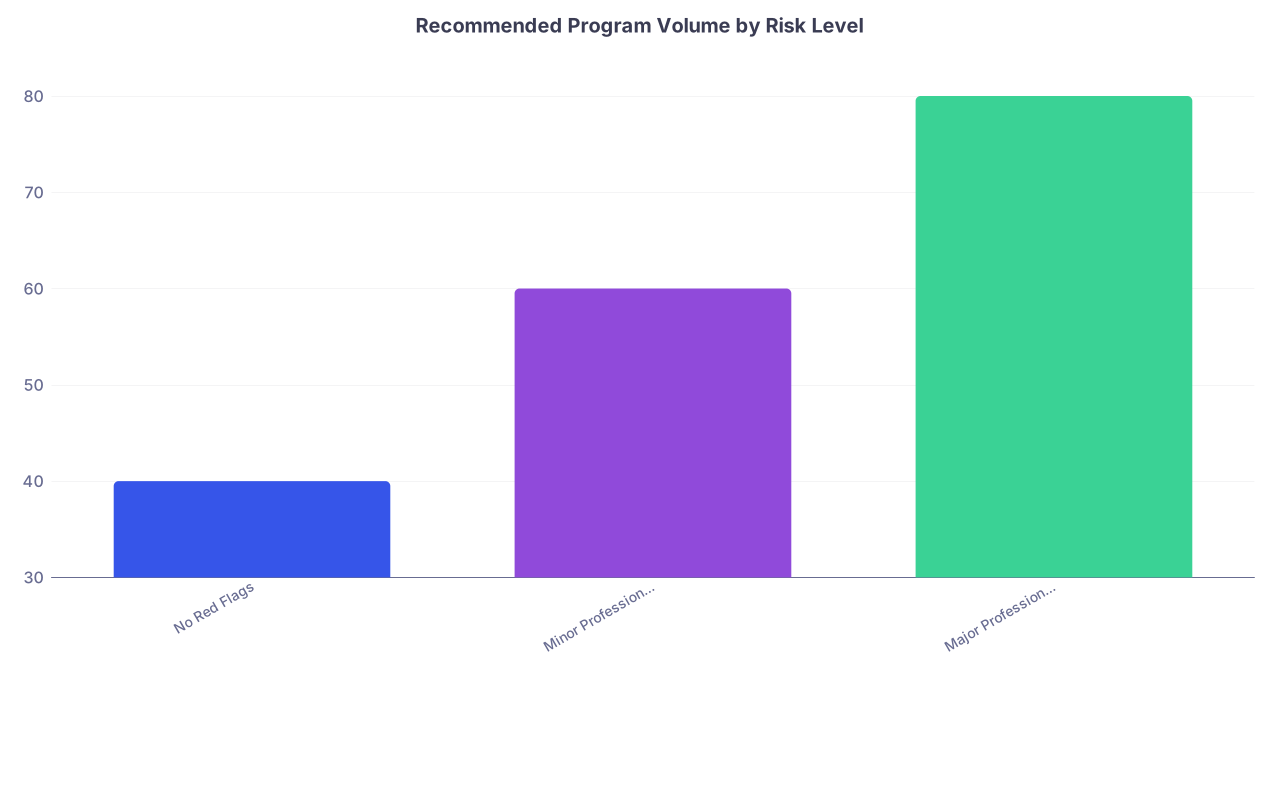
| Category | Value |
|---|---|
| No Red Flags | 40 |
| Minor Professionalism Issue | 60 |
| Major Professionalism Issue | 80 |
Step 3: Target programs that actually read holistically
Signals that programs may be more open-minded:
- Emphasis on “nontraditional applicants” or “second-career” students
- Strong focus on remediation and wellness
- Publicly discussed holistic review on their website or at conferences
Programs with a strong educational mission sometimes take “imperfect” applicants who have clearly learned and grown. They are less likely to gamble on someone who denies or minimizes problems.
Step 4: Use away rotations and sub-Is strategically
If you are still early enough in training to do this:
- Choose sub-internships where you can:
- Work directly with the PD/APDs
- Demonstrate reliability and professionalism daily
- Treat these as 4-week auditions:
- Early, consistently
- Document your efforts (ask for feedback, request letters)
A glowing letter from a sub-I where you were effectively functioning as an intern can counter a lot of old baggage.
6. On the Ground: How to Act on Rotations After a Professionalism Hit
This is where most people either quietly fix things—or unintentionally reinforce the concern.
Step 1: Over-communicate professionally
Especially if your issue was reliability or communication:
- Confirm expectations at the start of each rotation:
- “What time would you like me here in the morning?”
- “How do you prefer to be updated about patient issues?”
- Confirm deadlines:
- “When do you need my notes done by?”
- If you are running late or behind:
- You send a short, professional message early:
- “I am running 10 minutes behind because of [concrete reason]. I will be there at [time]. I apologize and will update you if that changes.”
- You send a short, professional message early:
Step 2: Show that you seek and use feedback
Program directors care a lot about coachability after any professionalism issue.
On every rotation:
- Ask 1–2 times: “Is there anything I could be doing differently to be a better team member?”
- When you get feedback, you:
- Repeat it back (“So, you would like me to…”)
- Implement it immediately
- If appropriate, acknowledge later: “I changed X based on your feedback, and it has helped.”
Attending physicians write comments like “very receptive to feedback” when you behave this way consistently. That phrase is gold in your context.
Step 3: Stay completely out of drama
You have lost your right to be in the middle of “he said / she said” political nonsense. You are on professionalism probation in the real world, even if formally off paper.
So:
- Do not gossip about staff, residents, or attendings.
- Do not send long venting texts or emails about rotations that could be screenshotted.
- Do not argue policy decisions with faculty. Ask clarifying questions, then comply.
Your brand should be: serious, focused, and boringly reliable.
7. Mental Framing: How to Carry This Without Letting It Cripple You
You have to walk a narrow line: fully owning what happened, without letting it define you.
Here is the frame that tends to keep people grounded:
- This happened. No rewriting history.
- It is documented. You cannot hide it.
- It is not the only thing documented. You will deliberately create a long trail of positive data after it.
- You control the recovery story. Programs care much more about the trajectory than the snapshot.
One more thing: do not get stuck in comparison.
You will see classmates with worse behavior and clean MSPEs. Because their incidents were never officially documented, or their deans were more lenient, or they just got lucky. That is maddening but irrelevant. You play the hand you have.
8. Put It All Together: A Simple 90-Day Rehab Plan
If you are 3+ months from application submission, you can do a lot. Here is a concrete 90-day framework:

| Step | Description |
|---|---|
| Step 1 | Day 1-7: Clarify Issue |
| Step 2 | Day 8-21: Meet Dean & Plan Remediation |
| Step 3 | Day 22-60: Execute on Rotations & Gather Feedback |
| Step 4 | Day 61-75: Secure Key Letters |
| Step 5 | Day 76-90: Craft Application Narrative & Practice Interview Answers |
Days 1–7
- Get your MSPE draft.
- Classify the issue (A/B/C).
- Write down a factual, two-sentence description of what happened.
Days 8–21
- Meet with dean / student affairs.
- Ask about formal remediation options.
- Confirm if MSPE wording can reflect remediation if completed.
- Identify 2–3 upcoming attendings who can see the “new you.”
Days 22–60
- Execute on rotations:
- Re-introduce yourself with intentionality.
- Ask for mid-rotation feedback, specifically on professionalism.
- Fix behavior in real time.
- Document a few concrete examples of how you have changed (for later use in statements and interviews).
Days 61–75
- Ask 2–3 key faculty for letters that explicitly address your professionalism growth.
- Confirm that they are comfortable doing this (if they hesitate, choose someone else).
Days 76–90
- Write your ERAS entry about the adverse action if applicable.
- Decide if the personal statement needs a short paragraph on this.
- Create and rehearse your 30–60 second interview explanation.
- Review your program list and increase volume if needed.
The Bottom Line
Three things matter most if you have a professionalism citation in your MSPE:
- Own it and fix it in reality first. Not in essays. Not in spin. In your day-to-day behavior on rotations, with documented improvement and strong faculty support.
- Control the narrative. Be factual, concise, and forward-looking in ERAS, your MSPE context, and interviews. No excuses, no drama—just what happened, what changed, and who you are now.
- Adjust your strategy, not your ambition. Apply more broadly, lean on programs that actually practice holistic review, and use strong post-incident letters and evaluations to show that this is one chapter, not your whole story.
Handled correctly, a professionalism citation becomes a data point—not a verdict.