
Academic probation does not automatically kill your residency chances. Hiding it, minimizing it, or handling it sloppily does.
If you are on, or have been on, academic probation, you are now managing two problems at once:
- fixing the underlying academic or professionalism issue, and
- building a clean, defensible paper trail that program directors can trust.
You need a plan for both. Not vibes. Not hope. A documented, stepwise plan.
This is that plan.
Step 1: Get Completely Clear on What Happened (On Paper, Not in Your Head)
Most students can describe their probation verbally in messy, emotional terms. “It was a rough year, some personal stuff, I failed two blocks, they put me on probation but it got lifted later.” That will not fly in ERAS or in interviews.
You need cold, boring, administrative clarity.
A. Collect every relevant official document
You are building a “probation folder” that you’ll reference for years. Create a physical and digital version.
Gather:
- Official academic probation letter(s)
- Any related professionalism or conduct letters
- Remediation plans and completion confirmations
- Course/clerkship failure or marginal pass notifications
- Any email from your dean’s office summarizing outcomes
- Updated transcript (after resolution)
- MSPE / dean’s letter draft when available (later)
If something is missing, request it:
- Email student affairs:
- Subject: “Request for documentation – Academic Probation”
- Ask for:
- The official start and end dates of probation
- The specific policy under which it was assigned
- A summary of the conditions and their completion status
Do not rely on memory. Program directors care about dates, status (active vs resolved), and scope (academic vs professionalism vs both).
B. Define the problem in one precise sentence
You need a sentence that is factually accurate and simple. For example:
- “I was placed on academic probation in March 2023 after failing the Internal Medicine clerkship exam.”
- “I was placed on academic probation during my first preclinical year for failing two systems blocks.”
- “I was placed on professionalism probation after a documented lapse related to repeated late arrivals to clinic.”
Write yours down. If you cannot explain it clearly in 1–2 sentences, you are not ready to explain it to a program director.
C. Build a one-page internal summary
This is NOT for ERAS. This is for you, and possibly your dean/mentor. One page, structured:
What happened
- Dates
- Trigger (specific failure or conduct issue)
- Official language from the school policy (brief quote or paraphrase)
Why it happened (root cause)
- Limited to 3–5 bullet points
- No drama, no excuses: sleep, depression, caregiving responsibilities, poor test-taking strategy, untreated ADHD, etc.
What the school required
- Retake exam X, repeat clerkship, mandatory counseling, professionalism course, etc.
- Deadlines and results
Outcome
- Probation lifted on [date]
- Returned to good standing
- Performance since then (grades, comments, no further incidents)
You will keep coming back to this page when you write your personal statement, fill out ERAS, and prep for interviews. It keeps your story consistent.
Step 2: Separate the Real Problem from the Surface Symptom
“Failed exam” or “late notes” are surface symptoms. You have to fix those. But program directors want to know if you have fixed the underlying problem.
I am going to be blunt: “I just needed to work harder” is a useless explanation. It tells a PD you have not understood your own failure.
A. Diagnose the true root causes
Use categories. Most probation cases fall into a mix of:
Skill deficits
- Poor test-taking
- Weak clinical reasoning
- Disorganized note writing
- Time management disaster
Circumstances
- Major family illness or death
- Financial stress with excessive work hours
- Unsafe housing, commuting 2+ hours daily
- Unstable Wi-Fi, computer failure during remote exams (yes, I have seen this wreck a semester)
Health / mental health
- Depression, anxiety, panic
- ADHD
- Sleep disorders
- Untreated chronic illness
Professionalism / behavior
- Chronic lateness
- Poor communication, unprofessional emails
- “Difficult to work with” feedback
- Boundary issues with patients or staff
Write down your specific contributors under these buckets. If you only write “stress” and “COVID,” you are not being specific enough.
B. For each root cause, define a concrete correction
You are building an “evidence of repair” list. For each real cause, you need:
- One or more concrete changes you made, and
- Some proof that it worked.
Examples:
Test-taking deficit
- Change: Completed 2 full UWorld passes, used NBME practice exams to guide weak areas, started weekly tutoring sessions.
- Evidence: Shelf scores improved from 15th to 65th percentile across three consecutive clerkships.
Depression
- Change: Started with a psychiatrist, adjusted medications, weekly therapy, set regular sleep/wake schedule.
- Evidence: No missed assignments or clinical days for 18 months; grades improved from marginal passes to high passes/honors.
Professionalism / lateness
- Change: Implemented two-alarm system, arrived 15 minutes early to every shift, calendar reminders for every deadline.
- Evidence: Narrative comments: “Always early to rounds,” “Extremely reliable,” “Consistently prepared.”
Write it as a two-column table in your notes:
| Root Cause | Corrective Actions & Evidence |
|---|---|
| Test-taking deficit | Tutor, UWorld, NBME practice; shelf scores improved |
| Depression | Therapy, medication, sleep hygiene; no missed days |
| Lateness | Double alarms, early arrivals; strong eval comments |
You are going to use this later to frame your story: “Here was the problem. Here is exactly how I fixed it. Here is the track record since.”
Step 3: Build a Formal Academic Probation Action Plan (Not in Your Head)
Now you translate all this into a real action plan that you can show to a dean or mentor and that can subtly inform your application materials.
Your plan must cover three domains:
- Documentation – the paper and data trail
- Advocacy – people speaking for you
- Repair – objective proof you are no longer a risk
A. Documentation: Lock down your record and narrative
Your goals:
- Nothing in your record is a surprise to you.
- The way your dean’s office describes it matches the way you describe it.
- You have your own clean, repeatable explanation.
Concrete steps:
Meet with student affairs / dean
Ask explicitly:
- “How will this be described in my MSPE?”
- “Will the word ‘probation’ appear?”
- “Will this be reported as professionalism vs academic vs both?”
Take notes in the meeting. Immediately after, send a brief recap email:
- “Thank you for meeting. My understanding is: [summary]. Please let me know if I misunderstood any part.”
That email becomes part of your documentation.
Check transcript and status
- Confirm:
- Probation is listed as resolved/ended
- Grades are updated after remediation
- Any notations that should have been removed actually are removed
- Confirm:
Create your 3–4 sentence public explanation
You will need a slightly longer version than that one-liner from Step 1. It must contain:
- The fact of probation, stated plainly
- The cause in non-dramatic language
- The correction
- The positive outcome since
Example:
“During my second year, I was placed on academic probation after failing two preclinical courses while I was struggling with untreated depression and ineffective study strategies. I worked closely with student affairs and a psychiatrist, completed treatment, remediated both courses, and probation was lifted after one semester. Since then, I have passed all subsequent coursework and clerkships on the first attempt, with strong evaluations and improved exam scores.”
Write your own version. Refine it now, not the night before your first interview.
B. Advocacy: Build people who will vouch for the “new you”
Program directors trust patterns and people, not just applicant self-stories.
You want at least 2–3 credible advocates who can say, in effect:
“I know there was an issue. It has been fully addressed. This person is now reliable.”
1. Identify your best potential advocates
Priority order:
- Dean / student affairs dean – they sign or shape the MSPE
- Clerkship or course director from after probation – especially in core specialties
- Research or longitudinal mentor who saw you before and after
- Attending physician who directly supervised you on a demanding rotation
You want at least:
- One person who understands the probation situation in detail.
- Two people who can independently speak to your current performance and reliability.
2. Have explicit conversations about the red flag
Do not hope they “just know.” Schedule short meetings:
- Explain:
- What happened (briefly)
- What you changed
- How things have gone since
- What kind of residency you are aiming for (IM, FM, Psych, etc.)
Then ask a direct but respectful question:
“Given everything you have seen of me since probation was resolved, do you feel comfortable supporting my residency application strongly and addressing my growth if needed?”
If someone hesitates, do not push. That is not your letter writer.
3. Arm your recommenders with specifics
Send them:
- Your CV
- A concise summary (1 page max) of:
- The probation situation (2–3 sentences)
- Changes you made
- Objective improvements (scores, comments, projects, leadership roles)
You are not writing your own letter. You are giving them the raw material so they can credibly say, “This is not hand-waving; there is data.”
C. Repair: Produce hard evidence you are not a risk going forward
This is where most students do too little. One good semester after probation is not enough for competitive programs. You want a streak.
1. Academic performance streak
You are aiming for a clear “before vs after” pattern:
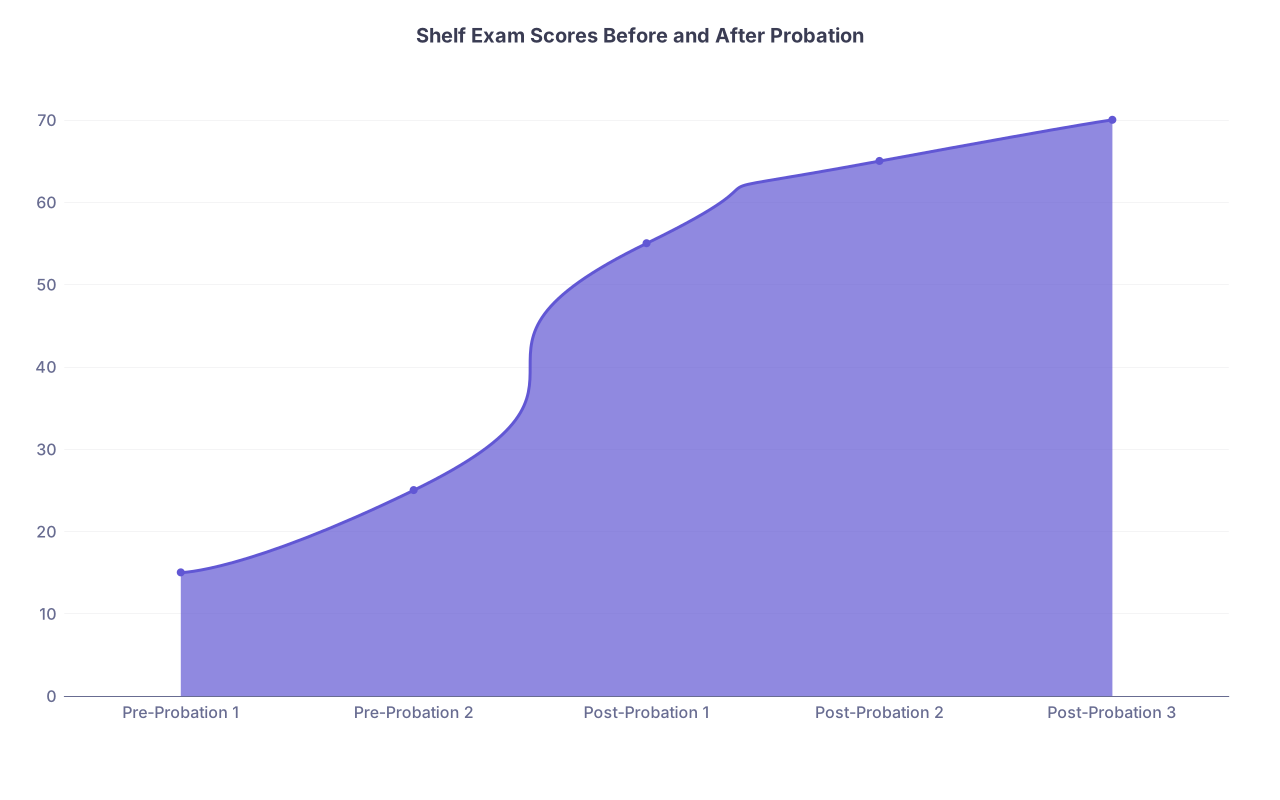
| Category | Value |
|---|---|
| Pre-Probation 1 | 15 |
| Pre-Probation 2 | 25 |
| Post-Probation 1 | 55 |
| Post-Probation 2 | 65 |
| Post-Probation 3 | 70 |
If you are still in school:
- Prioritize passing everything cleanly over chasing honors in every rotation.
- Secure at least a few clearly above-average performances on core clerkships post-probation.
- Track your own data:
- Shelf percentile before vs after
- OSCE scores
- Narrative comments with phrases like “significant improvement,” “outstanding,” “top student.”
If you have already graduated or are in a gap year:
- Consider:
- A structured research year with strong, clear supervision
- A paid clinical job that allows for letters (scribe, clinical research coordinator, MA if licensed)
- Additional coursework (MPH / master’s, if done seriously, not as a random “degree for the sake of it”)
2. Professionalism / reliability record
If your issue involved behavior, tardiness, or communication, you need a zero-incident record for as long as possible after:
- No missed shifts
- No late notes
- No unexcused absences
- No “communication issues” in evaluations
Ask for feedback mid-rotation:
“Are there any concerns whatsoever about my reliability or communication? I am actively working to be as consistent as possible.”
You want written comments like:
- “Exceptionally reliable.”
- “Always early.”
- “Very receptive to feedback; showed clear growth during rotation.”
Those words can directly counteract older professionalism red flags.
Step 4: Integrate Your Plan into ERAS, MSPE, and Personal Statements
You are not just cleaning up your act; you are strategically presenting it.
A. MSPE / Dean’s Letter: Influence what you can
You do not control the MSPE. But you can shape it indirectly.
Meet with the dean early (months before MSPE locks)
- Share a concise summary of:
- The probation
- Your remediation
- Your positive trajectory
- Provide objective data:
- Post-probation grades
- Notable comments from attendings
- Any awards or leadership roles
- Share a concise summary of:
Ask specific, reasonable questions
- “Is there any context you feel is appropriate to include about my improvement since probation?”
- “Are there parts of my trajectory you think would reassure residency programs?”
You are not asking them to omit or whitewash. You are inviting them to present a balanced picture.
B. ERAS: Where and how to disclose
ERAS has specific sections where probation may appear:
- Education / Medical School – transcript/MSPE are uploaded
- Disciplinary actions / interruptions – direct questions
- Experience / Personal Statement – your narrative control
1. Answer disciplinary questions directly
If there is a yes/no question about probation:
- If you were on academic or professionalism probation, the answer is yes.
- Do not play semantic games. Program directors hate that.
If there is a comment box:
- Use a short, structured answer (3–5 sentences):
- What happened
- Why (briefly)
- What you did
- How things look now
You can adapt your 3–4 sentence explanation from earlier.
2. Decide whether to address it in your personal statement
General rule:
- If the probation is easily visible (on transcript/MSPE) and significant (full semester/year, professionalism issues), address it briefly in the personal statement.
- If it is minor and already clearly contextualized in MSPE (e.g., brief academic probation early in MS1 fully resolved with spotless record since), you can sometimes leave it out of the PS and rely on the ERAS comment box + MSPE.
When you do address it:
- Do not lead with it. One short paragraph in the middle or later part is enough.
- Focus on:
- Responsibility, not blame
- Specific changes you made
- How those changes made you stronger as a future resident
Example paragraph:
“Early in medical school I faced academic probation after failing two preclinical courses during a period when I was struggling with depression and poor study habits. I sought treatment, worked closely with student affairs, and remediated both courses. The process forced me to rebuild my routines and ask for help earlier. Since then, I have passed all subsequent coursework and clerkships on the first attempt, with strong evaluations and steadily improving exam scores, and I carry that discipline and self-awareness into every clinical setting.”
That is enough. Do not linger.
Step 5: Prepare for the Interview Conversation Without Sounding Defensive
If your probation is visible, you should assume someone will ask.
The most common formats:
- “Tell me about this probation note in your record.”
- “I see there was an academic difficulty here. What happened?”
- “How have you grown since that time?”
You need rehearsed, flexible responses. Not scripted, but practiced.
A. Use a tight 4-part structure
- Fact – One line: what, when.
- Cause – Brief, honest, no melodrama.
- Correction – Concrete actions taken.
- Outcome – Evidence of sustained improvement and what you learned.
Example (academic probation, preclinical):
- “In my second year I was placed on academic probation after failing two systems-based courses.”
- “At the time I was dealing with untreated depression and was studying in a very passive, last-minute way that had worked in undergrad but was not sufficient for medical school.”
- “I met with student affairs and a psychiatrist, started treatment, and worked with a learning specialist to restructure my schedule, use active recall, and take practice questions consistently.”
- “I remediated both courses, probation was lifted after one semester, and since then I have passed all coursework and clerkships on the first attempt, with improved exam scores and positive clinical evaluations. It also made me much more proactive about asking for help early, which I now do routinely in clinical settings.”
Say it out loud several times. Adjust until it sounds like you, not like a legal statement.
B. Practice handling follow-up questions
Program directors may push a bit. Common follow-ups:
- “What safeguards do you have now to prevent this from happening in residency?”
- “How will you handle the workload when things get busy?”
- “If we spoke to your dean, what would they say about how you handled this?”
Prepare specific answers:
- Safeguards:
- Detailed schedule, accountability system, early communication with supervisors when struggling, consistent mental health follow-up.
- Workload:
- Concrete examples of high-volume rotations you handled well since probation.
- Dean’s perspective:
- “My understanding from our conversations is that they see this as a resolved issue and have seen consistent improvement in my performance and professionalism since.”
If you sound vague or defensive, they will assume the issue may repeat.
Step 6: Target Programs Strategically (You Are Not Applying Like a “Clean” Applicant)
You are playing a different game. You need to be smart about where you apply.
A. Understand general risk tolerance
Programs differ in their willingness to take someone with academic or professionalism red flags. Rough pattern:
| Program Type | Typical Risk Tolerance for Probation |
|---|---|
| Top academic university programs | Low |
| Mid-tier university programs | Moderate |
| Community programs with academics | Moderate to higher |
| Pure community programs | Often higher |
| Highly competitive specialties | Very low |
Are there exceptions? Yes. But you can not build a strategy on exceptions.
If you had serious probation, be realistic:
- Ultra-competitive specialties (Derm, Ortho, ENT, Plastics, Neurosurgery) are extremely difficult unless there is a very compelling, well-supported redemption arc and strong connections.
- Primary care fields (FM, IM, Psych, Peds) and some community-based programs often care more about whether you are now reliable and hardworking than whether you had a bad semester in M2.
B. Apply broadly and early
With probation in your record:
- Apply to more programs than a comparable “clean” applicant in your chosen specialty.
- Submit ERAS on the opening day if at all possible. Early application does not erase the red flag, but it removes avoidable disadvantages.
C. Use away rotations and sub-internships strategically
If you are still in school and have time:
- Choose away rotations / sub-Is at places you would genuinely consider ranking.
- Treat them as a month-long interview:
- Be early.
- Volunteer for work.
- Ask for feedback mid-rotation.
- Request a letter only if the feedback is strong.
Why it matters: a glowing letter from a program that has seen you up close can outweigh an old academic probation note, especially if your improvement is obvious.
Step 7: Build a Timeline and Checklist So You Actually Do All This
An action plan is useless if it lives in your head. Put this into a timeline.
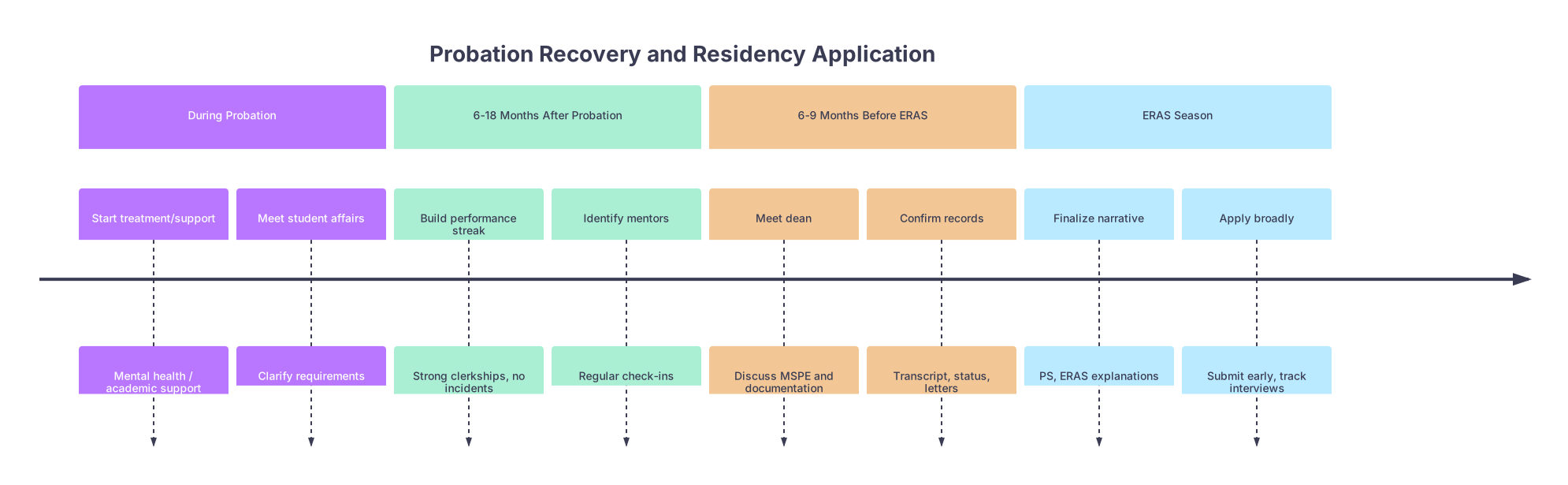
| Period | Event |
|---|---|
| During Probation - Start treatment/support | Mental health / academic support |
| During Probation - Meet student affairs | Clarify requirements |
| 6-18 Months After Probation - Build performance streak | Strong clerkships, no incidents |
| 6-18 Months After Probation - Identify mentors | Regular check-ins |
| 6-9 Months Before ERAS - Meet dean | Discuss MSPE and documentation |
| 6-9 Months Before ERAS - Confirm records | Transcript, status, letters |
| ERAS Season - Finalize narrative | PS, ERAS explanations |
| ERAS Season - Apply broadly | Submit early, track interviews |
Create a simple checklist:
- Collect all official probation-related documents
- Write one-page internal summary (what/why/what changed/outcome)
- Meet with student affairs dean; clarify MSPE language
- Build root-cause vs correction table
- Identify 2–3 strong advocates; meet with each
- Track post-probation academic and evaluation data
- Draft 3–4 sentence ERAS explanation
- Decide personal statement strategy; draft and revise
- Practice 4-part interview answer and follow-up questions
- Construct realistic, broad program list based on risk tolerance
- Submit ERAS early and keep communication professional
Print it. Actually check boxes.
A Brief Word on When the Problem Is Professionalism, Not Just Academics
Academic probation is one thing. Professionalism probation is heavier. Program directors care a lot about it because it predicts real-world problems.
If your issue was professionalism-related (lateness, rude behavior, boundary issues), you need to go further:
- Get documented professionalism teaching or remediation:
- Workshops, communication courses, coaching sessions.
- Ask supervisors to comment specifically on:
- Teamwork
- Responsiveness to feedback
- Respectful communication with staff
Do not say “I learned professionalism.” Show:
- “Since that incident, every attending has commented on my reliability and communication. For example, on my last surgery sub-I, the attending wrote: ‘One of the most professional and dependable students I have worked with this year.’”
That kind of granular evidence is what helps a PD take a chance.
Visualizing Your Improvement (For Yourself and Your Mentors)
Sometimes it helps to literally see the before/after trend. Sketch something like this for your own tracking:
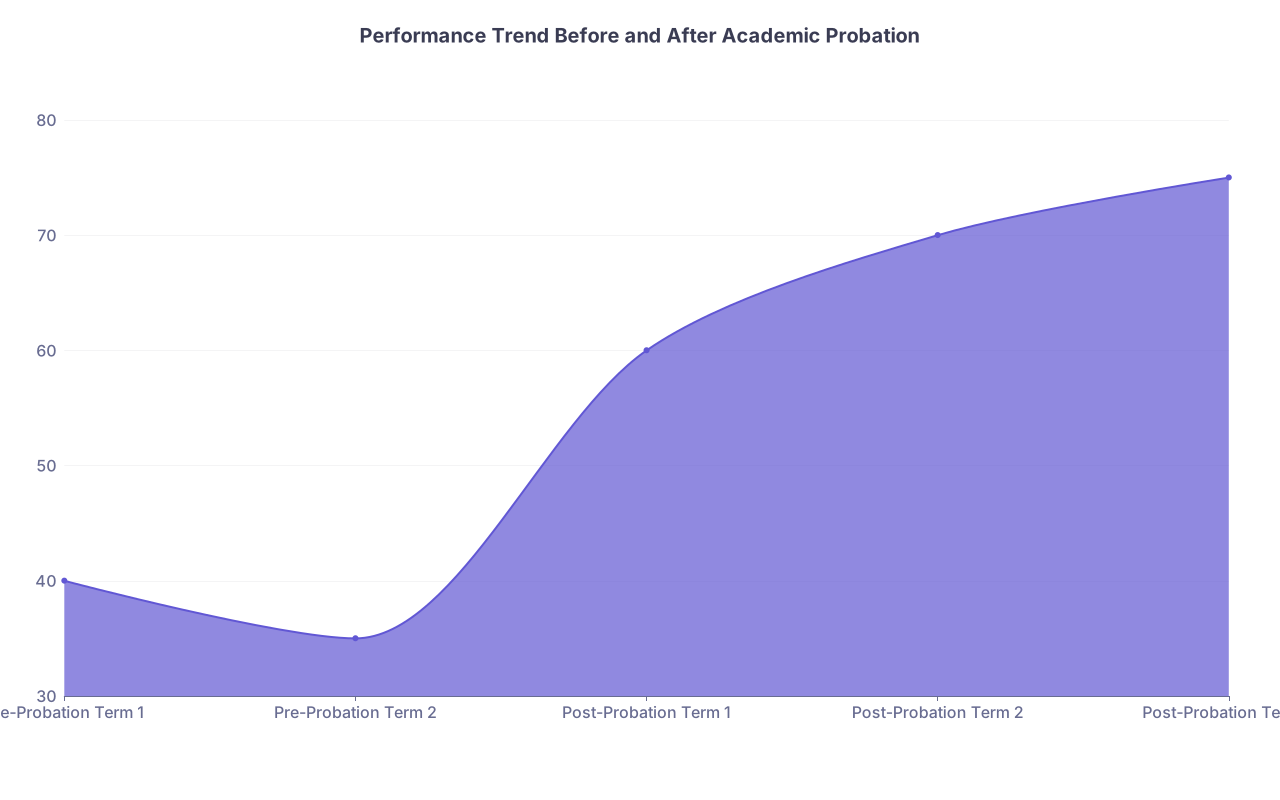
| Category | Value |
|---|---|
| Pre-Probation Term 1 | 40 |
| Pre-Probation Term 2 | 35 |
| Post-Probation Term 1 | 60 |
| Post-Probation Term 2 | 70 |
| Post-Probation Term 3 | 75 |
Keep an internal log:
- Exam percentiles
- Clerkship grades
- Key comments from attendings
This is not just for your ego. It arms your letter writers and gives you concrete talking points.
Final Takeaways
Three things matter most now:
Own the story and the paperwork. Know exactly what is in your record and create a clear, consistent explanation that matches your MSPE and ERAS responses. No surprises.
Prove sustained repair, not temporary damage control. Build a long enough track record of solid performance and professionalism that program directors can reasonably believe the risk is behind you.
Leverage people and structure, not hope. Meet with your dean, enlist strong advocates, practice your narrative, and apply strategically. A smart, disciplined plan beats quiet anxiety every time.