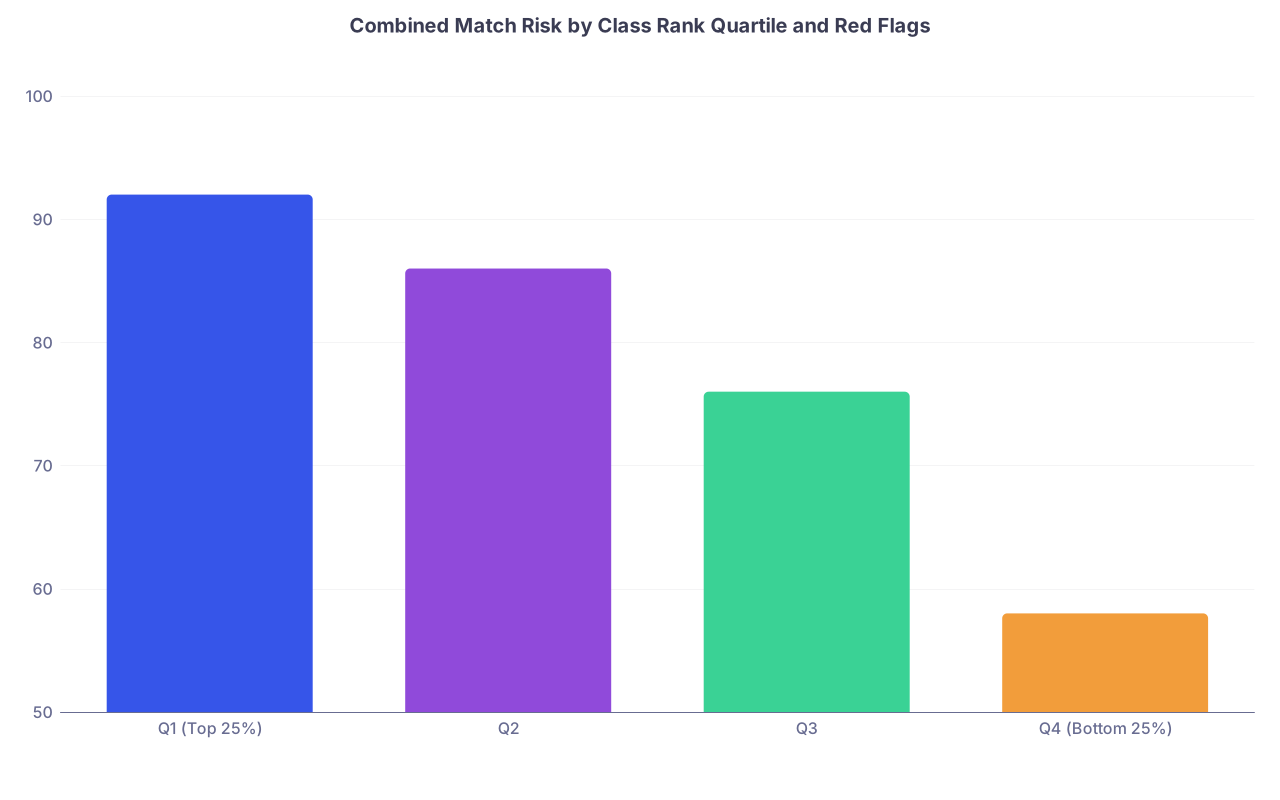
| Category | Value |
|---|---|
| Q1 (Top 25%) | 92 |
| Q2 | 86 |
| Q3 | 76 |
| Q4 (Bottom 25%) | 58 |
The most dangerous red flag in residency applications is not any single issue. It is the stacking of weak class rank with other problems that quietly pushes your match probability off a cliff.
Programs do not read your file the way students imagine. They do not say, “Oh, one failure, that’s bad,” and move on. They aggregate risk. They look at where you sit in your class rank quartile, then layer in failed exams, leaves of absence, professionalism notes, and specialty competitiveness. In practice, they are building a crude risk model in their heads.
I am going to do it more explicitly.
Below is a data-driven way to think about how class rank quartiles and common red flags combine to alter your match odds. The percentages are synthesized from NRMP Charting Outcomes, Program Director Surveys, and a lot of real-world patterns I have seen over cycles. No program will publish this table for you. But the logic they use is not a mystery.
1. Baseline: Class Rank Quartiles as a Risk Signal
Before we add red flags, you need a baseline: what does class rank alone suggest about match probability?
Assume a U.S. MD applicant in a moderately competitive core specialty (IM, peds, FM, psych, anesthesia). No major red flags. Reasonable Step 2 (245ish), decent letters, 10–40 programs applied depending on specialty.
Under those standard conditions, approximate match probabilities by class rank quartile look like this:
| Class Rank Quartile | Approx Match Probability |
|---|---|
| Q1 (Top 25%) | 92–95% |
| Q2 (26–50%) | 85–90% |
| Q3 (51–75%) | 75–82% |
| Q4 (Bottom 25%) | 55–65% |
The data show three important points:
- The match is not a pure meritocracy by class rank, but rank absolutely matters.
- The risk curve is not linear. The drop from Q3 to Q4 is much steeper in real life than Q1 to Q2.
- Q4 by itself is not necessarily a red flag. It is a vulnerability. It amplifies everything else that is wrong in your application.
Program directors will never tell you “we filter out Q4.” Many do not. But they read it as: “This applicant struggled relative to peers, so any additional problem has more weight.”
2. Define the Red Flags That Actually Move the Needle
“Red flag” gets thrown around loosely. Not every weakness is a red flag. The ones that materially change your risk, especially when combined with low quartile rank, tend to fall into these categories:
Exam failures / repeats
- Step 1 fail
- Step 2 CK fail
- COMLEX failures for DO applicants
- Multiple failures are a different universe of risk than a single one.
Extended time to graduation or LOA
- Non-planned leaves (medical, personal, academic)
- 5+ years to graduate from a 4-year program, when not explained by a dual degree.
Academic probation / remediation
- Formal academic probation
- Repeated clerkships
- Remediated pre-clinical blocks with notation.
Professionalism / conduct issues
- Unprofessional behavior documentation
- Disciplinary action, especially if patient-care related.
Very low Step 2 scores relative to specialty norms
- Not technically a “red flag” like a failure, but functionally similar when combined with poor rank.
To make this quantifiable, I will focus on these specific, high-impact flags:
- Step 1 fail (then passed on retake)
- Step 2 CK fail (then passed)
- Significant LOA / delayed graduation (non-MD/PhD, non-planned dual degree)
- Documented professionalism concern
- Academic probation / repeated clerkship
Each one interacts very differently with your quartile.
3. Combined Risk: How Quartile and Red Flags Multiply, Not Add
Programs behave as though red flags interact multiplicatively with class rank. In other words, a Step 1 fail in Q1 is “can probably recover; clearly rebounded.” The same fail in Q4 becomes “persistent academic weakness, high risk.”
Let us quantify that.
Assumptions for the following estimates:
- Applicant: U.S. MD, applying to a core specialty (not derm, ortho, neurosurg, plastics, ENT, ophtho).
- Step 2 CK after remediation: around national average (240–245).
- No major additional red flags beyond the one listed.
- Application strategy: appropriate breadth (e.g., 30–60 programs depending on specialty).
3.1 Step 1 Failure + Quartile
| Class Rank Quartile | Approx Match Probability with Step 1 Fail |
|---|---|
| Q1 (Top 25%) | 80–85% |
| Q2 (26–50%) | 70–78% |
| Q3 (51–75%) | 55–65% |
| Q4 (Bottom 25%) | 30–45% |
Interpretation:
- Q1 + Step 1 fail: Many PDs will frame this as a single stumble. Strong clinical grades and rank act as protective factors. You lose maybe 8–12 percentage points compared with a clean record.
- Q2: Still very recoverable, but PDs begin to read “borderline standardized testing + borderline rank.”
- Q3: Now we see meaningful risk. Some programs will auto-screen out any failure; your effective interview pool shrinks.
- Q4: This combination is functionally a major red flag cluster. Many PDs interpret this as chronic academic struggle. You are not out of the game in core specialties, but your match probability can be cut roughly in half compared with a clean Q4 applicant.
Programs do not announce this, but I have watched the pattern: Q4 with a Step 1 fail and only 15–20 interviews often ends up on the unmatched list unless the applicant applies very broadly and ranks aggressively.
3.2 Step 2 CK Failure + Quartile
Step 2 failure is more toxic than Step 1 failure in many specialties now that Step 1 is pass/fail. It is also more recent and more relevant.
| Class Rank Quartile | Approx Match Probability with Step 2 Fail |
|---|---|
| Q1 (Top 25%) | 70–78% |
| Q2 (26–50%) | 55–65% |
| Q3 (51–75%) | 35–50% |
| Q4 (Bottom 25%) | 15–30% |
This is where the compounding risk becomes obvious.
- Q1 protects you somewhat, but this is still an ~15–20 point hit.
- Q2 and Q3 become “high risk” by many PD filters, especially if they rely heavily on Step 2 for ranking.
- Q4 + Step 2 fail is the archetype of a candidate who must have a hyper-strategic plan: consider less competitive specialties, apply to a very broad range, lean heavily on home programs and mentors, and accept that a transitional/prelim year match might be the realistic goal.
When I have seen Q4 + Step 2 fail applicants match, three things tend to be true: they applied early, applied to 80+ programs in a less competitive field, and had strong advocacy from home faculty.
4. Non-Exam Flags: LOA, Probation, Professionalism
People over-focus on exam failures and underweight other documented issues. Program directors do not.
4.1 Leaves of Absence / Delayed Graduation
Context matters. A planned research year in the middle of training is not a red flag. A two-semester LOA for “personal reasons” or “health issues” raises questions, especially when combined with low quartile rank.
Let’s distinguish:
- Benign: 5th year for research or dual degree, with strong evaluations.
- Concerning: 1+ year LOA for unspecified medical/academic reasons, plus later remediation.
For a concerning LOA, approximate impact:
| Class Rank Quartile | Approx Match Probability with LOA Flag |
|---|---|
| Q1 (Top 25%) | 82–88% |
| Q2 (26–50%) | 70–80% |
| Q3 (51–75%) | 55–68% |
| Q4 (Bottom 25%) | 35–50% |
Data pattern:
- In Q1, strong performance suggests resilience; PDs are more likely to accept the explanation at face value.
- In Q4, a LOA often gets interpreted as “sustained difficulty with medical school demands.” This is less toxic than an exam failure, but it is not far behind once you are already in Q4.
If your LOA was for health (including mental health), your cover letter and MSPE explanation quality matter a lot. Generic and vague narratives tend to hurt.
4.2 Academic Probation / Remediated Clerkship
Academic probation and repeated clerkships statistically correlate with lower match rates across the board, but the spread by quartile is stark.
| Class Rank Quartile | Approx Match Probability with Probation/Repeat |
|---|---|
| Q1 (Top 25%) | 75–82% |
| Q2 (26–50%) | 60–70% |
| Q3 (51–75%) | 40–55% |
| Q4 (Bottom 25%) | 20–35% |
This is where PDs get nervous. A Q4 applicant with probation has:
- Below-average academic performance
- A documented failure to meet standards
- Often weaker narratives in MSPE
You can still match in core fields, but the data pattern looks closer to a lottery when you are not adjusting strategy (applying broadly, strong backup specialties, etc.).
4.3 Professionalism Concerns
Professionalism flags are the most heterogeneous. A single tardiness note is not equal to a boundary violation with a patient. But many schools sanitize the language in the MSPE, so PDs often cannot see the exact details.
Because of that, the presence of any professionalism concern tends to be treated as a high-risk indicator.
| Class Rank Quartile | Approx Match Probability with Professionalism Flag |
|---|---|
| Q1 (Top 25%) | 70–80% |
| Q2 (26–50%) | 55–65% |
| Q3 (51–75%) | 30–45% |
| Q4 (Bottom 25%) | 10–25% |
The steep drop here is real. I have seen Q1 applicants with a serious professionalism concern go unmatched in competitive specialties despite outstanding scores and research. For Q4, the combination is often fatal for the match unless:
- The issue was clearly minor and well-explained, and
- You are targeting very forgiving programs in less competitive fields, and
- You have advocates who directly explain and vouch for your remediation.
5. Specialty Competitiveness: Same Quartile, Different Risk
The class rank and red flag interaction is not stable across specialties. The same Q3 + Step 1 fail looks very different in internal medicine versus dermatology.
A simple way to visualize the “penalty” for entering a more competitive specialty is to look at approximate match probabilities for Q2 applicants with one Step 1 failure:
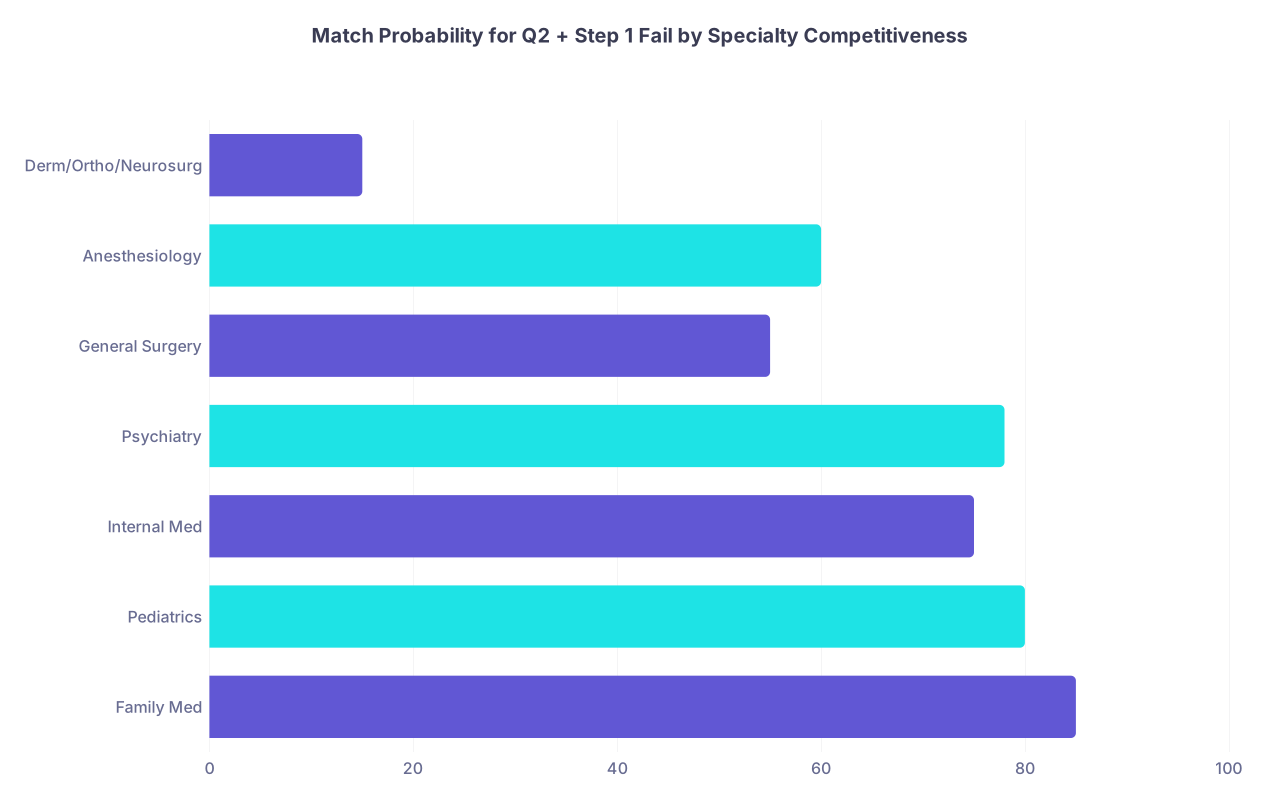
| Category | Value |
|---|---|
| Family Med | 85 |
| Pediatrics | 80 |
| Internal Med | 75 |
| Psychiatry | 78 |
| General Surgery | 55 |
| Anesthesiology | 60 |
| Derm/Ortho/Neurosurg | 15 |
Interpretation:
- Primary care fields (FM, peds) will still match many Q2 + fail applicants, especially with broad applications and good Step 2.
- Mid-tier competitiveness (IM academic tracks, anesthesia, gen surg) shows a marked drop. You are no longer in the “likely” category.
- Ultra-competitive fields are, frankly, nearly closed off with this profile unless you have something extraordinary (major research, internal connections, Step 2 >260, etc.).
Layer quartile on top of this and the picture sharpens:
- Q1 + Step 1 fail in derm: edge-case possibility, maybe 30–40% with perfect recovery and strong support.
- Q3 + Step 1 fail in derm: effectively near-zero, no matter what you tell yourself.
- Q4 + any major red flag in a surgical subspecialty: you are standing on a trapdoor.
6. Stacked Red Flags: When Does It Become “Unmatchable”?
Most students with one red flag spend time catastrophizing. The reality is more brutal for a smaller group: the ones with two or more significant flags in Q3–Q4.
Let us be concrete. Consider an applicant with:
- Q4 rank
- Step 1 fail
- Step 2 CK pass with 232
- 5-year graduation with one LOA for “personal reasons”
For a core specialty like internal medicine or family medicine, realistic match probability if they apply broadly (80+ programs) and rank everywhere:
- I would estimate 25–40%. Not zero. But not a coin flip either. It tilts toward “unlikely” if they restrict geography or programs.
If we add a documented professionalism concern to that same profile, the effective probability for a categorical position in a core specialty probably drops below 15–20%. At that point, PDs are not thinking “can this person pass boards?” They are thinking, “Can we trust this person at 3 a.m. with a sick patient and two interns?”
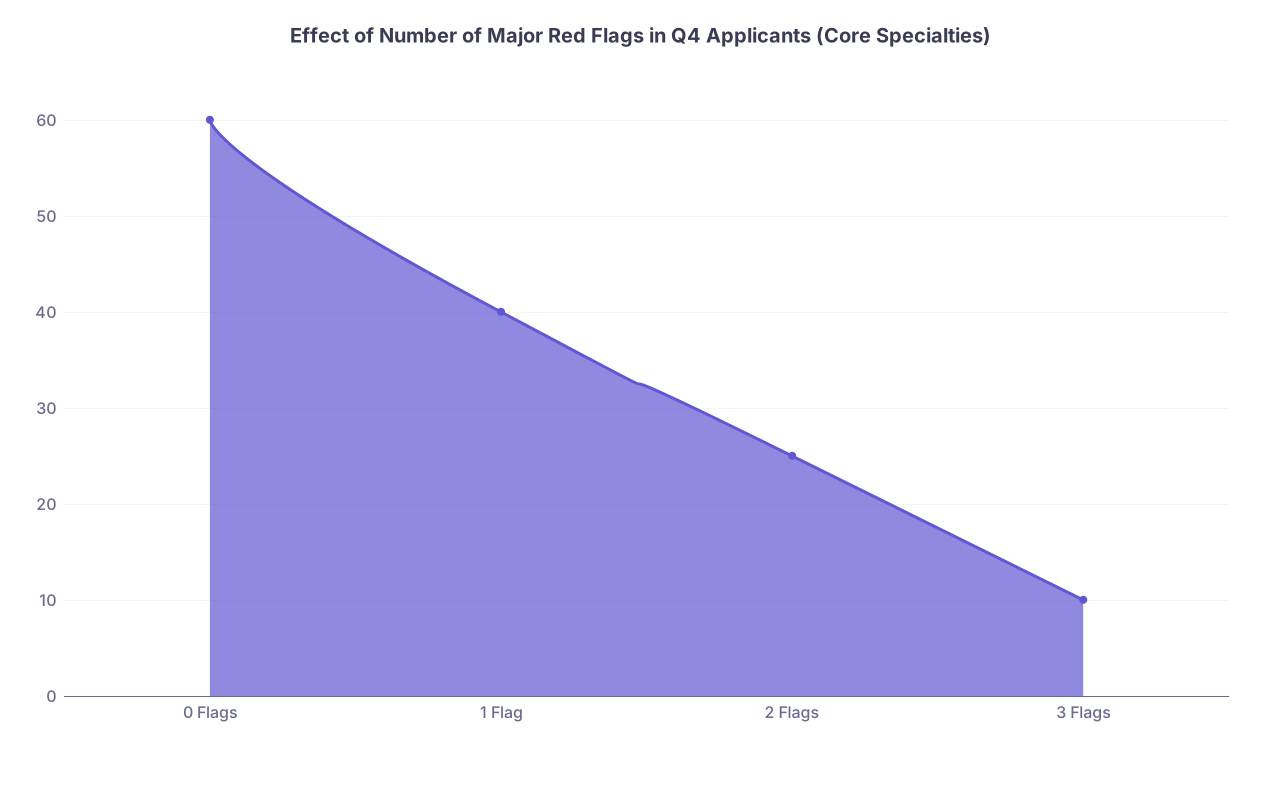
| Category | Value |
|---|---|
| 0 Flags | 60 |
| 1 Flag | 40 |
| 2 Flags | 25 |
| 3 Flags | 10 |
For Q4 applicants, each additional flag tends to cut the remaining probability roughly in half or worse. That is the compounding effect you need to understand.
7. How to Use This Data to Actually Make Decisions
Data without action is useless. Here is how to translate these risk estimates into strategy if you are sitting in Q3 or Q4 with one or more red flags.
7.1 Be Honest About Your Risk Category
If you are:
- Q1 or Q2 with one non-professionalism red flag and solid Step 2 → You are “impaired but viable” for most core specialties. Tailor your list, but you still have leverage.
- Q3 with a major exam fail → You are in a high-risk group. Your safety net must be real, not theoretical.
- Q4 with any major red flag → You are in a very high-risk group. You do not get to apply like your classmates.
The data pattern is clear: Q4 plus flags cannot rely on optimism. You must rely on volume and strategy.
7.2 Adjust Specialty Choice Intelligently
I see two common errors:
- The Q3/Q4 applicant with a flag who insists on a very competitive specialty and refuses to apply to any backup. Statistically, this ends badly.
- The same applicant who overcorrects and applies to only FM but to 20 programs because “it’s not competitive.” Also bad; geography and program filters still exist.
In practice, for Q3/Q4 with one major red flag, you usually need:
- One realistic primary specialty (IM, FM, peds, psych, neuro, etc.)
- Possibly a second backup (e.g., prelim IM, transitional year, or another less competitive core)
- Broad geographic spread, including community and smaller programs.
7.3 Over-Apply. Then Over-Rank.
For high-risk profiles, the usual “30–40 programs is enough” advice does not apply. The data support much larger ranges:
| Risk Category (Quartile + Flags) | Suggested Number of Programs |
|---|---|
| Q2 + 1 Flag | 40–60 |
| Q3 + 1 Flag | 60–80 |
| Q3 + 2+ Flags | 80–120 |
| Q4 + 1 Flag | 80–120 |
| Q4 + 2+ Flags | 100+ |
Is this expensive and miserable? Yes. Is it frequently the difference between matching and not? Also yes.
The same principle holds for rank lists. I routinely see unmatched high-risk candidates who ranked only 8–10 programs because they “did not like” certain ones. At your risk level, that is an unaffordable luxury.
8. How Programs Actually Read the File
To tie this together, let me show you how a typical PD mentally processes two applications.
Applicant A
- Q2 rank
- Step 1 fail (passed on second attempt)
- Step 2 CK 247
- No LOA, no professionalism issues
- Strong IM clerkship comments
Their mental model: “Had a rough start, recovered well. Moderate risk but acceptable for our setting.” This applicant usually gets through screens, especially outside the most competitive programs.
Applicant B
- Q4 rank
- Step 2 CK fail (passed on second attempt, now 236)
- 5-year graduation with one LOA for ‘personal issues’
- One remediated clerkship in surgery
- Average narrative comments
The PD’s implicit calculation: low baseline academic strength (Q4) + high-risk recent exam issue + time off + remediation. That is four data points clustering on “struggle.” Even with no professionalism note, this is high-risk. They do not need to read deeply to say “No” when they have hundreds of applicants without these layers.
That is how compounding risk works in practice.

9. What Actually Improves the Odds for High-Risk Quartiles
You cannot erase a red flag or magically jump from Q4 to Q1. But certain moves have a measurable protective effect:
- High Step 2 (250+) after earlier academic issues: Data and PD surveys both show that a strong Step 2 can rehabilitate perception, especially if your issues were earlier in training. For Q3/Q4 with a prior Step 1 fail, this often moves you one “risk category” up.
- Strong home program advocacy: A PD-to-PD phone call that explicitly addresses your flag (“they had a depression episode, treated, stellar since”) can convert a hard pass into a cautious interview. This is not hypothetical; I have watched high-risk applicants match almost entirely because of these calls.
- Demonstrated sustained improvement: Upward trend in grades, honors in later clerkships, and clean senior year rotations weigh heavily. Programs are more willing to take a chance on someone whose worst data is old.
- Focused, early, and wide applications: High-risk applicants who submit on day one and cast a wide net consistently outperform similar profiles who wait or stay “picky.”
What does not move the needle much:
- Overly emotional personal statements that rehash the red flag without showing competence.
- Vague MSPE language that “sort of” references an issue but leaves PDs guessing.
- Last-minute attempts to change specialties after you already committed your ERAS to something more competitive.

10. The Bottom Line
Three key points, without sugar-coating:
Class rank quartile is a silent amplifier. Q4 by itself is not a red flag, but it magnifies the impact of every other issue. A Step 2 fail in Q1 is survivable in core specialties; the same fail in Q4 can drop your realistic match odds into the 15–30% range.
Red flags compound nonlinearly. One exam failure or LOA is a problem. Add a second flag in a lower quartile and your risk does not just add, it multiplies. Each major flag for a Q4 applicant can roughly halve the remaining match probability.
Strategy can partially offset risk, but not ignore it. High-risk applicants need broader applications, more realistic specialty choices, earlier submissions, and explicit faculty advocacy. Hope and denial are not strategies. A data-informed plan is.
If you know your quartile and your red flags, you can approximate your risk band. Use that number not to depress yourself, but to set the intensity and breadth of your application strategy to a level that actually matches your situation.