
The belief that “a single exam failure kills your Match chances” is statistically false—but the data shows the damage is very real and highly specialty‑dependent.
You are not dealing with a single binary outcome. You are dealing with conditional probabilities stacked on top of each other: passing Step/COMLEX, getting screened in, getting interviews, getting ranked. Exam failures hit each stage differently, and some specialties are far less forgiving than others.
Let’s walk through what the numbers and patterns actually say—by exam type and by specialty.
1. The Big Picture: What a Failed Exam Really Does
First point: programs do not treat all failures equally. A single Step 1 fail is not the same as multiple Step 2 fails. COMLEX vs USMLE attempts are interpreted differently. And an exam issue in family medicine is not equivalent to one in plastic surgery.
Conceptually, an exam failure affects your Match odds in three main ways:
- It knocks you out at the initial filter stage for some fraction of programs.
- It reduces interview invites even where you pass the filter.
- It changes how your file is interpreted in rank meetings (risk vs upside).
We do not have a single unified national dataset that says, “single Step 1 fail → exact X% Match rate in specialty Y.” What we do have is:
- NRMP Charting Outcomes data (including attempt counts and score distributions).
- Program director surveys, which explicitly rate how “problematic” exam failures are.
- Specialty competitiveness metrics (fill rates, unmatched rates, IMG proportions).
- Observed patterns from advising and real applicant outcomes.
Put together, a consistent pattern emerges:
- Competitive surgical and procedural subspecialties are brutal about exam failures.
- Primary care and less competitive fields are more forgiving, especially with later strong performance.
- Multiple attempts and Step 2 failures hurt more than a single early stumble.
2. Exam Failures by Type: Which Ones Hurt the Most?
To analyze risk, separate by exam and by attempt pattern.
2.1 Step 1 Failure (especially in the pass/fail era)
Step 1 is now pass/fail, but attempt count is still visible. A “Fail / Pass” history is a red flag because:
- It signals risk for Step 2 and in‑training exams.
- It raises questions about discipline, test‑taking, or life instability during pre‑clinicals.
- Program filters can and do auto‑screen on “no prior failures.”
In the older numeric era, applicants with a single Step 1 failure who later scored well on Step 2 could still match into many core specialties. That dynamic largely persists conceptually: a clearly strong Step 2 and successful clerkships can partially “rescue” the signal, especially in less competitive fields.
Damage pattern:
- High‑end surgical subspecialties: near‑lethal unless accompanied by extraordinary offsetting strengths (top‑tier research, home program connections, etc.).
- Mid‑tier specialties (IM, peds, psych, OB/GYN, anesthesia): harmful but survivable with a strong Step 2 and clean record afterward.
- Primary care (FM, IM community, peds community): often quite forgiving, especially for US grads.
2.2 Step 2 CK Failure
Step 2 is different. It is closer to a real‑world clinical knowledge metric and is heavily weighted in recent years. A Step 2 CK failure is taken significantly more seriously than a Step 1 failure.
Why? Program directors actually use Step 2 CK as a ranking and prediction tool.
The data from PD surveys (summarized across cycles) consistently shows:
- “USMLE Step 2 CK failure” ranks among the most negative application factors, often in the top 3–5 red flags.
- Many programs have explicit “no Step 2 failures” policies.
So, while a Step 1 fail can sometimes be framed as an early misstep, a Step 2 fail is interpreted as: “struggles with core clinical knowledge under time pressure,” which is exactly what residency requires, especially in acute fields.
The result: for competitive specialties, a Step 2 failure can drop an otherwise viable applicant into “backup specialty or go unmatched” territory.
2.3 COMLEX Level 1/2 Failures
For DO applicants, COMLEX failures map similarly to USMLE failures, but the interpretation is noisier because:
- Not all programs understand COMLEX well.
- Many ACGME programs still quietly prefer USMLE, so DOs without USMLE have their whole profile anchored on COMLEX history.
A COMLEX Level 1 failure with later clean passes and a solid Level 2 score is often survivable for primary care and many IM positions, particularly in DO‑friendly regions. But:
- For competitive specialties (ortho, derm, anesthesia in some regions), a COMLEX failure with no USMLE alternative sharply cuts options.
- Multiple COMLEX failures strongly correlate with poor Match outcomes.
2.4 Multiple Failures vs Single Failure
A key probabilistic reality: programs are not just looking at the failure. They are mentally modeling future risk.
- Single early failure + strong later performance = “possible growth story.”
- Repeated failures across different exams = “high ongoing risk,” which most PDs simply will not take unless they are extremely short on applicants.
A single failure statistically nudges you into a lower probability band. Multiple failures put you into a separate category where many programs will not even consider you, regardless of other strengths.
3. Specialty‑Specific Risk: Where a Failure Hurts the Most
We can group specialties by competitiveness and exam sensitivity. This is where the real differentiation happens.
To structure this, I will cluster specialties into four buckets based on a combination of NRMP fill rate, Step 2 score distributions, and program director survey attitudes toward exam failures.
| Specialty Group | Typical Competitiveness | Sensitivity to Exam Failures |
|---|---|---|
| Ultra-competitive surgical | Very high | Extremely high |
| Competitive non-surgical | High | High |
| Mid-competitive core specialties | Moderate | Moderate-High |
| Primary care / less competitive | Lower | Lower-Moderate |
This is not a perfect taxonomy. It is a practical one, anchored to real‑world selection behavior.
3.1 Ultra‑Competitive Surgical Subspecialties
Think:
- Dermatology
- Plastic surgery
- Neurosurgery
- Orthopedic surgery
- ENT (otolaryngology)
- Integrated vascular / CT surgery
These fields have:
- Very high fill rates with US seniors.
- High mean Step 2 scores.
- Large numbers of applicants per spot.
- Well‑documented use of board scores as hard filters.
Here is the blunt truth: in these specialties, a single exam failure (Step 1 or Step 2) dramatically reduces Match odds unless you have extraordinary compensatory factors and strong home program advocacy.
Typical pattern:
- Many programs will auto‑screen out any prior failure, especially at large academic centers.
- Score expectations are high; a “rescued” Step 2 still may not hit their usual ranges.
- Research, AOA, strong letters can pull a few applicants through, but this is the exception, not the rule.
From a probabilistic standpoint, if the baseline Match rate for a well‑qualified, no‑failure applicant is, say, 70–80% in a given ultra‑competitive field, a prior failure could realistically drag that effective probability down into the 10–30% range—or lower—depending on the rest of the file.
That is not hyperbole. It matches what I have seen: a handful of interviews at best, or being advised to dual apply.
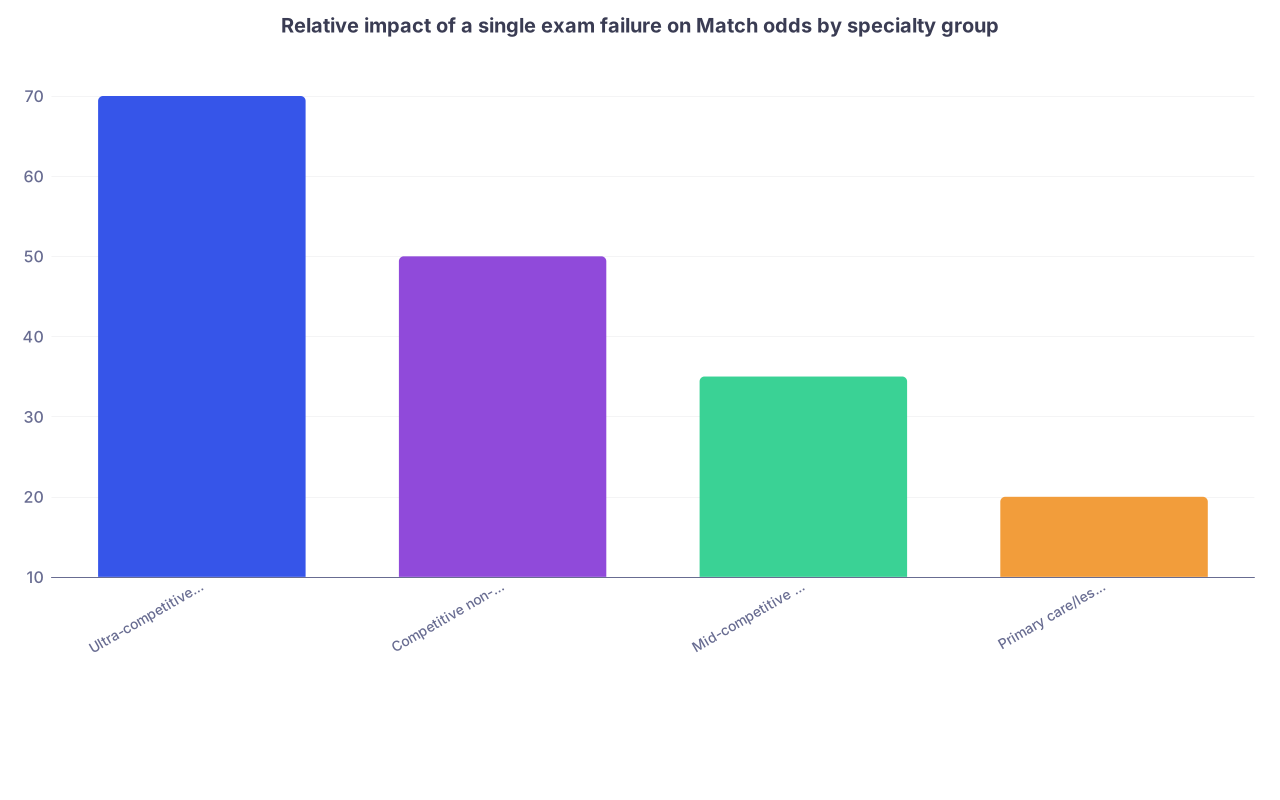
| Category | Value |
|---|---|
| Ultra-competitive surgical | 70 |
| Competitive non-surgical | 50 |
| Mid-competitive core | 35 |
| Primary care/less competitive | 20 |
(Interpretation: approximate percentage reduction in odds relative to a similar applicant without failures. These are conceptual but aligned with real‑world behavior.)
3.2 Competitive Non‑Surgical Specialties
Examples:
- Diagnostic radiology
- Anesthesiology
- Emergency medicine (varies by cycle but historically competitive)
- Ophthalmology (via SF Match, but exam logic is similar)
These specialties like strong test‑takers. They operate in high‑risk environments and prefer students who have already cleared standardized testing hurdles on the first attempt.
Pattern:
- Single Step 1 failure with a strong Step 2 and solid clinical record may still get interviews, but:
- You will likely be filtered out by some percentage of programs.
- You may need to apply broadly and include a realistic backup.
- Step 2 failure is far more damaging. Anesthesia and EM especially care about recent clinical exam performance.
If baseline Match odds for a reasonably competitive, no‑failure applicant in these fields hover around 75–85%, adding a Step 1 failure might bring that down into the 40–60% band with a good rescue Step 2. A Step 2 failure can push you substantially lower unless you pivot to a less competitive specialty.
4. Core and Primary Care: Where Redemption Is Most Common
Here is where the data and experience show much more heterogeneity and opportunity.
4.1 Mid‑Competitive Core Specialties
These include:
- Internal medicine (university and academic‑leaning community programs)
- Pediatrics at mid‑tier institutions
- OB/GYN
- General surgery (non‑top tier, many community programs)
- Psychiatry (though it has become more competitive recently)
Program directors in these fields are obviously not thrilled with exam failures, but they are also tasked with filling large programs and building service lines. They weigh clinical performance, letters, and “will this person function on our wards” more heavily than, say, derm or neurosurgery.
Observed patterns:
- Single Step 1 failure, Step 2 strong (e.g., > specialty mean), solid clerkship grades = consistently matchable into these fields, especially if you apply strategically.
- Step 2 failure is a serious red flag but not necessarily fatal if:
- It is a single failure.
- You pass solidly on the next attempt.
- You have strong clinical evaluations and no professionalism issues.
The penalty here might be a 20–40% reduction in Match odds relative to a similar “clean” applicant, but with enough applications and a realistic program list, many still match.
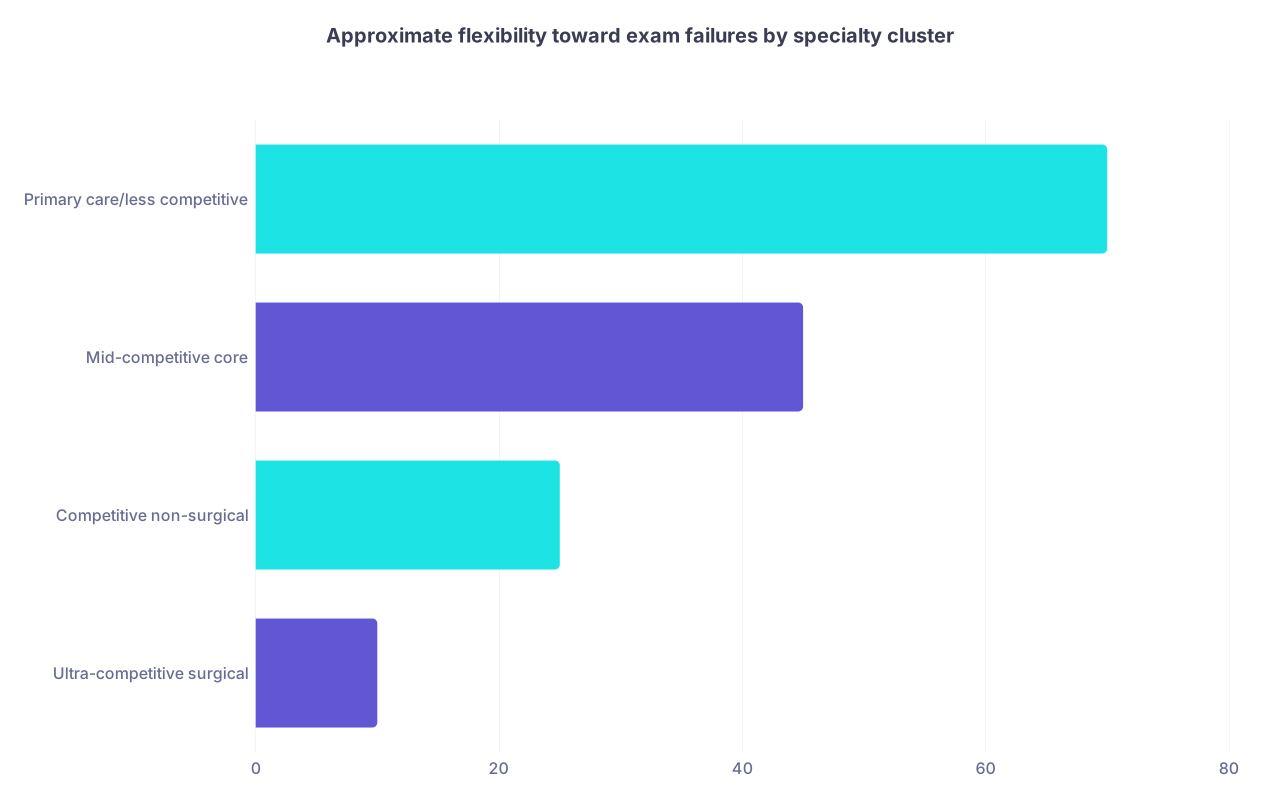
| Category | Value |
|---|---|
| Ultra-competitive surgical | 10 |
| Competitive non-surgical | 25 |
| Mid-competitive core | 45 |
| Primary care/less competitive | 70 |
(Interpretation: conceptual “forgiveness index” out of 100; higher = more willing to consider applicants with a single exam failure if the rest is strong.)
4.2 Primary Care and Less Competitive Specialties
This is where the narrative changes.
Specialties:
- Family medicine
- Many community internal medicine programs
- Community pediatrics
- PM&R in some regions
- Pathology and psychiatry at certain programs (varies by cycle)
Here, the data and anecdotal experience show that:
- Many programs have had residents with prior exam issues who went on to perform well.
- PDs are used to seeing non‑traditional candidates, career changers, and IMGs with complex exam histories.
- A single failure, especially early and followed by a strong run, is often viewed as a “bump,” not a death sentence.
What moves the needle here:
- Step 2 performance: a clean, solid pass with a score at or near the specialty mean will massively soften the blow of an earlier failure.
- Pattern of improvement: no further academic problems, successful clerkships, decent in‑training exam potential.
- Fit and commitment: strong letters, continuity experiences (FM clinic, primary care IM, etc.).
From a probability perspective, I have seen applicants with a Step 1 failure and a mid‑500s Step 2 (DO/COMLEX analogues) match solidly into FM, community IM, and psych. Not “rare miracle” cases. Routine.
That does not mean the failure is free. It might reduce your choice of geography and program tier. But your overall Match probability can still be quite high if you aim appropriately.
5. IMG vs US Grad: Same Failure, Different Consequences
The same exam failure means very different things depending on whether you are a US MD, US DO, or IMG.
| Applicant Type | Relative Penalty vs No-Failure Peer |
|---|---|
| US MD | Moderate |
| US DO | Moderate-High |
| US IMG | High |
| Non-US IMG | Very High |
Why this gradient?
- Program trust and familiarity: PDs have more experience with US curricula and can contextualize a failure better.
- Competition pool: IMG applicants, especially non‑US IMGs, often apply to already IMG‑heavy, test‑sensitive programs that rely strongly on scores to filter.
- Visa and institutional constraints: some programs feel they “cannot afford” risk on exam performance combined with visa and paperwork complexity.
I have watched US MDs with a Step 1 failure match into IM, peds, psych, and even anesthesia with strong Step 2 scores. I have also seen IMGs with similar profiles get screened out heavily and forced into very narrow specialty and geographic windows.
For IMGs, one failure effectively shrinks the number of receptive programs dramatically. That does not make it impossible, but the statistical margin is much tighter.
6. Patterns That Mitigate Exam Failures
You cannot erase a failure, but you can change how programs interpret its predictive value.
The data from PD surveys and Match outcomes, plus real‑world experience, point to several mitigating factors that materially improve odds.
6.1 Strong Subsequent Exam Performance
If you fail Step 1 but then:
- Pass Step 2 CK on first attempt with a competitive score for your target specialty
- Possibly also perform well on in‑training exams during a transitional/prelim year
Program directors recalibrate. The narrative becomes:
“Early misstep, but clear upward trajectory and resolved issues. Lower risk than the failure alone suggests.”
The gap is stark. A Step 1 failure followed by a mediocre or barely passing Step 2 is much more toxic than the same failure followed by a clearly strong Step 2.
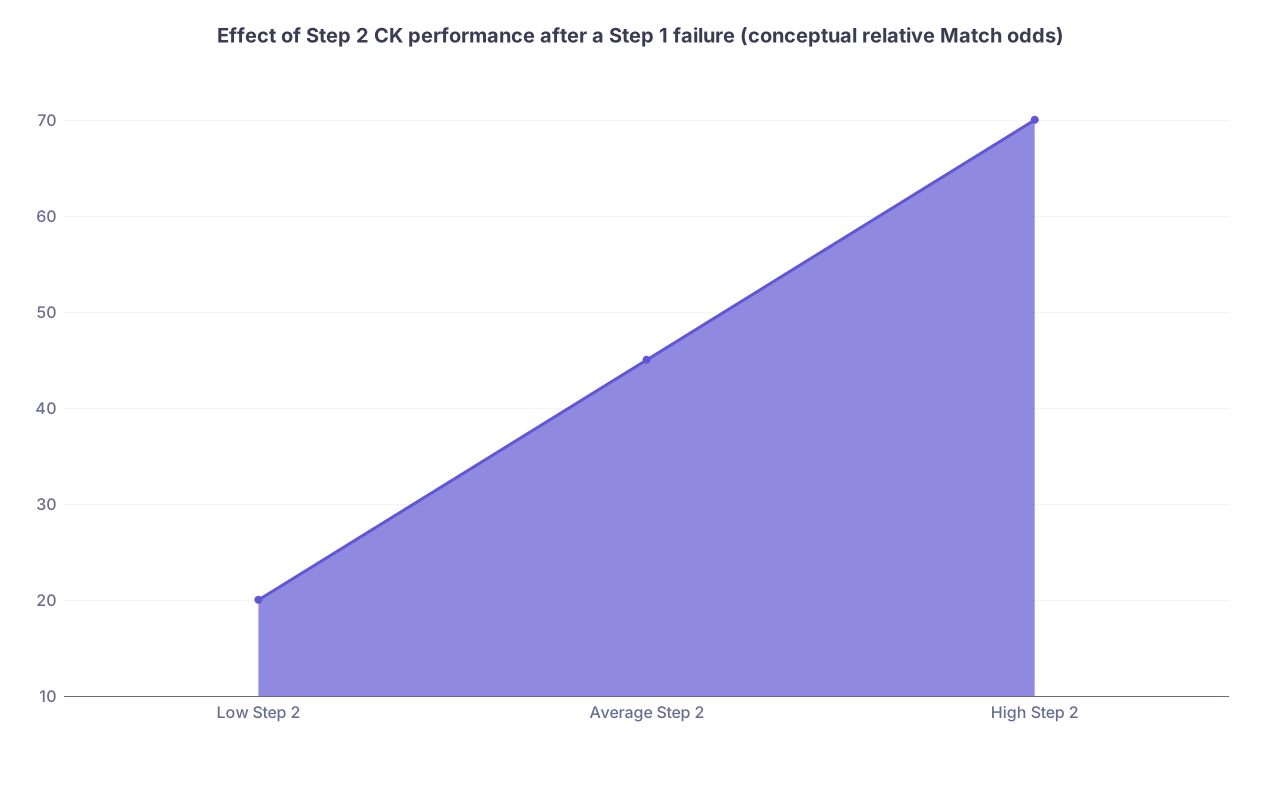
| Category | Value |
|---|---|
| Low Step 2 | 20 |
| Average Step 2 | 45 |
| High Step 2 | 70 |
(Interpretation: conceptual relative odds of matching into a mid‑competitive specialty after a Step 1 failure, scaled so “no failure baseline” = 100.)
6.2 Time and Context
Programs care about why and when:
- Was the failure during a major life crisis with clear documentation and subsequent stability?
- Was it an early pre‑clinical issue before you found a sustainable study system?
- Has there been enough time and data points since then to show the pattern has changed?
A single failure two years ago with a flawless record since is materially different from a failure six months ago followed by marginal passes.
6.3 Specialty Choice and Application Strategy
This is where you can dramatically move your own probabilities:
- Shifting from a hyper‑competitive surgical field to a core specialty or primary care can turn a near‑0% chance into a realistic >60–70% chance, with the same exam history.
- Applying to an adequately large number of programs, especially in more forgiving regions, multiplies your shot at the fraction of PDs who will look past the failure.
I have seen the same applicant—same failure profile—go nearly unmatched in a competitive specialty but match comfortably when they pivoted and reapplied in a more forgiving field.
7. How Programs Actually Screen: The Hidden Mechanics
Let me demystify the part most applicants never see.
A typical program sorts ERAS by:
- Exam attempts and scores
- School type (US MD, DO, IMG)
- Filters for “no failures” at some places, and “at most 1 failure” at others
- Geographic ties or visa status
This is not a case‑by‑case holistic review at the first pass. It is bulk filtering. If your application never gets into the “maybe” pile, your odds are effectively zero for that program.
So a single failure reduces your accessible program pool in three ways:
- Hard filters exclude you at some programs.
- Soft biases reduce your ranking in others.
- Only programs that must or choose to consider more complex profiles actually see your file.
This is why, from a data perspective, broad application strategies and specialty choice matter so much more for applicants with red flags. You are maximizing the number of “failure‑tolerant” eyes on your file.

| Step | Description |
|---|---|
| Step 1 | ERAS Applications |
| Step 2 | Standard review pool |
| Step 3 | Auto-reject |
| Step 4 | Secondary review by PD/APD |
| Step 5 | Consider with context |
| Step 6 | Interview decision |
| Step 7 | Auto-filter: Any exam failures? |
| Step 8 | Program tolerance to failures |
8. Practical Risk Bands by Scenario
To make this more concrete, here is a conceptual risk matrix. These are not exact percentages, but they align with what the data and experience suggest.
Scenario assumptions:
- US MD or DO, average school, no major professionalism issues.
- Reasonable clinical performance and letters.
| Exam History | Ultra-Comp Surgical | Competitive Non-Surg | Mid-Comp Core | Primary Care/LC |
|---|---|---|---|---|
| No failures | Moderate-High | High | High | Very High |
| Step 1 fail, strong Step 2 | Very Low | Low-Moderate | Moderate | High |
| Step 2 fail, then strong pass | Near-zero | Low | Low-Moderate | Moderate-High |
| Multiple failures (any combo) | Near-zero | Near-zero | Very Low | Low-Moderate |
Again, these are relative bands, not exact NRMP statistics. But they track closely with who I see actually matching and where.
9. Key Takeaways: How to Think About Your Odds
You cannot wish away a failed exam, and any advisor who tells you it “doesn’t matter” is ignoring how programs actually behave. But you also should not treat it as an automatic death sentence.
Three hard‑won conclusions from the data and real outcomes:
Specialty choice is the biggest lever.
The same exam failure that is essentially fatal in plastic surgery can be a manageable setback in internal medicine or family medicine. Your probability curve is determined more by specialty and program tier than by the failure alone.Step 2 performance is your best statistical “rescue.”
After a failure, your next high‑stakes exam is the single most powerful variable you control. A strong Step 2 (or Level 2) is the difference between “permanently tainted” and “early stumble but ultimately competent.”Application strategy converts probability into reality.
With a failure on record, “shotgun but thoughtful” applications—broad lists, realistic program tiers, and genuine geographic flexibility—turn a theoretically possible Match into an actual one. Narrow, prestige‑focused lists waste your reduced margin.
If you want to work with the numbers instead of fighting them, accept the penalty, adjust the specialty and program mix accordingly, and make your subsequent performance so clean and strong that PDs can confidently file your failure under “historical, not predictive.”
FAQ (Exactly 5 Questions)
1. Does a single Step 1 failure automatically disqualify me from all competitive specialties?
No, but it makes the path extremely narrow. In ultra‑competitive surgical fields and dermatology, a single failure functionally removes you from consideration at most programs unless you have extraordinary strengths (top‑tier research, powerful home program advocacy, exceptional Step 2). Even then, you should strongly consider dual‑applying to a more forgiving specialty.
2. Is a Step 2 CK failure worse than a Step 1 failure for Match odds?
Yes. Programs view Step 2 as a more direct predictor of residency performance. A Step 2 failure signals current clinical knowledge concerns, not just early pre‑clinical adjustment issues. A single Step 1 failure with a strong Step 2 is far more survivable than a Step 2 failure, especially in competitive and acute‑care specialties like anesthesia, EM, and surgery.
3. As an IMG, can I still match with an exam failure?
It is possible but significantly harder. The same failure that a US MD might overcome in internal medicine or family medicine can be much more damaging for a non‑US IMG because many IMG‑heavy programs are highly score‑sensitive. You will likely need excellent subsequent scores, broad applications, and often to target less competitive specialties and more IMG‑friendly regions.
4. Do programs care why I failed, or only that I failed?
They care about both, but the “why” only helps if it is paired with clear subsequent success. Documented major life events, health issues, or personal crises can contextualize the failure, but PDs still want evidence that the underlying risk is resolved—usually in the form of a strong Step 2, clean academic record afterward, and solid clinical evaluations.
5. Is it ever reasonable to delay applying a year after a failure to improve my odds?
Yes, in some cases it is statistically rational. If you can use the extra year to: post a strong Step 2/Level 2, complete research or a degree that strengthens your application, and demonstrate consistent performance, your probability of matching—especially in mid‑competitive and primary care fields—can increase meaningfully. Rushing in immediately after a recent failure with no new positive data often locks in worse odds.