
The brutal truth: the data shows that repeat residency applicants face sharply declining match probabilities—but the drop is not uniform, and it is not random. There are clear patterns, inflection points, and specialty-specific cliffs.
If you are a reapplicant after one or two failed match cycles, you are not in a mysterious black box. Your odds follow fairly predictable trajectories once you factor in three variables: prior USMLE performance, US grad vs. IMG status, and whether you changed strategy between cycles.
Let me walk you through what the numbers actually say, not what people hand-wave on forums.
1. What the Data Actually Shows About Reapplicants
The National Resident Matching Program (NRMP) and ECFMG reports do not print “reapplicant” in flashing red letters, but the signal is there if you read closely and connect datasets.
Key empirical points from recent NRMP/ECFMG trends (aggregated and approximated because reapplicants are not always directly labeled):
- First-time US MD seniors in the Match:
Match rate: ~92–94% overall (all specialties combined). - Repeat US MD applicants (not seniors anymore):
Match rate: often in the 45–65% range, depending on specialty and number of prior attempts. - IMGs (US-IMG and non-US IMG) first-time:
Match rate commonly ~55–65% (varies by year and specialty). - Repeat IMG applicants:
Match rate frequently drops into the 20–40% band unless major improvements occur.
So yes, the second and third run are harder. But they’re not automatic death sentences.
Conceptual Probability Trajectory
Think of four buckets:
- First-time applicant
- Reapplicant after 1 failed cycle
- Reapplicant after 2 failed cycles
- Reapplicant after 3+ cycles
The data pattern, across multiple years and specialties, looks like this:
- Bucket 1 → highest baseline probability.
- Bucket 2 → sharp drop, especially if nothing substantial changed.
- Bucket 3 → another large drop; you are now a statistical outlier.
- Bucket 4 → vanishingly small match probabilities in competitive specialties; possible but rare in primary care if you markedly upgrade your profile.
To make this concrete, here is a simplified comparative table. These are realistic, rounded ranges informed by NRMP/ECFMG trends and program director survey behaviors, not exact single-year point estimates.
| Applicant Type & Attempt | Conservative Match Probability Range |
|---|---|
| US MD, 1st attempt (all specialties) | 90–94% |
| US MD, 2nd attempt (reapplicant) | 50–70% |
| US MD, 3rd+ attempt | 20–40% |
| IMG, 1st attempt | 55–65% |
| IMG, 2nd attempt | 25–45% |
| IMG, 3rd+ attempt | 10–25% |
This is the macro view. Your personal probability depends on specialty choice, board scores, red flags, visa needs, and whether you look like the “same application again” or a genuinely upgraded candidate.
2. First Failure: What Happens to Your Match Odds on the Second Try
The first failed match is the pivot point. After one cycle, your trajectory can either stabilize or start a downward spiral, depending on how you respond.
Baseline Drop After 1st Failure
From the data side, here is the general pattern:
- A first-time US MD senior in internal medicine may have ~97–98% match probability.
- A US MD reapplicant in IM might be in the 75–85% range if:
- No major red flags.
- Reasonable number of interviews.
- Application improved (Step 3, new LORs, stronger personal statement, etc.).
- If the reapplicant changes nothing and re-runs the same strategy, I have seen individuals plunge into the 30–50% band quickly, even in “less competitive” specialties.
Programs do not treat you as a neutral reset. You are now “an unmatched applicant,” which program directors interpret as a signal.
Why the Second Attempt Is Statistically Different
Three concrete mechanisms drive the drop:
Unmatched status becomes a red flag in itself
PDs do not have time to run Bayesian inferences; they use shortcuts. If 90%+ of first-time US MD seniors match and you did not, you are now in the unusual subset. They ask: what did everyone else see that made them pass?Interview offers are sticky
Programs that passed on you once often pass again unless there is conspicuous change. I have seen applicants get 12 interviews first cycle, then 4 the next with almost the same application.Applicant pool inflation
Total applicants per year keep increasing while positions grow more slowly. Reapplicants add to the denominator, not to new spots. It is simple geometry—more competition for similar seat counts.
Quantifying the Second Attempt Scenario
Let us break down a realistic example: US MD aiming for internal medicine.
- First cycle:
- 45 programs applied
- 8 interviews
- Ranked all 8
- Did not match
A typical NRMP probability curve (using historical “interview count vs. match probability”) would put a US MD with 8 IM interviews at ~90%+ chance of matching. If you still did not match, several red flags become likely:
- Poor interview performance.
- Very limited geographic flexibility on rank list.
- Major red flag discovered late (professionalism, dismissal, failure).
- Late or incomplete rank list strategy.
Now second cycle:
- If you apply broadly (80–100 IM programs), improve letters, complete a prelim year or strong research year, and demonstrate that the underlying problem was corrected, your probability might recover to ~70–85%.
- If you run nearly the same application again with minimal change, your effective probability may be 40–60% at best—because some programs will implicitly filter reapplicants or de-prioritize them.
Red Flags After the First Failure
Program directors scrutinize three things after a first failed cycle:
- Gaps: “What did you do with the last 12 months?”
If the answer is vague (“helped in a clinic sometimes, studied, did some observerships”), your signal looks weak. - Accountability: Do your new letters address the prior shortcomings or just restate old strengths?
- Trajectory of scores and accomplishments: Step 3 passed? New publications? Substantive US clinical experience with hands-on responsibility?
The data trend is clear: reapplicants who convert the gap year into quantifiable improvements maintain roughly two-thirds or more of their original match probability. Those who do not often see their odds halved.
3. Second Failure: Probabilities After Two Unmatched Cycles
Two failed cycles is where the curves get steep. By the third attempt, you are operating outside the main distribution. Programs know it. You feel it.
Quantitative Impact of Two Failures
Using aggregated NRMP and anecdotal program-level evidence, this is the approximate landscape:
For a US MD:
- First attempt (US MD, broad IM / FM / Peds):
Match probability: 90–98% (depending on specialty). - Second attempt (after 1 failure):
Match probability: 50–75%, assuming real improvement. - Third attempt (after 2 failures):
Match probability: often 20–40% even in primary care, lower in competitive fields.
For IMGs, the drop is harsher:
- First attempt: 55–65% (primary care focused).
- Second attempt: 25–45%.
- Third attempt: 10–25%, with many clustering near the bottom of that range if nothing dramatic has changed.
Here is a comparative visualization of rough probabilities for an applicant focused on primary care (IM/FM), with decent but not stellar scores:
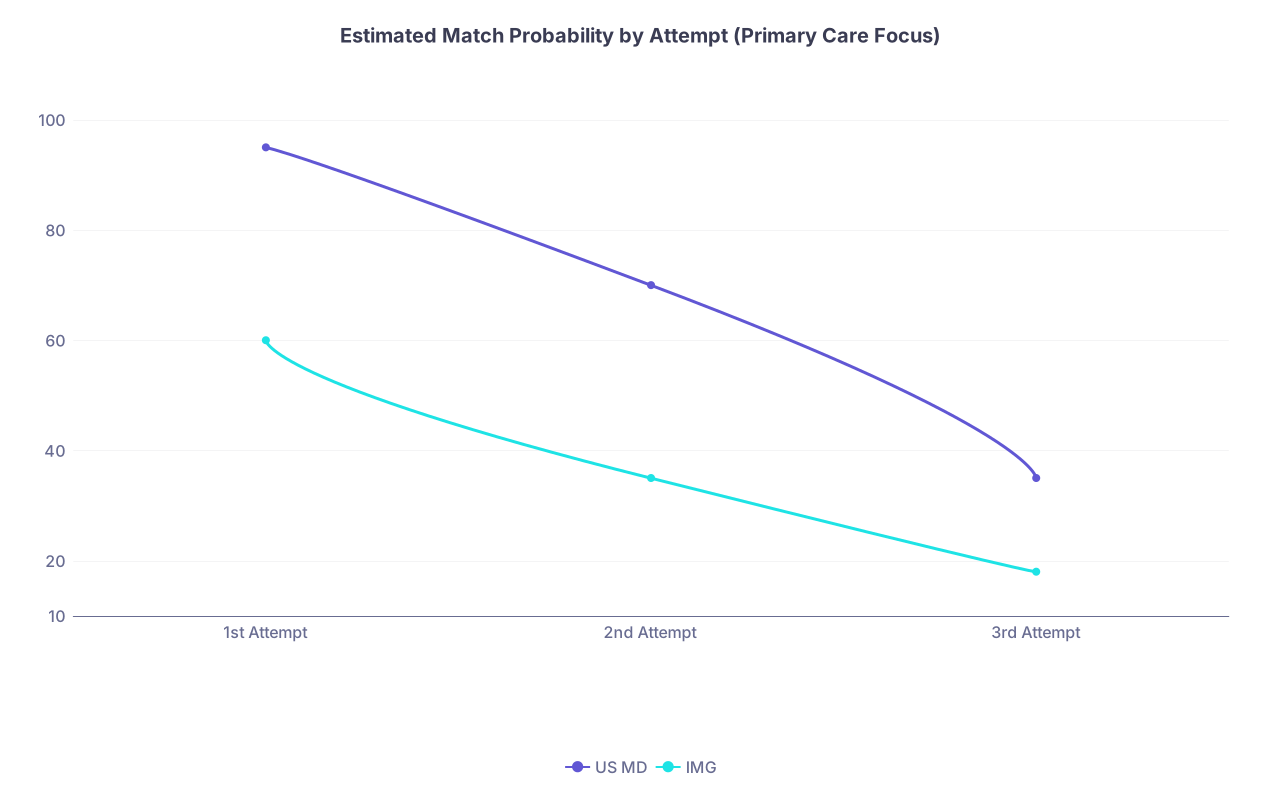
| Category | US MD | IMG |
|---|---|---|
| 1st Attempt | 95 | 60 |
| 2nd Attempt | 70 | 35 |
| 3rd Attempt | 35 | 18 |
You can argue with the exact numbers, but the shape of those curves is accurate: steep declines at each failed attempt.
Why Two Failures Are Statistically Devastating
There are three main reasons:
Selection bias against repeat failures
PDs see two prior unmatched cycles as a strong negative predictor. Internally, I have heard people say explicitly: “If they could not match twice, I am not going to be the one who takes the risk.”Increasing gap duration
Each additional year away from graduation degrades your profile. Data from multiple years confirms that graduates >3–5 years out have lower match rates, even controlling somewhat for other variables.Signal of stagnant improvement
If your second cycle did not fix the issues from the first, programs infer that the underlying constraints (scores, professionalism, communication skills, or visa limitations) are structural, not temporary.
Specialty Differences After Two Failures
Specialty matters a lot. After two failed cycles:
- Fields like dermatology, plastic surgery, neurosurgery: statistically near zero unless you entirely reinvent your trajectory with a PhD-level research career, transfers, or other extreme measures.
- Mid-tier competitiveness (EM, gen surg, anesthesiology): odds fall into single digits for many reapplicants unless they already completed a preliminary year and built very strong departmental relationships.
- Primary care (IM/FM/Peds, possibly psych): still viable, but your realistic probability band is commonly in the 15–40% range depending on:
- Step 1/2CK history
- Step 3 completion
- US clinical experience volume and quality
- Fresh, strong letters
- Willingness to apply very broadly and consider community programs in less desirable regions
4. Structural Factors That Modify Reapplicant Trajectories
Your raw “attempt count” is not the only variable. Certain structural features significantly amplify or soften the penalty of being a reapplicant.
4.1 Exam Score History
Nothing drives program behavior more than exam performance plus attempt history.
- Multiple Step failures + multiple unmatched cycles = catastrophic for probability.
This combination pushes many applicants into single-digit match odds despite extensive effort. - Decent scores but repeated no-match often point to:
- Interview skills problems,
- Poor specialty fit,
- Unrealistic geographic restrictions,
- Or a toxic letter / professionalism red flag.
Those can be corrected, but it takes targeted work, not token adjustments.
4.2 US Grad vs. IMG
The data is brutal here:
- US MD / DO status often acts as a “resilience multiplier.” A US MD with two unmatched cycles switching to FM with good Step 3 and a strong recent clinical year can still have >30–40% odds.
- Non-US IMGs with two unmatched cycles and no major new achievements often sit below 15–20% probability, even if they apply to 150+ programs.
Programs are not being fair. They are being conservative. They trust US training pipelines more and have limited interview slots.
4.3 Gap Years and What You Do With Them
Here is the simple algorithm programs run, informally:
- Gap year + strong, continuous, supervised clinical or research work in the US + Step 3 passed + new letters from US faculty → “Improving candidate, may be worth a shot.”
- Gap year + low-intensity observerships, no clear supervisor, no Step 3, no publications → “Stagnant candidate, risk of repeating same outcome.”
If you treat a reapplication year as a waiting room rather than a performance year, the data suggests your odds degrade quickly.
5. Strategic Changes That Actually Move Your Probability
Reapplicants who match on 2nd or 3rd attempts almost never do it by “trying again harder with the same plan.” They change something quantifiable.
5.1 Broadening or Changing Specialty
The single biggest lever is specialty choice.
- Switching from a moderately competitive specialty (e.g., anesthesiology, EM, categorical surgery) to primary care (IM/FM/Peds/Psych) can more than double your probability after a failure.
- Staying in a hyper-competitive field after one failure usually moves you into ≤10% probability territory for subsequent cycles if you are not a top 5–10% applicant on paper.
I have seen applicants go from 0/40 interviews in EM to 12/80 in FM with essentially the same scores but a different narrative and letters tailored to primary care.
5.2 Geographic and Program-Type Flexibility
The data is crystal clear: people who only apply to coastal academic centers after multiple failures almost never match.
If you are serious about changing your odds, your application pattern should show:
- Broad distribution across:
- Community programs
- Smaller cities
- Less “popular” states
- Willingness to rank prelim and categorical tracks where logically appropriate.
- Openness to “backup specialty” lists.

| Step | Description |
|---|---|
| Step 1 | Unmatched 1-2 Times |
| Step 2 | Low Match Probability |
| Step 3 | Assess Specialty Choice |
| Step 4 | Switch/Focus on IM/FM/Peds/Psych |
| Step 5 | Maintain Specialty, Add Backups |
| Step 6 | Apply Broadly: 80-150 Programs |
| Step 7 | Add Step 3, New LORs, USCE |
| Step 8 | Higher but Still Reduced Probability |
| Step 9 | Change Strategy? |
| Step 10 | Primary Care Acceptable? |
5.3 Quantifiable Improvements
Program directors look for hard evidence, not vague “I learned from this experience” statements.
Concrete upgrades that clearly improve probability:
- Passing Step 3 (for IMGs this is almost mandatory as a reapplicant).
- Substantial US clinical experience with clear responsibility (not just shadowing).
- New letters explicitly addressing your work ethic, clinical reasoning, and professionalism.
- Publications or serious research involvement (more relevant in academic tracks).
Reapplicants who stack 2–3 of these improvements between cycles often maintain >50% match probability in primary care even after a prior failure.
6. When the Data Says “Stop”: Recognizing Diminishing Returns
There is an uncomfortable but necessary question: at what point does the data say you are unlikely to match, no matter how much you want it?
Patterns I have seen repeatedly:
- Three or more cycles with:
- Repeated low interview counts (<5).
- No major change in scores or CV between cycles.
- Ongoing visa limitations and narrow specialty targeting.
In that setup, the implied probability over another 1–2 cycles often drops into the single digits. You might spend another 2–3 years, tens of thousands of dollars in applications, travel, and opportunity cost, for a ~5–10% chance.
On the other hand, scenarios where another attempt may still be rational:
- You are a US MD/DO.
- You have at least mid-range scores without multiple failures.
- You are willing to pivot fully into primary care, geographic flexibility, and broad application strategy.
- You can invest in a serious clinical/research year with strong mentorship and new letters.
The point is not to scare you. It is to run the numbers honestly. Treat this as an ROI decision. Each new attempt carries cost and diminishing incremental probability unless you fundamentally alter the inputs.
7. Putting It All Together: Realistic Trajectories After 1st and 2nd Failures
Let me summarize the core probability trajectories in a more integrated view, focusing on a reapplicant who is willing to pivot into primary care and actually improve their profile.
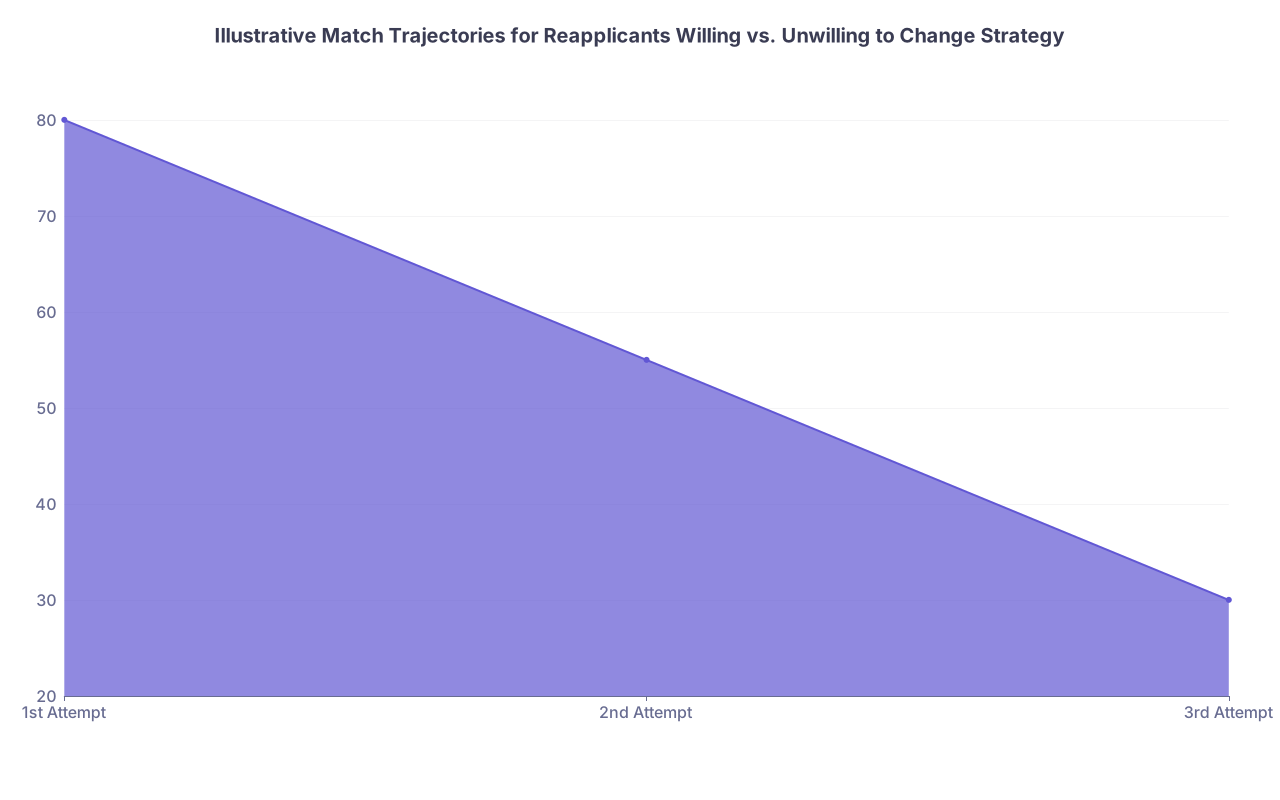
| Category | Value |
|---|---|
| 1st Attempt | 80 |
| 2nd Attempt | 55 |
| 3rd Attempt | 30 |
Use this as a conceptual aid with an important twist:
- Applicant A (changes strategy each time: specialty pivot, Step 3, new letters, more programs) might look like:
1st attempt: 80% → 2nd: 55–60% → 3rd: 30–35%. - Applicant B (same strategy, minimal improvement) might realistically look like:
1st attempt: 80% → 2nd: 30–40% → 3rd: 10–15%.
Same CV on paper. Different decisions. Very different trajectories.
FAQ (Exactly 5 Questions)
1. Do programs explicitly track whether I am a reapplicant?
Yes. Programs can see prior applications in ERAS and often recognize names, especially if your file was discussed in prior years. Some track reapplicants in internal spreadsheets. Being a reapplicant is not an automatic rejection, but it is a known factor and often triggers closer scrutiny of why you did not match previously.
2. Is it better to skip a year and not apply than to apply weakly and fail again?
If your application is clearly not competitive and you know you cannot meaningfully improve it before the next cycle (for example, no Step 3, no USCE, persistent visa barriers), skipping a year to build a stronger profile can be rational. Each unmatched attempt statistically reduces future probabilities, so treating the Match as a “lottery ticket” when your ticket is weak is usually a bad move.
3. How many programs should a reapplicant apply to after one or two failures?
Data and program director behavior both suggest that reapplicants must apply more broadly than first-timers. For primary care, 80–150 programs is not unusual, especially for IMGs and those with red flags. For US MD/DO candidates with moderate risk, 60–100 in IM/FM is common. The key is breadth plus realistic program selection, not just raw count.
4. Does completing a preliminary year improve my match odds significantly as a reapplicant?
Often yes, especially if you are switching into internal medicine, family medicine, or anesthesia from a surgical prelim. A strong prelim year with excellent letters demonstrates clinical reliability and can partially override concerns about being unmatched previously. The effect size varies, but I have seen applicants move from nearly no interviews to solid interview lists after a high-performing prelim year.
5. At what point should I seriously consider an alternative career path?
You should start doing sober probability and cost-benefit analysis after the second failed match, particularly if you are an IMG or have multiple exam failures. If, after two cycles, you have low interview counts, no substantial new achievements, and are unwilling or unable to pivot specialty or geography, the data supports considering alternative careers in research, industry, public health, or non-clinical roles. Two failures are not an absolute endpoint, but they are a strong signal that repeating the same strategy is statistically unsound.
To close this cleanly:
- Each unmatched cycle materially lowers your future match probability; the drop after the first and second failures is steep but modifiable.
- Reapplicants who change specialty, broaden geography, and add hard improvements (Step 3, USCE, strong letters) maintain far better odds than those who simply “try again.”
- Past a second or third failure, continuing without a fundamentally different strategy becomes a low-ROI gamble; the data demands an honest reassessment.