
Red flag applicants do not have “bad luck.” The data shows they have systematically worse interview yield and dramatically lower match probability—often by a factor of 2–5× compared with clean applications at the same Step score.
Programs track this. They talk about it bluntly on selection committees: “This is a reapp with 205 and two failures. We are not touching this.” If you want to understand your odds—or fix them—you have to look at the numbers, not the folklore.
Below I will break down:
- Common red-flag profiles
- Interview invite yield by profile type
- Match probability by interview count and red-flag status
- Where the “noisy gossip” about red flags is wrong—and where it is brutally correct
The Baseline: What a “Clean” Applicant Looks Like in the Data
Before you understand red flags, you need a baseline. No academic issues, no professionalism problems, no major gaps in training. Solid but not stellar.
For a typical mid-tier categorical specialty (internal medicine, pediatrics, psychiatry) and U.S. MD seniors with “clean” records, the NRMP data over multiple cycles shows roughly:
- Step 2 CK 230–240
- 12–18 programs applied (older era) → now often 40–60+ in competitive years
- ~12–15 interviews offered if they apply reasonably broadly and on time
- 95–98% match rate with ≥10 interviews
For U.S. DO seniors in the same specialties:
- Slightly lower mean Step 2 CK
- Need more applications (60–100+)
- Typical interview counts: 6–10 for reasonably competitive DO applicants
- Match rate ~90–95% with ≥8–10 interviews
For IMGs, the numbers slide more:
- Even with strong scores, interview counts often cluster in the 3–8 range
- Huge dependence on visa status, year of graduation, and geography
- Match rates can sit anywhere from 30–70% depending on combination of factors
This is the control group. Once you add red flags, interview yield drops sharply at every stage—screen, invite, rank.
Core Red Flag Profile Types
Let me sort red flags into distinct profile types, because the impact is not uniform. A failed Step is not the same as a misdemeanor in the chart, and both are not the same as being dismissed from a program.
1. Exam-Related Red Flags
These are the most common and the easiest for programs to quantify.
- USMLE/COMLEX failure (Step 1, Step 2 CK, Level 1, Level 2-CE)
- Very low passing scores (borderline performance patterns)
- Large score drop between Step 1 and Step 2 CK
For example, a Step 1 fail followed by Step 2 CK 230 is a very different story than two fails and a Step 2 of 214.
2. Academic/Progression Red Flags
- Course failures or remediation in med school
- Extended time to graduate (non-research gap)
- Probation for academic reasons
- Repeating a year
These are often buried in the MSPE. Programs look. Some PDs literally start at the “adverse actions” section.
3. Professionalism / Conduct Red Flags
Here is where the floor can fall out:
- Conduct probation
- Boundary violations, harassment issues
- Unprofessional behavior documented in MSPE or Dean’s letter
- Dismissal or forced leave from a prior residency
These are low-frequency but ultra–high-impact red flags. One line of text can drop your interview yield to near zero.
4. Training Gaps and Unusual Pathways
Individually, these are not always red flags. In combination with other issues, they become problematic.
- Multiple years out of medical school without continuous clinical work
- Switching specialties late with no clear narrative
- U.S. clinical experience gaps for IMGs
- Long unexplained CV gaps (1+ years)
5. Reapplicants / Prior Unmatched Attempts
The system as a whole is unforgiving to prior unmatched applicants without a clearly upgraded profile. Program coordinators and PDs often filter on “prior attempt” immediately.
Interview Yield by Profile Type: How the Numbers Actually Shift
Interview yield = number of interview invitations / number of applications submitted.
The numbers below are composite estimates from NRMP outcomes, specialty reports, and what selection committees actually see. They are not exact to the decimal point, but the differences are directionally correct and large.
Baseline: No Red Flag, Mid-tier Specialty, U.S. MD
- Typical application list: 40 programs
- Interviews: 12–15
- Yield: ~30–37%
Call that your control.
Profile A: Single Exam Failure, Subsequently Strong Step 2 CK
Scenario: Step 1 fail, Step 2 CK 235–245, no other issues.
What I have seen in multiple cycles:
- Applications: 60–80
- Interviews: 8–12
- Yield: ~10–18%
So you roughly need 1.5–2× more applications to land a similar interview count. But this is still salvageable, especially in non-competitive specialties.
Profile B: Multiple Exam Failures or Low Passing Scores
Scenario 1: Step 1 fail, Step 2 CK barely passing (205–215).
Scenario 2: Two failures on any major exam, even with eventual pass.
Observed pattern:
- Applications: 80–120+
- Interviews: 2–7
- Yield: ~3–8%
Now you are in the territory where one or two lost interviews (illness, scheduling conflict) can ruin the entire season. Some applicants in this group apply to 150+ programs and still get <5 interviews in core specialties.
Profile C: Academic Probation / Repeated Year, No Exam Failures
Scenario: Repeated M2 or M3 year, or formal academic probation, but Step 2 CK 235+, good letters.
Impact is subtle but real:
- Applications: 60–80
- Interviews: 8–14 (depending how positive the MSPE language is)
- Yield: ~13–23%
This is not as toxic as exam failures. A very strong upward trend and explicit “resolved” language in the MSPE can buffer the damage.
Profile D: Professionalism/Conduct Probation
This is where the data gets brutal. Many programs simply hard-filter these applications out.
Scenario: Documented professionalism issue (e.g., unprofessional behavior on a clinical rotation) in MSPE.
What tends to happen:
- Applications: 80–150
- Interviews: 0–5
- Yield: ~0–6%
And the qualitative part: at the committee table, if there are enough other applicants, these files rarely get discussed beyond “anyone want this one?” Silence, move on.
Profile E: ≥2 Years Out of School, Minimal Clinical Activity (IMG especially)
Scenario: 3+ years since graduation, sparse recent clinical work, average scores.
Patterns, particularly in IM:
- Applications: 100–200+
- Interviews: 1–6
- Yield: ~1–6%
If there is active, verifiable clinical work and fresh letters, this improves. Without that, interview yield is almost entirely dependent on personal connections or community programs willing to take a chance.
Comparative View
| Profile Type | Apps Sent | Avg Interviews | Yield % |
|---|---|---|---|
| No Red Flags (US MD, mid-tier spec) | 40 | 12–15 | 30–37% |
| Single Exam Fail, Strong Step 2 | 70 | 8–12 | 11–17% |
| Multiple Exam Issues / Low Pass | 100 | 3–7 | 3–7% |
| Academic Probation / Repeated Year | 70 | 8–14 | 11–20% |
| Professionalism Probation | 120 | 0–5 | 0–4% |
| 3+ Years Out, Limited Clinical Work | 150 | 1–6 | 1–4% |
The takeaway: move from “no red flag” to “multiple red flags” and you are dropping from roughly 1 interview per 3 apps to maybe 1 per 30–50 apps. That is not subtle.
Match Probability by Interview Count and Red-Flag Status
NRMP publishes a well-known relationship: more interviews = higher match probability, with steep gains up to ~10–12 interviews.
For U.S. MD seniors in internal medicine, for example:
- 1–3 interviews → match probability ~70–80%
- 7–9 interviews → >95%
- 12+ interviews → effectively >98%
But that is averaged over all applicants, including those with clean records. Red-flag applicants change the slope.
Clean vs Red-Flag: Same Interviews, Different Odds
Let’s look at a simplified model for mid-tier specialties.
Assume two applicants with 8 interviews each:
- Applicant 1: Clean file, solid Step 2 CK, normal progression
- Applicant 2: Step 1 fail + low Step 2 CK + reapplicant
On paper: both have 8 interviews. In reality, they are not in the same position.
Programs rank the red-flag applicant lower. Sometimes much lower. That shifts the conditional probability of matching for a given interview count.
Approximate numbers based on NRMP match probability curves + observed ranking behavior:
| Interviews | Clean Applicant (no flags) | Single Exam Flag | Multiple / Serious Flags |
|---|---|---|---|
| 1–2 | 45–60% | 25–40% | 10–25% |
| 3–4 | 70–85% | 50–70% | 25–45% |
| 5–6 | 85–92% | 70–85% | 40–60% |
| 7–8 | 92–97% | 80–90% | 55–70% |
| 9–10 | 95–98% | 88–93% | 65–78% |
| 11–12 | 97–99% | 90–95% | 70–82% |
You can argue about a few percentage points. You can not argue the direction: red-flag applicants need more interviews to reach the same match probability.
Visualizing the Drop-Off
Here is what this looks like if you compare interview yield by severity class.
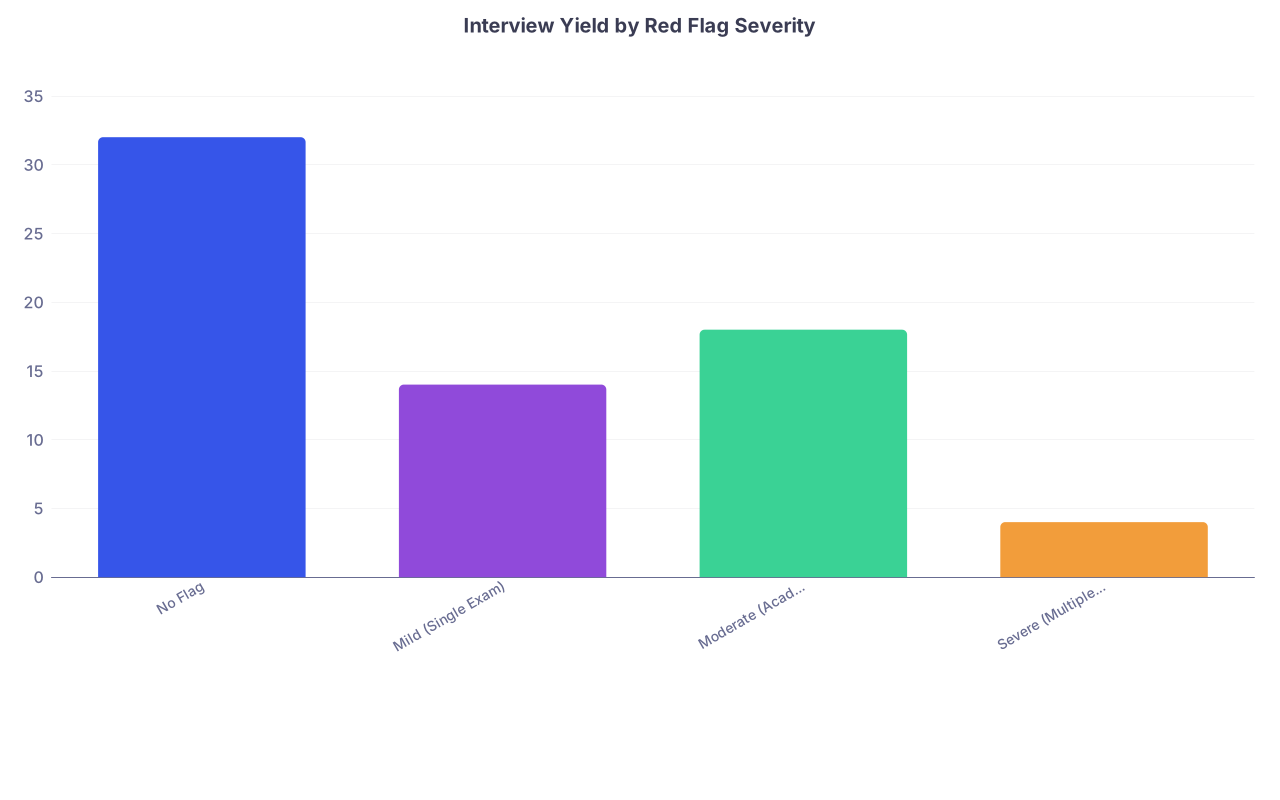
| Category | Value |
|---|---|
| No Flag | 32 |
| Mild (Single Exam) | 14 |
| Moderate (Academic) | 18 |
| Severe (Multiple/Professionalism) | 4 |
Rough mapping:
- No Flag: ~30–35% yield
- Mild (single exam failure with strong recovery): ~10–18%
- Moderate (academic issues but clean conduct): ~15–20%
- Severe (multiple fails, professionalism): low single digits
If you are in the severe category and applying to 60 programs in internal medicine, you probably get 0–3 interviews. That is not pessimism. That is what the math suggests.
Where Specialty and Degree Type Change the Picture
Not all specialties penalize red flags equally. Some basically treat them as automatic no-go; others will tolerate a single blemish if the rest is stellar or the applicant fills a real service need.
Highly Competitive Specialties (Derm, Ortho, Plastic, ENT, Rad Onc)
- Functional tolerance for red flags: near zero.
- A single Step failure or professionalism concern usually takes you out of contention, even with a 260 Step 2 CK.
- Interview yield for red-flag profiles in these fields is often literally 0, no matter how many applications go out.
Mid-Competitive (EM, Anesthesia, Gen Surg, OB/GYN)
- One mild academic or exam red flag may be survivable if everything else is top-tier, but you will be pushed toward lower-tier or community programs.
- Professionalism flags are nearly disqualifying.
- As EM tightened in recent cycles, I watched reapplicants with prior failures go from 8–10 interviews to 0–2, with essentially the same scores.
Less Competitive / High-Need (IM, Family Med, Psych, Peds)
- These are the “salvage” specialties for many red-flag applicants.
- Programs still screen out multiple failures and professionalism issues, but some will consider a single resolved exam failure or academic remediation, especially in community and rural settings.
- For IMGs with gaps, this is often the only realistic category.
Degree Type: MD vs DO vs IMG
Everything above is modulated by training background:
- U.S. MD with a single red flag is still fundamentally in a better pool than an IMG with the same issue. Program directors say this bluntly.
- U.S. DO with exam failures faces an uphill battle in some historically MD-favoring regions and specialties.
- IMG with any red flag (failure, gap, professionalism) + visa requirement: you are almost entirely dependent on niche programs or direct connections.
Process Flow: How Red Flags Get Filtered
Most applicants imagine an admissions committee “discussing” each red flag thoughtfully. Often, that never happens. Filters do the work.

| Step | Description |
|---|---|
| Step 1 | Applications Submitted |
| Step 2 | Score and Degree Filters |
| Step 3 | Auto Reject |
| Step 4 | Red Flag Screen |
| Step 5 | Manual Review |
| Step 6 | Rank by Scores, Letters, Fit |
| Step 7 | Interview Offers |
| Step 8 | Score / Degree Cutoffs Met? |
| Step 9 | Exam Failures? |
| Step 10 | Professionalism / Dismissal? |
The key point: your file is often never read by a human if it fails early filters. And if the MSPE or ERAS flags “adverse action,” many programs auto-exclude up front.
Match Strategy by Profile Type: Data-Driven, Not Magical Thinking
You cannot change past failures. You can change how much risk you carry into a given cycle. The only honest way to do that is to align your application volume and specialty choice with the numbers, not the stories you read on Reddit.
Single Exam Failure, Strong Recovery
Data says:
- You will need 1.5–2× as many applications to approximate the same number of interviews.
- Match probability with 8–10 interviews is still high (~80–90%).
Tactical moves:
- Apply more broadly in geography and program tiers.
- Prioritize specialties with higher tolerance (IM, FM, Psych, Peds, some Anesthesia programs).
- Use the personal statement and MSPE addendum to show remediation and sustained performance, not excuses.
Multiple Exam Failures or Very Low Scores
The numbers are harsh:
- Expect <10% interview yield even with a wide net.
- To get 6–8 interviews, you may need 100–150+ applications in some specialties.
- Even with 6–8 interviews, match probability may sit in the 50–70% range.
Strategies that actually change the trajectory:
- Consider a less competitive specialty or prelim-only year if open to retooling.
- Add tangible improvements: new Step attempt with strong score jump (if any exam remains), robust clinical work, and letters explicitly commenting on reliability and growth.
- Be realistic about the possibility of >1 cycle.
Professionalism or Dismissal Red Flags
I will be blunt: data here is terrible. Interview yield is often near zero unless:
- The issue is clearly minor and explicitly resolved in the MSPE.
- You have a PD-level advocate who knows you personally.
- You apply to a very large number of community programs, often in less desired geographies.
If this is your profile:
- You should be applying extraordinarily broadly (150–200+ programs is not crazy in IM/FM), unless constrained by visa or finances.
- You must have at least one person in a position of authority willing to go on record that the prior issue is resolved and you are safe to supervise.
- You should prepare mentally for a multi-year rehabilitation path with significant non-residency clinical work or research.
Reapplicants
Programs are data-driven here. A prior unmatched attempt predicts lower odds in the next cycle unless there is clear objective upgrade.
Typical pattern:
- Same scores, same LORs, same specialty: interview yield drops 30–50% from first cycle.
- Real upgrades (Step 2 CK jump, strong new U.S. letters, meaningful research, clear narrative): yield can stabilize or even improve, but rarely to “clean” levels.
For a reapplicant with prior red flags:
- Assume functionally “multiple red flag” category unless you can show compelling remediation.
- Use a spreadsheet. Track programs that already rejected you twice; many will not change their minds.
A Quick Look at Score vs Match by Applicant Type
To make this even more concrete, here is a rough scatter concept: same Step 2 CK, different match probabilities by red-flag category.
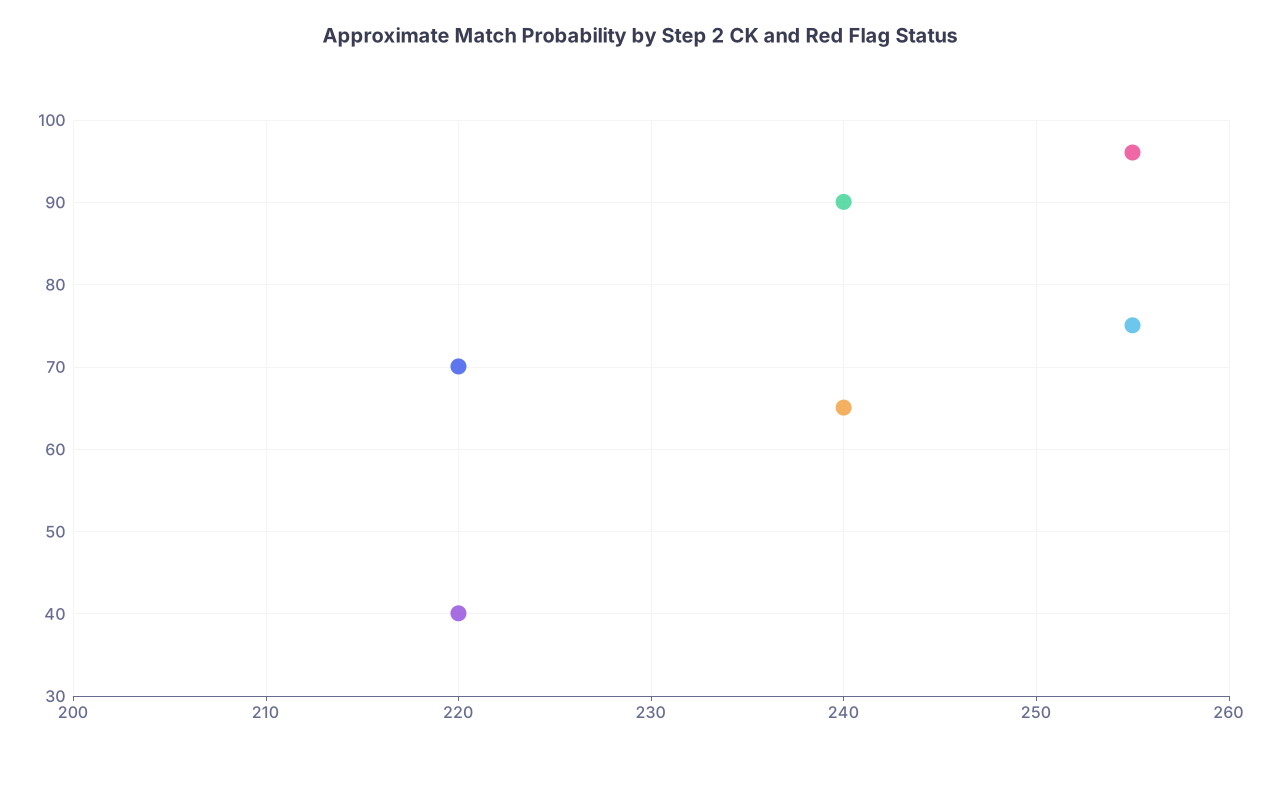
| Category | Value |
|---|---|
| Clean-220 | 220,70 |
| Flag-220 | 220,40 |
| Clean-240 | 240,90 |
| Flag-240 | 240,65 |
| Clean-255 | 255,96 |
| Flag-255 | 255,75 |
Interpretation:
- At Step 2 CK ~240, a clean applicant might have ~90% match probability (with appropriate applications and interviews).
- A red-flag applicant at the same score might sit closer to ~60–70%.
Scores help. They do not fully erase red flags.
What Actually Moves the Needle for Red-Flag Applicants
Some interventions are cosmetic and do almost nothing. Others, the data and committees agree, can materially improve your odds.
High-impact:
- Strong Step 2 CK (or Level 2) score after any Step 1 / Level 1 issues.
- Fresh, specific letters from U.S. supervisors describing reliability, professionalism, and clinical judgment.
- Documented, continuous clinical work or research productivity in the interim years.
- Honest, concise explanation that owns the mistake and shows sustained change, not a one-time fix.
Low-impact (but commonly overvalued):
- Generic research with no publications or strong letters.
- Unstructured “observerships” without hands-on evaluation or meaningful letters.
- Rewriting the personal statement 10 times without changing the underlying story.
- Sending dozens of “interest” emails to programs that have clearly filtered you out.
Here is how committees informally weight remediation credibility:
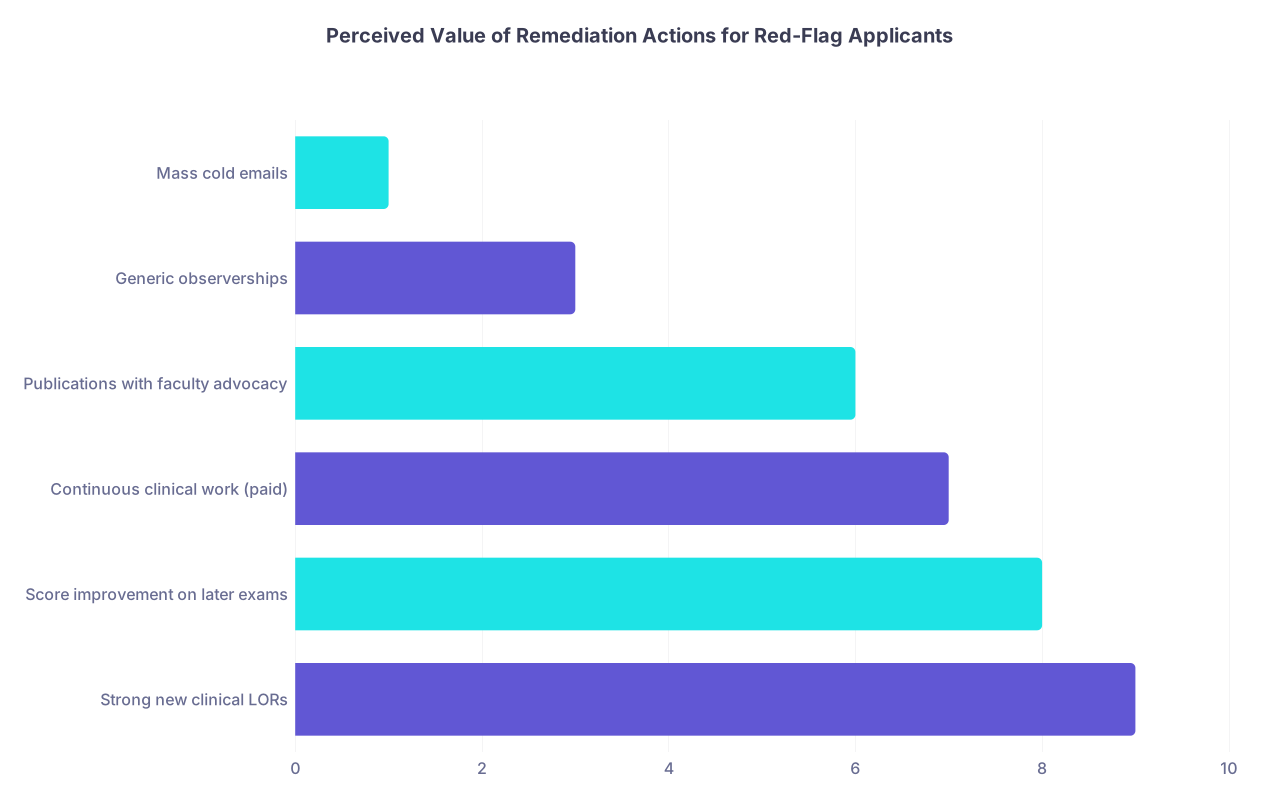
| Category | Value |
|---|---|
| Strong new clinical LORs | 9 |
| Score improvement on later exams | 8 |
| Continuous clinical work (paid) | 7 |
| Publications with faculty advocacy | 6 |
| Generic observerships | 3 |
| Mass cold emails | 1 |
Scale 1–10, roughly: letters and later performance matter most. Spam emails and shadowing barely move the needle.
Where the Myths Are Wrong
Three myths I see repeated:
“One Step failure means you will never match.”
False. Single failure + strong recovery + realistic specialty + broad applications → still good odds. But you are not competing on the same footing as a clean file.“If you just apply to enough programs, you will match.”
Half-true. Volume helps, but with severe red flags, increasing from 100 to 200 applications might gain you 1–2 extra interviews. Not zero, but not magical.“Red flags do not matter if you interview well.”
Wrong. They still dictate how many programs even meet you and how far down the rank list you end up. Great interviewing helps, but it cannot fully undo repeated failures or misconduct.
Final Thoughts: The Data-Driven Reality
Three key points, and then I am done.
Red flags push your interview yield off a cliff. A clean applicant might get 1 interview for every 3–4 applications. A severe red-flag applicant might need 30–50 applications per interview.
Match probability is not just “number of interviews.” For the same interview count, red-flag applicants are ranked lower and matched less often. To approach “clean” odds, you typically need more interviews and stronger evidence of remediation.
The only rational strategy is to align your specialty choice, application volume, and remediation efforts with the actual data—not your ego, not online anecdotes. If you are honest about your profile and respond with numbers, not denial, you still have a path. It is just narrower, and the margin for error is gone.