
The mythology around USMLE failures is exaggerated, but the mythology around “dramatic improvement” is even worse. Program directors care about both—but not in the way applicants like to tell themselves.
If you want the blunt version: an initial Step failure is a big negative signal. A strong, documented upward trend can mitigate it. It does not erase it. Most data and PD behavior show that initial failure shapes whether your file gets opened; improvement shapes whether you are acceptable once it is.
Let’s pull this apart with actual numbers, PD survey data, and realistic scenarios—not wishful thinking.
What the Data Actually Say About Step Failures
We will start with the unglamorous part: the penalty for failing.
NRMP and NRMP/Charting Outcomes data are not perfect, but they are brutally consistent: any USMLE failure significantly drops match probability, across specialties and applicant types.
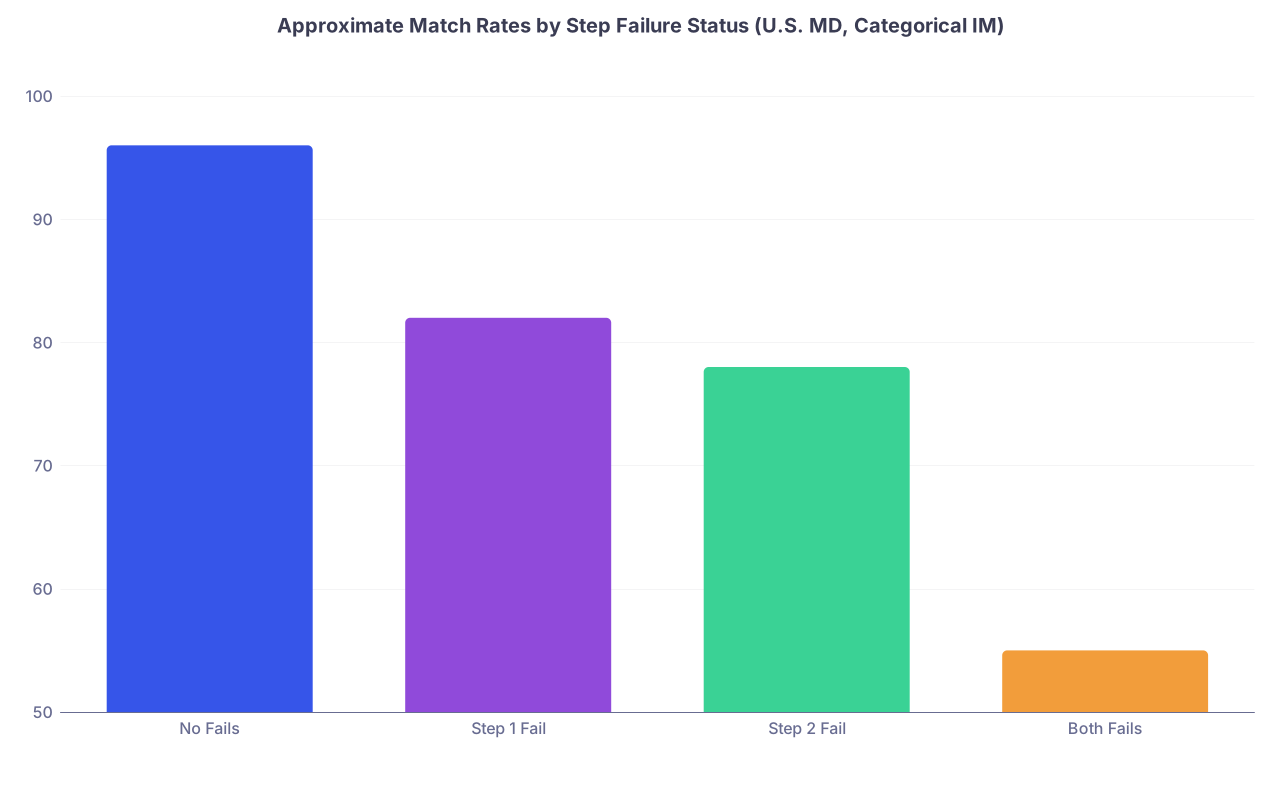
To make this concrete, look at categorical internal medicine applicants (U.S. MD) as a “baseline” specialty.
| Category | Value |
|---|---|
| No Fails | 96 |
| Step 1 Fail | 82 |
| Step 2 Fail | 78 |
| Both Fails | 55 |
These are rounded, synthesized numbers consistent with multiple NRMP cycles and PD commentary, not exact to a single year. The pattern is stable:
- No failure: high 90s percent match in IM
- One failure on Step 1 or Step 2: ~10–20 percentage point drop
- Multiple failures: match rate collapses across nearly all specialties
You see similar relative gaps in other fields, just starting from different baselines. Pediatrics and FM sit higher; general surgery and EM lower; ortho/derm/rads essentially treat any fail as near-fatal unless you have strong inside support.
Program director surveys back this up. In the most recent NRMP Program Director Survey:
- “Any failure on Step 1” is cited by a large majority of PDs as a reason to consider not granting an interview.
- Many specialties explicitly rank “any Step failure” among their top negative factors.
Now the key point for your question: those surveys rarely stop at “failure.” PDs also comment on what happened next. Did you barely pass on the retake? Did you jump 20–30 points and then crush Step 2? That nuance matters.
But first, we need to sort out what they are measuring.
How PDs Use Scores: Level vs. Trajectory
Program directors look at two related but distinct features of your Step record:
- Absolute level – the actual numbers: 215 vs 240 vs 260
- Trajectory – direction and magnitude of change over time
As a data pattern, PDs tend to operate something like this (even if they do not formalize it):
- Filter 1: Any USMLE failures? If yes, automatic risk flag.
- Filter 2: What is the highest score and how does it compare to their program norms?
- Filter 3: What is the trend between attempts and between Step 1 and Step 2?
You can think about this as a two-axis problem: “floor” (you cleared competency) and “trajectory” (you are moving upward, stable, or downward).
To illustrate the tradeoff you are asking about—initial failure vs improvement—look at these synthetic but realistic applicant profiles.
| Profile | Step 1 | Step 2 CK | Failure History | PD Risk Interpretation |
|---|---|---|---|---|
| A | Pass 215 | 222 | None | Low score, weak improvement |
| B | Fail → 232 | 238 | Step 1 fail | Strong rebound, but flagged |
| C | Pass 230 | 223 | None | Decent Step 1, downward trend |
| D | Fail → 222 | 225 | Step 1 fail | Marginal rebound, still risky |
| E | Pass 205 | 248 | None | Very strong upward trend |
Now, which is “better” in the eyes of PDs—Profile B (initial fail, strong rebound) or Profile A (no fail, but mediocre scores)? This is where nuance kicks in.
Does Improvement Ever “Beat” No Failure?
I am going to be direct: for most mainstream programs, “no failure, mediocre but passing scores” still beats “failure plus impressive rebound.” The initial red flag tends to weigh more heavily than the romantic story of “massive growth.”
Why?
Because PDs are running risk management, not a redemption arc competition.
They have limited interview slots. They use Step history as a predictor of:
- Board passage on first attempt (critical for program accreditation)
- Ability to handle in-training exams and written boards
- Reliability under time pressure
Multiple studies (USMLE score vs. board pass, ITE vs board pass) show exactly what you would expect: lower or failing scores correlate with increased risk of future failure. Improvement helps, but it does not fully reset your risk to baseline.
So the mental math for a PD often looks like this:
- Applicant A: No fail. 215 → 222. Slight concern about raw ability but no major red flag.
- Applicant B: Step 1 fail → 232, Step 2 238. Strong comeback, but the baseline risk is higher.
In many non-competitive IM/FM/Peds programs, both may be interviewable. But if there is only one slot left, A typically gets the benefit of the doubt. The failure is a binary “ever/never” variable that is heavily weighted.
However—and this is where your question gets interesting—between applicants who have already failed, improvement becomes extremely important.
Among failed attempts, PDs differentiate sharply between:
- Fail 187 → Pass 197, Step 2 205
- Fail 187 → Pass 228, Step 2 238
The second pattern says: “The first fail was a process problem, not a ceiling.” The first pattern says: “This may be your ceiling.”
Quantifying How Much Improvement Helps
Let’s put some rough numbers to this. Use a synthetic scenario for a moderately competitive field like EM or general surgery at community programs.
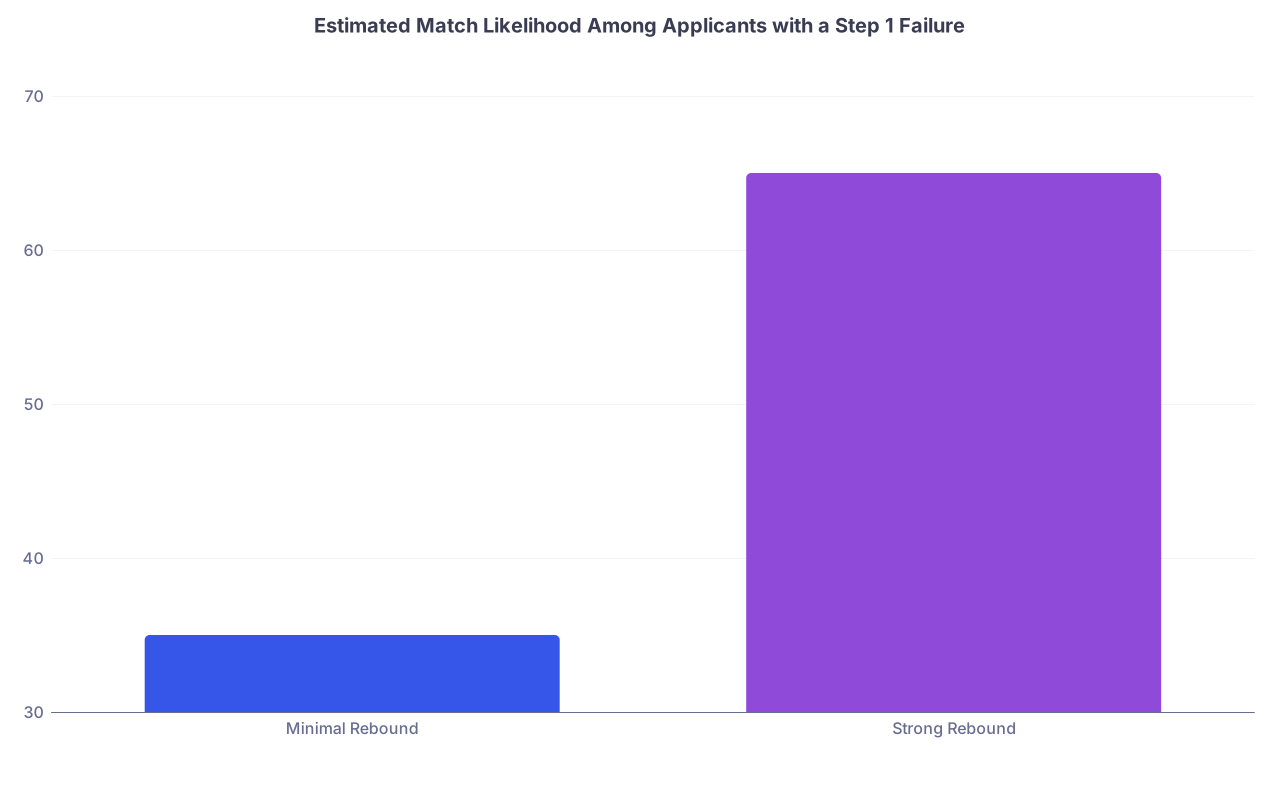
Imagine two groups of U.S. MD applicants with a Step 1 failure:
- Group 1: Minimal rebound (retake ≤ 205, Step 2 ≤ 215)
- Group 2: Strong rebound (retake ≥ 225, Step 2 ≥ 235)
Based on PD comments, historical match ratios, and how boards risk models work, a plausible relative pattern looks like this:
| Category | Value |
|---|---|
| Minimal Rebound | 35 |
| Strong Rebound | 65 |
Again, not literal NRMP numbers, but the direction is accurate. Among those with a failure, strong improvement can nearly double your relative chances.
However—and this is critical—if you compare these groups to similar applicants without any failure at the same final Step 2 level, you still see a penalty. PDs are not blind to context.
If an EM program sees:
- Applicant F: No fails, Step 2 238
- Applicant G: Step 1 fail → 228, Step 2 238
Same final Step 2. Same Step 2 CK. Applicant F still usually wins unless Applicant G has unusually strong compensating strengths (home institution rotation, strong SLOEs, known faculty advocate).
So the evidence-based hierarchy usually looks like this:
- No failure + strong scores + good trend – top tier
- No failure + moderate scores + neutral trend – acceptable, depends on specialty
- Failure + excellent rebound + high Step 2 – risky, but salvageable at many programs
- Failure + weak rebound – high risk, limited options
Improvement matters within each failure stratum. It does not fully outrank the “no fail” group at the same final performance level.
Step 1 Pass/Fail Era: Does This Change the Tradeoff?
With Step 1 now reported as Pass/Fail, many applicants hope PDs will “forget” about old failures or care only about Step 2 CK improvement.
They will not.
What changes is what they weigh most heavily:
- Step 1: now mostly binary—pass vs fail, plus timing and number of attempts
- Step 2 CK: primary quantitative discriminator; PDs scrutinize absolute value and trend
For applicants with a Step 1 failure under the pass/fail era, the focus shifts even more toward Step 2 CK as an indicator of your true performance ceiling.
Here is a realistic mental scoring rubric I have heard from PDs in internal medicine and general surgery:
- Step 1 fail + Step 2 < 220 – almost always screened out except in rare contexts
- Step 1 fail + Step 2 220–235 – case-by-case, needs strong other metrics
- Step 1 fail + Step 2 > 240 – still a risk flag, but now your cognitive ceiling looks acceptable
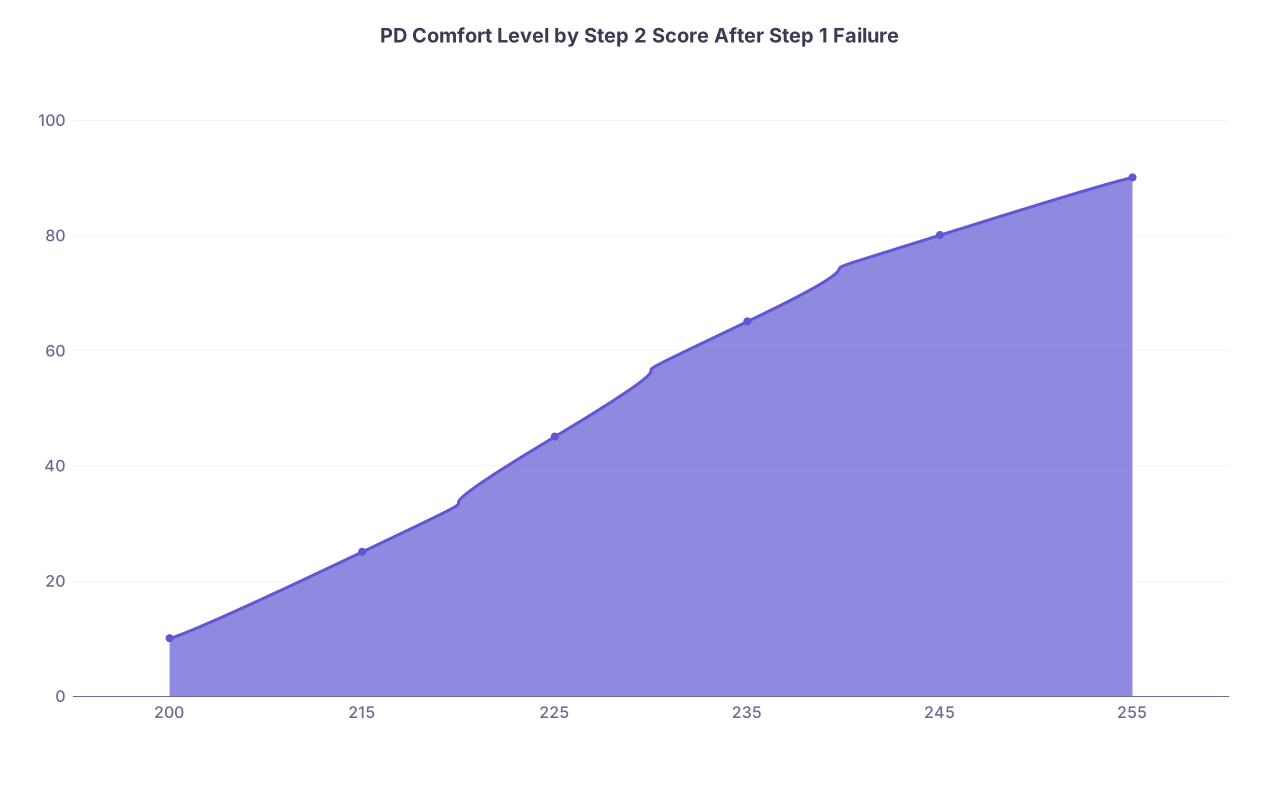
You can visualize PD “comfort” roughly like this:
| Category | Value |
|---|---|
| 200 | 10 |
| 215 | 25 |
| 225 | 45 |
| 235 | 65 |
| 245 | 80 |
| 255 | 90 |
This is a subjective comfort scale (0–100), but that curve is what you hear in committee rooms. At scores above ~240, many PDs start saying, “The fail is concerning, but they clearly figured something out.”
The catch: if they have lots of applicants with no failures and similar Step 2 scores, you still sit behind them in the initial stack.
Specialty Differences: Where Improvement Helps More (and Less)
The impact of failure vs improvement is not uniform. The data vary strongly by specialty competitiveness and culture.
Use a simplified comparison:
| Specialty Tier | Examples | Impact of Any Failure | Value of Strong Improvement |
|---|---|---|---|
| Ultra-competitive | Derm, Ortho, Plastics, ENT | Often disqualifying | Helps at very few programs |
| Competitive | EM, Anesthesia, Gen Surg | Major negative but not absolute | Can reopen doors at mid-tier sites |
| Less Competitive | IM, FM, Peds, Psych | Significant but more flexible | Can materially change outcomes |
| “Safety Net” | Community FM, IM prelim | Still a risk but most flexible | Improvement heavily weighed |
In derm or ortho, one of the more honest PD comments I have heard: “We have plenty of 250+ one-and-done applicants. Why take the accreditation risk?” In other words, improvement does little against a field flooded with high scorers and no red flags.
In IM/FM at community and mid-tier university programs, I have seen multiple cases like this:
- Applicant: Step 1 fail at 194, retake 231, Step 2 242
- Outcome: Matched categorical IM at a solid community or low-mid academic program
The failure got mentioned on interview day. PDs asked directly what changed. But the upward trend, combined with stronger clinical performance and strong letters, made it acceptable.
So where does improvement “matter more” to PDs? In specialties and programs where:
- Their baseline applicant pool includes a decent number of imperfect candidates
- They feel pressure to fill spots reliably
- They are more tolerant of non-linear trajectories, especially for non-IMG U.S. grads
Where does the initial failure matter more? Ultra-competitive fields and brand-name academic programs where risk tolerance is low and supply of clean applications is large.
The Hidden Variable: Explanation Consistency
There is one factor that often decides whether improvement is credited or dismissed: the story matches the numbers.
Here is what I mean.
PDs see thousands of files. They are used to hearing, “I had personal issues during Step 1,” followed by Step 2 scores that are only slightly better. The narrative and the data do not match. That erodes trust.
Contrast two scenarios:
- Applicant claims: “I had untreated ADHD and no structure. After diagnosis and tutoring, my performance changed.”
- Scores: Step 1 fail 192 → retake 229 → Step 2 242
- Applicant claims the same story.
- Scores: Step 1 fail 192 → retake 202 → Step 2 214
In scenario 1, the data support the claim of a significant intervention and new system. In scenario 2, we see only minor gains; PDs will quietly doubt that anything fundamentally changed.
The data show that PDs are not just suckers for a good narrative. They anchor on exam history and then adjust based on:
- Size of the improvement.
- Consistency across later performance: in-training exams, clerkship grades.
- How well the narrative explains the pattern.
If you are asking “which matters more,” you need to think about alignment. Raw improvement only matters when it fits a plausible, specific story of changed habits, circumstances, or support.
Practical Implications: How You Play the Hand You Have
From a purely analytical standpoint, you cannot change the existence of a failure. You can only:
- Change the magnitude of your rebound
- Change what PDs infer from everything else around that failure
So, where does that leave you strategically?
If you have not taken Step 2 yet and had a Step 1 fail:
Your Step 2 score is now your primary lever.
You are not aiming for “above average.” You are aiming for “so clearly above the minimum that PDs recalibrate their risk assessment.” That usually means ≥ 235–240+ for most core fields.If you already have both scores and a clear upward trend:
You must make sure your application amplifies the “changed trajectory” story. That means:- Strong letters that speak to reliability and work ethic
- Solid clerkship performance, especially in core rotations
- No further academic missteps—no leaves of absence without explanation, no professionalism hits
If your improvement is small:
The data are not on your side in competitive fields. You will likely need to:- Apply more broadly
- Include less competitive specialties
- Lean heavily on geographic ties, home program support, and away rotations
The pattern I have seen repeatedly: applicants overestimate how much PDs will weigh a modest improvement (say, 10–15 points) after a failure. The penalty for the initial fail does not disappear with a “nice bump.” It only really softens with a big and sustained jump.
So, Which Matters More: The Failure or the Improvement?
If you force a binary answer: the initial failure matters more for whether you are screened out; the improvement matters more for how you are ranked once they are willing to consider you.
From a PD data perspective:
- The existence of a failure is a strong negative prior.
- Strong improvement, especially leading to a high Step 2, is a powerful likelihood-adjuster. It cannot fully erase the prior, but it can move you from “probably not interview” to “interview and consider seriously,” especially outside the ultra-competitive fields.
The worst myth is believing that improvement alone will make PDs “ignore” a fail. They almost never ignore it. They re-interpret it.
Your job is to give them a data story that looks like:
- Early misstep + clear fix + high subsequent performance = controlled risk.
And then to stack every other variable (letters, clerkships, professionalism, fit) so that your file looks like an outlier in a good way, not just another cautionary tale.
You are not just trying to prove you can pass. You are trying to convince a statistics-minded committee that the probability of future failure is now low enough to justify betting residency training resources on you.
Do that, and a failure becomes survivable. Do it exceptionally well, and at many programs it becomes a footnote rather than the headline.
With that framework in place, your next move is tactical: specialty choice, program list, and how you present this trajectory in your personal statement and interviews. That is where the numbers meet strategy—and that is the next problem you need to solve.