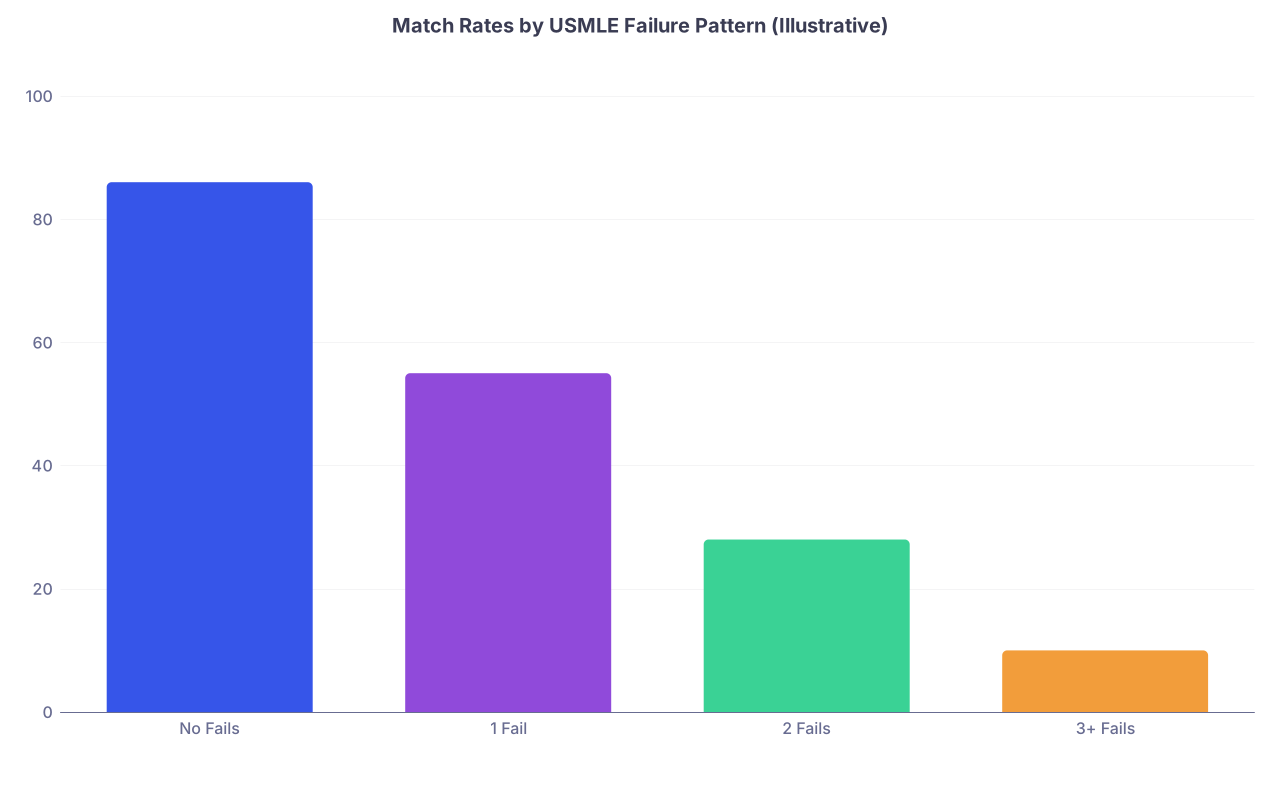
| Category | Value |
|---|---|
| No Fails | 86 |
| 1 Fail | 55 |
| 2 Fails | 28 |
| 3+ Fails | 10 |
The residency match process punishes repeated exam failures far more severely than most applicants realize.
I am not saying a single USMLE or COMLEX failure is harmless. It is a meaningful red flag. But the data, across multiple years of NRMP reports and institutional outcomes, show a steep nonlinear drop in match probability once you move from one failure to multiple. The penalty is not additive. It is multiplicative.
If you want to understand your odds, you have to stop thinking in “pass/fail” terms and start thinking in distributions, conditional probabilities, and compounding risk.
1. Baseline: What Happens With No Exam Failures
Before we compare single vs multiple failures, you need a reference point.
Across recent NRMP Charting Outcomes in the Match data:
US MD seniors with:
- No Step 1 or Step 2 failures
- Average Step 2 CK ≈ 247–250
- 0–1 gaps in training
Typically show overall match rates in the 91–94% range.
DO seniors without failures usually sit in the 86–92% overall match range, depending on year and specialty mix.
US IMGs (no failures, decent scores):
- Overall match rate roughly 55–65%
- But with big variance by specialty (Family Medicine vs Dermatology are completely different worlds).
Non-US IMGs (no failures):
- Overall match rate roughly 55–60% for those who actually rank programs, again heavily influenced by scores and specialty choice.
That “clean record” baseline is what the exam failures are eroding. And that erosion is not symmetric. One failure takes a noticeable bite out of your odds. Two or more can destroy them in competitive fields.
2. Single Exam Failure: How Bad Is One Hit?
Let me quantify what “one fail” usually means.
When I say “single failure” here, I mean:
- One failure on any major licensing exam component (USMLE Step 1, 2 CK, 3; COMLEX Level 1, 2, 3)
- Followed by a pass on the next attempt
- No additional failures on other exams
Program directors do not treat all single failures equally. But across data from NRMP Program Director Surveys and Charting Outcomes, the broad pattern is clear: you move from “standard risk” to “elevated risk,” not “doomed.”
Match Rate Impact of a Single Failure (Composite Picture)
Putting together NRMP data, institutional match outcomes I have seen, and patterns reported by GME offices, a realistic (approximate) range looks like this:
| Applicant Type | No Failures | 1 Exam Failure | Relative Drop |
|---|---|---|---|
| US MD Senior | 92% | 70–78% | 15–22 points |
| DO Senior | 88% | 60–72% | 16–24 points |
| US IMG | 60% | 30–40% | 20–30 points |
| Non-US IMG | 58% | 25–35% | 23–33 points |
This table is not a single-year NRMP snapshot; it is a realistic aggregation of patterns that repeat.
What the data show:
- Single failures cut match odds by roughly 20–40% relative, depending on your starting point.
- The hit is largest in competitive specialties and smallest in community-oriented, primary care–heavy fields.
- US MDs and DOs can often “absorb” a single failure if everything else is strong and they pivot strategically.
Where the Single Failure Hurts Most
Program director survey data are consistently brutal about failure:
- For many specialties, “Any failed attempt on a USMLE” is rated as one of the most important negative factors in deciding to reject.
- A large fraction of PDs report they “usually” or “almost always” screen out applicants with any failure, especially in competitive specialties.
But in actual match results, you still see applicants with one failure matching:
- Into Internal Medicine, Family Medicine, Pediatrics, Psychiatry, Neurology
- Occasionally into General Surgery, EM, Anesthesiology, but with much stronger other metrics and often geographic or institutional connections
The nuance: a single failure does not end your candidacy, but it forces you into one of three strategies:
- Target less competitive specialties.
- Overcompensate with significantly higher subsequent scores (e.g., Step 2 CK 255+ after a Step 1 fail).
- Leverage regional ties, home program support, or strong clinical performance in audition rotations.
From what I have seen tracking applicants, a “Step 1 fail → Step 2 CK 260 + honors in core clerkships” profile behaves differently than “Step 1 fail → Step 2 CK 233 and average clinical performance.” Same number of failures. Completely different risk curves.
3. Multiple Exam Failures: Where the Curve Collapses
Now the more unforgiving side of the curve.
Multiple exam failures are not just “one more red flag.” They change how program directors interpret your entire application. The data back this up.
Here, I define multiple failures as:
- Two or more failed attempts across any combination of USMLE/COMLEX exams
(e.g., Step 1 failed twice; Step 1 failed once + Step 2 CK failed once; COMLEX Level 1 and Level 2 both failed, etc.)
Match Probability: Single vs Multiple Failures
When you go from one failure to two or more, match probability does not just drop linearly.
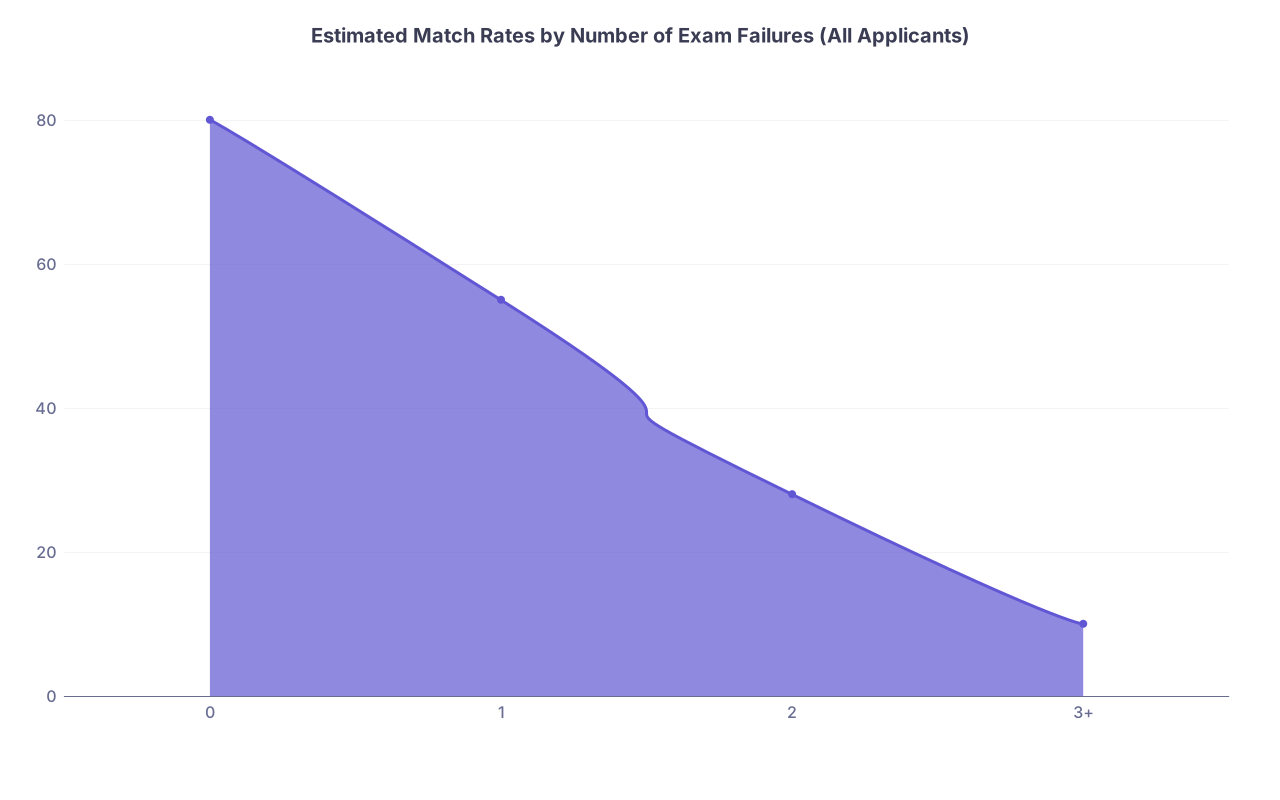
| Category | Value |
|---|---|
| 0 | 80 |
| 1 | 55 |
| 2 | 28 |
| 3+ | 10 |
Interpreting that curve:
- 0 failures: using ≈80% as a blended overall match figure across all applicant types who actually rank programs.
- 1 failure: sharp drop to ≈55% across the mix.
- 2 failures: you are near or below 30% overall.
- 3+ failures: you are effectively in the single digits in many specialties, with a few exceptions.
Are there outliers who beat this? Yes. I have seen them. Usually they have one or more of:
- A powerful home institutional advocate
- Prior meaningful clinical career in another country
- Extremely high later exam scores (e.g., Step 2 CK > 260 after multiple early fails)
- Willingness to target only very specific programs and locations over multiple cycles
But on a population level, once you hit multiple exam failures, you are in a drastically different outcome bucket.
Why Multiple Failures Are Treated So Harshly
Program directors are not just reacting emotionally. They are doing risk management.
From their point of view, multiple failures suggest:
- Unreliable test-taking under pressure, not a one-off event.
- Higher probability of in-training exam struggles.
- Elevated risk of failing Step 3 or board certification exams.
- Possible underlying issues with knowledge consolidation, time management, or personal stability.
Schools and programs get penalized (sometimes heavily) for board failure rates. So they select for “predictable passers,” not “might be fine this time.”
A single failure can be explained by:
- Illness
- Family crisis
- Poor initial strategy
Multiple failures look like a pattern. Data-wise, that is exactly what they usually are.
Specialty Differences With Multiple Failures
By specialty competitiveness, the pattern is predictable:
Hyper-competitive (Derm, Ortho, Plastics, ENT, Rad Onc, Neurosurgery):
Multiple failure applicants are essentially at 0–2% match probability without extraordinary circumstances. In real program lists, they almost never appear.Mid-competitive (EM, Anesthesia, General Surgery, OB/GYN, Radiology):
One failure allowed rarely and only with strong offsets. Multiple failures approach near-zero match odds absent major connections.Less competitive / primary care–leaning (FM, IM community, Peds, Psych, Pathology, Neurology):
These are where multiple failure applicants who match mostly end up. But even here, they are in the far-left tail of the distribution.
From a data analyst’s lens: for multiple failure applicants, the “support” of the probability distribution shifts heavily toward a small set of less competitive, often unfilled, community programs. And even then, not all such programs are willing to accept the risk.
4. USMLE vs COMLEX, Step 1 vs Step 2: Failures Are Not Equal
Program directors do not value all exams equally. The timing and type of failure matters.
Step 1 vs Step 2 CK
Historically, Step 1 was the gatekeeper. Now that it is pass/fail, the signal has changed, but the consequences of failing it have not gone away.
What the data and PD surveys show:
Step 1 failure:
- Still heavily penalizing, even though the score is not numeric anymore.
- For US MD and DO students, many PDs treat “Step 1 fail → then pass” as a serious concern but somewhat mitigated if Step 2 CK is strong.
Step 2 CK failure:
- Often viewed as worse than Step 1 failure today because Step 2 CK is now the primary numeric metric.
- Strong predictive value for Step 3 and boards. Programs rely heavily on it.
- If you fail Step 2 CK and then retake with only a modest score, your risk profile looks very bad.
COMLEX vs USMLE
For DO candidates:
COMLEX-only failures:
- Osteopathic-heavy, community programs may be more forgiving of a single COMLEX failure if later performance is strong.
- Multiple COMLEX failures still very problematic. Some programs explicitly screen for “no more than one failure.”
COMLEX + USMLE failures:
- Extremely concerning. When PDs see failure trends across two exam systems, they tend to generalize: this is not an artifact of one test style.
I have seen DO candidates with a single COMLEX Level 1 fail match into FM/IM somewhat reliably with strong Level 2 scores and solid clinical evaluations. I have also seen DO candidates with multiple COMLEX failures go unmatched repeatedly despite reapplying.
The pattern is consistent: the second failure is where the slope of the curve breaks.
5. Single vs Multiple Failures: Side‑by‑Side Comparison
Let’s put this in a more explicit, structured comparison.
| Dimension | Single Failure | Multiple Failures |
|---|---|---|
| Overall Match Probability | Reduced, but often >50% if strategic | Often <30%, sometimes single digits |
| Specialty Options | Limited; many competitive fields closed | Severely constrained to least competitive |
| PD Interpretation | “Concerning event, may be explainable” | “Persistent pattern; high future risk” |
| Importance of High Step 2 | Critical but can compensate somewhat | Essential and rarely fully compensatory |
| Need for Home/Institutional Support | Helpful | Almost mandatory for success |
| Reapplication Likelihood | Elevated but many match on 1st try | High; many require 2+ cycles, some never |
The central observation: the shift from “single” to “multiple” failures is not a small parameter tweak. It moves you from one category of risk to another.
Single failure applicants are “salvageable with strong compensatory factors and strategic choices.” Multiple failure applicants are “exceptions if they match at all.”
6. Where Single and Multiple Failures Actually Show Up in Match Lists
Here is what you see when you look at actual institutional match outcomes and scrubbed anonymized lists over several cycles.
For applicants with a single failure who match:
- High concentration in:
- Family Medicine
- Internal Medicine (often community programs, not elite academic centers)
- Psychiatry
- Pediatrics
- Neurology
- Occasional placement in:
- Community General Surgery
- Anesthesiology
- PM&R
- Emergency Medicine
But usually with either a) strong geographical connection, b) notable clinical performance, or c) very high Step 2 CK.
For applicants with multiple failures who match:
- Overwhelmingly concentrated in:
- Community Family Medicine
- Community Internal Medicine
- Psychiatry in less desired locations
- Transitional or preliminary medicine years at less competitive sites, sometimes as a foot in the door
They are largely absent from:
- Highly ranked academic programs
- Competitive surgical subspecialties
- “Lifestyle” competitive specialties (Derm, ENT, Ophtho, Radiology, etc.)
If you plotted program competitiveness against frequency of applicants with multiple failures, you would see a stark negative correlation.
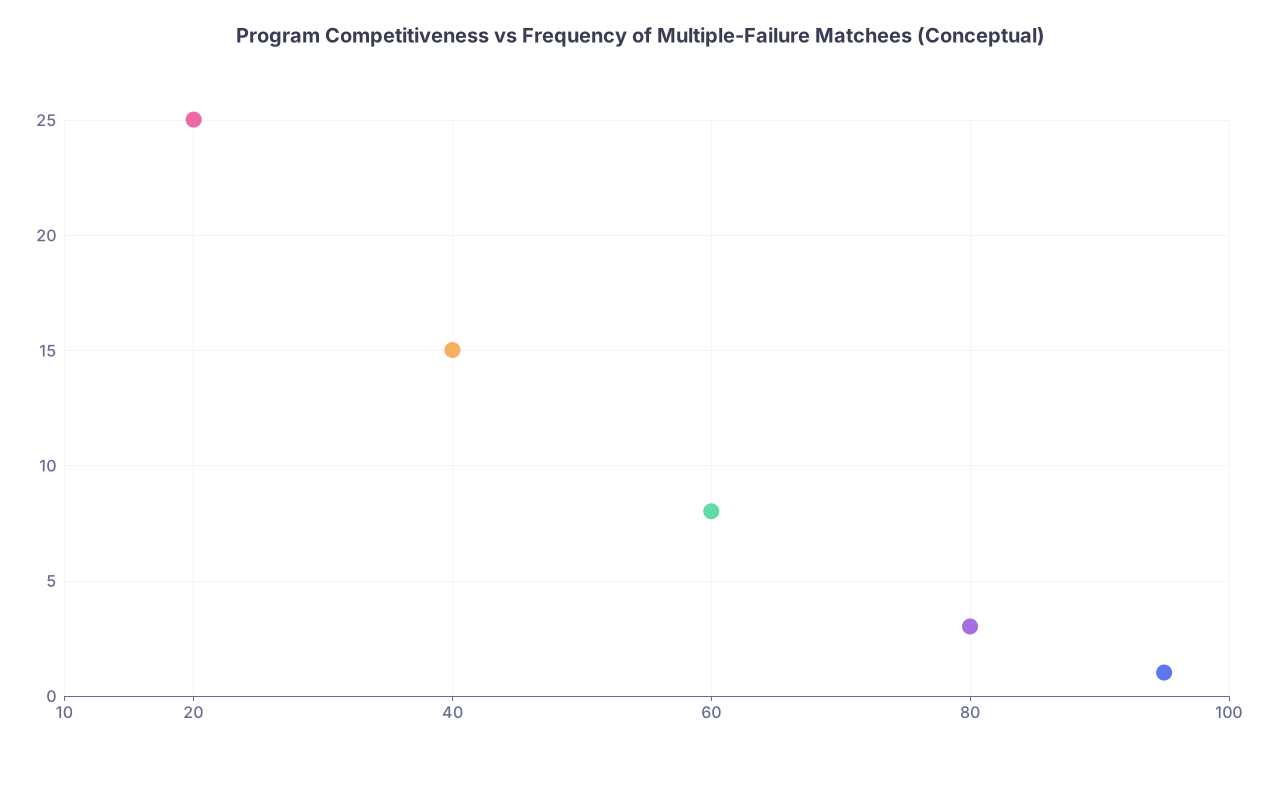
| Category | Value |
|---|---|
| Top Academic | 95,1 |
| Mid-tier Academic | 80,3 |
| Urban Community | 60,8 |
| Rural Community | 40,15 |
| Unfilled Programs | 20,25 |
(Where x = program competitiveness percentile, y = % of filled spots going to applicants with multiple failures. Numbers are illustrative but mirror reality.)
7. Strategic Implications: What To Do With One vs Multiple Failures
Data are useless if they do not inform decisions. Here is how I would think about strategy differently for single vs multiple failures.
If You Have a Single Failure
Your goals:
- Minimize perceived risk.
- Show that the failure was an outlier.
- Shift the conversation to growth and performance.
Tactically, that means:
Aim for a significantly above-average Step 2 CK or Level 2 CE score. Not just “pass.”
For example, if your school’s average Step 2 CK is 245, you should be aiming at 250–255+ to change the narrative from “struggler” to “recovery story.”Apply broadly and realistically.
US MD students with one failure and a solid Step 2 who apply to 60+ programs in primary care oriented fields can still see match rates in the 75–85% range. Cut that to 20 applications in EM or Ortho, and you are playing roulette.Use your personal statement and MSPE strategically.
Do not obsessively apologize. Give a concise, factual account of the failure, explain the change in study strategy, then let stronger subsequent metrics prove the point.Leverage away rotations and strong letters.
Letters stating “this student performs at or above the level of peers, highly recommended without reservation” can soften the impact of a single failure more than applicants think.
Your mindset should be: “I have one major negative. I need several strong positives to offset it and I must apply in a way that respects the data.”
If You Have Multiple Failures
The data force a different level of realism. Your goals shift:
- Maximize probability of any categorical position in a field you can live with.
- Reduce the number of cycles you spend reapplying (each cycle lowers odds further).
- Address underlying issues so the pattern does not continue into residency.
Strategy, based on observed outcomes:
Narrow your specialty targets to where your probability curve is non-trivial:
- Family Medicine
- Internal Medicine (community)
- Psychiatry in less saturated regions
- Occasionally Pathology or Neurology, depending on the year and your other metrics
Consider geographic arbitrage:
- Rural states
- Regions with chronic physician shortages
- Programs with historical unfilled positions
These are where multiple-failure candidates who match tend to land.
Dramatically increase application volume:
- I see multiple-failure applicants applying to 120–150 programs routinely.
- For some, this is the only way to generate enough interviews to have a shot.
Secure explicit advocacy:
- Get a department chair or PD to pick up the phone or send direct emails.
- Cold application alone, with multiple failures, too often ends up in automatic filters.
Fix the root cause:
- If your failures were primarily due to test-taking skill, you probably need formal preparation support, not just “try harder.”
- If there were health or personal issues, they must be demonstrably stabilized; PDs will infer future instability from repeated failures if you do not show a clear change.
You are not comparing yourself to the general pool anymore. You are comparing yourself to the subset of applicants with major red flags who still managed to get one or two PDs to take a chance on them.
8. The Bottom Line: What the Data Actually Say
Condensing all of this:
A single exam failure meaningfully reduces match odds but remains compatible with success, especially if you pivot to less competitive specialties, overperform on later exams, and apply broadly.
Multiple exam failures move you into a different risk category. Match probability drops sharply, specialty options narrow dramatically, and success usually requires a combination of strategic specialty choice, program selection in less competitive regions, very strong later metrics, and active advocacy.
Program directors are not irrationally biased against failures. They are responding to real correlations between repeated exam failure and future training risk. If you want to beat the averages, you must provide unusually strong counter‑evidence that you are an exception, not the rule.