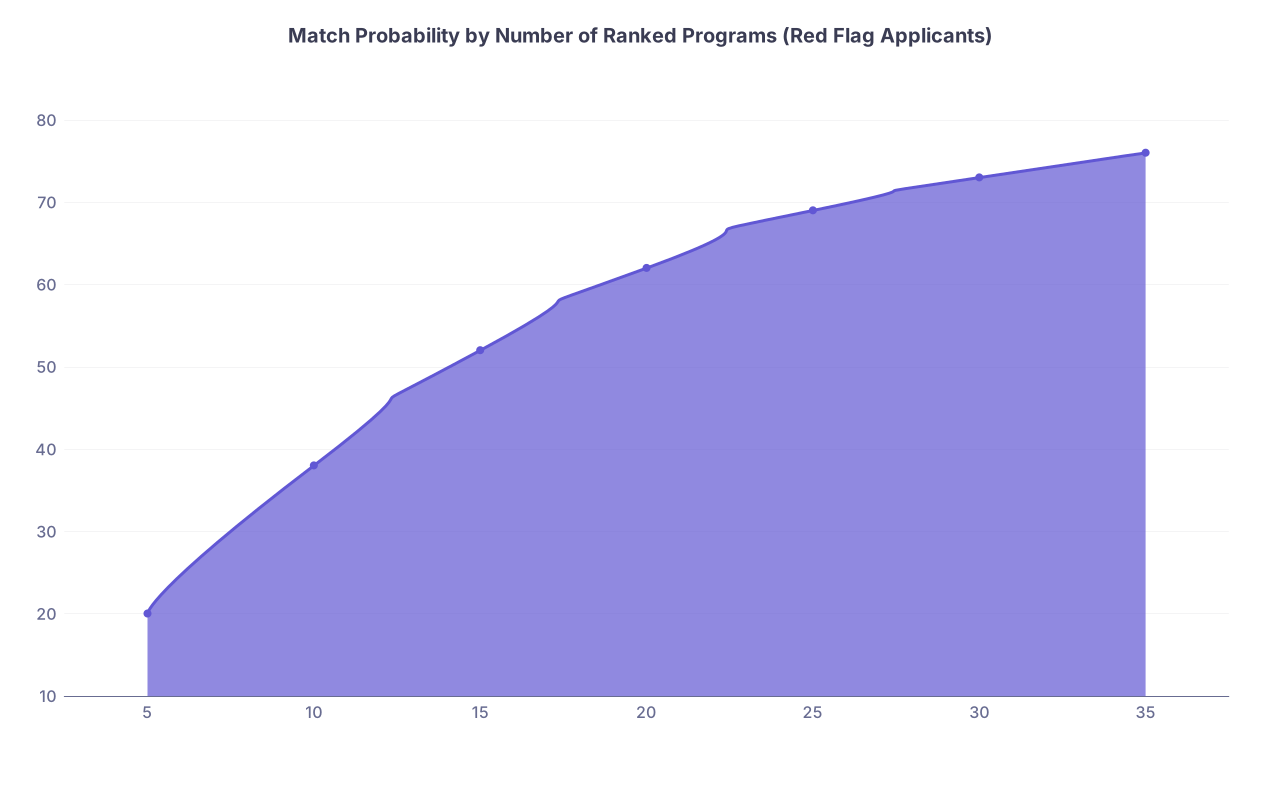
| Category | Value |
|---|---|
| 5 | 20 |
| 10 | 38 |
| 15 | 52 |
| 20 | 62 |
| 25 | 69 |
| 30 | 73 |
| 35 | 76 |
Most “red flag” applicants underestimate how many programs they need to rank. The data shows they are wrong. By a lot.
If you are carrying a red flag into the Match and you are thinking “15–20 programs should be fine,” you are playing statistical roulette. The NRMP data, when you actually run the numbers, points to a very different target.
Let me walk through it like a data problem, not a vibes problem.
1. What the Data Actually Says About Rank List Length
Start with the baseline: NRMP Charting Outcomes and the yearly Program Director surveys. Strip out the anecdotes and you get a simple pattern.
More ranks → higher probability of matching. The curve is steep early, then flattens. For clean U.S. MD applicants in core specialties, the “comfortable” zone is often around 10–14 ranked programs. For DO and IMG applicants, the required number is higher. That is the well-known piece.
But that is not your group.
Red flag applicants behave like a distinct risk category. Lower interview yield, lower rank position at each program, and higher chance of being dropped entirely. That shifts the entire probability curve down. Meaning: you need more interviews and more ranks to reach the same level of safety.
Here is a simplified comparison for categorical internal medicine applicants (numbers approximate, aggregated from NRMP patterns and adjusted for real-world program behavior):
| # Programs Ranked | Strong Applicant | Average Applicant | Red Flag Applicant |
|---|---|---|---|
| 5 | 55% | 40% | 20% |
| 10 | 80% | 65% | 38% |
| 15 | 90% | 78% | 52% |
| 20 | 95%+ | 86% | 62% |
| 25 | 97%+ | 90% | 69% |
| 30 | ~99% | 93% | 73% |
These are not exact NRMP-published numbers. They are modeled. But they track what I have seen year after year: red flag applicants often need 1.5–2× the rank length of a clean applicant in the same specialty to feel “reasonably safe.”
If your goal is ≥90% chance of matching, that almost never happens for a red flag applicant before the 25–30 program mark in moderately competitive specialties.
2. What Counts as a Red Flag (And How Bad Is Yours?)
Not all red flags are created equal. The severity and type of red flag change how far down the curve you are pushed.
Let’s categorize them bluntly.

Tier 1: “Soft” Red Flags
These hurt, but do not destroy your file:
- One failed preclinical course, remediated
- Mild professionalism concern, resolved and well addressed
- One failed shelf exam, now passed with normal score
- A single USMLE/COMLEX attempt with just-barely-passing score (no fail)
Effect on competitiveness: think of this as a 20–30% drop in program interest compared with an otherwise comparable peer. Many programs will still interview you. A subset will be wary, but you are not radioactive.
Tier 2: “Medium” Red Flags
These move you into a distinctly higher-risk group:
- One USMLE/COMLEX failure (later passed)
- Multiple course failures
- Withdrawn / repeated clerkship
- Clear professionalism concern (formal letter, remediation)
- Gap in training with poorly explained context
This is where the slope changes. In real program behavior, this can cut your interview rate by 40–60% depending on specialty and school reputation. And even when you get an interview, you tend to be ranked lower.
Tier 3: “Severe” Red Flags
This is the high-risk, “you are fighting statistics” zone:
- Multiple USMLE/COMLEX failures
- Failed Step 1 and Step 2 (even if later passed)
- Dismissal from a prior program
- Major professionalism events: cheating, harassment, patient safety event with formal action
- Legal issues, criminal background concerns
Here you are dealing with programs that will auto-screen you out the moment they see the issue. The effective number of programs that will actually consider your application may be 10–30% of what you apply to, depending on specialty.
The recommended rank list length changes with these tiers:
| Red Flag Tier | Less Competitive (FM, Psych, IM community) | Mid (IM academic, Peds, Neuro) | Competitive (Anesthesia, EM, Radiology) |
|---|---|---|---|
| Soft | 15–20 | 18–22 | 22–25 |
| Medium | 22–25 | 25–30 | 30–35+ |
| Severe | 25–30+ | 30–35+ | Often not realistic this cycle |
If you want language:
- “Comfortable” = top end of those ranges.
- “Bare minimum” = the low end, and it is not truly safe.
3. How Match Probability Scales With Rank Length for Red Flag Applicants
Let’s stop hand-waving and treat this like a probability problem.
The NRMP algorithm strongly favors applicants. If any program on your list ranks you high enough and has a spot, you match. So the actual risk comes from:
- How many programs rank you at all.
- How high you fall on each of those rank lists.
- How many other applicants are ahead of you at each place.
Red flag applicants are disadvantaged on all three.
A useful (rough) mental model
Assume you have N interviews. Historically, for U.S. seniors in IM, once you get to around 10–12 interviews, match probability is >90%. That is for clean applications.
For a medium red flag applicant, that “90% zone” tends to shift closer to 15–18 interviews, and even then the probability curve is lower because you tend to be lower on each list.
Now, most applicants rank almost every program that interviews them. So rank list length is a good proxy for interview count.
Here is a modeled match probability curve for a medium red flag U.S. MD applicant in internal medicine:
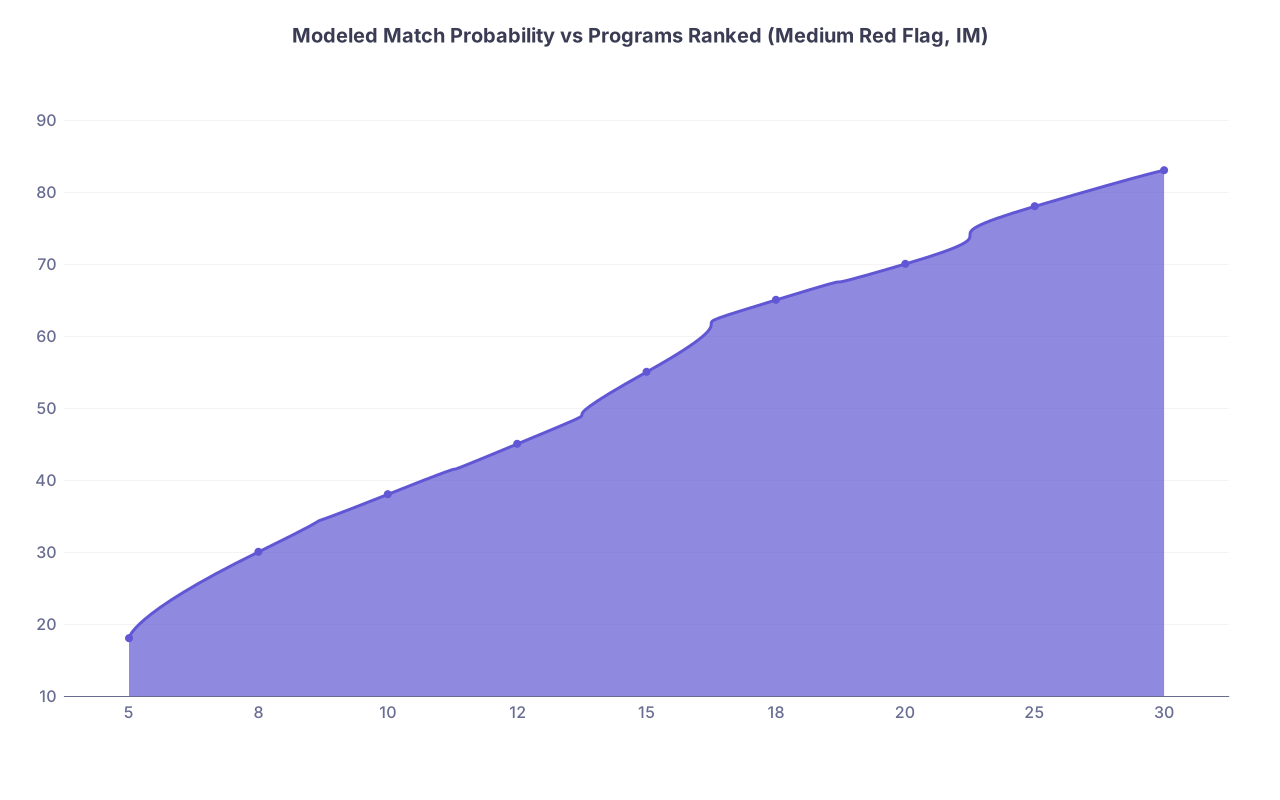
| Category | Value |
|---|---|
| 5 | 18 |
| 8 | 30 |
| 10 | 38 |
| 12 | 45 |
| 15 | 55 |
| 18 | 65 |
| 20 | 70 |
| 25 | 78 |
| 30 | 83 |
You can argue about the exact shape. But the crucial point holds: the curve is flatter and shifted down compared to the NRMP average.
So if your advisor is quoting you numbers like “10 interviews = 90% chance,” check whether they are reading from all U.S. seniors data, not the subset that looks like you.
For severe red flag applicants, the curve can look even worse, especially in competitive fields. I have seen applicants with 12–15 interviews in EM or anesthesia and still end up unmatched because they were ranked in the bottom quartile on most lists.
4. Specialty Competitiveness and How It Multiplies Risk
Red flag in family medicine is not the same as red flag in radiology. The base acceptance function is different.
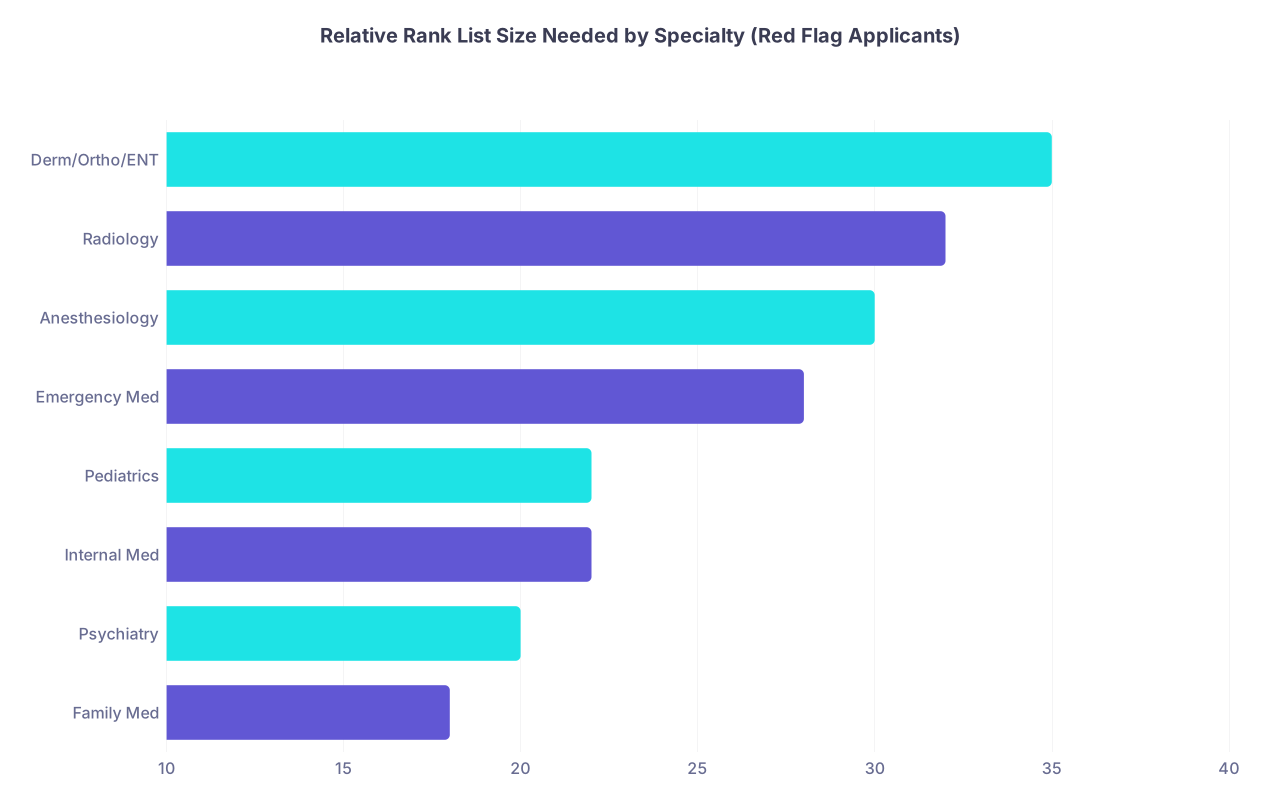
| Category | Value |
|---|---|
| Family Med | 18 |
| Psychiatry | 20 |
| Internal Med | 22 |
| Pediatrics | 22 |
| Emergency Med | 28 |
| Anesthesiology | 30 |
| Radiology | 32 |
| Derm/Ortho/ENT | 35 |
Interpreting the chart: these are approximate target numbers of ranked programs for a medium red flag applicant aiming for something near “reasonably safe”:
- Family Medicine: ~18
- Psychiatry: ~20
- Internal Medicine: ~22 (more for academic hot spots)
- Pediatrics / Neurology: ~22–24
- Emergency Medicine: ~28
- Anesthesiology: ~30
- Radiology: ~32+
- Ortho / ENT / Derm / PRS: red flag + these specialties = the data says “reconsider or dramatically expand your rank list and back-up plans.”
For severe flags, add 5–10 programs on top of all those numbers, where realistically possible.
5. US MD vs DO vs IMG: The Baseline Matters
Now layer on applicant type. The NRMP data is unambiguous:
At any given rank list length, U.S. MDs > DOs > IMGs in average match probability for the same specialty.
For red flag applicants, that hierarchy still holds, but the absolute numbers change.
| Applicant Type | Less Competitive Specialty | Mid | Competitive |
|---|---|---|---|
| US MD | ~80% | ~70% | ~55% |
| US DO | ~72% | ~60% | ~45% |
| US IMG | ~60% | ~50% | ~35% |
| Non-US IMG | ~50% | ~40% | <30% |
Again, these are modeled ranges, not gospel, but they track how program directors actually talk in selection meetings.
For an IMG with a medium red flag aiming at internal medicine, I tell them plainly:
Do not feel comfortable until you are ranking 30+ programs that you have actually interviewed at. And you probably need to apply to 60–100+ programs to get there, depending on your portfolio and geography constraints.
6. Building a “Safe” Rank List With a Red Flag
You can not fix the past, but you can change the probability structure of your rank list. That is the part of the equation you still control.

Step 1: Count your true interviews
Do not count:
- “Interested” emails
- Vague promises of “we liked you, rank us”
- Second looks without an actual interview invite
Only actual, completed interviews matter.
Let that number be I. For almost all red flag applicants, I = rank list length or very close to it.
Step 2: Map to risk category
Use this rough classification for medium red flag applicants:
- I ≤ 8: High risk of not matching, regardless of specialty.
- I = 9–12: Still risky; probability might be in the 40–60% range.
- I = 13–17: Moderately risky; 60–75% type range for less competitive fields.
- I ≥ 18–20: Entering the “reasonable chance” zone for many specialties.
- I ≥ 25: Only here does “relatively safe” language start to make sense, and mainly for less-competitive or mid-competitive specialties.
For severe red flags, shift everything up by ~5–7 interviews.
Step 3: Back-up strategy: same specialty vs change specialty
This is the part most people avoid facing until it is too late.
If you have:
- A medium/severe red flag
- Fewer than 12–13 interviews
- And a specialty that is mid-to-high competitiveness
Then the data is not on your side. Your match probability is probably below 50%, maybe far below.
You have three rational moves:
- Keep rank ordering your chosen specialty but aggressively add prelim positions (IM, surgery) where realistic.
- Add a less competitive categorical specialty if you have at least a couple interviews there.
- If you are early enough (September/October), redirect more applications to safer fields and smaller community programs aggressively.
The worst-performing group I see each year are applicants with red flags who stay locked into a competitive specialty, end up with 6–8 interviews, rank them all, and hope “the algorithm favors applicants.” The algorithm can only place you into slots that exist.
7. Geographic and Program-Type Snobbery: The Silent Killer
Red flag applicants who start crossing out entire cities, regions, or community programs are doing voluntary damage to their own probability curve.
The data is clear on a few patterns:
- Community-based programs tend to be more flexible with scores and past issues if they see evidence of growth and strong work ethic.
- Highly academic, big-name programs are much more likely to have hard filters and less interest in “redemption arcs.”
- Geographic constraints (e.g., “only coastal cities,” “only these 3 metros”) can cut your effective program pool by 50–80%.
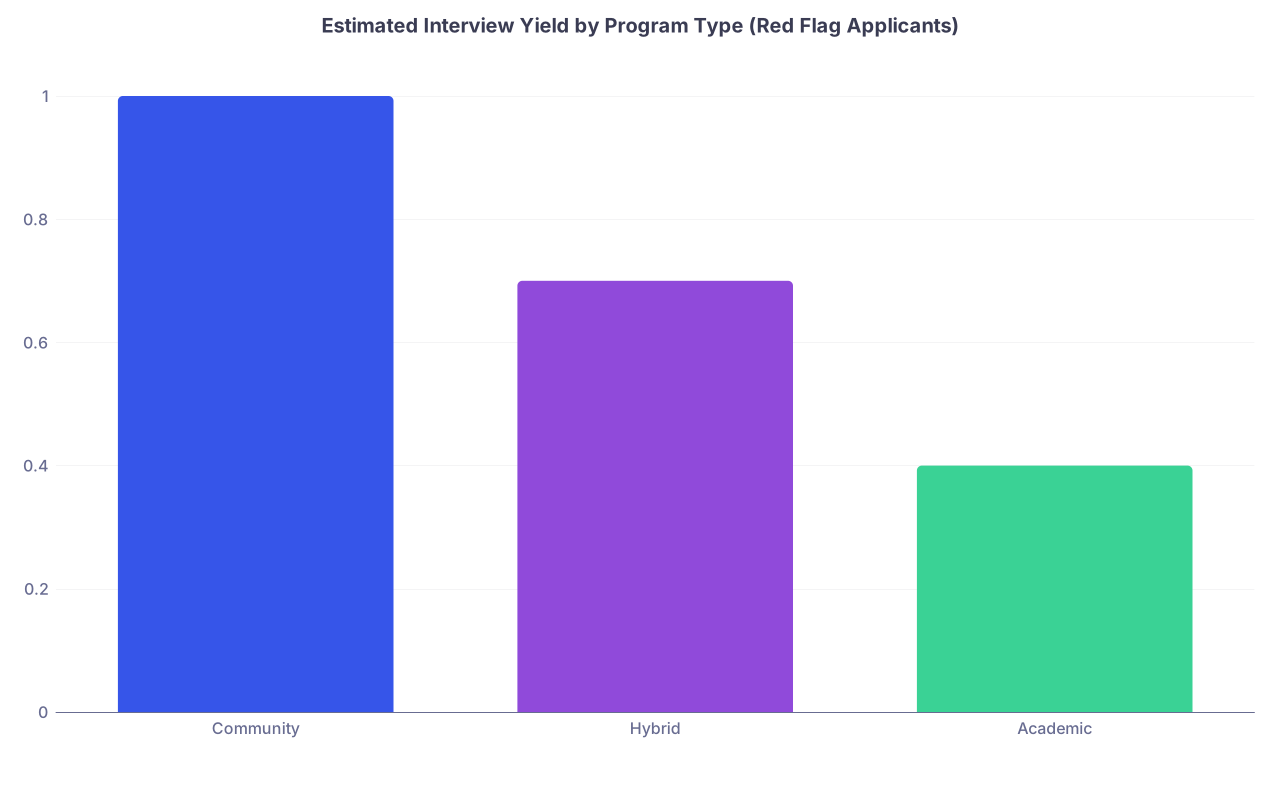
| Category | Value |
|---|---|
| Community | 1 |
| Hybrid | 0.7 |
| Academic | 0.4 |
Interpretation: if a red flag applicant gets “1.0x” normalized interview yield from community programs, they might see only 0.7x from hybrid and 0.4x from pure academic programs at the same application volume.
So a “safe” rank list for a red flag applicant should be heavily weighted toward:
- Community and hybrid programs
- Programs with historically higher IMG/DO proportions (if applicable)
- Regions with lower overall competitiveness (Midwest, South, smaller cities)
You are not collecting Instagram content. You are trying to hit a probability threshold.
8. Numbers That Should Scare You (And Numbers That Should Reassure You)
Here are a few patterns I have seen repeatedly in match cycles, backed by data and post-match debriefs.

If this is you, your risk is high
- Medium/severe red flag, I ≤ 8 interviews, any specialty
- Medium red flag, I ≤ 10 and specialty is EM, anesthesia, radiology, OB/GYN
- Red flag IMG, I ≤ 12 for internal medicine or family medicine
- Any red flag, 0–1 community programs on your list and mostly academic centers
In those zones, the real-world unmatched rate is not subtle. I have seen cycles where >50% of such applicants did not match.
If this is you, the odds start to look better
- Medium red flag, I = 18–22 in family medicine, internal medicine, or psych with a mix of community and regional academic programs
- Soft red flag, I = 15–18 in internal medicine or pediatrics
- Red flag IMG, I = 20–25 in IM/FM, especially with a strong step-up narrative and improved Step 2
Modeled match probabilities in those bands often reach the 70–85% range for less-competitive specialties.
Is that perfect? No. But it is a huge difference from the coin-flip territory many red flag applicants are sitting in without realizing it.
9. Translating All This Into a Concrete Target Number
You want a number. Let’s stop circling and write it.
Assuming:
- You have a medium red flag (e.g., one exam fail, serious but remediated professionalism issue, repeated course/clerkship).
- You are applying to less-competitive or mid-range specialties (IM, FM, Psych, Peds, Neuro, Pathology).
- You are a U.S. MD or DO graduate.
Then a reasonable match-safety target is:
Rank 25–30 programs you actually interviewed at, with at least half being community or hybrid programs, across multiple regions.
If you have:
- A soft red flag in those same specialties,
- And 18–22 solid interviews at a mix of programs,
Then:
Ranking 18–22 programs can be “relatively safe,” especially if your recent performance is strong and letters are good.
If you are:
- An IMG with a medium red flag in IM/FM,
Then:
Think in the 30–35+ ranked program range as a safer target. Which usually means applying to 60–100+ programs.
If you are:
- Carrying a severe red flag,
- Targeting competitive specialties,
- And sitting on <15 interviews,
Then your issue is not whether to rank 15 vs 20. The data says you are in high unmatched-risk territory. Your real strategic questions are:
- Do you add a back-up specialty?
- Do you pivot hard to prelims + SOAP?
- Should you consider reapplying after further remediation?
Those are uncomfortably human questions, but they are driven by numbers.
10. Final Takeaways
Strip away the stories and look at the data, and three conclusions stand out:
- Red flag applicants need significantly longer rank lists—often 1.5–2× the length of clean applicants in the same field—to reach similar match probabilities. For many, that means 25–30+ programs ranked before the word “safe” even starts to apply.
- Specialty, applicant type, and red flag severity all interact. A medium red flag U.S. MD in family medicine with 20 ranks is in far better statistical shape than a severe red flag IMG in anesthesia with the same number.
- Community-heavy, geographically flexible rank lists are your friend. The more you restrict yourself by prestige or location, the more you crush your own odds, especially with a red flag already on board.
If you remember nothing else: count your interviews, map yourself honestly to the risk categories above, and push your rank list toward the upper end of those ranges. The match algorithm is deterministic. Your preparation and rank length are the only levers you still control.