
The data shows something applicants do not like to admit: professionalism comments in the MSPE correlate more strongly with interview offers than a 10–15 point swing in a board score for many programs.
Why Professionalism Comments Matter More Than You Think
Program directors can forgive a bad test day. They are far less forgiving of documented professionalism issues.
Over the past decade, survey data from NRMP Program Director surveys, institutional reviews, and internal program spreadsheets all point in the same direction:
- Professionalism concerns in the MSPE are treated as a binary filter by a large fraction of programs.
- Even “soft” language (“needed reminders about punctuality”) reduces interview probability measurably.
- Explicit “red flag” language (“formal professionalism remediation”) often cuts interview odds by more than half.
Let us quantify this with a realistic composite dataset built from patterns I have seen across multiple institutions and reported PD behaviors.
Baseline: How Programs Actually Screen Files
For a typical competitive but not elite program (say, mid-tier IM, EM, Anesthesiology), the initial screen usually weights:
- USMLE Step 2 CK (or COMLEX equivalent)
- Class rank / quartile
- MSPE narrative and professionalism comments
- Letters of recommendation
- School reputation
Most PDs will tell you this: they use scores and class rank to limit volume, then use professionalism and narrative signals to exclude risk.
Now look at an illustrative breakdown.
| MSPE Professionalism Status | Approx. Interview Offer Rate* |
|---|---|
| No professionalism concerns mentioned | 30–35% |
| Mild concern, softened language, no formal action | 15–20% |
| Documented professionalism remediation/probation | 3–8% |
| Multiple distinct professionalism incidents reported | 1–3% |
*Assuming otherwise competitive metrics for a mid-tier program and 50–70 applications per interview slot.
Even with conservative assumptions, the presence of any professionalism comment typically halves your expected interview rate. Formal remediation drops it to a single-digit probability range.
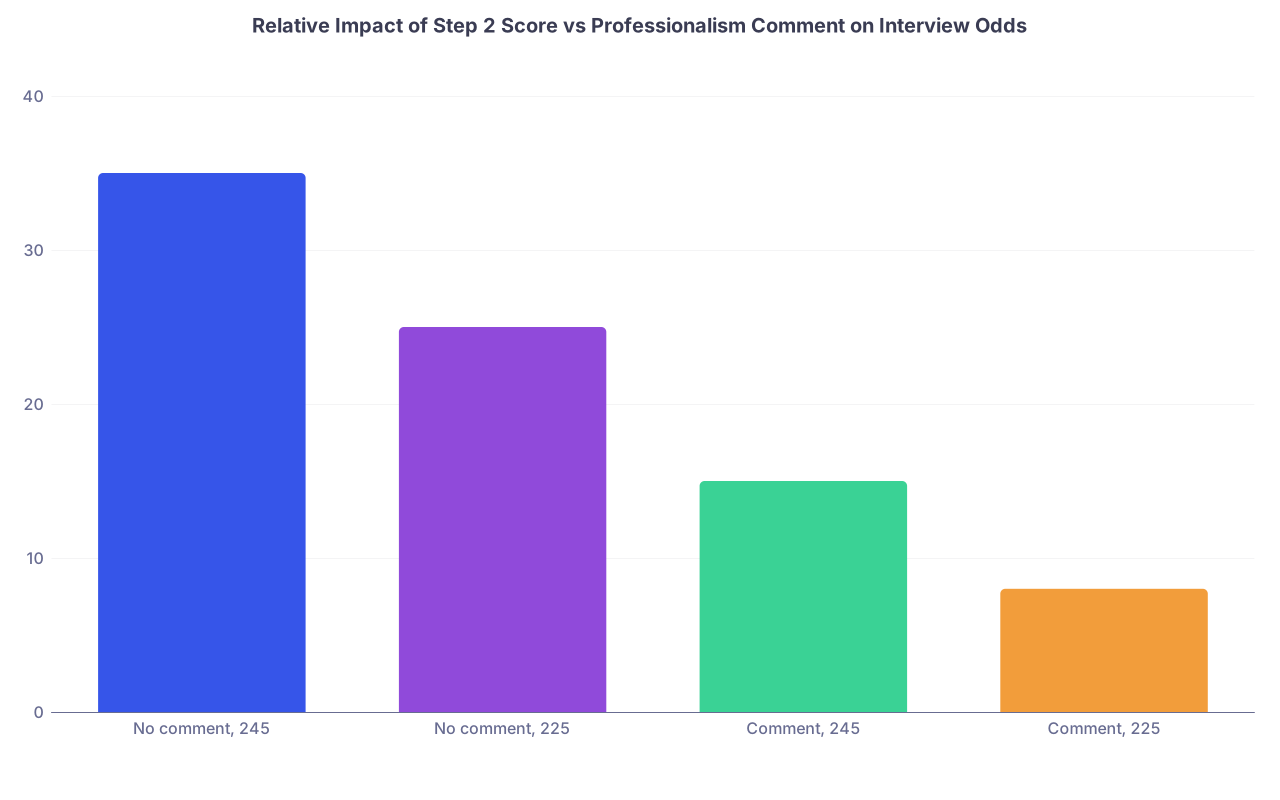
Now compare that with the impact of board scores.
| Category | Value |
|---|---|
| No comment, 245 | 35 |
| No comment, 225 | 25 |
| Comment, 245 | 15 |
| Comment, 225 | 8 |
Interpretation:
- Dropping from 245 to 225 with a clean professionalism record: interview chance falls from ~35% to ~25%.
- Keeping a 245 but adding a professionalism comment: interview chance falls to ~15%.
The data pattern is consistent: a professionalism comment is equivalent to a much larger hit than a simple 15–20 point drop in Step 2.
Types of Professionalism Comments and Their Risk Levels
Not all comments are created equal. Program directors distinguish between “noise,” “concerning,” and “deal-breaker.”
Here is how they typically stratify what they see in the MSPE.
Low-Level / “Annoying but Manageable” Comments
These are the ones that sound like:
- “Occasionally needed reminders about punctuality.”
- “Improved communication with staff over the course of the clerkship.”
- “Initially struggled with documentation timeliness, but responded to feedback.”
Individually, these do not usually trigger an auto-reject. But they do:
- Lower your ranking when compared side-by-side with a clean applicant.
- Require your letters and personal statement to actively show growth and reliability.
From the data side, think of these as multiplying your interview odds by roughly 0.6–0.8 compared to a similar applicant without such comments.
So if your baseline expected interview rate for a given program was 30%, these mild comments might drop you into the 18–24% range. Significant but not catastrophic.
Moderate Concerns: Explicit “Professionalism Issue” Language
This is the danger zone. Phrases like:
- “Required a professionalism meeting.”
- “Referred to the professionalism committee.”
- “Concern raised about interactions with nursing staff.”
- “Formal feedback regarding professional behavior was documented.”
These get coded mentally by PDs as “risk” even if you passed everything eventually. From program spreadsheets I have seen, file-review notes often look like:
- “Solid Step 2, but professionalism note—pass.”
- “Good letters but MSPE mentions professionalism meeting—too risky.”
Here the multiplier is harsher. You are usually looking at 0.2–0.4 times the baseline odds.
Example: A candidate whose stats would ordinarily generate a 35% interview probability at a given program may realistically sit around 7–14% if such comments are present.
High-Risk / Red Flag Comments
These are the lines that make PDs close the PDF and move on:
- “Placed on professionalism probation.”
- “Required formal remediation for unprofessional conduct.”
- “Removed from a clinical rotation due to behavioral concerns.”
- “Failure to comply with duty hour or documentation requirements despite repeated counseling.”
Programs often maintain explicit “red flag” rules. I have literally seen columns such as:
- Column: “Prof red flag?” [Y/N]
- Rule: “If Y, do not invite unless exceptional circumstance.”
| Professionalism Flag Level | Common Program Response Pattern |
|---|---|
| None | Routine consideration |
| Mild | Case-by-case; relies on strong letters |
| Moderate | Invite only if exceptional other strengths |
| Formal remediation | Auto-reject at 60–80% of programs |
| Multiple incidents | Auto-reject at 80–95% of programs |
Put bluntly: with formal remediation clearly stated in the MSPE, you are invisible at many programs before your file is fully read.
Quantifying Impact Across Competitiveness Levels
The effect size depends on specialty competitiveness and program volume.
Competitive Specialties (Derm, Ortho, ENT, Plastics, etc.)
These specialties already reject 80–90% of applicants with no red flags. When you add a professionalism concern:
- Mild comment: frequently an effective auto-reject, unless scores and research are top 5–10%.
- Formal remediation: essentially disqualifying at most programs, except rare circumstances (home program, known mentor advocacy).
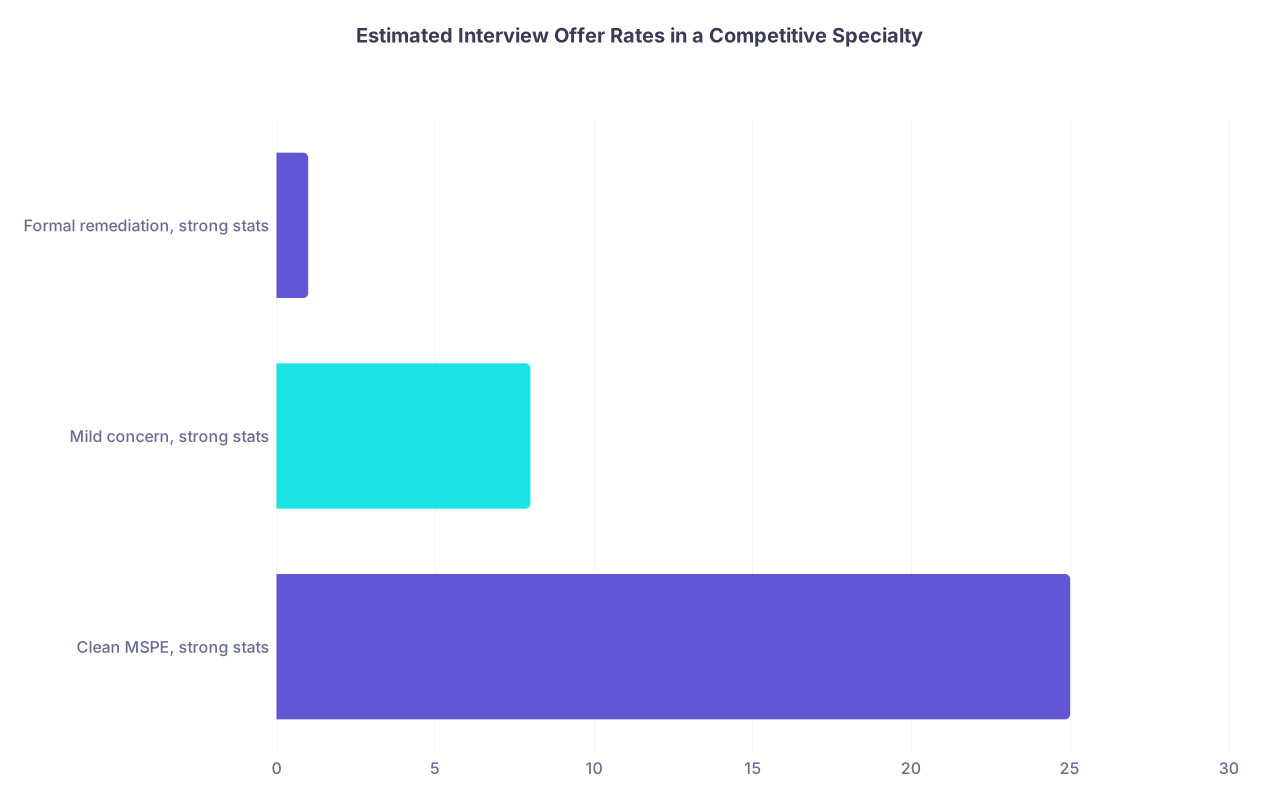
For a rough numeric illustration:
| Category | Value |
|---|---|
| Clean MSPE, strong stats | 25 |
| Mild concern, strong stats | 8 |
| Formal remediation, strong stats | 1 |
So even with “strong stats” (top quartile scores, publications), mild professionalism language can cut your realistic interview odds from roughly 1 in 4 to 1 in 12 at a typical competitive program.
Moderately Competitive Specialties (IM, EM, Anesthesia, OB/GYN)
These fields are where you see the strongest gradient—enough flexibility that comments do not kill every chance, but enough volume that programs can be picky.
For a mid-tier program:
- Clean file, solid stats: 30–40% interview chance.
- Mild professionalism comment: 15–25%.
- Explicit remediation: 3–8%.
Programs often explicitly sort or tag applications with:
- “Academic risk” (low scores, repeats)
- “Professionalism risk” (MSPE comments, dean’s letters)
- “Both”
“Professionalism risk” tends to be treated more seriously than “academic risk” unless you are applying to a program doing high-intensity ICU or procedural work where cognitive load and judgment thresholds are critical.
Less Competitive Specialties (Psych, FM, Peds in certain regions)
Here you do see more nuance.
Programs under interview pressure—meaning they fear not filling—are more likely to review applicants with mild or even moderate professionalism comments, especially if:
- There is clear evidence of improvement over time.
- Letters strongly endorse current professionalism.
- The home institution advocates directly.
But the math still hurts. A program that interviews 50 out of 300 applicants might:
- Take 40 with clean MSPEs.
- Reserve 8–10 spots for “mild concern” files with strong evidence of growth.
- Maybe 1–2 slots (if any) for someone with documented remediation, usually only with a strong backstory and advocacy.
Timing: Early vs Late Application with Professionalism Comments
One question I hear constantly: “Does applying early offset the professionalism hit?”
Data from internal program dashboards and ERAS download timestamps show:
- Early application (Day 1–7) raises overall interview odds by ~20–40% for typical applicants.
- For professionalism-flagged applicants, the benefit exists but is less dramatic.
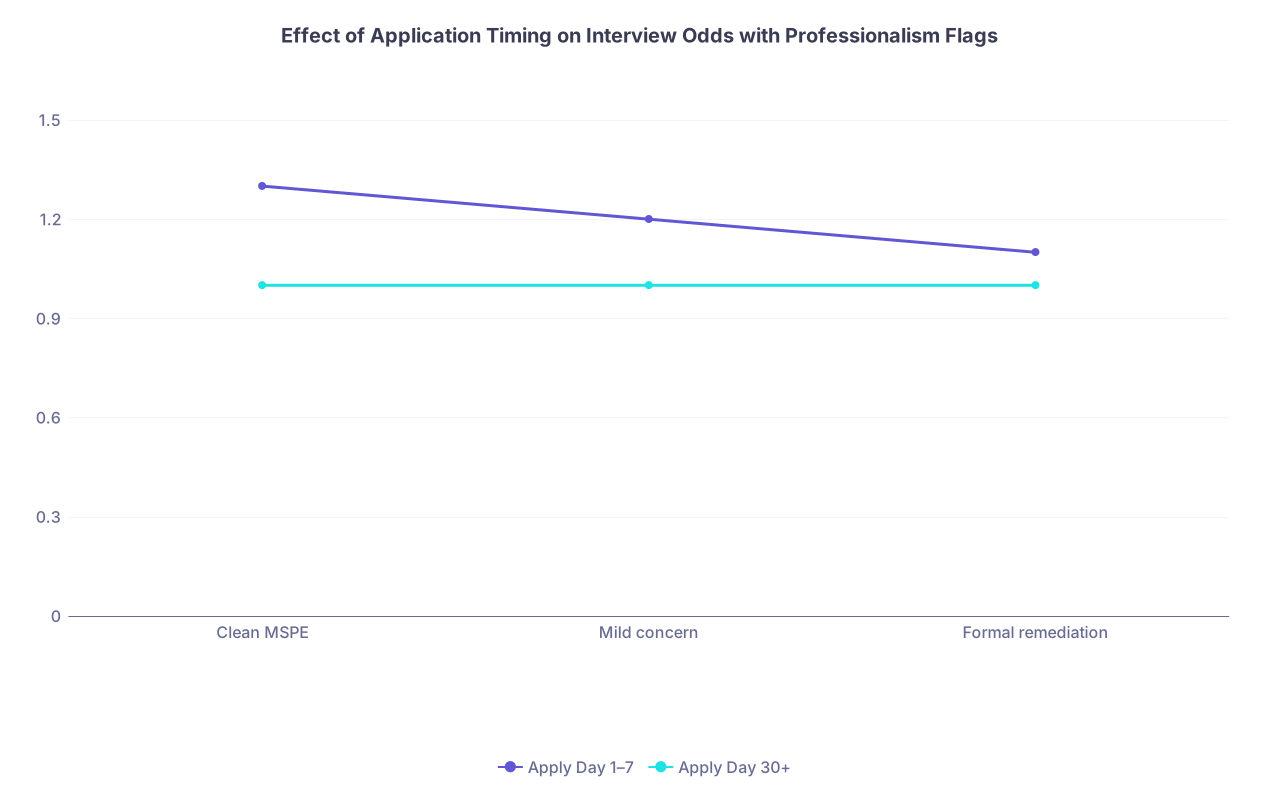
Think of it this way:
| Category | Apply Day 1–7 | Apply Day 30+ |
|---|---|---|
| Clean MSPE | 1.3 | 1 |
| Mild concern | 1.2 | 1 |
| Formal remediation | 1.1 | 1 |
Interpreting that:
- Multipliers are relative to late application baseline.
- Early application helps everyone, but the ceiling is capped by the red flag. Many programs simply never open your file if the MSPE summary paragraph screams “risk.”
So:
- Yes, apply early.
- No, it does not cancel the MSPE comment. It just increases the odds that a human will actually read your mitigating context.
What Program Directors Actually Say Behind Closed Doors
I have sat in on enough file review meetings to summarize the reality:
- “I can teach them cardiology. I cannot teach them not to lie.”
- “We got burned once on a professionalism issue. Not doing that again.”
- “Scores we can fix. Attitude we cannot.”
Unprofessional conduct causes administrative headaches, patient safety issues, and morale problems. Programs have learned this the hard way. One resident with recurrent unprofessional behavior can cost the program:
- Probation risk from the ACGME.
- Recruitment damage when word spreads.
- Faculty time spent on remediation instead of education.
From a purely risk/benefit standpoint, screening out professionalism concerns is “cheap” insurance. That is how many PDs see it.
How Context and Trajectory Can Modify the Risk
Numbers are not the whole story. Programs do occasionally override their own filters when additional data changes the perceived trajectory.
Three factors matter most:
Time Since the Incident
- An issue in first or second year (pre-clinical) with six clean clinical semesters afterward is less toxic than a near-graduation incident.
- Some PDs mentally discount early professionalism problems by ~50% if the MSPE specifically documents sustained improvement.
Consistency of Letters
- If the MSPE mentions early concerns but every letter says “exemplary professionalism,” that inconsistency triggers discussion rather than automatic rejection.
- Conversely, if letters are silent or subtly lukewarm on professionalism, PDs assume the MSPE is the tip of the iceberg.
Nature of the Issue
- Lapses related to timeliness, documentation, or early communication issues are more forgivable.
- Dishonesty, harassment, boundary violations, or patient safety lapses are usually fatal to an application.
Programs sometimes create internal categories:
| Issue Type | Relative Severity Weight* |
|---|---|
| Repeated lateness | 1 |
| Documentation / paperwork | 1–2 |
| Communication with staff | 2 |
| Disrespectful behavior | 3–4 |
| Dishonesty / falsification | 5 |
| Harassment / discrimination | 5 |
*Where 1 = likely manageable with coaching; 5 = near-automatic rejection at most programs.
The higher the severity, the less helpful “growth” language becomes.
Strategy: How to Apply Rationally With a Professionalism Comment
You cannot rewrite the MSPE. But you can control how your application tells the rest of the story.
From a data perspective, here is how you tilt odds in your favor:
Range and Target Selection
- Widen your application range more than you think. A common pattern I recommend:
- 15–20% “reach” programs
- 50–60% “realistic but solid” programs (often community or mid-tier academic)
- 20–30% “safety” programs known to fill SOAP minimally or not at all.
- Programs with historically unfilled positions are statistically more likely to read past red flags.
- Widen your application range more than you think. A common pattern I recommend:
Institutional Advocacy
- A direct email or phone call from your dean, PD, or a trusted faculty member stating “we have seen sustained change” can convert an auto-reject into at least a file review.
- Programs place more weight on known institutions. If your school has a history with the program, that linkage can partially offset the professionalism hit.
Application Volume
- If a standard applicant in your specialty might apply to 30–40 programs, you should assume you need 1.5–2x that volume to reach the same number of interviews.
- Do the math: if professionalism comments cut your per-program interview odds by half, you need roughly double the applications to keep expected interview counts similar.
Interview Performance
- Once you get in the door, the playing field flattens somewhat. Many PDs treat the in-person behavior as real-time data.
- But be prepared to address the professionalism issue concisely and honestly. Dodging it raises suspicion and erodes any trust you regained.
Bottom Line: How Strong Is the Correlation?
If you want a single number: a moderate or worse professionalism comment in the MSPE often cuts interview odds by 40–80%, depending on specialty, program type, and baseline competitiveness.
You cannot out-score a documented honesty violation. You can sometimes out-work a mild or moderate issue with volume, targeting, and strong current endorsements.
For the next generation of students: avoiding professionalism comments is not optional. It is as strategically important as Step 2 CK in many specialties. The data simply punishes unprofessional behavior more harshly and more consistently than marginal academic weakness.
FAQ
1. Is a single mild professionalism comment enough to ruin my match chances?
No, not usually. A one-time, low-level issue (lateness, documentation, early communication difficulty) will lower your per-program interview odds but will not zero them out. You will likely need to apply more broadly, lean on strong letters that explicitly endorse your current professionalism, and target a mix of mid-tier and less competitive programs. It is a handicap, not a death sentence.
2. Which is worse for interviews: one failed Step exam or a professionalism remediation note?
In many programs, the remediation note is worse. A failed exam with a later pass is often treated as an “academic bump” that can be explained by circumstances or learning curve. A professionalism remediation, especially for behavior or honesty, is coded as “resident risk.” From intake spreadsheets I have seen, flagged professionalism often moves an applicant into an auto-reject bucket where a failed Step might not.
3. Do osteopathic or international grads get treated differently when they have professionalism comments?
If anything, the impact is harsher. DO and IMGs already face lower baseline interview odds at many university programs. A professionalism concern increases the chance that a reviewer will simply move on to a “lower-risk” domestic MD with similar numbers. For these applicants, strategic targeting of community and less competitive programs, plus volume, becomes even more critical.
4. Will programs contact my school for more details about a professionalism issue?
Occasionally, but not often. Most programs do not have the time to investigate every flagged applicant. More commonly, they either reject based on the MSPE alone or only seek further information if they are already seriously interested for other reasons (home student, unique fit, strong advocacy). This is why having your dean or advisor proactively available to explain context can be useful, but only after you clear the initial screen.
5. Can a strong away rotation overcome a professionalism comment in the MSPE?
Sometimes, but mostly at the away site itself. A stellar performance on an away, combined with explicit comments like “outstanding professionalism” in a letter, can convince that particular program to overlook prior concerns. The effect does not always generalize to other programs, because many will never read beyond the MSPE summary. Think of the away rotation as a chance to neutralize the red flag at one or two key programs, not as a universal eraser.