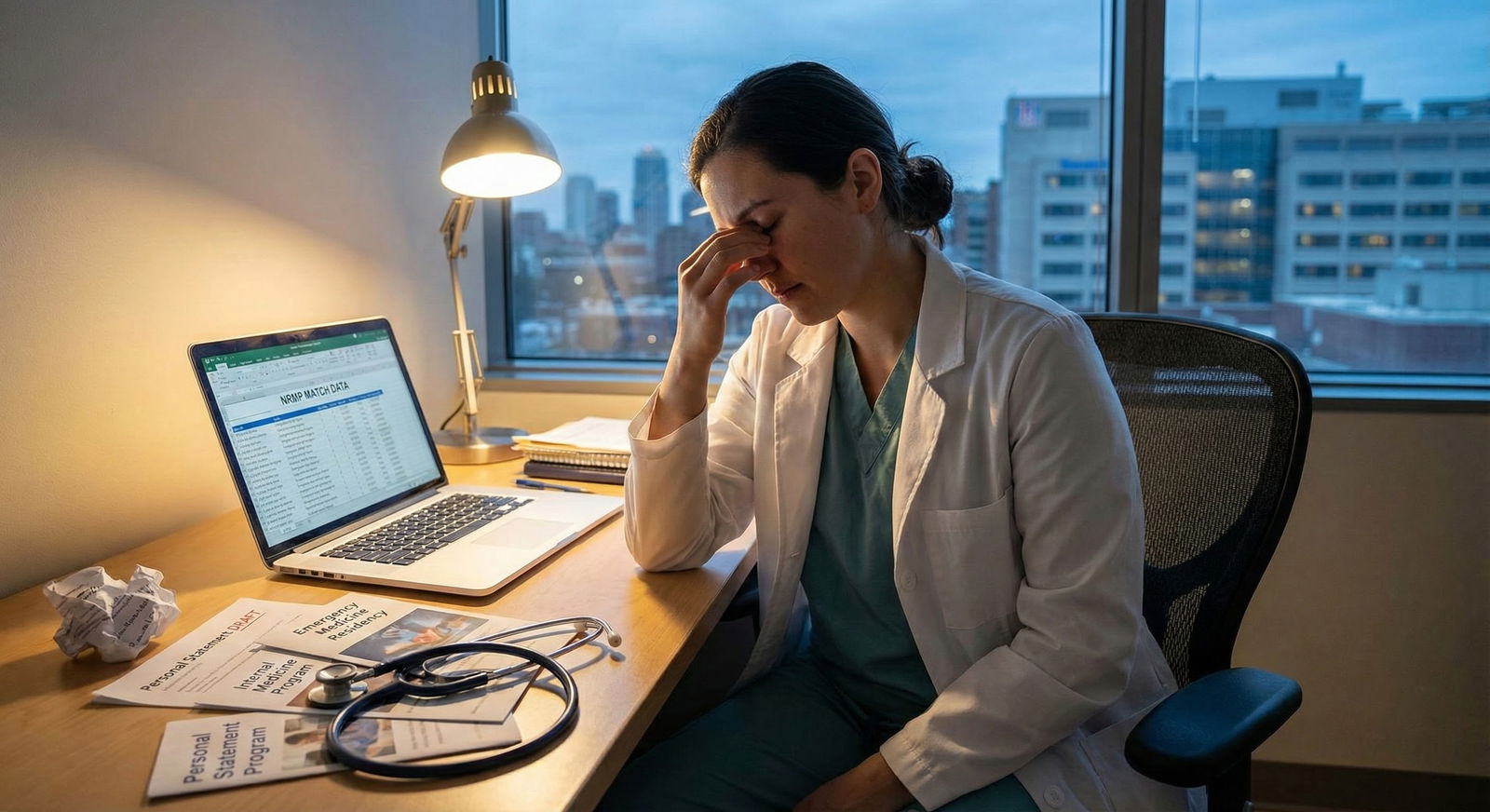
The assumption that “a failed match ruins your career” is statistically false—but the recovery is neither quick nor guaranteed.
What the Data Actually Shows About Prior Match Failure
Let me start with the uncomfortable number: prior unmatched status is one of the strongest negative predictors of matching on a future attempt. The NRMP has made this obvious for years—most people just do not look closely at the reapplicant tables.
Across multiple NRMP Charting Outcomes and Main Match data sets, three patterns show up consistently:
- First-time applicants match at substantially higher rates than repeat applicants with the same board scores and specialty.
- The longer you remain unmatched (multiple cycles), the worse your subsequent odds become.
- Those who “recover” typically do so by:
- Switching to a less competitive specialty, and/or
- Dramatically improving the objective profile (scores, research, USCE, year of grad issues).
So the answer to the headline question: yes, many reapplicants do recover and match. But the path is statistically narrow, and the recovery almost never looks like “same specialty, same profile, just better luck.”
To make this concrete, we need to get under the hood of the numbers.
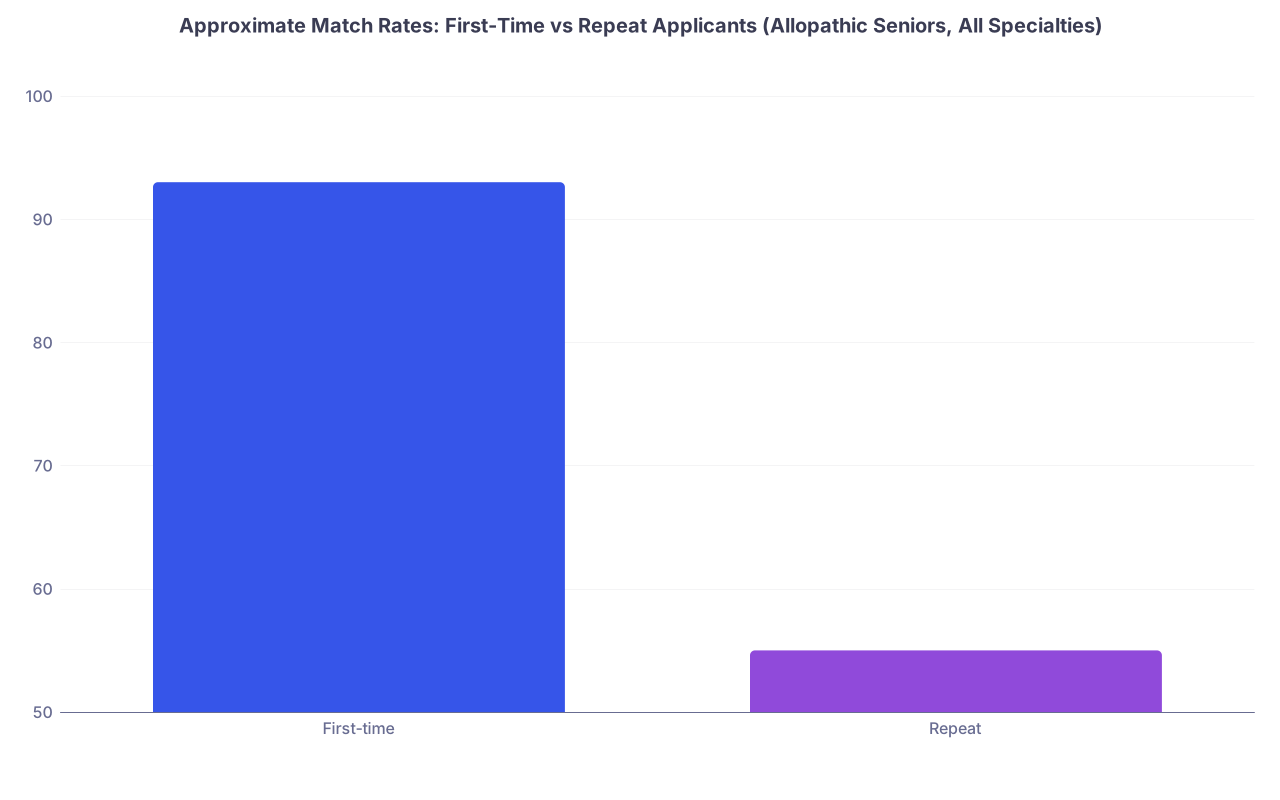
| Category | Value |
|---|---|
| First-time | 93 |
| Repeat | 55 |
These are rounded but directionally correct based on NRMP summaries over recent years: roughly >90% match for first-time U.S. MD seniors vs ~50–60% for re-applicants in aggregate, with big variation by specialty and applicant type.
How Prior Match Failure Changes Your Odds
Let me be blunt. Programs filter by red flags, and “previously unmatched” is functionally a red flag, especially in competitive fields.
The NRMP “Charting Outcomes in the Match” and various Program Director Surveys repeatedly show three high-impact variables for interview offers:
- USMLE/COMLEX scores
- Failing a USMLE/COMLEX attempt
- Prior withdrawal/no-rank or prior unmatched status
Prior match failure is not always coded explicitly in automated filters, but the signals are obvious in ERAS:
- Previous cycles listed
- Gaps in training after graduation
- No prior residency training despite time since grad
Program directors know what they are looking at.
Quantifying the Penalty
We do not have perfect, granular public data by specialty and prior failure, but we do have enough to outline the pattern.
For U.S. MD seniors (all specialties combined):
- First-time match rates: typically 92–94%.
- Reapplicants (same category) after one failed cycle: typically around 45–60% depending on year and specialty mix.
For U.S. IMGs and non-U.S. IMGs, the drop is more brutal:
- First-time IMG match rates: ~60% (US-IMG) and ~55% (non-US-IMG) in recent years, depending on specialty mix.
- Repeat IMG applicants: commonly drop into the 25–40% range.
You can argue about single-digit fluctuations year to year, but the directional reality is stable: once you fail to match, your baseline odds roughly get cut in half, unless you change something major.
Let me put that into a simple expected-value lens.
Say your original specialty had a:
- 75% match probability for a first-timer with your stats.
- After an unmatched year with no meaningful changes, you are realistically closer to 30–40% on reapplication in that same field.
If you switch into a less competitive specialty where your profile is above-median, your odds might climb back into the 70–80% range. That is what “recovery” looks like in the data—the recovery is usually by changing the game, not replaying the same one.
Where Recovery Actually Happens: Specialty Shifts and Strategy
The people who recover from prior match failure tend to follow specific patterns. I have seen this over and over in applicant data and outcomes.
Pattern 1: Competitive-to-Noncompetitive Pivot
An unmatched applicant who initially went for:
- Dermatology
- Orthopedic Surgery
- Plastic Surgery
- Neurosurgery
- ENT
- Even sometimes Anesthesiology or EM in hyper-competitive cycles
…then pivots to:
- Internal Medicine
- Family Medicine
- Pediatrics
- Psychiatry
- Pathology
- Sometimes Neurology or PM&R depending on their metrics
The probability shift is dramatic.
| Strategy After Failure | Approx Match Probability (Second Attempt) |
|---|---|
| Same competitive specialty, similar app | 10–30% |
| Same specialty, significantly improved | 30–50% |
| Switch to moderately competitive field | 50–70% |
| Switch to least competitive field | 70–85% |
These are ranges based on combining NRMP aggregates and real-world outcomes I have seen, not official NRMP stratifications. But they track closely with what program directors report anecdotally.
The harsh reality: “recovery” often means letting go of the original dream specialty.
Pattern 2: Year-of-Grad and Gap Management
The second axis that matters: how far you are from graduation.
Year-of-graduation (YOG) penalty is most severe for:
- IMGs (some programs will not even consider >3–5 years from graduation).
- Applicants without meaningful clinical activity or advanced degrees in between attempts.
If you fail to match and then spend a year:
- Doing no clinical work
- No research productivity
- No formal degree or structured program
…you compound your problem. Programs now see not just a prior match failure, but also unexplained time off. That is a double red flag.
Compare that to a reapplicant who spends the year:
- In a research fellowship with publications or abstracts
- Working as a pre-residency fellow, hospitalist scribe, or clinical observer with strong letters
- Completing a master’s degree related to public health, research, or clinical science
- Or, for IMGs, gaining robust U.S. clinical experience with hands-on exposure
The difference in reapplication outcomes between those two profiles is enormous.
Pattern 3: Data-Driven Program List Expansion
First-time applicants routinely under-apply. I see applicants with:
- Mid-tier scores and average applications
- Applying to 20–30 programs in competitive fields
Then they are shocked when they get 1–2 interviews or none.
Reapplicants who successfully recover almost always:
- Expand their program lists significantly (sometimes 1.5–3x the number of programs), and
- Use actual match and interview data to target programs that historically interview or match applicants with their profile.
The ones who do not adjust? They repeat the same pattern and call it “bad luck.”
What The Data Says About “Multiple” Failed Cycles
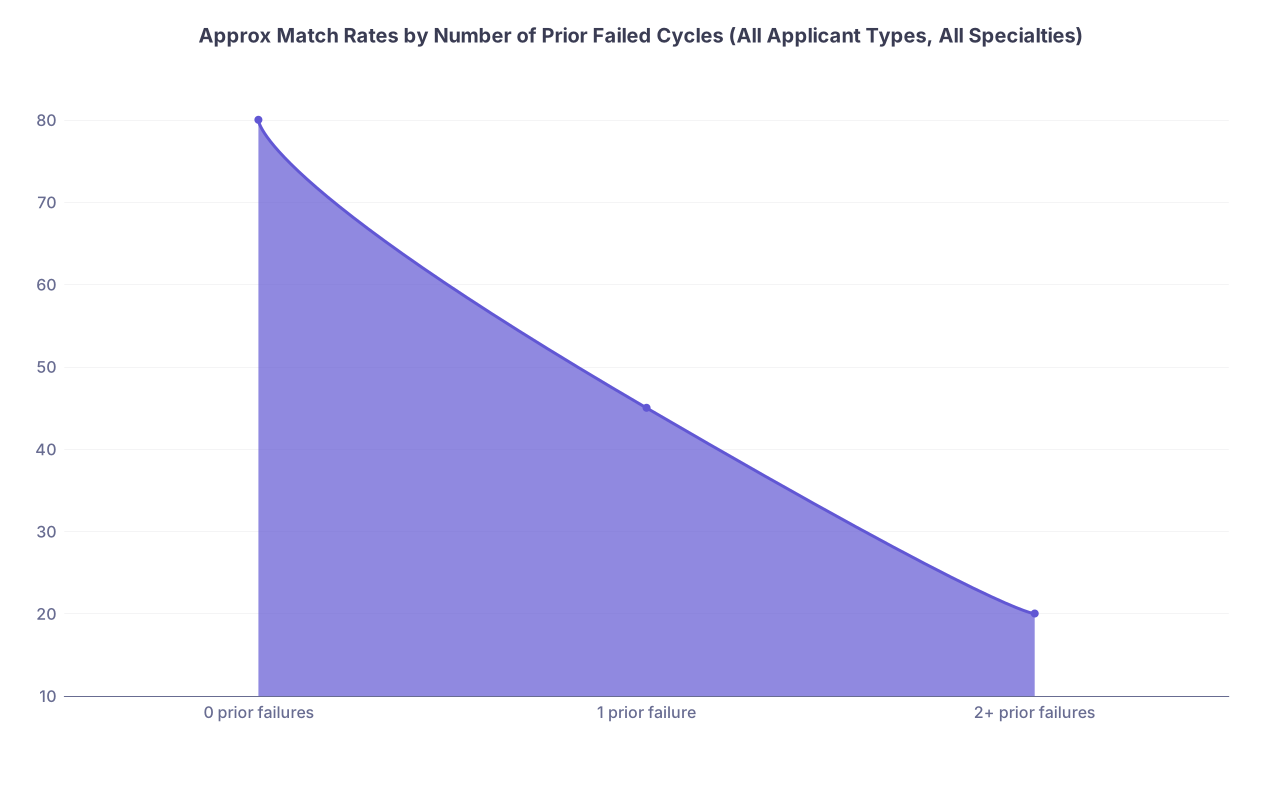
There is a hidden line here. One failed match is a serious warning sign. Two failed matches is, statistically, almost a career deceleration point that is very hard to reverse.
| Category | Value |
|---|---|
| 0 prior failures | 80 |
| 1 prior failure | 45 |
| 2+ prior failures | 20 |
Again, these are ballpark, aggregated estimates across heterogeneous applicant types and specialties, but this is the curve I consistently see:
- 0 failures: majority match
- 1 failure: near-halving of match probability
- 2+ failures: your base probability drops to something like 10–25%, and often lower in competitive fields
By the time someone is attempting a third or fourth match with no substantial change in profile or strategy, the odds are brutally low. I have seen a few succeed on the 3rd attempt, but always with major shifts:
- Completely new specialty, often IM or FM
- New degree or strong research portfolio
- Powerful new letters from U.S. faculty
If you are on cycle two and thinking about a third, you are in “hard data reality check” zone, not “just keep trying and it will work out” territory.
Which Applicant Types Recover Best?
You cannot talk about prior match failure without segmenting by applicant category. The baseline odds and recovery potential differ a lot.
U.S. MD Seniors / Recent Grads
They have the best recovery odds on paper.
- Strong institutional support sometimes continues into the reapplication year.
- Less YOG penalty, especially if they reapply immediately.
- If they pivot to primary care or a less competitive field within 1–2 years of graduation, match recovery is common.
I have seen many unmatched EM or Surgery hopefuls successfully land:
- Categorical Internal Medicine
- Transitional/Prelim years, then later slot into categorical IM or another field
- Family Medicine, Psychiatry, Neurology
But the success stories almost always involve honest recalibration: fewer “reach” programs, more realistic targets, and a wider net.
U.S. DO Graduates
Osteopathic grads are in a strange middle zone.
Post-merger, DO applicants compete head-to-head more with MDs, especially in historically ACGME programs.
Recovery data patterns:
- Strong for those who move decisively into DO-friendly fields (FM, IM, Psych, PM&R, Neuro, some EM programs depending on region).
- Much weaker in surgical subspecialties on reapplication unless they have exceptional metrics and connections.
Prior match failure for DOs aiming at Ortho, Derm, or competitive procedural fields is often career-defining unless they pivot to another specialty where DOs are well represented.
U.S.-IMG and Non-U.S.-IMG Applicants
This is where prior failure hurts the most.
- Many programs already have filters against older year-of-grad or IMG status.
- Adding “unmatched last year” on top of that is a powerful negative.
I have seen IMGs recover, but almost exclusively when they:
- Switch to less competitive fields like IM, FM, Psych, Pathology, and
- Add strong U.S. clinical experience plus new letters, and
- Drastically expand the program list (sometimes >150–200 programs).
An IMG reapplicant trying again for something like Radiology or Surgery with minimal profile change is essentially gambling on extremely long odds.
What “Successful Recovery” Actually Looks Like
Let me summarize the profile of applicants who actually dig themselves out of the prior-failure hole. This is pattern recognition based on many cases.
Case Archetype 1: The Competitive-to-IM Pivot
- Initial attempt: U.S. MD, applied to 40 Anesthesiology programs, Step 1: 230s, Step 2: 240s, limited research, few aways. Unmatched.
- Recovery year: Takes a research year in perioperative medicine / critical care, gets 1–2 publications, picks up a strong letter from a big IM department.
- Reapplication: Targets 80–100 Internal Medicine programs (academic + community), Step scores now look above median for IM.
- Outcome: 10–15 interviews, matches categorical IM.
Did they “recover”? Statistically yes. Career saved. But not in the original specialty.
Case Archetype 2: The IMG With Improved USCE + Volume
- Initial attempt: Non-US IMG, 5 years since graduation, limited USCE, applied to 70 IM programs. Unmatched, 2 interviews.
- Recovery year: 6–12 months of hands-on USCE (observerships / externships where allowed), strong letters, some QI project or case report.
- Reapplication: Applies broadly to 180+ IM and FM programs, leans heavily into community-based programs that historically take IMGs.
- Outcome: 5–8 interviews, matches community IM or FM.
Again, recovery is real, but it hinges on numbers: more applications, more relevant experience, and targeting the correct tier.
Case Archetype 3: Same Specialty, But Profile Reinvented
This is the least common but does happen, usually in mid-tier competitiveness specialties (e.g., Psych, PM&R, less competitive IM programs).
- Initial attempt: Mid-tier application, small program list, mediocre PS, generic letters. Unmatched.
- Recovery year: Diagnoses the real weaknesses—adds meaningful experience, rewrites personal statement, obtains 2–3 fresh, strong letters, expands to 2–3x programs.
- Reapplication: Same specialty, but with a visibly stronger file and better targeting.
- Outcome: Matches, often at lower- or mid-tier community programs.
The critical point: “same specialty, same application, try again” is almost never the path that works.
Tactical Decisions After Match Failure: Data-Driven Moves
If you are sitting on a failed match, your next choices are basically a probability problem.
Here is the rough decision matrix I walk people through.
| Move | Relative Impact on Next-Cycle Odds |
|---|---|
| Switching to a less competitive specialty | Very High |
| Expanding program list (2–3x) | High |
| Adding strong USCE / research | High |
| New letters from recognized faculty | Medium–High |
| Cosmetic PS/ERAS edits only | Low |
Cosmetic changes (rewriting your personal statement, slightly tweaking experiences) do not move the needle much on their own. Programs weight:
- Specialty choice and competitiveness
- Objective metrics (scores, publications, USCE, YOG)
- Volume and targeting of applications
The data is clear: if you want a materially different outcome, you must introduce a materially different application profile.
Mental Trap: “It Was Just Bad Luck”
I hear this line constantly from unmatched applicants:
“I had decent stats. I think it was just bad luck this year.”
Sometimes that is partially true. But statistically, nearly all unmatched candidates had at least one of the following:
- Specialty choice misaligned with their profile
- Undersized or poorly targeted program list
- Weak or generic letters
- Gaps or red flags (failures, professionalism issues, poor communication, late scores)
- Coming from a disadvantage category (older YOG, IMG, low Step 1/2)
Pure bad luck is rare. With thousands of positions and thousands of applicants, outcomes correlate heavily with measurable variables.
If you treat your failure as random noise rather than a signal, you will likely repeat it.
So, Do Reapplicants Actually Recover?
Here is the bottom line, without sugar:
- Yes, a substantial subset of reapplicants do match on a second attempt.
- Recovery is far more likely if they pivot to an appropriately competitive specialty and significantly change their application profile.
- The probability of “same specialty, minimal changes, better luck” leading to a different outcome is low.
- Multiple failed cycles drastically erode odds, especially for IMGs and older graduates.
The traditional narrative—“If you just keep trying, something will work out”—is statistically irresponsible. The data says: if you keep trying the same thing, your odds remain poor. If you re-engineer your strategy based on real numbers, your odds can become quite reasonable again.
You are not doomed by a failed match. But you are on a narrower path now, and every next move has to be made with cold, unromantic attention to the data.

| Step | Description |
|---|---|
| Step 1 | Unmatched |
| Step 2 | High risk of repeat failure |
| Step 3 | Select less competitive specialty |
| Step 4 | Strengthen profile in same field |
| Step 5 | Add USCE/Research + New Letters |
| Step 6 | Expand and retarget program list |
| Step 7 | Reapply with materially different profile |
| Step 8 | Root-cause analysis done? |
| Step 9 | Change specialty? |
With that framework, you can at least stop guessing and start acting like you believe the numbers.