
The belief that “a research year fixes a red flag” is dangerously oversold. The data show it sometimes helps, sometimes does nothing, and in a few specialties it is basically cosmetic surgery on a structural problem.
You are not asking a generic question. You are asking a specialty-specific, probability question: “Given this red flag and this specialty, how much does a research year shift my Match odds, and is it worth 12–24 months of my life?”
Let’s treat it that way.
1. What the Data Actually Say About Red Flags + Research Years
Start with the blunt reality: NRMP and specialty organizations do not publish a neat “research year rescue index.” But we can triangulate from several data sources:
- NRMP Charting Outcomes in the Match (US MD, DO, and IMGs)
- NRMP Program Director Survey
- Specialty-specific program director statements and panel data
- Published match outcomes from research-heavy programs and research tracks
Across these, three patterns show up consistently:
- Research productivity correlates with higher match rates in certain specialties (derm, plastics, ENT, neurosurgery, ortho, rad onc).
- Red flags (exam failures, major professionalism issues, large YOG gaps) correlate with sharply lower interview and match rates, across the board.
- Research helps “explain” a gap or add value, but rarely neutralizes a high-severity red flag by itself.
So the question is not “Does a research year help?” That is too vague. The real question is: for each specialty, does a research year:
- Convert a hard “no” to a “maybe”?
- Convert a “maybe” to an “interview with caution”?
- Or just add lines to the CV with no measurable odds change?
To make this concrete, here is a simplified view of how various red flags hit you, before adding research.
| Red Flag Type | Typical Impact on Match Odds* |
|---|---|
| Step/COMLEX failure (one attempt) | 20–40% lower match rate vs peers |
| Multiple exam failures | 50%+ lower; often near-zero in competitive |
| Failed remediation/probation | Severe; screens out at many programs |
| Extended LOA for academic reasons | Moderate to severe, depends on context |
| Mild professionalism concern | Moderate drop; depends on narrative strength |
*Estimates synthesized from NRMP data, PD survey reports, and specialty panels. Not exact but directionally accurate.
Now layer research on top. A good way to visualize this is as an incremental bump in probability, not a full reset.
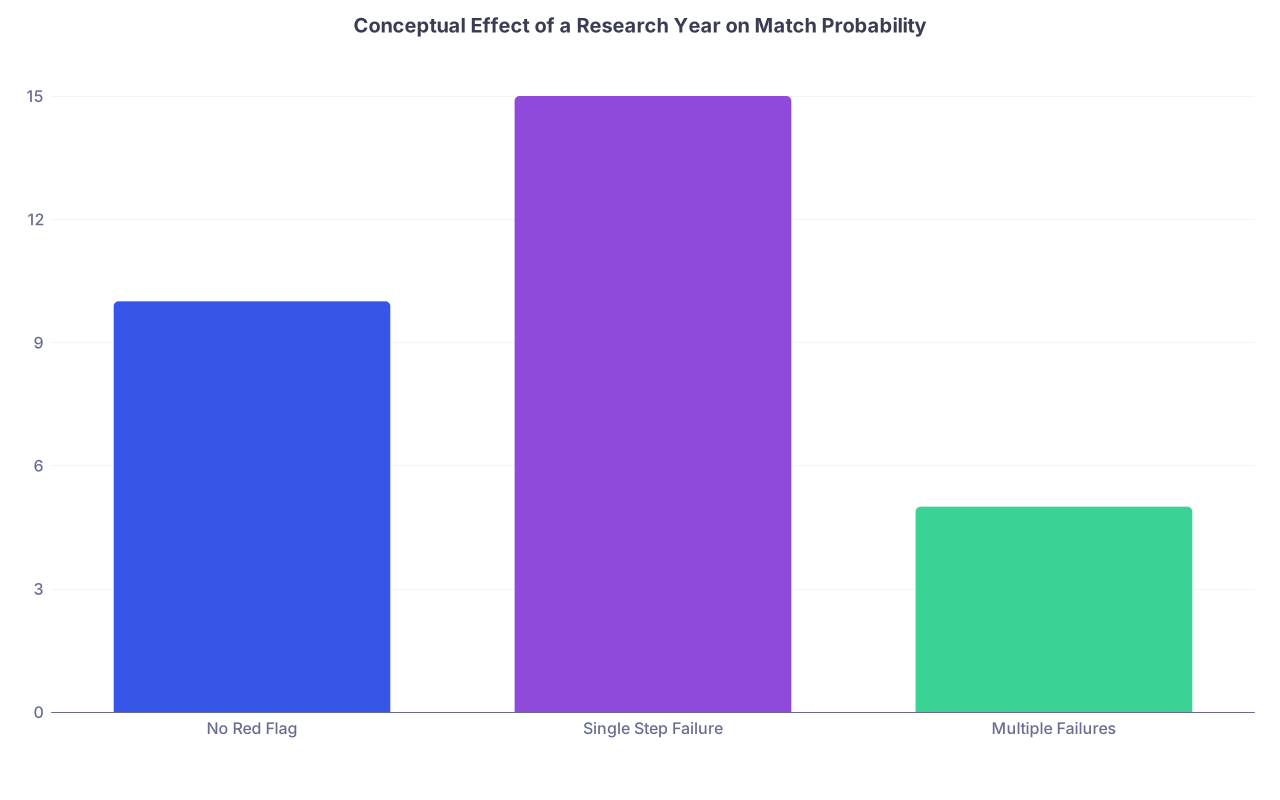
| Category | Value |
|---|---|
| No Red Flag | 10 |
| Single Step Failure | 15 |
| Multiple Failures | 5 |
Interpretation: a strong research year might add something like 10 percentage points to your match probability in a research-heavy specialty if you have no red flag, 15 points if it helps partially offset a single exam failure, and maybe only 5 points (if that) if there are multiple severe issues. These are conceptual effect sizes, not literal numbers.
Now let’s look at what happens by specialty.
2. High-Research, Hyper-Competitive Specialties
These are specialties where research itself is a strong positive predictor of matching, even in clean applications. So a research year naturally has more leverage.
Dermatology
Dermatology is ground zero for “take a research year to be competitive.” For clean applicants, that is often rational. For red flag applicants, the picture is mixed.
Data snapshot (US MD, recent Charting Outcomes trends):
- Matched applicants often show:
- Step 2 in 245–255+ range
- Median 8–10+ abstracts/pubs/presentations
- High research involvement rates (70%+ with significant research)
If you add a red flag like a Step 1 failure or marginal Step 2:
- Program director survey data: derm PDs rank exam performance and professionalism above research. Many explicitly say failures are very concerning.
- In practice, I see applicants with:
- Single Step failure + 1–2 derm research years + 10–20 pubs
- Still matching only when supported by a strong derm department advocating heavily.
Where a derm research year helps:
- Explaining a YOG gap with productive derm research.
- Converting a “probably auto-screen” into a “we will at least read the file.”
- Building relationships at a single home or away institution that is willing to vouch hard for you.
Where it does not rescue:
- Multiple exam failures.
- Major professionalism issues.
- No clear improvement story (scores did not rebound, narrative is weak).
Net: In dermatology, a research year can partially offset a single exam red flag if the rest of the profile is strong and you have a department backing you. It almost never rescues multiple serious red flags.
Plastic Surgery (Integrated)
Plastics is similar, with even more emphasis on in-house impressions.
Data patterns:
- Matched US MDs often have:
- Top-quartile Step 2 scores
- Double-digit publications/presentations, many in plastics
- One or more dedicated research years common at top programs
Program directors openly state: they hire people they know. A plastics research year at a strong institution is effectively a 12-month audition.
For a red flag applicant:
- Single Step failure + strong later Step 2 + 1–2 years plastics research at a well-known center + glowing letters = possible, but the odds are still substantially below average.
- If the red flag is professionalism (probation, remediation, serious incident), most plastics PDs will not touch the application, research or not.
Important nuance: In plastics, research is not pure numbers. It is visibility. You are in conferences, ORs, meetings. That can somewhat dilute a previous exam misstep, because PDs feel they “know” you.
But again, this is rescue-in-rare-cases, not systematic recovery.
Otolaryngology (ENT), Neurosurgery, Ortho, Rad Onc
I will group these, with specialty-specific tilts.
Commonalities:
- All have higher-than-average research output among matched applicants.
- All have PDs who value:
- Strong Step 2 (since Step 1 is pass/fail now).
- No professionalism concerns.
- Departmental fit and reliability.
Where a research year helps:
- ENT / Neurosurgery: A year in a big-name lab with high-output and strong letters can move you from “unlikely” to “plausible” if your red flag is a single Step failure or lower but passing score.
- Ortho: Less research-fetish than neuro/ENT, more emphasis on audition rotations and letters. A research year at a high-volume ortho department is useful if it includes clinical exposure and relationship-building.
- Rad Onc: The specialty is contracting. Programs are more risk-averse now. Research used to be a major plus; now it is necessary but not sufficient.
Where it fails:
- Multiple Step/COMLEX failures. The PD survey is blunt: many programs auto-screen them out.
- Any professionalism red flag. Surgical fields are particularly unforgiving.
Net: In these specialties, a research year can meaningfully shift odds if the red flag is moderate and you overcompensate with outstanding scores, output, and letters. It does not erase systemic issues.
3. Moderately Competitive, Research-Friendly Specialties
These are the “middle” group: research looks nice, helps at top programs, but is not the central currency everywhere.
Internal Medicine (categorical, academic vs community)
The data here are clear:
- Overall IM match rates for US MDs are high, even with some blemishes.
- Academic IM programs (university hospitals, research tracks) show:
- Higher average Step 2.
- Greater prevalence of research (multiple abstracts/pubs).
For a red flag (e.g., single Step failure or repeated exam):
Community IM: A research year rarely changes your fate. Programs care more about:
- Clinical performance
- Passed boards by the time of ranking
- Work ethic and reliability
Many will accept a single failure if your later performance is solid. They do not need you to have a year of bench work.
Academic IM: Here research can help significantly. If your red flag is:
- Step failure but later Step 2 240+ and strong clinicals
- Then adding 1 year of productive outcomes research or QI with 3–5 publications can mitigate risk and signal academic value.
For IMGs and DOs:
- A research year at a US academic IM department, with strong mentorship and US letters, can substantially improve interview volume. It doubles as a structured way to get US clinical exposure.
- But again, it works best when the red flag is modest (single fail, older YOG) and the research year tells a coherent, productive story.
Net: Internal medicine is one of the few areas where a research year can realistically “rescue” a mildly red-flagged application into strong academic programs, if executed well. For severe red flags, even IM has limits.
Pediatrics, Family Medicine
These fields are less research-sensitive, more relationship and service-driven.
Pediatrics:
- Research is valued at children’s hospitals and academic programs, particularly for subspecialty-focused applicants.
- A research year can help:
- Explain a training gap.
- Show commitment to a specific niche (e.g., NICU, hem/onc).
But for classic red flags:
- Single Step failure + later improvement: Many peds programs will still interview you with strong clinical feedback and advocacy from faculty, even without a research year.
- Professionalism problems: Again, research does not fix trust issues.
Family Medicine:
- FM programs rarely require extensive research.
- Their stated priorities: clinical performance, community fit, interpersonal skills.
- A research year in FM is over-kill for most programs and does little for red flag rescue unless it is part of a broader rehabilitation story (e.g., you had an LOA and came back with structured QI work, clear growth).
Net: In peds and FM, research year is generally a weak lever for rescuing red flags. Other interventions (away rotations, consistent performance, targeted program selection) have better ROI.
4. Lifestyle and Procedural Specialties: EM, Anesthesia, Rad, Neurology
Emergency Medicine
EM has gone through a wild cycle: previously competitive, then applicant shortages, now some stabilization.
Historically:
- Research was nice but not essential.
- SLOEs (Standardized Letters of Evaluation) and clinical performance dominated.
For red flags:
- A failed Step is concerning but sometimes tolerable if SLOEs are strong and there is clear upward trajectory.
- A research year in EM has limited effect unless it is at a department that will also give you strong SLOEs and advocate loud.
Given the current market with some unfilled spots, a research year is usually not the limiting factor for red flag applicants. Program selection and networking carry more weight.
Anesthesiology
Anesthesia has become more competitive again post-COVID, but not at derm/plastics levels.
Data patterns:
- Matched US MDs usually have solid (not necessarily elite) scores.
- Some research is common but not universal.
Effect of a research year:
- If your red flag is a modest Step score or single failure, a research year may increase attractiveness to top academic anesthesia departments, especially if outcomes/ICU/QI-related.
- For community programs, additional research often does little beyond filling a gap and signaling seriousness.
Radiology, Neurology
Radiology:
- Strong Step 2 and strong letters are king.
- Research is valued in academic radiology, but less so than in derm/plastics.
- A research year can help salvage a slightly weak academic profile; it will not erase multiple exam failures.
Neurology:
- Growing field with moderate research emphasis.
- A research year in stroke, epilepsy, or neuroimmunology can clearly help for academic programs.
- For red flags, it works similarly to IM: moderate rescue possible for single exam failures, not for severe professionalism issues.
5. Cost–Benefit: Is a Research Year a Rational Move for You?
To decide, you need to treat this as an expected value problem, not a vibes problem.
Break it down:
- Baseline match probability in your target specialty with your current profile.
- Realistic incremental probability change from a strong research year.
- Cost: 1–2 years of time, lost attending income, opportunity cost, potential burnout.
A simplified model:
Suppose:
- Without research year, your chance of matching in a moderately competitive specialty with a Step failure is ~40%.
- With a strong research year at a known department, this might move to ~60%.
If the specialty is your non-negotiable, that 20 percentage point gain might justify the one-year delay.
But in other situations:
- If your baseline odds are already 70%+ (e.g., for IM/FM with a mild red flag), and a research year might push you to 80–85%, then you have added 1 year for a relatively modest probabilistic gain.
- That may not be rational unless you strongly want an academic niche that actually requires research.
Here is a conceptual comparison by specialty “research leverage":
| Specialty Group | Research Year Impact on Odds* |
|---|---|
| Derm/Plastics/ENT/Neurosurg | High for mild red flags; low otherwise |
| Ortho/Rad Onc | Moderate to high |
| IM (academic), Neurology | Moderate |
| Peds, Anesthesia, Radiology | Low to moderate |
| EM, FM, Community IM | Low |
*Impact refers to potential relative change in match probability if the research year is strong and well executed.
6. When a Research Year Does Rescues a Red Flag (and When It Clearly Does Not)
You should be brutally honest with yourself. These patterns show up repeatedly.
Scenarios Where a Research Year Often Helps
You are targeting a research-intense specialty (derm, plastics, ENT, neurosurg) and:
- You have a single Step failure but a strong Step 2, strong MS3/4 performance.
- You can secure a research position within a respected department with a track record of converting research fellows to residents.
- You are prepared to generate real output (not just your name in the middle of one poster).
You are aiming for academic IM or neurology and:
- Your red flag is a modest exam misstep or a short gap.
- You can use a research year to:
- Demonstrate sustained productivity.
- Obtain stellar letters from recognizable faculty.
- Clarify your academic trajectory (fellowship interest, QI focus, etc.).
Scenarios Where It Rarely Works
You have:
- Multiple exam failures, or
- Probation / serious professionalism sanctions, or
- A very long and poorly explained training gap
...and you expect one research year to make you “competitive” in derm, plastics, integrated surg, or similar. Data and PD behavior say: this almost never happens.
You are applying to FM or lower-tier community IM programs and:
- Your main deficits are clinical performance or interpersonal skills.
- Programs care about recent, consistent clinical reliability, not an extra year in a lab.
In those cases, your time is almost always better spent on:
- Additional strong US clinical experiences / sub-internships.
- Clear remediation and documentation of improvement.
- More strategic program selection and geographic flexibility.
7. Practical Strategy: If You Do the Research Year, How to Maximize Its Signal
If you decide a research year is rational, treat it as a high-stakes intervention, not a gap filler.
Key principles:
- Choose location > project. A mediocre project in a high-visibility department that writes strong letters beats an obscure lab with zero advocacy.
- Aim for measurable output:
- At least 2–3 concrete products: publications (even middle author), national presentations, major QI initiatives.
- Sync the story:
- Your personal statement and interviews need to connect the red flag, the decision to do research, and the growth/skills gained.
- Stay clinically visible:
- Many strong research positions in clinical departments include clinic days, conferences, involvement in patient care pathways. Use them. PDs want to see you operating like a near-resident, not just a data analyst.
If your research year just pads your CV with a couple of posters and no one in the department really knows or vouches for you, the rescue effect is marginal at best.
8. Visual: How Much Does Research Matter vs Other Factors?
For many specialties, research is not the #1 driver of decisions. A schematic for high-research vs lower-research specialties:
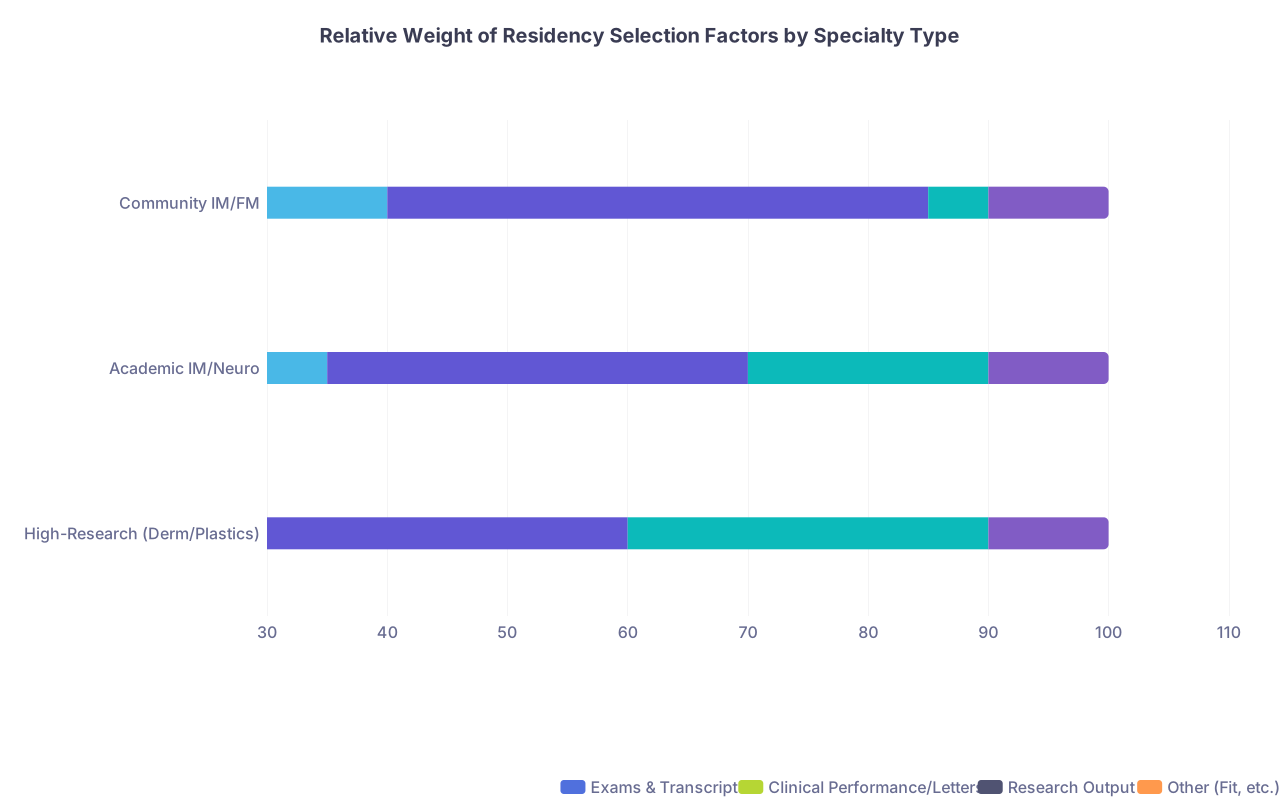
| Category | Exams & Transcript | Clinical Performance/Letters | Research Output | Other (Fit, etc.) |
|---|---|---|---|---|
| High-Research (Derm/Plastics) | 30 | 30 | 30 | 10 |
| Academic IM/Neuro | 35 | 35 | 20 | 10 |
| Community IM/FM | 40 | 45 | 5 | 10 |
Interpretation: in derm/plastics, research may be ~30% of the perceived value. In community IM/FM, maybe 5%. If your red flag is in exams or professionalism, pouring all your effort into the 5–30% domain while ignoring the 60–70% domain is misaligned.
9. Bottom Line
Two key points and then we are done.
- A research year can partially rescue certain red flags in research-heavy specialties and academic tracks, but it rarely neutralizes severe problems. It is an incremental probability tool, not a magical reset button.
- The specialty context matters more than generic advice. In derm/plastics/ENT/neurosurg, a research year is often mandatory and can be decisive for borderline profiles. In FM, EM, and many community programs, it has minimal impact on red flag rescue relative to clinical performance, letters, and program fit.
Use the data patterns, not anecdotes from the loudest person in your group chat.
FAQ (Exactly 5 Questions)
1. Does a research year help more after a Step 1 failure or a Step 2 failure?
For most specialties now that Step 1 is pass/fail, a Step 2 failure is more toxic, since Step 2 is often the main numeric filter. A research year can soften the impact of a Step 1 failure, especially if Step 2 is strong. For a Step 2 failure, research helps less; programs may still doubt your ability to pass boards on time.
2. Is a research year more valuable than doing extra away rotations for red flag applicants?
In surgical and EM fields, an extra away rotation with strong evaluations and letters often has more impact on rescuing a red flag than a research year, because it directly demonstrates clinical reliability. In derm/plastics and certain academic IM tracks, research and away rotations both matter; often they are combined (research year at a department where you also rotate).
3. How many publications do I need in my research year for it to “count”?
There is no magic threshold, but for high-research specialties, I start to see meaningful impact when applicants have at least 3–5 concrete outputs (articles, major abstracts, book chapters) tied to well-known mentors. One poster and a case report typically do not move the needle much for red flag rescue.
4. If I have a professionalism red flag, can a research year change program directors’ minds?
Rarely. Professionalism issues are about trust and risk, not academic potential. A research year could help if it is part of a clear, documented remediation arc with trusted faculty vouching strongly for your growth, but many PDs will remain extremely cautious regardless of your research output.
5. Does a research year help DOs and IMGs with red flags more than US MDs?
It can, but mainly through increased U.S. visibility and strong letters, not just the research line itself. For DOs and IMGs with mild red flags, a research year at a U.S. academic center sometimes opens doors that would otherwise stay closed, particularly in academic IM, neurology, and a few surgical subspecialties. For severe red flags, the same ceiling applies: research helps perception but does not erase fundamental concerns.