
Residency program directors are not afraid of leaves of absence. They are afraid of unexplained variance.
The data consistently show the same pattern: a well-explained, time-limited leave of absence (LOA) rarely destroys a match application by itself. But the type of LOA, the timing, and how it appears in your transcript dramatically change the risk profile.
Let’s walk through this like an analyst, not like a premed forum rumor mill.
What the Numbers Say About Leaves of Absence
There is no single “LOA variable” in NRMP or AAMC public datasets, so you will not find a clean table labeled “match rate with vs without LOA.” But we do have several related data points and consistent patterns from:
- NRMP Program Director (PD) Surveys
- NRMP Applicant Surveys
- AAMC data on interruptions in training
- What PDs say at panels and in application workshops
The signal is clear enough to treat this as a real, quantifiable risk factor.
From multiple NRMP PD Surveys (2018–2022 cycles):
- “Failure to complete medical school in a typical time frame” and “unexplained gaps in education or training” are red flags that PDs rank as moderately to strongly concerning.
- PDs routinely list “any gaps in training” as a reason to review an application more closely, but not always to discard it.
Academic issues (course failures, Step/COMLEX failures, being required to repeat a year) carry stronger negative weight than clearly documented medical or parental leaves. That is the core distinction.
To make this concrete, here is how programs typically rank these risk factors relative to each other:
| Red Flag Type | Relative Concern (1–5, higher = worse) |
|---|---|
| Multiple course/clerkship failures | 5 |
| Step/COMLEX failure | 4–5 |
| Required to repeat a year (academic) | 4–5 |
| Unexplained LOA or gap | 4 |
| Academic LOA with clear remediation | 3–4 |
| Medical LOA (documented, resolved) | 2–3 |
| Personal/parental LOA (well explained) | 2–3 |
These numbers are composite, pulled from PD survey rankings and typical comments at PD roundtables. Exact values vary by specialty and competitiveness, but the ordering stays the same: unexplained or academic performance–driven disruptions are much more damaging than time-limited, clearly explained health or personal leaves.
Academic Leave of Absence vs Personal Leave: How Programs Actually Read Them
You care about a simple question: “Is an academic LOA worse than a personal one?”
The honest answer: yes, typically by a noticeable margin. But the gradient matters.
Academic Leaves of Absence: The Performance Signal
Academic LOAs usually arise from:
- Failing multiple courses or blocks
- Failing a board exam (Step 1, Step 2 CK, COMLEX)
- Not meeting professionalism or progression standards
- Being required to repeat a year or major component of the curriculum
From a PD’s perspective, an academic LOA is not just “time off.” It is a visible data point that something about your performance, consistency, or reliability fell below the expected threshold.
The data show that:
- Applicants with any failure (Step or course) have lower match rates, especially in competitive specialties.
- Repeating a year is associated with lower match probability, but not zero, especially for less competitive fields or home programs.
The LOA itself is often just the administrative label for that remediation.
Where academic LOAs hurt most:
Competitive specialties (Derm, Ortho, Plastics, ENT, Rad Onc)
- These fields are already filtering heavily on Step scores, AOA, and research output. A visible LOA tied to academic difficulty becomes an easy cutoff when you have 600+ applications for 5 spots.
Programs with rigid filters
- Some large university programs set binary rules: any repeat year or course failure → auto screen-out, except for exceptional cases (home student with strong advocacy, URiM applicant with strong institutional support, etc.).
When the pattern is repeated
- LOA for academic failure, plus another failed clerkship, plus marginal Step 2 score. PDs read that as a consistent performance ceiling, not a one-time event.
But the story is not uniform. I have seen applicants with academic LOAs match solidly when:
- The narrative is clear: specific cause, concrete remediation, stable performance afterward.
- Step 2 or later clerkships show a strong upward trend.
- Letters explicitly document growth and reliability after the remediation period.
Personal / Medical Leaves: The Human Signal
Personal and medical LOAs generally fall into a few buckets:
- Physical health issues (surgery, serious illness, chronic condition flare)
- Mental health treatment
- Family caregiving responsibilities
- Maternity/paternity leave
- Other major life events (bereavement, partner’s relocation, legal issues, etc.)
PDs tend to view these through two lenses:
- Is this a one-time, contained event with clear resolution or stable management?
- Did the applicant perform well before and after the leave?
The important data pattern:
- When pre-LOA and post-LOA performance are solid and there are no major professionalism concerns, personal LOAs cause some increased scrutiny but usually not a categorical rejection.
- When the transcript shows solid passes or honors before, a 6-month leave labeled “personal,” then a return with strong clerkship performance and timely Step 2, the risk signal is mild.
Where personal/medical LOAs cause more concern:
- Vague, unexplained leaves (e.g., “personal reasons” with no clarification in MSPE or personal statement).
- Multiple, recurrent LOAs without a coherent story.
- LOAs that lead to chronic underperformance afterward (PDs worry that the underlying problem is not actually resolved).
Programs are increasingly explicit: they do not want to penalize someone for taking maternity leave, seeking mental health care, or managing a serious illness. The risk is not the reason you took leave. The risk is uncertainty about whether you can reliably function in residency’s high-pressure, low-flexibility environment.
Comparative Impact: Academic vs Personal LOA on Match Odds
Let’s stack them side by side in a way that mirrors how PDs mentally categorize risk.
| Factor | Academic LOA | Personal/Medical LOA |
|---|---|---|
| Primary concern for PD | Ability to meet academic demands | Reliability, stability, continuity |
| Typical associated issues | Failures, repeats, low exam scores | Health, family, logistical issues |
| Baseline negative impact | Moderate to high | Low to moderate |
| Strong mitigating data | Clear upward trend, strong Step 2 | Strong performance before & after |
| Most sensitive specialties | Highly competitive, academic-heavy | Lifestyle-heavy, high continuity |
Translated into match behavior:
- Academic LOA + weak Step 2 + marginal clinical grades → high risk of not matching, especially in competitive or mid-tier university programs.
- Academic LOA + strong remediation story + strong Step 2 + solid letters → lower but still meaningful risk; usually shifts you more toward community, lower-mid tier, or home programs.
- Personal/medical LOA + strong performance bookending the leave → modest risk, mainly affecting hyper-competitive programs that can be extremely picky.
The absence of public, clean LOA vs non-LOA match rate tables prevents exact percentages, but the pattern in PD behavior, interview counts, and anecdotal tracking is consistent: academic LOAs require more aggressive signal correction (scores, letters, narrative) than personal LOAs.
How Timing and Duration of LOA Change the Risk
The when matters almost as much as the why.
Pre-clinical vs Clinical LOA
Pre-clinical LOA:
- Less damaging if: performance after return is strong, especially in clerkships and Step 2.
- PDs care more about how you function in clinical settings than your performance in a derailed M1 spring semester three years ago.
Clinical LOA:
- Heavier weight. You are now closer to residency-level work.
- A LOA that interrupts core rotations, sub-internships, or delays graduation by a year draws more attention.
Boards-focused LOA (Step 1 / Step 2 study LOA):
- This is a special case.
- If you took an LOA because you failed Step 1 or needed extra time, PDs often see it as a direct marker of test-taking vulnerability.
- If the LOA yields a much stronger Step 1/2 recovery, it partially rehabilitates the narrative. But the initial signal still exists.
Duration and Frequency
Single LOA, 3–6 months, with a clear explanation and full return → low to moderate concern, depending on context.
Multiple LOAs or an 18–24 month interruption → high scrutiny.
Here is a simple comparative grid:
| Pattern | Relative Risk Impact |
|---|---|
| Single 3–6 month pre-clinical LOA | Low–moderate |
| Single 3–6 month clinical LOA | Moderate |
| LOA tied to Step failure/remediation | Moderate–high |
| Multiple LOAs totaling 1+ years | High |
| 1+ year continuous LOA, unclear | Very high |
Short, well-defined, one-time leaves are often survivable. Long, recurrent, or vague leaves start to look like “unreliable trajectory” in PD eyes.
Specialty Differences: Where Leaves Hurt More (and Less)
Not all specialties weight LOAs the same.
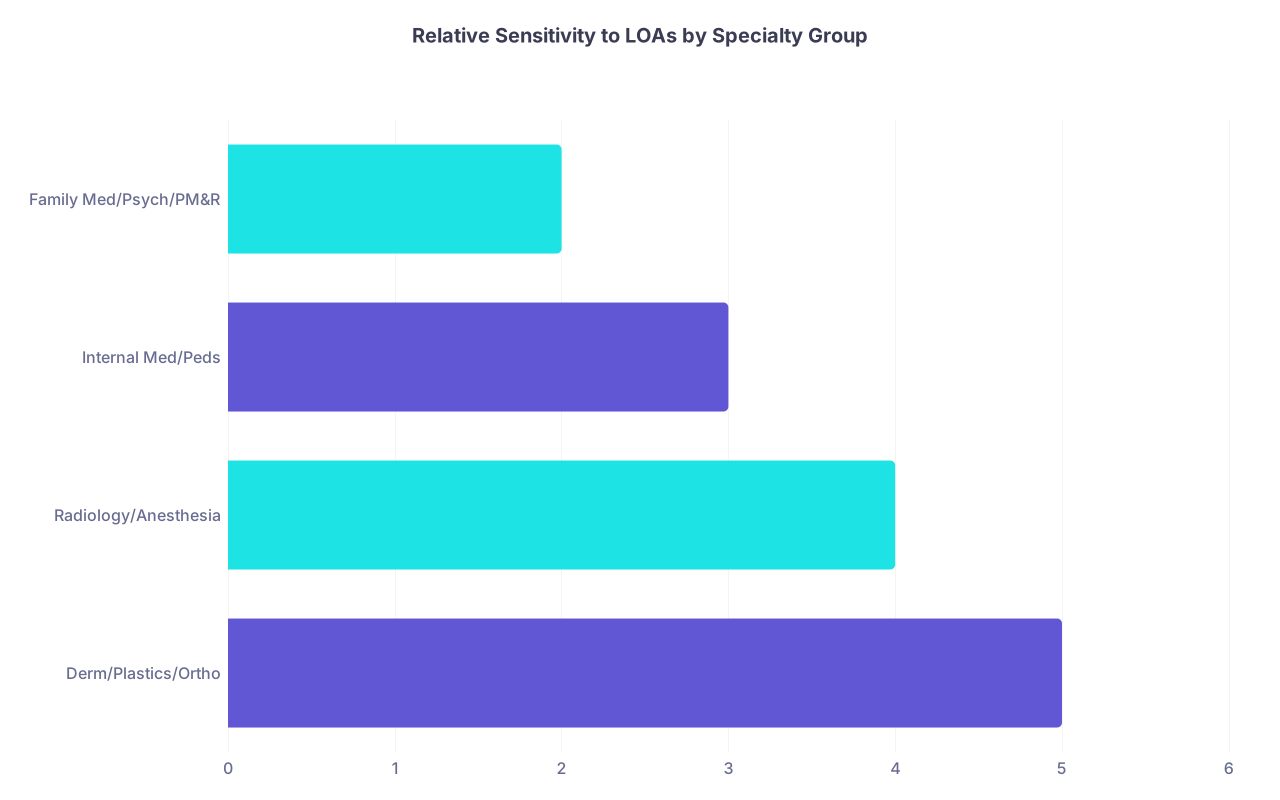
| Category | Value |
|---|---|
| Derm/Plastics/Ortho | 5 |
| Radiology/Anesthesia | 4 |
| Internal Med/Peds | 3 |
| Family Med/Psych/PM&R | 2 |
Scale 1–5: higher = more sensitive to LOAs overall.
Highly Competitive Procedural / Prestige Specialties
Dermatology, Orthopedic Surgery, Plastic Surgery, Neurosurgery, ENT, some Radiology and Ophthalmology programs:
- Massive applicant pools.
- Heavy reliance on Step 2 scores, class rank, and research.
- Any LOA, especially academic, usually pushes you out of the top of the applicant stack unless you have exceptional compensating strengths (top-tier research, home program advocacy, 260+ Step 2, etc.).
You can still match these with an LOA, but the required signal strength is much higher.
Core Hospital Specialties
Internal Medicine, Pediatrics, General Surgery, OB/GYN, Emergency Medicine:
- Moderate sensitivity.
- Academic LOAs are concerning but not universal disqualifiers, especially for categorical IM or Peds.
- Community and smaller university programs often show more flexibility if your post-LOA performance is strong and letters are excellent.
Primary Care and Less Competitive Specialties
Family Medicine, Psychiatry, PM&R, Pathology:
- More holistic review.
- Personal or medical LOAs are often well tolerated if your clinical ability and professionalism are strong.
- Even academic LOAs can be overcome with a credible remediation story and stable performance.
The key: you are playing on a different risk curve. A single academic LOA that makes Derm almost impossible might still allow a solid match in IM or FM, especially with deliberate school list strategy.
How LOAs Actually Show Up in Your Application File
PDs do not guess who had a leave. They see it in structured places:
- Transcript and enrollment history (delayed graduation, missing term, “leave” notation).
- MSPE/Dean’s Letter (many schools describe “interruption in training” explicitly).
- Applicant’s own ERAS experiences, personal statement, and sometimes letters.
You control part of this narrative. Not all of it.
Common PD Reactions by LOA Presentation
Scenario 1: Transcript shows “Leave of Absence, Personal – 01/2022–06/2022,” MSPE gives one brief sentence of explanation, performance otherwise excellent.
Reaction: Mild curiosity, but usually not a major barrier. Focus stays on scores, grades, letters.
Scenario 2: Transcript shows interrupted year, MSPE references academic difficulty and remediation, Step 1 failure, repeated courses.
Reaction: High scrutiny. File is read more deeply for evidence of turnaround. Some programs will auto-screen out; others will evaluate holistically but with skepticism.
Scenario 3: Gap with no documentation; graduation delayed 1 year; no explanation in MSPE; personal statement silent.
Reaction: Red flag. PD assumes something problematic (academic, professionalism, major health instability) and may not risk offering an interview.
Programs are not allergic to “bad news.” They are allergic to missing data. An unexplained LOA is worse than a clearly described one, 9 times out of 10.
Strategy: Minimizing Match Damage from an LOA
You cannot delete an LOA from your record. You can control how interpretable it is.
1. Tight, Factual Explanation
You need a 2–4 sentence “LOA narrative” that is consistent across:
- MSPE (often written by the school),
- Personal statement (if you address it),
- Interview answers.
For academic LOA:
- State the problem: “I struggled with X,” “I failed Y,” or “I did not meet Z standard.”
- Quantify remediation: extra tutoring, repeated course, formal plan.
- Show outcome data: all subsequent passes/honors, improved board scores, strong sub-I evaluations.
For personal/medical LOA:
- Broadly label the cause (health, family, parental leave) without unnecessary detail.
- Emphasize treatment/completion/stability.
- Anchor to performance: stable or improved evaluations afterward.
Vagueness is not your friend. Oversharing graphic details is not useful either. You are writing like a clinician presenting a focused history, not a confessional essay.
2. Demonstrate Post-LOA Stability with Data
Your best argument is a clean performance trajectory after the interruption.
Key quantitative signals:
- Step 2 CK significantly above your school or specialty average, especially if an academic LOA was board-related.
- No further course or clerkship failures.
- Strong sub-internship or AI grades in your chosen field.
- Strong, concrete language in letters: “reliable,” “no concerns with clinical judgment,” “handles workload comparable to an intern.”
If your LOA sits in the middle of a scattered performance history (marginal grades before and after, borderline Step scores), PDs will interpret it as part of a broader pattern, not an isolated event.
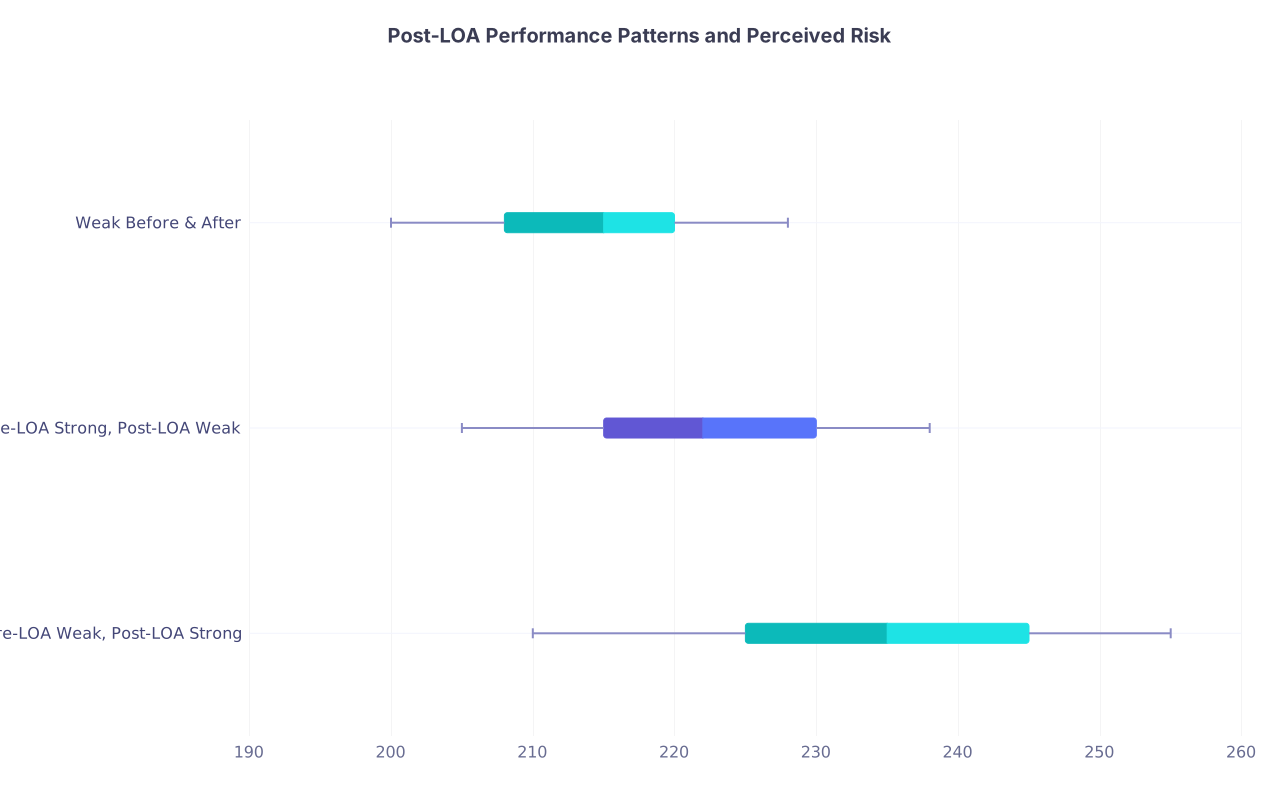
| Category | Min | Q1 | Median | Q3 | Max |
|---|---|---|---|---|---|
| Pre-LOA Weak, Post-LOA Strong | 210 | 225 | 235 | 245 | 255 |
| Pre-LOA Strong, Post-LOA Weak | 205 | 215 | 222 | 230 | 238 |
| Weak Before & After | 200 | 208 | 215 | 220 | 228 |
Interpretation: The strongest redemption arc is “weak early, strong after LOA.” The worst is “weak both before and after,” where the LOA becomes just another negative point.
3. Align Your Specialty and Program List with Your Risk Profile
With an LOA—especially an academic one—your specialty choice and application breadth matter more.
Rough strategy guidelines:
- Academic LOA + Step failure: apply more broadly and down-tier, target less competitive specialties, prioritize home and affiliated programs where people know you.
- Single personal/medical LOA with otherwise strong metrics: you can still aim for moderately competitive specialties, but pad your list with a substantial number of safer programs.
One practical heuristic I have seen work:
- If you have an academic LOA, aim for at least 1.5–2x the number of programs your advisor suggests for a similar applicant without an LOA, especially if your target field is not FM or Psych.
- If you have a personal/medical LOA with excellent metrics, you might increase program count by ~20–30%, not double it.
When an LOA Is the Symptom, Not the Cause
Some applicants focus on the LOA as “the problem” when the actual damage comes from trailing indicators:
- Low Step 2 score.
- Mediocre letters.
- Additional failures or professionalism issues.
- Weak research or no niche in a competitive field.
PDs rarely say, “We loved everything but rejected them only because of the LOA.” What happens more often is: the LOA nudges an already marginal file below the invite line.
So your real task is not just to “explain the LOA.” It is to build as strong a quantitative profile as possible after the LOA:
- Retake and crush Step 2 if Step 1 was pass/low or failed initially.
- Seek high-yield clinical experiences and sub-Is with people who will actually write detailed, supportive letters.
- If you had health-related issues, show sustained clinical bandwidth in your fourth year.
You are trying to move your application from “borderline with question marks” to “borderline but clearly trending up and now stable.”

| Step | Description |
|---|---|
| Step 1 | Leave of Absence |
| Step 2 | Academic |
| Step 3 | Personal/Medical |
| Step 4 | Moderate Risk - Match possible with strategy |
| Step 5 | High Risk - Limited specialties/programs |
| Step 6 | Type of LOA |
| Step 7 | Post-LOA Performance |
Bottom Line: What the Data and Behavior Actually Show
Academic leaves of absence are more damaging than personal or medical leaves because they directly signal problems with performance. They do not end your chances, but they shift you onto a steeper hill that requires stronger compensating data.
Personal and medical LOAs, when clearly explained and bookended by strong performance, carry only modest penalty in most fields. The real problem is not the leave itself but ambiguity, recurrence, or weak performance afterward.
The decisive variables after any LOA are: clarity of explanation, upward/steady performance trajectory, and smart specialty/program targeting. You cannot erase the LOA. You can make it a single, well-contained data point in an otherwise coherent application rather than a flashing red flag with no story.