You just finished the interview. Adrenaline crash. Suit still on. You're thinking you nailed it, or blew it.
Doesn't matter. Your next 24 hours matter more.
Most applicants go dark after interviews. Big mistake. Program directors are ranking you while you're still driving home. This is your closing window. Here's exactly when and how to communicate so you stay at the top of their list without looking desperate.
This article is for educational purposes only. It is not financial advice, not legal advice, and not tax advice. Figures vary by individual circumstances, so consult a qualified professional before acting.
The 24-Hour Rule: Why Speed Matters in Post-Interview Communication
At this point you should have thanked everyone in the room, in person. Now you do it again, better, in writing.
Day 0, Interview Day, 6 PM: On your drive home or in your hotel lobby, jot down specifics. Who said what? Dr. Chen mentioned her QI project on sepsis bundles. The chief resident talked about the new simulation lab. Write it down now. Tomorrow you won't remember.
Day 1, The Morning After, 8-10 AM: This is your send window. 24-48 hours is the sweet spot. Earlier looks anxious, later looks like an afterthought. I tell my students: 9 AM local time of the PROGRAM the next day. It hits their inbox at the top of the morning.
What to send:
- One email per key interviewer. Not a mass email. Program director, plus 1-2 faculty you connected with. If a chief resident went out of their way for you, include them.
- Personalize or delete it. "Thank you for the wonderful interview" gets deleted instantly. "Thank you for walking me through how the MICU team handles overnight admissions, especially your point about resident autonomy on nights" gets remembered.
- Use a skeleton, not a script. Keep your structure the same, change the middle. That middle 2 sentences are everything.
- Close with interest. Not "I hope to rank you highly." Try "After speaking with you, [Program Name] remains a top choice for me because of [specific reason]." Subtle. Professional. Clear.
(See also: how program directors discuss candidates in post-interview meetings for more insight.)
At this point you should not be writing these from scratch on your phone. Have a template document ready before interview season starts.
Anatomy of the Perfect Thank You Email
150-200 words. That's it. Program directors read 500 of these in January. They don't want your life story.
Here's the structure that works. Every time.
A real example that landed:
Subject: Thank you - [Your Name], Interview 1/12
Dr. Patel,
Thank you for taking time yesterday to discuss your work in resident-led addiction medicine consults. I've been thinking about your point that intern year is when you learn to sit with uncertainty, not eliminate it.
After seeing how your residents support each other on rounds and hearing about the continuity clinic panel, I'm even more excited about University Medical Center.
Thank you again for considering my application.
Best, Sarah L., AAMC ID: 12345678
See what that does? 72 words. Specific. Human. No fluff.
What kills it:
- Typos. One "Dear Dr. Patal" and you're done. I've seen a ranked-to-match applicant drop 10 spots for misspelling the program director's name.
- Copy-paste errors. "I loved my interview at [Other Program Name]." Instant rejection.
- Generic praise. "Your program is amazing" means nothing. Tell them WHY.
At this point you should proofread out loud once, then send. No one will ever tell you they ranked you higher because of a thank you, but they will rank you lower because you didn't send one.
The Letter of Intent: Timing and Strategic Placement
This is your one bullet. Use it wisely.
A Letter of Intent is not a thank you email. It's a declaration: You are my #1. I will rank you #1.
Timing matters more than wording.
Week-by-week timeline:
- Mid-January to early February: Your last interviews. You should be finalizing your personal rank list.
- 4-6 weeks before Match Day, this is your window. For 2026, that's late January to early February. Too early and you haven't seen all programs. Too late and rank lists are certified. Dead zone.
- Send to ONE program only. One. Program directors talk. If you send two #1 letters, you torch your credibility in the whole specialty.
How to write it:
- Address it to the Program Director. If there's a Chair of the Selection Committee, CC them.
- Subject: Letter of Intent - [Your Name] - [Specialty] Match
- State it plainly in the first paragraph: "I am writing to let you know I will be ranking [Program Name] as my #1 choice."
- Give 2-3 concrete reasons why they are #1, rotation structure, mentorship fit, city, research alignment.
- If you have real updates, published paper, new award, Step 3 passed, add one line.
Does it work? Data is fuzzy, but the pattern is consistent.
Thank you only bumps you. Thank you + one sincere LOI bumps you more. Four or five emails? Diminishing returns. Looks needy.
What to Do When You're on Hold: Intermediate Check-Ins
At this point you should be in the dreaded middle stretch. December to January. No news is normal. But sometimes you have real news.

Send an update only if you have substance. Substantive means:
- New publication accepted (not submitted)
- Major award, grant, or leadership role
- Step 2 CK score released, Step 3 passed, or additional credential
- You presented at a national conference
If you have one of those: One paragraph. Maximum.
Dr. Lee, I wanted to share a quick update: My first-author manuscript on ED boarding was accepted to Journal of Hospital Medicine this week. I've attached the citation. I appreciated your focus on QI scholarship at [Program Name] and wanted you to have this update before rank meetings. Best, [Name]
That's it. No "just checking in." No "wondering where I stand."
At this point you should NOT send weekly "still interested!" emails. One meaningful update between thank you and LOI is the max for most programs. If you have no update, silence is better than noise.
Pro tip I give every applicant: Keep a simple spreadsheet. Program | Thank you sent (date) | Update sent (date) | LOI sent (yes/no). Keeps you organized and prevents the nightmare duplicate email.
Critical Mistakes to Avoid After Interviews
I've watched strong applicants sabotage themselves in February. Don't be them.
1. The mail-merge disaster. Program directors can smell a template with one name swapped. If you wouldn't say it to their face in that room, don't write it.
2. Over-communication. More than 2-3 meaningful contacts per program is too much. One thank you + one update (if needed) + one LOI (for your #1) is the perfect cadence. Anything more and you go from eager to anxious.
3. Negotiating before you match. Never bring up salary, moonlighting, vacation, benefits, or contract language in post-interview notes. It's a Match violation vibe, even if it's not technically one. Rank is based on fit, not perks.
4. Asking for your rank. "Can you tell me where I'll be ranked?" Don't. Ever. It puts them in an ethical bind and makes you look unprofessional. Even "I hope you rank me highly" is borderline. Say "You are my top choice" instead.
5. Sloppy channels. That casual DM to a resident on Instagram? That text to a fellow interviewee complaining about a program? Assume everything is forwarded. Keep all communication on professional email.
Here's your full timeline so you don't have to guess:
Summary: Your Post-Interview Communication Checklist
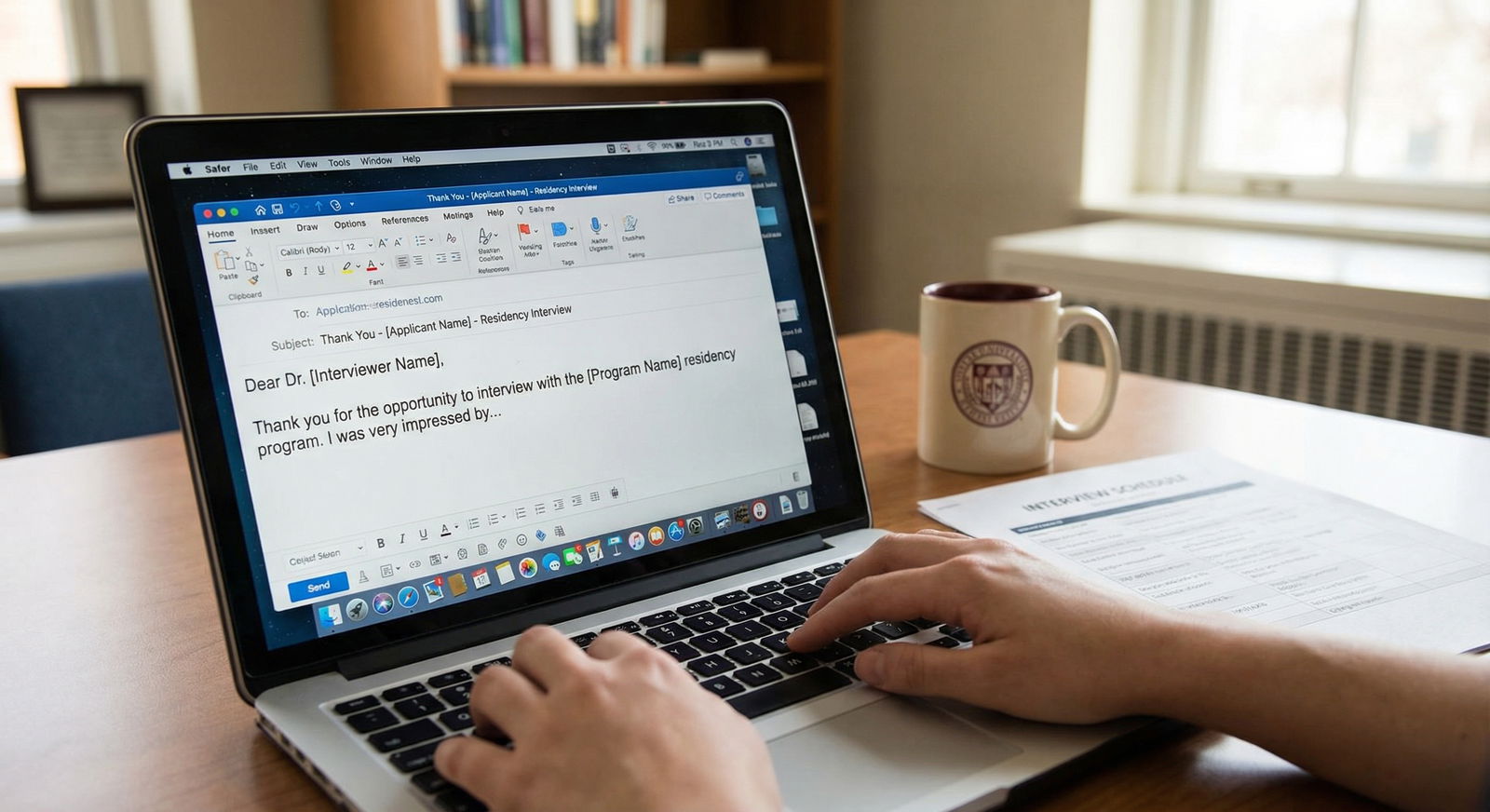
You don't need to be clever. You need to be consistent and timely.
At this point you should run this checklist after every single interview:
- [ ] 24-48 Hour Thank You: Personalized, specific, 150-200 words, typo-free. Sent at 9 AM program time.
- [ ] One Strategic LOI: 4-6 weeks before Match Day, to ONE program only, stating clearly you will rank them #1.
- [ ] Optional Update: Mid-December to mid-January, only if you have a publication, award, or new score. One paragraph.
- [ ] Quality Control: No mass emails. No salary talk. No asking for rank info. No more than 3 total contacts per program.
- [ ] Final Proofread: Read it aloud. Check the name. Check the program. Then send.
The Match isn't won with a perfect thank you note. It's lost with a sloppy one, or with silence when you were memorable in person. You did the hard work to get the interview. Close the loop like a professional.
You got this. Now go send that email before you forget Dr. Chen's sepsis story.