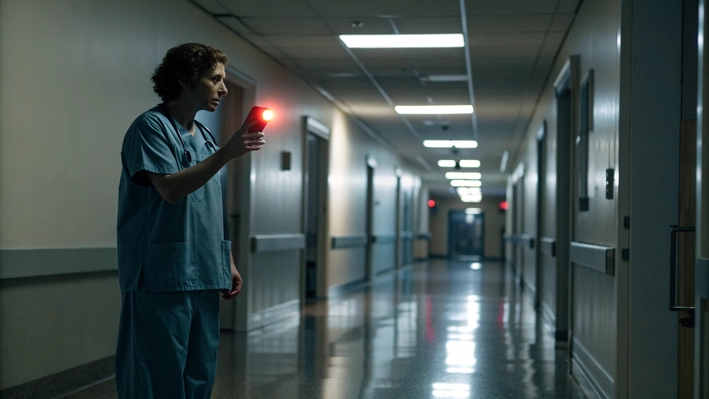
Call will expose every weakness you have. Your organization. Your medical knowledge. Your emotional control. Your ability to function while hungry, interrupted, and one page away from disaster. That sounds dramatic, but if you've done enough nights, you know it's not dramatic at all. It's Tuesday.
This matters because call isn't just a miserable rite of passage. It's where you build your reputation. Attendings remember the resident who calls early, thinks clearly, and doesn't melt down when three things happen at once. Nurses remember whether you're responsive, respectful, and useful. Your co-residents remember whether you leave a clean sign-out or hand over a trash fire at 6 a.m. And you remember it too. Call is where a lot of residents either grow up fast or keep suffering the same avoidable mistakes for years.
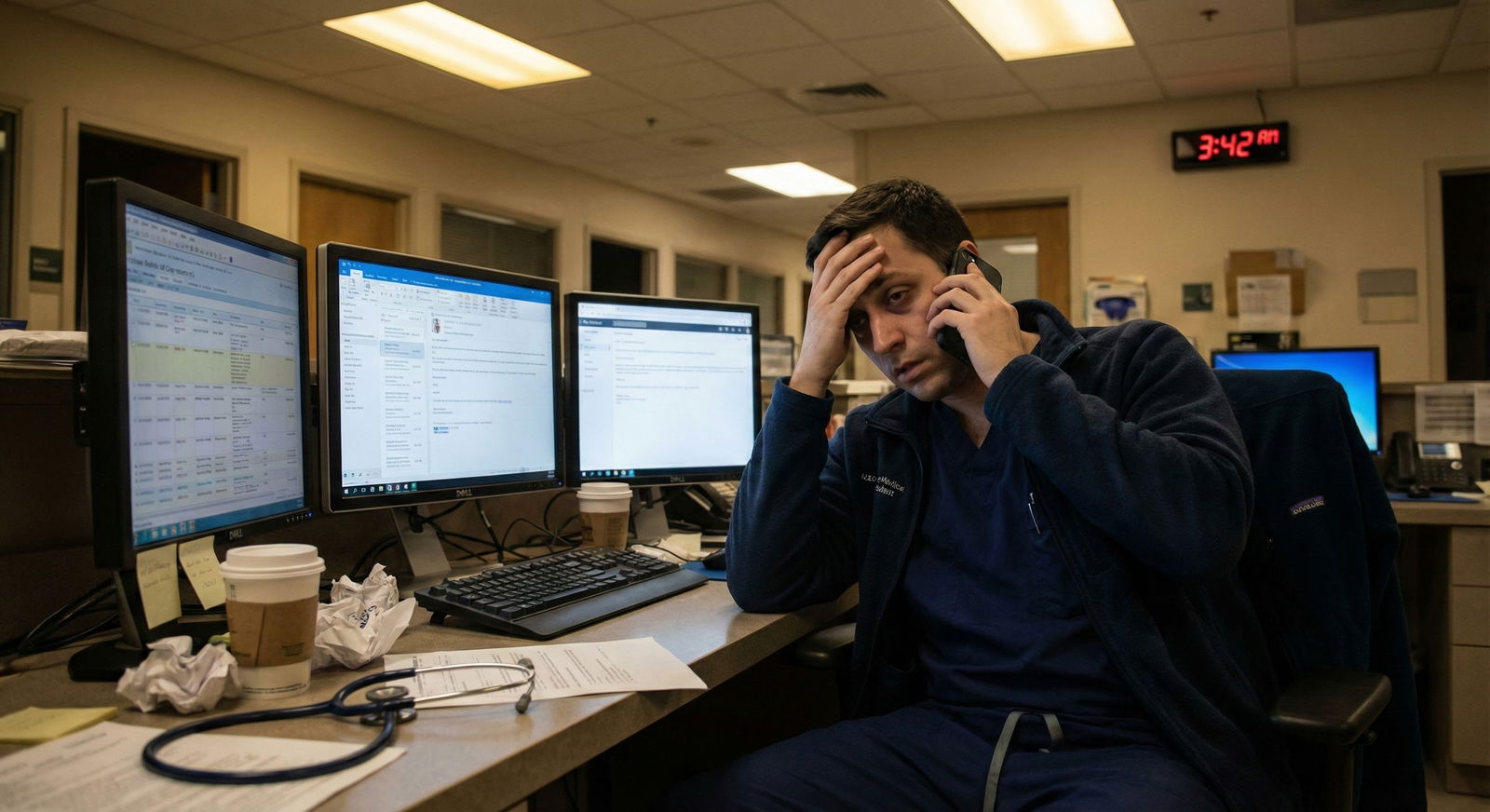
I've seen the same pattern over and over. The resident who struggles usually isn't lazy or dumb. They're unprepared in very fixable ways. They don't have a system for cross-cover. They chase every page with equal urgency. They don't protect tiny opportunities to eat, sit, think, or write things down. They assume they'll remember details later. They won't. Nobody does at 4 a.m.
The good news: call survival is trainable. You do not need to become some mythical iron-willed machine who never gets tired and knows every electrolyte protocol from memory. You need structure. You need a triage mindset. You need a small set of high-yield habits that work when your brain is running on fumes.
If you're in residency now and dread call, good. That dread can be useful if it pushes you to prepare instead of winging it. Winging it on call is dumb. Systems win.
Introduction
The hardest part about being on call isn't just the volume. It's the constant forced switching. You're answering a page about a fever, then evaluating chest pain, then trying to remember whether bed 14's potassium was 2.9 or 3.1, then your senior asks why the new admit hasn't been staffed yet, then the ED is calling again. This is where residents get in trouble. Not because they don't care, but because the night turns into noise.
Call also strips away the comfortable parts of medicine. During the day, there's more backup, more structure, more eyes on the patient, more time to recover from a shaky decision. Overnight or on a brutal weekend call, it's different. Fewer people. Less margin. More dependence on your judgment. That's why call matters so much to your career. It teaches the practical medicine nobody learns from pretty slide decks.
And yes, it can be survivable. More than that, it can make you genuinely better. Better at triage. Better at deciding what needs action now versus what can wait until morning. Better at communicating in one clean sentence instead of five rambling ones. Better at staying functional when the environment is bad. Those are physician skills. Real ones.
The residents who do well on call aren't always the smartest on paper. Usually, they're the ones who prepare before the shift, organize during the shift, and recover after the shift. Boring answer. Correct answer.
The Core Challenge
The core challenge of call is this: too many demands, too little bandwidth, and just enough fatigue to make you overconfident about bad shortcuts.
Let's name the common pitfalls, because they're predictable.
Pitfall 1: Treating every page like it's equally urgent
This is rookie behavior, and it will bury you. "Patient wants melatonin" is not "new oxygen requirement and tachypnea." "Family requesting update" is not "blood pressure 78/40." If you don't sort pages immediately by urgency, the shift starts running you instead of the other way around.
My rule: the first question in your head should always be, Is this unstable, time-sensitive, or annoying? Those are different buckets. If a nurse pages "patient looks bad," call back now. If they page for bowel regimen at 2:17 a.m., that can wait five minutes while you deal with the GI bleeder.
Pitfall 2: Walking into a patient room without a plan
You don't need a perfect diagnosis before seeing the patient, but you do need a framework. Why are you being called? What are the vitals? What's the code status? What's the problem list? What happened in the last 12 hours?
I've watched residents waste ten minutes gathering basic facts at the bedside while the nurse is staring at them, wondering if anyone is actually in charge. Before you go in, get the one-minute snapshot:
- Why now?
- Latest vitals
- Relevant labs
- Current meds
- Code status
- What the bedside nurse is worried about
That one-minute pause saves stupid errors.
Pitfall 3: Weak sign-out habits
Bad sign-out is sabotage. Sometimes accidental, still sabotage.
If the daytime team signs out "watch blood pressures" without telling you the patient's baseline, what they've already tried, or when to call the ICU, you're now practicing medicine in a fog. But here's the part residents don't like hearing: if sign-out is vague, it's still your job to clarify before the team disappears.
A strong sign-out includes:
- Active problems
- What might go wrong overnight
- What to do if it does
- What absolutely requires escalation
For example: "Ms. J is septic but improving, MAPs have been low 60s all afternoon, got 2 liters already, if systolic stays under 90 after the next bolus or mental status worsens, call me and consider ICU eval." That's useful. "Keep an eye on her" is garbage.
Pitfall 4: Over-ordering because you're anxious
Anxious residents shotgun labs and imaging because action feels safer than thought. It isn't. At 3 a.m., random orders create new noise, wake up patients, trigger more pages, and sometimes send you down the wrong path. Don't order because you're nervous. Order because the result will change what you do.
If the patient has stable chronic asymptomatic hypertension, you do not need a stat hydralazine adventure because the systolic is 182. That's how you turn a manageable night into self-inflicted chaos. On call, don't create problems to prove you're doing something.
Pitfall 5: Waiting too long to ask for help
This one hurts people. Residents wait because they don't want to look weak, or they think they should "figure it out themselves." That's ego wearing a white coat.
Call early when:
- A patient may be decompensating
- You don't understand the clinical trajectory
- You're choosing between levels of care
- You think a procedure, transfer, or urgent consult may be needed
- Your gut says, "This could go bad fast"
Nobody gets praised for the heroic delayed escalation that almost became a code.
What actually works
You need a repeatable on-call operating system.
1. Start the shift by building your mental map
Before the pages get stupid, know:
- Who is sickest
- Who is most likely to page overnight
- Which patients have tenuous respiratory status, bleeding risk, delirium, or unstable blood pressure
- Pending labs or imaging that may force decisions later
Circle your landmines early. The CHF patient on borderline oxygen, the confused post-op patient pulling lines, the brittle diabetic whose sugars are all over the place. Those are your likely 2 a.m. headaches.
2. Use structured triage
When a page comes in, sort it fast:
- Drop everything now: airway, breathing, circulation, altered mental status, chest pain, stroke symptoms, active bleeding, seizure, rapid escalation in oxygen needs
- Address soon: fever in high-risk patient, pain crisis, rising potassium, low urine output with concerning context, new arrhythmia but stable patient
- Can batch: sleep meds, diet requests, routine laxatives, expired PRNs, minor order clarifications
This sounds obvious. Under sleep deprivation, obvious things become weirdly hard unless you force a system.
3. Carry templates in your head
Not literal scripts for every disease. Just simple patterns.
For common overnight calls, know your first moves:
- Fever: vitals, symptoms, lines/tubes, cultures if appropriate, imaging only if indicated, assess instability
- Chest pain: bedside assessment, EKG, vitals, oxygen status, focused differential
- Low urine output: check overall status, bladder, fluids, renal function, obstruction, trend not one isolated number
- Agitation/delirium: look for hypoxia, urinary retention, pain, withdrawal, infection, meds. Don't leap straight to restraints and sedatives because the room is loud
High-yield areas win nights. Not obscure zebras. Bread-and-butter instability medicine.
4. Protect your brain
Eat before the shift. Bring food that can be swallowed in four minutes. Refill water whenever you pass a workstation. Write things down even if you think you'll remember. You won't. And if you get ten quiet minutes, don't waste them pretending you'll rest later. Sit. Pee. Snack. Put in orders. Reset.
That isn't weakness. That's maintenance.
5. Close loops obsessively
A lot of overnight errors aren't bad decisions. They're unfinished decisions.
- You ordered the CBC but didn't check it
- You told the nurse you'd come by and forgot
- You planned to reassess after pain meds and never returned
- You meant to update your senior and got distracted
This is how harmless nights become unsafe nights. Finish the loop. Every time.
Actionable Next Steps
If you're trying to get better at call, don't vaguely promise yourself you'll be "more organized." That's useless. Build a concrete system before your next shift.
Step 1: Make a pre-call checklist
Before every shift, spend 10 minutes on this:
- Eat something with protein and carbs
- Fill a water bottle
- Carry two pens, folded sign-out sheet, charger, stethoscope
- Review the sickest patients first
- Ask the day team: who might crash, who might page, what's the threshold to escalate
If you're covering new services, look up the top five overnight issues for that service. Surgery? Pain, urine output, post-op fever, hypotension, wound concerns. Medicine? Chest pain, dyspnea, AMS, sepsis, glucose disasters.
Step 2: Use a page-response script
When you call back a nurse, don't improvise chaos. Ask:
- What's happening right now?
- What are the latest vitals?
- What changed from baseline?
- What worries you most?
- Do you need me at bedside now?
That last question matters. Experienced nurses often know when something is off before the chart catches up. Listen to them. Not blindly. But seriously.
Step 3: Build your personal "overnight playbook"
Keep a note on your phone or pocket card with your common scenarios:
- Hyperkalemia steps
- Hypoglycemia treatment
- Acute chest pain checklist
- Sepsis basics
- Atrial fibrillation with RVR approach
- Delirium workup
- Cross-cover documentation reminders
This is not cheating. This is sane. Pilots use checklists. Residents should too.
Step 4: Practice escalation language
A lot of junior residents know when they're worried but say it badly. Fix that.
Use:
- "I'm concerned this patient is becoming unstable because..."
- "This is what changed..."
- "These are the vitals/labs..."
- "I've done X and Y, and I think the next step is Z"
- "Can you come assess with me?" or "I think we need ICU eyes now"
Clear escalation gets help faster. Rambling wastes time and makes you sound less credible than you are.
Step 5: Debrief after rough calls
After the shift, ask three questions:
- What page pattern kept tripping me up?
- Where did I waste time?
- What do I need to know cold before the next call?
That's how you improve fast. Not by suffering passively and hoping experience magically organizes itself.
Resources worth using
Skip bloated resources you'll never open at 2 a.m. Use tools that are fast and practical:
- Your hospital's escalation protocols
- Cross-cover or night-float handbooks from upper years
- Pocket cards for ACLS, electrolyte replacement, insulin management
- UpToDate or institutional references for focused questions
- Sign-out templates used by the strongest residents in your program
- Trusted seniors who are actually good on nights, not just loud about it
And get smart about building knowledge by frequency. Don't spend your limited prep time memorizing rare vasculitis criteria when you still get shaky with chest pain pages. That's backwards.
A simple plan for your next 7 days
If your next call is coming and you want something concrete, do this:
Day 1: Build your pre-call checklist Day 2: Make your overnight playbook note Day 3: Review top 10 pages on your service Day 4: Practice escalation scripts with a co-resident Day 5: Improve your sign-out format Day 6: Review one bad call from the past month and identify the failure point Day 7: Go into call with one goal: triage first, close loops second
That's enough to change your nights quickly.
Summary
Call survival isn't about becoming superhuman. It's about being prepared, focusing on high-yield problems, and refusing to let fatigue dismantle your judgment. The residents who handle call best do a few things consistently well: they start with a mental map, triage aggressively, ask focused questions, escalate early, and close every loop.
Be prepared. That's not optional. Focus on high-yield areas. That's what actually moves the needle. If you're in the thick of residency and call feels like controlled drowning, fix the system before you blame yourself. Most call misery isn't fate. It's bad workflow. And bad workflow can be corrected.