The way you write handoffs and notes on call is silently promoting you or quietly killing you.
Not your personality. Not your “I’m a hard worker” speech on interview day. The attending and program director are judging you off the scraps you leave in the chart at 2 a.m. and the way you talk at sign-out when you are exhausted and unguarded.
Let me tell you what they’re actually inferring when they read your notes and listen to your handoffs.
The Hidden PD Question: “Can I Trust You When I’m Asleep?”
Every program director has one core fear: the resident who looks fine at conference but is dangerous at 3 a.m.
We cannot watch you overnight. So we use proxies. Your notes. Your pages. Your handoffs. The way your cross-cover patients do (or do not) fall apart.
When PDs and attendings quietly review charts after a rough night, they are not reading like you read. They are not thinking “nice phrasing” or “good organization.” They are reverse-engineering your brain.
They ask:
- Did you recognize what mattered?
- Did you have a coherent plan or just write words?
- Are you the doctor I want in the hospital when my name is on the malpractice suit?
They will not tell you this. They will just mentally move you into one of three buckets: Reliable, Watch Closely, or Do Not Leave Alone.
Here is how your handoffs and notes push you into each category—whether you realize it or not.
What Your On‑Call Handoff Really Tells Them
Your sign-out is not “just logistics.” It is a live demonstration of how you think under load. The chiefs and attendings are listening much more closely than you think.
1. How you structure your handoff = how you structure your mind
When you sign out like this:
“Bed 12 is Mrs. Jones, 78, COPD, CHF, she came in with shortness of breath, she’s on 4 liters, um… her last BP was ok, she had some chest pain earlier but that’s resolved…”
What the PD hears through the grapevine:
- This resident is drowning in details and cannot prioritize.
- This is someone who will miss deterioration because they cannot filter.
- This person is going to generate “FYI” pages from nurses because nobody understands the plan.
A strong handoff sounds more like:
“Bed 12, Jones, 78, COPD/CHF. Admitted with acute on chronic hypoxic respiratory failure, on 4 L NC, sats mid‑90s. High‑risk: had brief chest pain at 19:00, ECG and trops negative x2, low suspicion for ACS. Anticipated issue: may tire out overnight. If increased work of breathing or rising CO2, low threshold to call ICU and consider BiPAP. Code status full.”
That structure tells us everything:
- You can name the main problem in one sentence.
- You’ve stratified risk.
- You’re forecasting what might go wrong and pre‑deciding your thresholds.
- You’ve thought about goals of care.
Program leadership hears about that sort of handoff. Your senior says in morning report: “Our intern last night gave a great sign-out on Jones, had already thought through escalation to BiPAP and ICU.” That sticks.
2. What you choose to say—and what you leave out
During sign-out, omissions are louder than words.
When you present a complex patient and never mention DNR/DNI status, high-risk labs, or critical pending results, attendings fill in the blank:
- “They do not know what is actually high‑risk.”
- “They are copy‑pasting the H&P in their head instead of thinking.”
I’ve watched PDs scroll through charts during CCC (Clinical Competency Committee) and say:
“She never mentioned that this guy was DNR in the handoff, and he arrested that night. I’m not sure she understands code status implications.”
And then suddenly, your “Professionalism” and “Systems-based practice” milestones are flagged as “needs improvement.”
They will never tell you it came from your handoff omissions. But it did.
3. Your tone under fatigue
People let their guard down at sign-out.
The intern who sighs dramatically and says, “Bed 7 is a trainwreck, good luck” just told everyone in the room:
- They externalize responsibility.
- They are not prepared.
- They cope by detaching rather than managing.
When that gets back to the PD, the story is not “they were tired.” The story is, “They don’t own their patients.”
Compare that to:
“Bed 7 is complex and tenuous. Pressors are off but still high risk. I’ve written out escalation thresholds in the note and messaged the fellow. If MAP stays <65 on current fluids, I’d call the fellow early.”
Same patient. Completely different reputation.
What Your Notes on Call Reveal About Your Clinical Brain
Now the charts. PDs and attendings quietly audit your notes, especially after bad nights, rapid responses, or ICU transfers. They are not looking for perfect grammar. They are looking for thinking.
1. The “Note Density” Trap
A chunky, multi-paragraph novel of a progress note does not impress anyone.
On the inside, physicians read huge notes as:
- Defensive documentation
- Lack of synthesis
- Lack of confidence disguised as word salad
They scroll past your three-paragraph “HPI,” ignore your pasted CT result, and go directly to two things: the Assessment/Plan and your overnight events.
If your A/P is five bullet points saying “continue to monitor” and “repeat labs,” that’s a giant red flag. It says you have no actual plan, you’re just requesting more data.
A strong overnight note might have:
- One or two key “Events” lines: “New hypotension 02:15, responded to 500 cc LR, lactate 1.8.”
- Focused A/P that answers: What changed? What did I think it was? What did I do? What will I do if X happens?
When we see a concise note that reads like a story instead of a legal document, we infer: this resident knows what matters.
2. How you document decisions under uncertainty
On call, you are constantly making 70% decisions with incomplete information. PDs don’t punish you for that. They punish you for pretending you were not making decisions.
If a patient had borderline vitals and you chose floor vs ICU, and it later went badly, attending reviews will go straight to your note. They’re looking for: did you recognize the risk and document your reasoning?
Bad:
“Patient stable. Will monitor.”
Good:
“Borderline hypotension (SBP 88–94) with new infection. After 1 L LR and no organ dysfunction, judged appropriate for monitored floor bed with q2hr vitals. Low threshold to escalate to ICU if pressor requirement or rising lactate.”
When PDs see this kind of thing consistently, their internal monologue is:
- “OK, they saw the borderline situation.”
- “They thought through alternatives.”
- “They acknowledged risk and defined escalation.”
That’s the resident they will trust with early autonomy.
3. The pattern that screams “I miss deterioration”
There is a chart signature of the unsafe resident. I’ve seen it more than once.
It looks like this:
- Repeated mentions of “tachycardic but asymptomatic”
- Vitals obviously trending worse, but no change in plan
- “Continue current management” as the reflex line
- 3 a.m. nursing note: “Resident notified.” No corresponding physician note.
When PDs see this pattern plus a transfer to ICU or a code, the conclusion is not subtle. Now you are “the one who misses sepsis” or “the one who blows off tachycardia.”
That label travels fast.
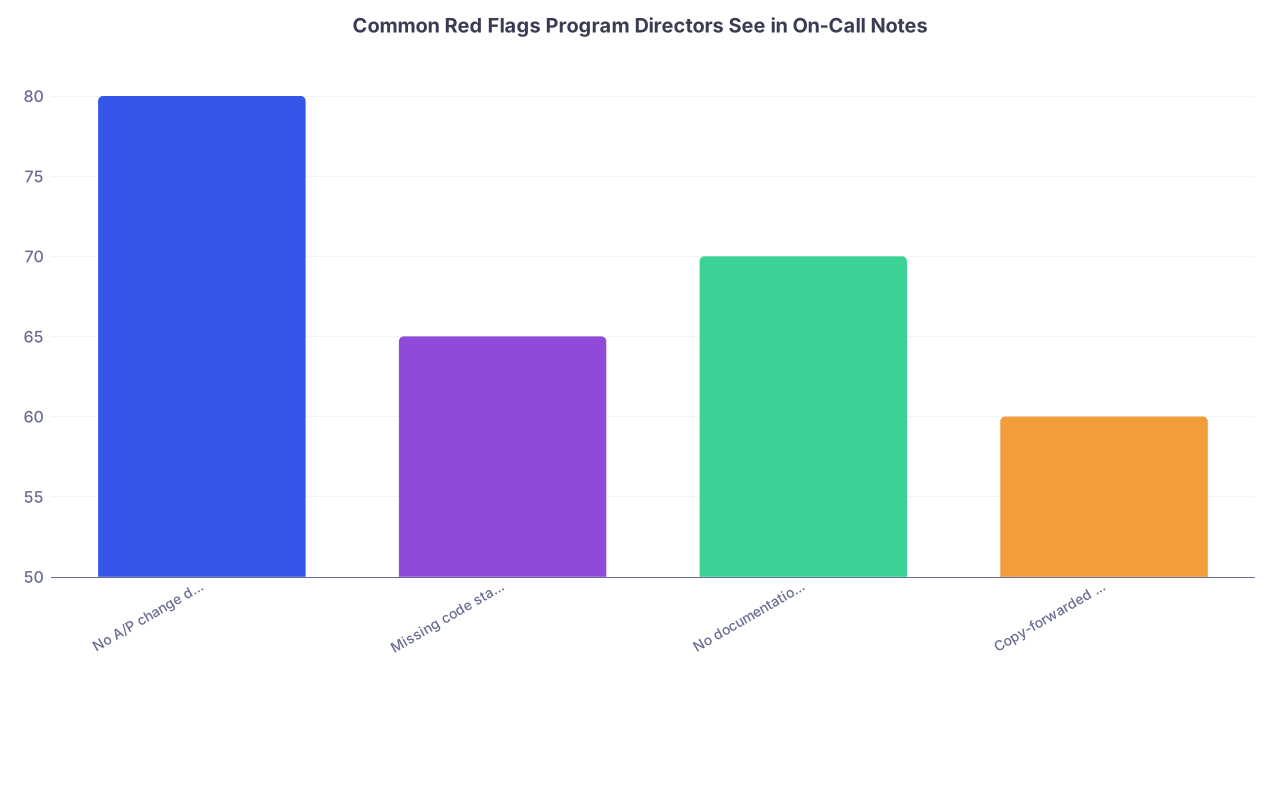
| Category | Value |
|---|---|
| No A/P change despite worse vitals | 80 |
| Missing code status | 65 |
| No documentation after critical page | 70 |
| Copy-forwarded exam inconsistencies | 60 |
Those percentages are not official data. They’re about how often faculty complain about each pattern in closed-door meetings. The first one dominates.
The Things PDs Infer About You as a Colleague
It is not just your medical reasoning they are judging. Your handoffs and notes also expose what sort of teammate you are when no one is watching.
1. Respect (or disrespect) for nurses
Your writing and your verbal handoff show immediately whether you work with nurses or around them.
When your notes say:
“Nurse reports hypotension. Ordered bolus.”
Compared with:
“RN Emily called with concern for soft BPs and new confusion; agree concerning for early sepsis. Ordered 1 L LR, broadened abx, increased monitoring.”
Same action. Completely different impression. The second one shows you listen, synthesize, and give appropriate credit. That matters.
PDs hear from nursing leadership. They see aggregate complaints. The resident whose name shows up often in “does not listen” emails gets scrutinized. We start reading your documentation with suspicion. And most of the time, we find what we are looking for.
2. Ownership vs passive coverage
On cross-cover, many residents slip into “babysitter” mode. PDs watch for that.
Ownership language:
- “I reassessed at 03:00 and adjusted the plan.”
- “Discussed with family about change in status.”
- “Updated primary team about overnight events with recommendation to…”
Passive language:
- “Covering provider notified.”
- “Orders placed.”
- “Issue to be addressed by day team.”
I have literally heard a PD say in CCC:
“Every time there’s a serious event, their note says ‘covering provider was notified’ like they were a bystander. That’s not ownership.”
You do not want to be in that sentence.
How PDs Use Handoffs and Notes in Evaluations and Promotion
Let’s talk about the part you never see: the meetings where your name is on the screen, and people are voting on whether you progress, get a good letter, or get held back.
1. Chart reviews after “events”
Any rapid response, code, unplanned ICU transfer, or angry family call can trigger a quiet chart review.
The PD or quality officer pulls:
- Nursing notes and pages
- Your cross-cover and progress notes
- Timestamps of orders
- Handoff documentation
Then comes the uncomfortable question in conference: “Was this a system issue or a resident issue?”
When it looks like:
- Early recognition, documented concern, reasonable plan, clear escalation instructions
- But ICU was slow to respond, or bed was delayed
You get defended. Attending says, “They did the right things. This was a system delay.”
When it looks like:
- Delayed documentation
- Same exam copied from earlier despite clear deterioration
- No mention of high-risk issues in sign-out
You become the “issue.” That goes in your file. It shapes how PDs interpret future borderline cases.
2. PDs triangulate what you say vs what you write
If you keep giving polished, confident presentations at noon conference, but your overnight notes show chaos, the trust gap grows.
We’ve all had this resident:
- Great on rounds, strong test scores, always has an answer
- Then you open their on-call note and see: “Patient feels ok. Continue to monitor.”
PDs notice that mismatch fast. They call it “performance vs practice.”
You get categorized as:
- Great test-taker
- Risky when unsupervised
- Needs more direct observation, less autonomy
That is how people with stellar Step scores quietly end up with average or weak letters.
3. Milestones and promotion discussions
In milestone-based evaluations, there are boxes for “Clinical reasoning,” “Patient care,” “Professionalism,” “Systems-based practice.” The committee has to justify ratings.
Your handoffs and notes are easy evidence.
- “Consistently anticipates overnight issues in handoffs” → Systems-based practice above level
- “Documented rationale for floor vs ICU, called fellow early” → Clinical reasoning, patient care
- “Fails to mention code status in critical patients” → Professionalism/systems flagged
I’ve been in the room when a borderline resident’s fate came down to one thing: whether the PD felt they could be trusted at 3 a.m. The proof was in exactly two places: their handoff style and their on-call charting.
Concrete Patterns That Get You Labeled (Good and Bad)
Let me walk through several patterns PDs and attendings quietly track.
The “Overreactor”
Profile:
- Calls ICU or fellow for every minor abnormality
- Handoffs are full of “watch this” with no prioritization
- Notes show lots of labs, imaging, but little synthesis
How PDs see it:
- Safe but inefficient
- Lacks confidence and clinical judgment
- OK for early intern, problematic if still the same late PGY‑2
What to fix:
- Learn to state pre-test probability: “Low-moderate suspicion for X because Y/Z.”
- In notes, write the “because.” Not just “ordered CT,” but “ordered CT to evaluate for ___ given ___.”
The “Underreactor”
Profile:
- Minimizes problems in handoff: “Yeah, soft BP but that’s normal for them.”
- Documentation is vague: “Patient feels better.”
- Reacts late to vitals, labs, or nursing concerns.
How PDs see it:
- Dangerous
- Doesn’t listen or consider worst-case
- Needs close supervision and sometimes formal remediation
What to fix:
- In handoff, clearly name high-risk features even if you think they’re benign: “Has soft BPs, historically low but still concerning in setting of new infection.”
- Document that you considered bad possibilities and why you felt they were less likely, plus your safety net.
The “Copy-Forward Technician”
Profile:
- Same physical exam, word for word, 3 days in a row
- Notes show “no distress” while nursing notes document 8/10 pain or confusion
- A/P looks like a template, not a brain
PD reaction:
- “They are not examining their patients.”
- “They are using the chart as a shield.”
This is one of the fastest ways to lose trust. And once you get that label, every chart you write will be scrutinized.

What Strong On‑Call Performance Actually Looks Like
Let me be explicit. This is the hidden standard the better residents hit—often without realizing how much it’s helping them.
1. In handoff
You consistently:
- Lead with the active problem and current stability in a single sentence.
- Flag the top one or two things you’re actually worried about.
- State code status and big-picture goals of care on any tenuous patient.
- Give specific “if X, then Y” instructions so the cross-cover is not guessing.
That last part is crucial. PDs love hearing that a resident gives clear contingencies. It screams “anticipates problems,” which is one of the most valued traits.
2. In your overnight notes
You:
- Keep Events succinct but concrete: “New AF with RVR to 150s at 01:30, asymptomatic. Given 10 mg IV diltiazem with improvement to 100s.”
- Show you reassessed the patient physically at least once after major events.
- Document your differential briefly, not just your action: “Most likely demand ischemia 2/2 sepsis; low suspicion for ACS given…”
- Lay out a short follow-up plan for the day team: “Primary team to reassess need for echo and trend trops; consider cardiology consult if chest pain recurs.”
Attendings read that and think: “This person understands continuity. They’re not just surviving the night; they’re setting us up for the day.”
3. In your escalation behavior
Good notes and handoffs go hand‑in‑hand with sane escalation.
PDs look for:
- Early calls to seniors/fellows before full disaster
- Documentation like “discussed with ICU fellow, agreed to monitor on floor with…”
- Handoffs that say “ICU aware, no bed yet, but will accept if…”
If you regularly call late, then backfill the note to look like you acted earlier, do not kid yourself. Timestamp discrepancies expose you. Nurses talk. PDs know.

| Step | Description |
|---|---|
| Step 1 | New abnormal vitals or event |
| Step 2 | Assess patient in person |
| Step 3 | Adjust floor management and document |
| Step 4 | Call senior or fellow early |
| Step 5 | Request ICU bed and document rationale |
| Step 6 | Enhanced monitoring on floor with clear triggers |
| Step 7 | Write brief focused note |
| Step 8 | High risk features |
| Step 9 | ICU needed now |
That is pretty much the internal algorithm of every attending who survives nights. Your notes and handoffs show whether your real algorithm matches.
How to Quietly Upgrade How PDs See You in 4 Weeks
You do not need a personality transplant. You need a few very deliberate shifts.
I’ll keep this practical.
1. In every sign-out, do this for any unstable or borderline patient
- State the main problem and current status in 1–2 sentences.
- Say explicitly: “My top concern overnight is ___ because ___.”
- Name code status and goals of care if there is any chance of decompensation.
- Give one clear contingency instruction: “If X, please do Y and call Z.”
You will sound more senior overnight than some second-years.
2. In every overnight event note, force yourself to answer four questions
Even if it is just a few lines:
- What changed?
- What did I think was going on?
- What did I do about it?
- What am I watching for next / who else is in the loop?
That structure alone makes PDs more comfortable signing their name next to yours.
3. Once per week, ask a trusted senior or attending to review one of your on‑call notes
Not for spelling. For thinking.
Say: “Can you skim this and tell me what you infer about how I reasoned?”
The feedback may sting once or twice. But it will save you from walking into your CCC meeting with unknown weaknesses.
| Handoff Style Example | Program Director Inference |
|---|---|
| Long, rambling, no prioritization | Poor synthesis, likely to miss deterioration |
| Very brief, no risk discussion | Underestimates severity, low situational awareness |
| Structured, anticipatory, with contingencies | Strong reasoning, safe for more autonomy |
| Blaming or dismissive language about patients/nurses | Professionalism concerns, poor team dynamics |
The Bottom Line: What They Really Decide From Your Handoffs and Notes
Let me strip this down.
Program directors are using your on-call handoffs and notes to silently answer three questions:
Can I trust you when I am at home asleep?
Your structure, anticipation, and documentation of uncertainty answer this more loudly than any evaluation form.Are you getting better or just surviving?
They watch whether your notes evolve from “monitor” and “continue current management” to concise, reasoned plans with clear next steps and thresholds.Would I want you as my own family’s doctor at 3 a.m.?
The residents who own their patients, respect nurses, escalate early, and document their thinking clearly—those are the ones PDs fight for when fellowship letters and chief positions are on the table.
Your on-call notes and handoffs are not busywork. They are the visible trace of your clinical brain under pressure. Make that trace look like the doctor you are trying to become, not the tired intern you feel like at 2 a.m.