
Most residents manage nighttime atrial fibrillation wrong: they treat the telemetry, not the patient.
Let me walk you through how to think, step‑by‑step, when it is 2:37 a.m., the nurse calls, and “the patient is in rapid afib to the 150s.” This is where people panic, reflexively slam in metoprolol, and then spend the next hour trying to fix the hypotension they created.
You need a structured mental algorithm. Not a memorized drug list. A decision tree that you can actually run half‑awake.
We will build exactly that: a resident‑level, on‑call decision tree for nighttime atrial fibrillation management.
1. First Rule: Do Not Treat the Monitor
The nurse calls: “Bed 12, HR 150s, irregular, looks like afib.”
Your first move is almost never “order metoprolol” or “start amio.” Your first move is to confirm three things:
- Is this actually atrial fibrillation with RVR?
- Is the patient stable or unstable?
- Is this new or known / chronic?
If you skip those, you will create problems.
Step 1A: Confirm the rhythm and the number
You cannot manage what you have not seen.
At minimum, you look at:
- Tele strip or bedside monitor (print a 6‑second strip if possible)
- Vital sign trend
- Ideally a 12‑lead EKG (but do not delay emergent treatment if unstable)
Ask yourself:
- Is it irregularly irregular?
- Are there identifiable P waves?
- Narrow complex vs wide complex?
- Artifact? (The classic: patient shivering, leads loose, HR shown as 180, palpated pulse 90.)
If anything feels off, have the nurse palpate a manual pulse and get a repeat automated BP. If still suspicious, ask for a manual cuff.
You would be surprised how often I have gone to the bedside for “afib 160” and found sinus tach at 120 in a febrile, shivering patient.
Step 1B: Stability check – ABC plus 4 numbers
Your real triage:
- Airway: talking in full sentences? Stridor? Gasping?
- Breathing: RR, work of breathing, O2 sat, accessory muscles?
- Circulation: BP, mental status, capillary refill, urine output (if Foley), skin perfusion.
- Consciousness: A&O? Confused? Syncope or presyncope?
Then the “4 numbers”:
- HR
- BP (both actual value and trend)
- O2 sat
- Lactate (if available / already drawn, not urgent to get for every episode)
Unstable AF means any of:
- Hypotension (e.g., SBP < 90 or MAP < 65, plus symptoms / poor perfusion)
- Shock (cool, clammy, altered, oliguria)
- Ongoing chest pain concerning for ischemia
- Acute pulmonary edema / severe dyspnea
- Syncope or near‑syncope from the arrhythmia
If unstable and rhythm is AF:
- Your mental label: “This is a DC cardioversion patient until proven otherwise.”
We will come back to that.
2. The Core Decision Tree: Four Questions You Must Answer
When you strip away the noise, your AF decision tree at night is built on four questions:
- Stable or unstable?
- Rate control vs rhythm control?
- What drug (or shock) is safe for this patient?
- What is my stroke risk / anticoagulation responsibility tonight?
Let me lay this out in a way your brain can actually run.

| Step | Description |
|---|---|
| Step 1 | Telemetry alert - irregular tachycardia |
| Step 2 | Confirm rhythm and vitals |
| Step 3 | Sync cardioversion |
| Step 4 | Assess onset, stroke risk, triggers |
| Step 5 | Focus on rate control |
| Step 6 | Consider rhythm strategy - amio or DCCV |
| Step 7 | Rate control and anticoagulation plan |
| Step 8 | Use digoxin or cautious amio |
| Step 9 | Use beta blocker or diltiazem |
| Step 10 | Unstable? hypotension, chest pain, shock, pulmonary edema |
| Step 11 | New AF or known AF? |
| Step 12 | Onset under 48 hr and low stroke risk? |
| Step 13 | HF with reduced EF or hypotension? |
Keep that mental shape. Every question plugs into one of those nodes.
3. Unstable AF: Your Job Is To Shock, Not To Be Clever
Residents commonly freeze here. They know the ACLS algorithm but hesitate because of anticoagulation or “cardiology is not here.”
If the patient is hemodynamically unstable because of the AF, the correct treatment is synchronized cardioversion. Period.
The unstable AF picture
Classic scenarios:
- BP 70s/40s, HR 180s, cool and clammy, new confusion.
- Flash pulmonary edema, frothy sputum, RR 30+, AF with RVR.
- Crushing chest pain, diaphoresis, HR 150+ in known CAD patient.
You do not:
- Keep layering metoprolol while the pressure circles the drain.
- Wait an hour for IV amiodarone to maybe help.
- Obsess over CHA₂DS₂‑VASc at 3 a.m.
You:
- Call for help (rapid response/code team, ICU, anesthesia if needed).
- Put on pads, set to synchronized cardioversion.
- Give sedation if time and hemodynamics allow (etomidate, midazolam, etc., per local protocol).
- Shock.
Energy levels (narrow complex, regular vs irregular; but many hospitals default):
- AF: 120–200 J biphasic is reasonable (check your local policy).
Stroke risk is real, but a dead brain from hypotension is worse than a theoretical embolus risk from cardioversion now.
Anticoagulation:
- If not contraindicated and not already on it, start appropriate anticoagulation shortly after stabilization (heparin drip, LMWH, or DOAC depending on clinical context and local standards, but this can be sorted with cardiology/primary team later that morning).
Overnight, your priority is saving life and perfusion. Not running a perfect AF workup.
4. Stable AF with RVR: Rate Versus Rhythm – How To Decide
Now the more common call: patient is stable but HR 130–160, irregularly irregular, BP okay, maybe mild symptoms.
This is where nuance matters.
Step 4A: New vs known AF, and symptom profile
Ask the nurse and the chart:
- Has this patient had AF before?
- Any notes from cardiology about chronic AF?
- Baseline rhythm on admission?
- Known EF? Valvular disease? Recent echo?
- Current symptoms: palpitations? dyspnea? fatigue? chest discomfort?
Categories:
Chronic / known AF, now in RVR
- Goal: rate control. Rhythm conversion rarely your middle‑of‑the‑night job unless specific reason.
New‑onset or unknown history AF
- Goal: figure out triggers + decide whether rate alone is enough or if rhythm strategy is warranted.
In residency, especially at night, you will mostly be doing rate control. Rhythm control is usually a planned, daytime sport unless the patient is crashing or clearly newly symptomatic with short duration.
Step 4B: Identify and treat precipitating factors
AF with RVR is often a symptom, not the disease.
Look for:
- Sepsis / infection (fever, WBC, cultures, pneumonia, UTI)
- Hypovolemia (diuretics, poor PO intake, GI losses)
- Hypoxia (PE, COPD, pneumonia, OSA)
- Pain, agitation, withdrawal (alcohol, benzos)
- Endocrine (thyrotoxicosis, uncontrolled hyperthyroidism)
- Post‑surgical stress, bleeding, anemia
- Myocardial ischemia
You should not just write “IV metoprolol 5 mg q5 minutes x3” without asking why the atria are freaking out.
Many times:
- 1 liter of balanced crystalloid in a dry, septic patient + antibiotics + oxygen brings rate down significantly.
- In untreated hyperthyroidism, you probably want beta blockade, not diltiazem, and you must address thyroid-specific therapy.
I usually order:
- Basic labs: BMP, Mg, CBC, troponin if any ischemic concern.
- TSH / free T4 if no recent thyroid labs and plausible cause.
- Repeat EKG, review prior ones.
Do not go crazy with labs at 3 a.m. But get the basics that change management.
5. Rate Control: Drug Choice by Phenotype
This is where residents live and die. Giving the wrong AV‑nodal blocker to the wrong patient creates “ICU admission by resident error.”
Think in phenotypes:
- No HFrEF, decent BP, reasonably stable
- HFrEF (EF ≤ 40%), marginal BP, or decompensated HF
- Borderline BP but no known HFrEF
- Severe COPD/asthma
5.1 No HFrEF, stable BP: Beta‑blocker or diltiazem
Most general ward, non‑HFrEF patients can handle either IV beta blocker or IV nondihydropyridine CCB.
Your choice:
Metoprolol:
- IV 2.5–5 mg over 2–5 min, repeat q5–10 minutes up to 15 mg total while monitoring BP and HR.
- Then convert to PO (e.g., 25–50 mg PO q6h or BID depending on patient size and response).
Diltiazem:
- IV bolus: 0.25 mg/kg over 2 minutes (commonly 15–20 mg), may repeat at 0.35 mg/kg.
- Then consider infusion: 5–15 mg/h titrated.
Which do I prefer?
- If mild hypotension risk, beta blocker is usually safer. Dilt is more vasodilatory.
- If hyperadrenergic state (thyrotoxicosis, alcohol withdrawal, post‑op catecholamine surge), beta blocker makes more physiologic sense.
- If moderate COPD or asthma and LV function fine, a small dilt bolus may be safer than beta blocker.
But: metoprolol 5 mg IV is almost never a catastrophic decision in the average medicine floor patient with HR 150 and BP 130/80.
5.2 HFrEF or unclear EF, or soft blood pressure: Digoxin first, amiodarone with caution
This is where people get hurt.
Diltiazem in a decompensated HFrEF patient can tank their BP and worsen pulmonary edema. Repeated IV metoprolol in a cardiomyopathic patient with BP 90/60 is also a good way to cause a rapid response.
Phenotype:
- Known EF 25–30%.
- BNP sky‑high.
- On loop diuretics and GDMT.
- Mild hypotension or signs of congestion.
Your default:
- Avoid or severely limit diltiazem.
- Be cautious with IV beta blockers (small doses at long intervals, if at all).
- Reach for digoxin or amiodarone, depending on scenario and institutional culture.
Digoxin:
- Slower onset (hours, not minutes), but favorable in low BP and HFrEF.
- Typical loading: 0.25 mg IV, then 0.25 mg IV q6h x 1–2 more doses, adjusted for renal function and age (frail, CKD → lower doses).
- Works best in sedentary, resting patients. Less effective for high sympathetic tone.
Amiodarone:
- Consider if:
- RVR refractory to cautious metoprolol or digoxin.
- Patient with HFrEF and symptomatic despite digoxin.
- Some ICUs use amiodarone as primary agent for HFrEF AF with RVR.
A common practical regimen:
- Amiodarone bolus 150 mg IV over 10 min
- Then infusion 1 mg/min for 6 hours, then 0.5 mg/min
But this depends heavily on local protocols and cardiology preferences.
Overnight, before starting an amio drip on a floor patient, I usually:
- Call the senior resident / ICU or cardiology if available.
- Confirm that they are okay being managed on the floor vs need for stepdown/ICU.
Amio is not benign. But in the right patient, it is lifesaving.
5.3 Borderline BP, no known HFrEF: Small, cautious, reassess every 10–15 minutes
Patient with:
- HR 150s
- BP 95/60 or MAP around 65
- No clear HFrEF but you do not have an echo
You are in the gray zone.
Pitfalls:
- Giving full 20 mg dilt bolus and dropping BP to 60 systolic.
- Giving multiple 5 mg metoprolol pushes rapidly.
A safer approach:
- Ask: are they dry? If hypotensive from hypovolemia, a small fluid bolus (250–500 mL) may actually improve both BP and HR.
- Use tiny doses: metoprolol 2.5 mg IV once; see what happens.
- Or low‑dose diltiazem 10 mg once. Then reassess.
- If no echo but you suspect HFrEF (S3, JVD, big LV on old imaging, long‑standing ischemic disease), lean away from diltiazem.
Remember: it is usually acceptable to leave a non‑crashing patient in the 110–120 range overnight if you have brought them down from 150–160 safely. You do not have to chase perfect HRs at 3 a.m. and risk hypotension.
5.4 COPD/Asthma: Do not be lazy with “no beta blockers ever”
This one is often misunderstood.
- Mild–moderate COPD: cardioselective beta blockers (e.g., metoprolol) are generally safe, especially in low doses.
- Severe asthma with recent bronchospasm: be more cautious and consider diltiazem first if LV function okay.
But I have watched interns be paralyzed by “they have COPD so no beta blocker,” then slam in 25 mg IV diltiazem on someone with borderline BP and concealed HFrEF.
You choose your poison. But you must choose it intentionally.
6. Rhythm Control at Night: When You Actually Consider It
Most nights, you will not be shocking or converting stable AF patients. But there are specific windows where rhythm control at night is appropriate.
Key concepts:
- Duration of AF
- Stroke risk (CHA₂DS₂‑VASc)
- Anticoagulation status
- Presence of clear precipitant vs truly new AF
Duration and stroke: the 48‑hour rule (simplified)
If:
- Onset clearly under 48 hours
- Low to moderate stroke risk (CHA₂DS₂‑VASc 0–1 in many guidelines)
- No structural heart disease or other red flags
Then:
- Rhythm control by cardioversion (pharmacologic or electrical) is considered safe without prior TEE in many protocols.
If:
- Onset uncertain
- Duration likely >48 hours
- High CHA₂DS₂‑VASc
- Not on anticoagulation
Then:
- Immediate cardioversion is higher stroke risk. Usually you rate control, start anticoagulation, and plan TEE‑guided or delayed cardioversion.
At 2 a.m. as a resident, unless you are in an ICU/cardiology rotation with explicit cardioversion protocols:
- You generally do not initiate elective cardioversion for a stable patient without attending involvement.
You do, however:
- Recognize who should probably get rhythm‑control evaluation in the morning.
- Protect them from unnecessary embolic risk.
Pharmacologic rhythm control overnight (e.g., amio with intent to convert) is more common in:
- ICU settings
- Post‑operative settings
- Under close monitoring with clear attending‑level involvement
7. Anticoagulation Decisions: What You Are Actually Responsible For Overnight
This part makes residents nervous for good reason. Stroke is high stakes. But your midnight role is narrower than you think.
You need to answer:
- Does this patient need to start anticoagulation soon?
- Is it safe to start tonight, or should this wait for attending/cardiology in the morning?
- Are there obvious red‑flag bleeding risks that would make anticoagulation unsafe?
Core stroke risk tool – CHA₂DS₂‑VASc:
| Component | Points |
|---|---|
| Congestive HF | 1 |
| Hypertension | 1 |
| Age 75 or older | 2 |
| Diabetes | 1 |
| Stroke/TIA/TE | 2 |
| Vascular disease | 1 |
| Age 65–74 | 1 |
| Female sex | 1 |
Most adults with AF end up with ≥2 points, especially in a hospitalized population.
Your overnight responsibility:
- Identify high‑risk patients not on anticoagulation.
- At least flag this clearly in your sign‑out and notes.
- In many settings, start heparin drip for new AF with high stroke risk unless:
- Active bleeding
- Platelets < 50k
- Very high fall risk / trauma
- Recent major surgery with high bleeding risk
- Intracranial hemorrhage history that has not been cleared by neurology
Know your hospital standard. Some services want:
- Heparin gtt started overnight for CHA₂DS₂‑VASc ≥2 if new AF. Others want:
- Wait for cardiology consult in the morning unless patient is in ICU.
When you are not sure:
- Call your senior / nocturnist.
- Document risk factors and your reasoning.
But do not ignore anticoagulation. That is how strokes happen three days later and people start reading the chart looking for who should have noticed.
8. Putting It Together: Practical Nighttime Scenarios
Let me run through a few real‑world‑style situations and how your decision tree plays out.
Scenario 1: The septic AF with RVR
- 72‑year‑old with pneumonia, sepsis, HR 150, BP 105/65, new “afib” on tele.
- Confirm AF on EKG. Irregularly irregular, narrow complexes.
- Stable, mildly tachypneic but improving on oxygen.
You:
- Recognize this is sepsis‑driven AF.
- Continue sepsis management: fluids, antibiotics, oxygen.
- For rate: metoprolol 5 mg IV once. Check in 10–15 min.
- If HR falls to 110–120, BP stable, you stop. No need to chase 80 overnight.
- Order Mg, troponin, BMP. Consider TSH if not recently checked.
- Document that this is likely sepsis‑provoked AF, plan for echo and cardio input if persists.
Scenario 2: The HFrEF patient in RVR with borderline BP
- 65‑year‑old with EF 25%, ischemic cardiomyopathy, admitted for volume overload.
- Now HR 140–150 in AF, BP 92/58, on 4 L O₂, mild dyspnea.
- AF confirmed on EKG.
You:
- Label phenotype: HFrEF, borderline BP, congested.
- Avoid IV diltiazem.
- Consider tiny metoprolol (2.5 mg IV) only if SBP staying > 95 and patient not in shock.
- Prefer digoxin load (adjusted for renal function).
- Discuss with ICU/cardiology early about amio vs transfer if rate remains 140s with symptoms.
- Diuresis continues as per HF plan, maybe slower until more stable.
Scenario 3: The post‑op, new AF at 4 a.m.
- 74‑year‑old POD#1 after hip fracture ORIF.
- HR 140, irregular, BP 130/70, AF on tele, symptomatic palpitations but stable.
- Duration: likely within last 2–3 hours (was sinus before surgery and on admission).
You:
- Check pain, oxygenation, volume status. Treat pain and hypoxia.
- She is stable, so you prioritize rate over immediate rhythm. IV metoprolol 5 mg or dilt 10–15 mg depending on EF and BP.
- Recognize she is high stroke risk (age, surgery, likely HTN).
- But she is fresh post‑op, so full‑dose anticoagulation is tricky. You do not unilaterally start heparin gtt in a brand‑new hip surgery patient unless explicit surgical clearance/protocol.
- Emphasize this in sign‑out: “New AF after hip ORIF, high stroke risk, not anticoagulated yet due to POD#1 – needs multidisciplinary discussion.”
Scenario 4: The crashing AF – do not delay shock
- 80‑year‑old with known AF, not anticoagulated, suddenly HR 180, BP 70/40, diaphoretic, altered.
- EKG: AF with RVR.
You:
- Call code/rapid response.
- Pads on, synchronized cardioversion planned.
- Do not get stuck on “but she is not anticoagulated, TEE?” That is daytime thinking.
- Shock her. Then clean up with anticoagulation decisions afterwards, with senior/ICU help.
9. Monitoring, Disposition, and Documentation: What You Should Leave Behind
Residents forget this part. The overnight fix is not the whole story.
Monitoring
After any IV rate‑control push:
- Recheck vitals (especially BP and HR) within 10–15 minutes.
- Watch for bradycardia, hypotension.
- If you overshoot and HR drops to 40, be ready with atropine, fluids, or even glucagon for beta blocker toxicity in extreme cases.
If you start:
- Diltiazem drip
- Amiodarone drip
- Multiple IV doses of AV nodal blockers
Think carefully whether:
- This patient still belongs on a general floor.
- Stepdown or ICU is more appropriate.
Disposition overnight
Ask:
- Does this AF episode change level of care?
- Do they need closer nursing ratio or telemetry upgrade?
- Do they need an early cardio or ICU consult in the morning?
Err on the side of safety. I would rather be criticized for a “too early” ICU transfer than for letting a marginal patient arrest on a busy med‑surg floor.
Documentation
Leave a paper trail for the morning team and for yourself.
Key points in your note:
- Onset and duration (what you know and do not know).
- Symptoms and stability assessment.
- Precipitating factors suspected (sepsis, volume status, etc.).
- EKG interpretation: AF with RVR; any ischemic changes.
- Drug doses given and response (be specific: “HR from 150 → 110, BP stable”).
- Stroke risk snapshot (CHA₂DS₂‑VASc summary).
- Anticoagulation plan and why (started vs deferred with rationale).
- Follow‑up plan: echo, cardio consult, telemetry duration.
This protects the patient and protects you.
10. A Quick Visual Summary of Common Rate‑Control Choices
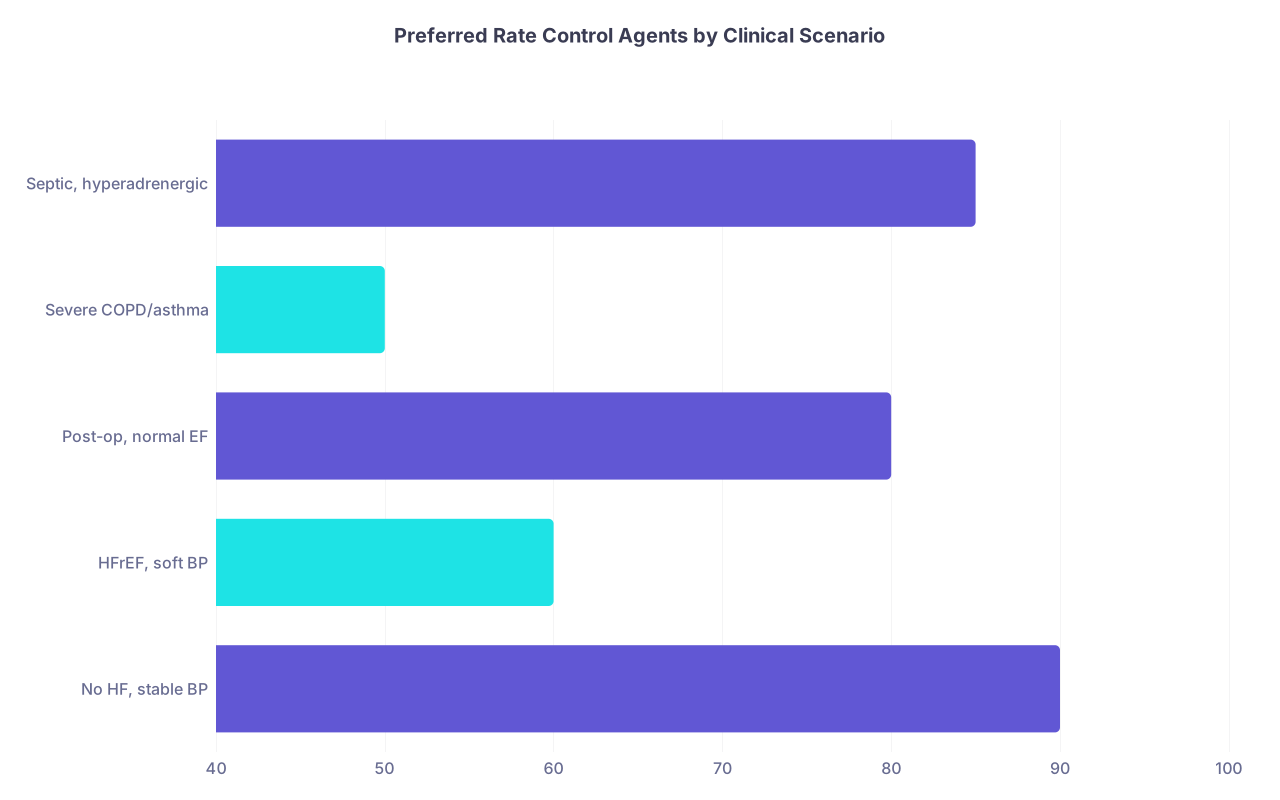
| Category | Value |
|---|---|
| No HF, stable BP | 90 |
| HFrEF, soft BP | 60 |
| Post-op, normal EF | 80 |
| Severe COPD/asthma | 50 |
| Septic, hyperadrenergic | 85 |
(Think of the “value” here as rough comfort level with beta blockers vs other agents; in real life, you will individualize, but the pattern stands.)
And another way to think about risk triage:
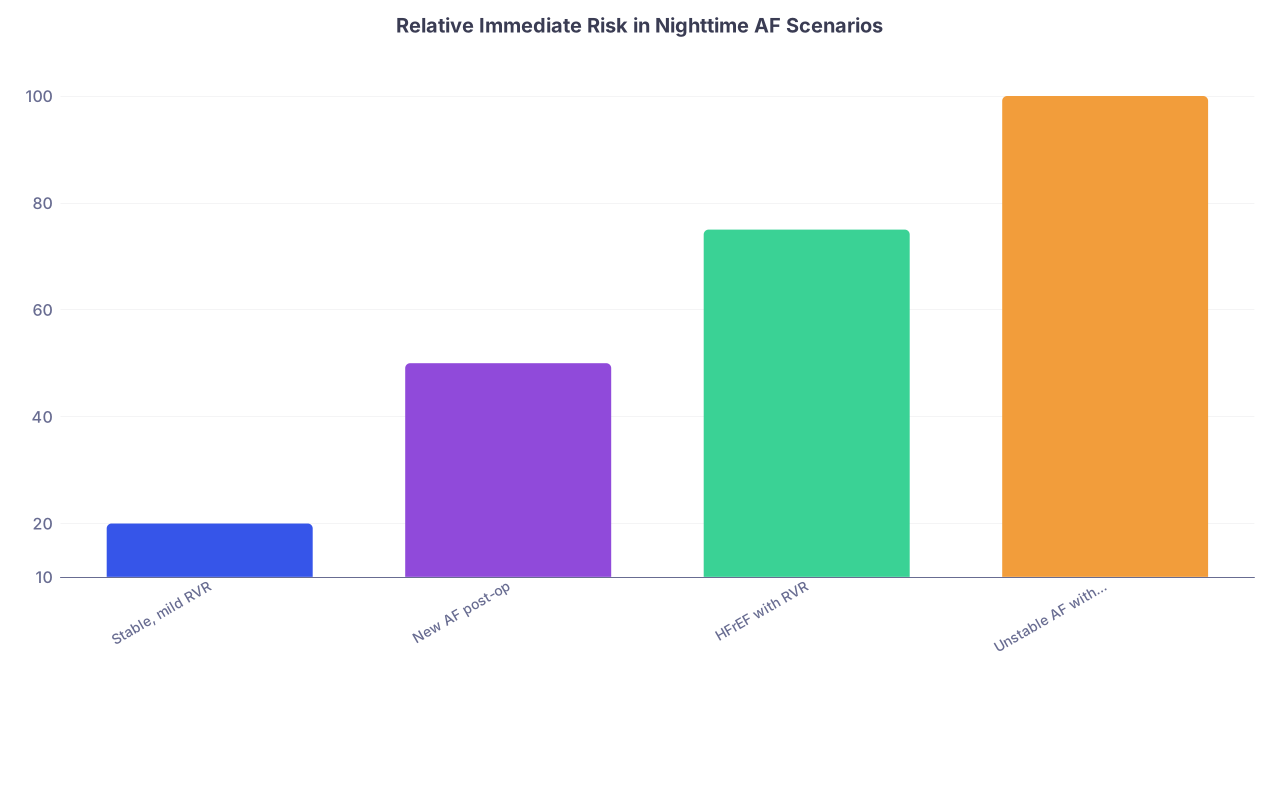
| Category | Value |
|---|---|
| Stable, mild RVR | 20 |
| New AF post-op | 50 |
| HFrEF with RVR | 75 |
| Unstable AF with hypotension | 100 |
Unstable AF and HFrEF + RVR are where you earn your call‑night stripes.
11. The Mental Checklist You Should Be Running
By your second or third month of nights, you want this to be automatic:
- Confirm rhythm and vitals. Not just “nurse says.”
- Stable vs unstable. If unstable → shock.
- New vs known AF; look for triggers, not just numbers.
- Rate control choice based on EF, BP, and lung disease.
- Do not chase perfect HR if it risks hypotension.
- Consider stroke risk and anticoagulation; at least flag clearly.
- Document and plan follow‑up, not just PRN metoprolol forever.
12. Final Takeaways
Three things to keep locked in your head:
- The rhythm does not matter if the patient is crashing: unstable AF gets synchronized cardioversion, anticoagulation questions come second, not first.
- Rate control is not “metoprolol for everyone”: your drug choice depends on EF, BP, and overall phenotype; HFrEF and soft pressures are where residents cause harm.
- Midnight AF is as much about diagnosis and trajectory as it is about drugs: find the trigger, think about stroke risk, and leave a clear plan for the morning rather than just knocking the rate down and walking away.